 Balanced
Please keep this page open after payment.
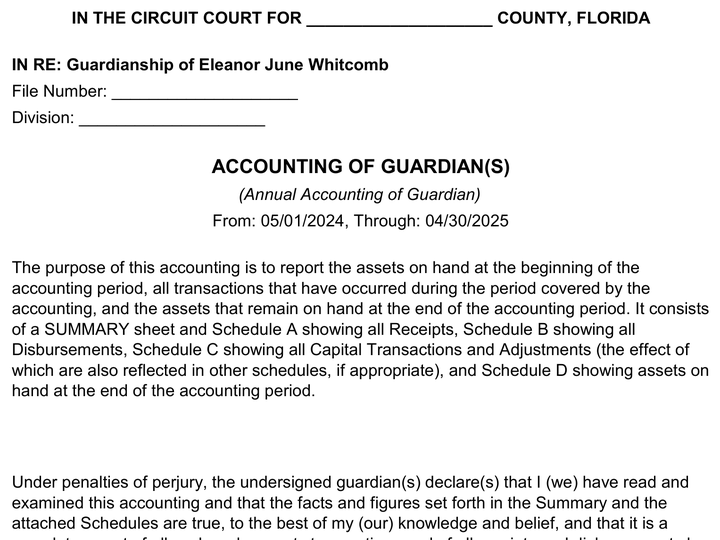
Inside a real Balanced workbook
Real Excel workbook pages generated by Balanced and anonymized for confidentiality.
Sample workbooks (Excel): Guardianship, annual · Guardianship, final · Estate, final · Estate, interim · Trust
Frequently Asked Questions
Your PDFs are processed securely and confidentially in your own browser and are never uploaded, stored or transmitted.
What is Balanced?
Balanced is web-based software that generates balanced, fully editable Florida accounting workbooks in Excel, in the model format of the Florida Probate Rules, directly from your PDF bank and brokerage statements. Balanced converts and organizes your statement data exactly as the statements show it, using disclosed, standard accounting conventions you can change. Everything beyond that comes from your own instructions. There is nothing to install: your PDF files are processed in your own web browser, and Balanced automatically prepares the accounting workbook from statement-traceable data, with each entry cited to the statement and page from which it was drawn. Customers pay $699 per accounting, with no subscription.
When is a Florida accounting due?
- Guardian of the property, annual accounting: on or before April 1 each year, covering the preceding calendar year; on a fiscal year the court authorizes, by the first day of the fourth month after it ends (s. 744.367, Fla. Stat.)
- Guardian, final report: promptly when the guardianship ends; when the ward has died, no later than 45 days after the guardian is served with letters of administration or curatorship (s. 744.527, Fla. Stat.; Fla. Prob. R. 5.680)
- Personal representative, final accounting: with the petition for discharge, within 12 months after letters are issued, or 12 months after the federal estate tax return is due when one is required, unless the court extends the time (Fla. Prob. R. 5.400)
- Trustee of an irrevocable trust: at least annually, on termination of the trust and on a change of trustee (s. 736.0813, Fla. Stat.)
More detail: Florida guardianship reporting deadlines.
Which Florida accountings does Balanced prepare?
A guardian’s annual and final accountings in the Fla. Prob. R. 5.696 model format; a personal representative’s interim and final accountings, and a trustee’s accounting, in the Fla. Prob. R. 5.346 model format, with Income, Principal and Totals columns. You choose the kind of accounting, and whether it is the final one, when you order.
What is in the workbook?
Every accounting is one Excel workbook in the model format, with a sheet for each of the following:
- Accounting: the cover page, with the model’s purpose statement and verification
- Summary: the starting balance, receipts, disbursements, distributions and capital transactions, and the assets on hand at the end, each a live formula over the schedules
- Schedule A Receipts and Schedule B Disbursements
- Schedule C Distributions (personal representatives and trustees)
- Capital Transactions: each sale with its carrying value, net proceeds and net gain or loss, and each purchase
- Assets at Close: every asset on hand at the end, with its carrying value and estimated current value
- Starting Balance Detail: the assets at the start of the period, itemized
- Transfers: money moved between the fiduciary’s own accounts, when there is any
- Known Liabilities (trustees)
- Review Notes: what to look at before the accounting is relied on
The schedule letters follow the model for each kind: a guardian’s accounting has Schedules A to D, a personal representative’s and a trustee’s Schedules A to E. The signatures and the attachments are the fiduciary’s.
How are sales, gains and losses handled?
As the model format sets out: sales, purchases and adjustments to carrying value go on the capital transactions schedule, each sale showing its carrying value and net proceeds, with the net gain or loss extended to the right and carried to the Summary. Changes in value of property that was not sold are not gains or losses; the estimated current value is shown beside the carrying value on the schedule of assets at the end.
Unless a prior accounting (such as your last Balanced workbook) is included or a different value is given in your information & instructions, each holding’s starting value is its value on the statements at the start of the accounting period. From there, Balanced tracks each holding lot by lot, first-in, first-out, and measures each sale against that value, not the brokerage’s printed cost basis.
Why does a Florida accounting take so long to prepare?
Because traditionally it is built by hand. Every receipt, disbursement, sale and transfer on months or years of statements has to be found, understood, sorted onto the right schedule and balanced to the penny. One missed or misplaced transaction throws the accounting out of balance, and finding it can take days. Balanced automates that work: it builds the accounting from your PDF statements, balanced and with each entry cited to its statement and page, so you spend your time reviewing it rather than building it.
How much does it cost?
$699 per accounting, paid once when you place your order. There is no subscription, no account to create, and no software to install. If you have a discount code, enter it on the Review & pay step.
How long will it take?
Most accounting workbooks are generated and delivered in about 1 hour, but generation times vary depending on the size and complexity of each accounting.
How is the accounting delivered?
By email, to the address you enter. You will receive two emails from info@balanced.law. The first arrives right away and confirms your order with the details you entered. The second arrives when your accounting is complete, with your Excel workbook attached.
Keep the workbook to prepare the next accounting.
Is the Excel workbook editable?
Yes. The workbook is a standard Excel file, and every sheet is fully editable, so you can review, adjust, and add to it as you see fit.
Are the PDF files ever shared, uploaded, or transmitted?
No. Your PDF files are securely processed in your own web browser, on your own computer, and the PDF files themselves are never uploaded, shared, or transmitted.
What other documents can I include?
Any PDF file that helps explain how you want your accounting prepared or provides other relevant information. For example:
- The inventory or the last accounting
- Closing statements for the sale of property
- A PDF of information & instructions describing transactions, payees, descriptions, and grouping or organizational preferences for receipts and disbursements
- Assets or activity that do not appear on the statements
- Other statements and ledgers
- Any document that provides or describes relevant accounting information, requests, or preferences
For information & instructions, you can use the optional template.
Other documents are optional. If you have none, press Next to skip that step.
Does Balanced offer other products or services?
No. Balanced Legal Technology does one thing: fiduciary accounting technology. There is no suite of other products or services, just a single, highly specialized focus on fiduciary accounting automation technology and setting a new state-of-the-art for accounting accuracy.
How accurate is Balanced?
Balanced reconciles each account to its own statements and traces each line to its source, with a citation on each data row to the statement and page it came from. Balanced accountings are impartial and verifiable.
Every accounting is a preliminary draft for the fiduciary’s own review and verification before it is relied on or filed.
Who developed Balanced?
Balanced was founded and developed by Marc Joyce, a practicing California trusts and estates attorney with a passion for computers and technology. Questions? Contact us or call (310) 780-8614.
Guides: Florida guardianship accounting · How to prepare the annual accounting · Annual accounting example · Florida probate accounting · Probate accounting example · Florida trust accounting · Personal representative fees · All states
Help: Deadlines · Free annual accounting template (Excel) · Free probate accounting template (Excel)
Filings: Florida Guardianship Inventory: The Verified Inventory · The Florida Clerk’s Guardianship Audit · Florida Guardianship Final Report and Discharge · Florida Simplified Guardianship Accounting · Objecting to a Florida Accounting · Waiver of Accounting in a Florida Probate · Florida Petition for Discharge: Closing the Estate · Florida Annual Guardianship Report: Plan vs Accounting