 Balanced
Please keep this page open after payment.
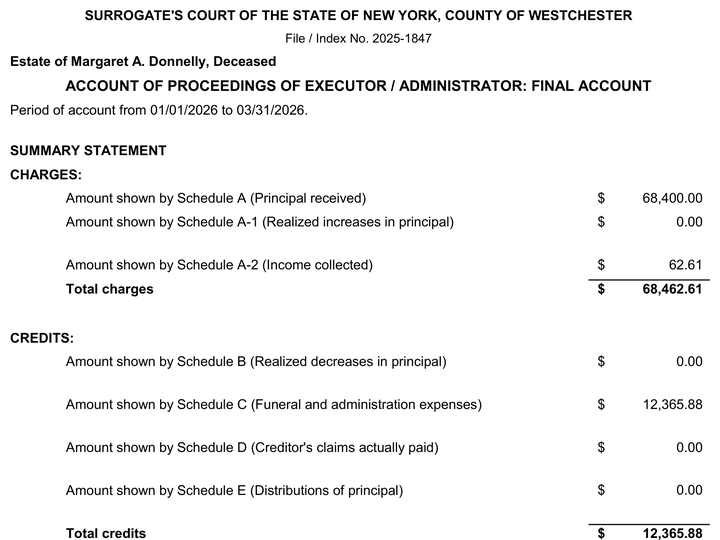
Inside a real Balanced workbook
Real Excel workbook pages generated by Balanced and anonymized for confidentiality.
Sample workbooks (Excel): Estate, executor's final account · Estate, executor's intermediate account · Trust, trustee's intermediate account · Article 81 guardian, annual report
Frequently Asked Questions
Your PDFs are processed securely and confidentially in your own browser and are never uploaded, stored or transmitted.
What is Balanced?
Balanced is web-based software that generates balanced, fully editable New York account workbooks in Excel, with the Surrogate’s Court Summary Statement and Schedules A to K or the Article 81 guardian’s annual report, directly from your PDF bank and brokerage statements. Balanced converts and organizes your statement data exactly as the statements show it, using disclosed, standard accounting conventions you can change. Everything beyond that comes from your own instructions. There is nothing to install: your PDF files are processed in your own web browser, and Balanced automatically prepares the account workbook from statement-traceable data, with each entry cited to the statement and page from which it was drawn. Customers pay $699 per accounting, with no subscription.
When is a New York account due?
- Executors and administrators: when the account is settled in the Surrogate’s Court, by the fiduciary’s own petition (SCPA 2208) or when the court or an interested person compels an intermediate or final account (SCPA 2205); an estate not fully distributed two years after letters were first issued (three when a federal estate tax return is required) files a status report with the court (22 NYCRR 207.42)
- Trustees: when the trust is settled, in the Surrogate’s Court (SCPA 2208) or, for a lifetime trust, in the Supreme Court (CPLR 7701)
- Article 81 guardians: an annual report in the month of May (Mental Hygiene Law § 81.31), examined by the court examiner (Mental Hygiene Law § 81.32), and a final report when the guardianship ends (Mental Hygiene Law § 81.33)
More detail: New York accounting deadlines.
Which New York accounts does Balanced prepare?
An executor’s or administrator’s account and a trustee’s account, intermediate or final, in the Surrogate’s Court format, and an Article 81 guardian’s annual or final report. You choose the kind of accounting and which account it is when you order.
What is in the workbook?
Every account is one Excel workbook. For an estate or a trust:
- Summary: the Summary Statement, charges and credits, each a live total of its schedule, ending at the balance on hand (principal and income apart for a trust)
- Schedules A, A-1 and A-2: principal received, realized increases, income collected
- Schedules B to E: realized decreases, funeral and administration expenses and taxes, creditors’ claims, distributions (C-2 and E-1 for a trust’s income)
- Schedule F: new investments and exchanges
- Schedule G: the property on hand at the end, at its inventory or acquisition value, with its market value beside it
- Schedules C-1, H, I, J and K: what each holds, for you to complete; Schedule I computes the statutory commission rates on the base you enter
For an Article 81 guardian, the report’s Summary and Schedules A to F. The signatures and the affidavit are the fiduciary’s.
How are investments, sales, gains and losses handled?
On a Surrogate’s Court account, property is carried at its inventory or acquisition value: each sale above that value is a realized increase (Schedule A-1), each sale below it a realized decrease (Schedule B), and the property still on hand is listed on Schedule G at that value, with its market value on the closing statement shown beside it. On a guardian’s report, the property at the end is at its value on the closing statements.
Unless a prior account (such as your last Balanced workbook) or the inventory is included, or a different value is given in your information & instructions, each holding’s starting value is its value on the statements at the start of the accounting period.
Why does a New York account take so long to prepare?
Because traditionally it is built by hand. Every receipt, disbursement, sale and transfer on months or years of statements has to be found, understood, sorted onto the right schedule and balanced to the penny. One missed or misplaced transaction throws the account out of balance, and finding it can take days. Balanced automates that work: it builds the account from your PDF statements, balanced and with each entry cited to its statement and page, so you spend your time reviewing it rather than building it.
How much does it cost?
$699 per accounting, paid once when you place your order. There is no subscription, no account to create, and no software to install. If you have a discount code, enter it on the Review & pay step.
How long will it take?
Most accounting workbooks are generated and delivered in about 1 hour, but generation times vary depending on the size and complexity of each accounting.
How is the accounting delivered?
By email, to the address you enter. You will receive two emails from info@balanced.law. The first arrives right away and confirms your order with the details you entered. The second arrives when your accounting is complete, with your Excel workbook attached.
Keep the workbook to prepare the next account.
Is the Excel workbook editable?
Yes. The workbook is a standard Excel file, and every sheet is fully editable, so you can review, adjust, and add to it as you see fit.
Are the PDF files ever shared, uploaded, or transmitted?
No. Your PDF files are securely processed in your own web browser, on your own computer, and the PDF files themselves are never uploaded, shared, or transmitted.
What other documents can I include?
Any PDF file that helps explain how you want your account prepared or provides other relevant information. For example:
- The inventory or the last account
- Settlement statements for the sale of property
- A PDF of information & instructions describing transactions, payees, descriptions, and grouping or organizational preferences for receipts and disbursements
- Assets or activity that do not appear on the statements
- Other statements and ledgers
- Any document that provides or describes relevant accounting information, requests, or preferences
For information & instructions, you can use the optional template.
Other documents are optional. If you have none, press Next to skip that step.
Does Balanced offer other products or services?
No. Balanced Legal Technology does one thing: fiduciary accounting technology. There is no suite of other products or services, just a single, highly specialized focus on fiduciary accounting automation technology and setting a new state-of-the-art for accounting accuracy.
How accurate is Balanced?
Balanced reconciles each account to its own statements and traces each line to its source, with a citation on each data row to the statement and page it came from. Balanced accountings are impartial and verifiable.
Every accounting is a preliminary draft for the fiduciary’s own review and verification before it is relied on or filed.
Who developed Balanced?
Balanced was founded and developed by Marc Joyce, a practicing California trusts and estates attorney with a passion for computers and technology. Questions? Contact us or call (310) 780-8614.
Guides: New York estate accounting · The executor’s account · Schedules A to K · New York trust accounting · The Article 81 annual report · A worked example · All states
Help: Deadlines · Commissions and fees · Free accounting worksheet (Excel)
More guides: Informal accounting and the receipt and release · How long to settle an estate · Small estates: voluntary administration · Compelling an account · Judicial settlement of an account · Objections and common errors · Guardian of a minor’s property: the annual account · Article 81 final report after a death