California Probate Code §1061: The Fiduciary Accounting Format Explained
Every California fiduciary accounting, whether for a trust, a decedent's estate, a conservatorship or a guardianship, is built on the same statutory skeleton. This is a practitioner's walkthrough of that skeleton: what the format requires, what each schedule contains, and why it's shaped the way it is.
What §1061 actually does
California Probate Code §1061 prescribes the summary of an account filed with the court, and §§1062 and 1063 add the schedules that support it. (Section 1060 limits these rules to accounts filed with the court. A trustee's account to beneficiaries is governed by §16063, though many trustees follow the same format.) Together they are a statutory template: a fiduciary produces this structure, with these schedules, summed according to this equation, or the account doesn't comply on its face.
The section is brief: a few pages of statute. But the format it prescribes has a specific internal logic worth understanding, because practitioners who understand the logic make fewer errors and can spot when something has gone wrong.
The charges-and-credits structure
A §1061 account is not a general ledger, not a balance sheet, and not an income statement. It's an account of the fiduciary's stewardship. Its purpose is to answer a single question, at a level of specificity a reviewer can verify:
What came into the fiduciary's hands, what went out, and what remained? And can every dollar be traced to a source document?
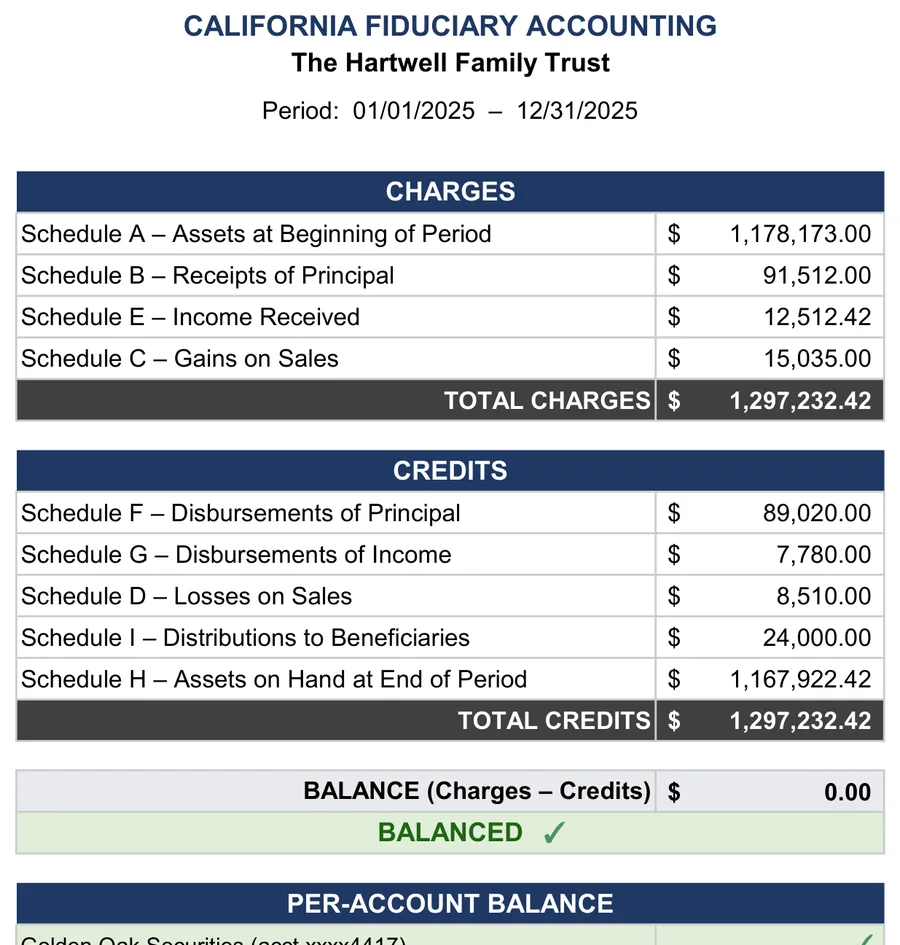
Everything the fiduciary received or was entrusted with goes on the charges side. Everything that left the estate, or remained on hand at the end, goes on the credits side. The two sides must equal exactly.
When both sides equal, to the penny, the accounting balances and the math on its face is internally consistent. This does not mean the accounting is accurate; it means the math adds up. Accuracy is always the fiduciary's independent responsibility to verify.
Here is what that looks like in a complete accounting:
The schedules
Section 1062 requires a supporting schedule behind each line of the §1061 summary. The statutes do not assign letters to the schedules; the letters below are the ones Balanced uses, and many practitioners use similar ones:
| Sch | Side | What it contains |
|---|---|---|
| A | Charges | Assets on Hand at Beginning of Period. The inventory of cash, investments, and other property the fiduciary held at the start of the accounting period, at the values carried forward from the prior accounting (or, for the first account, the inventory / date-of-death values). |
| B | Charges | Receipts. Cash coming in: deposits, collections on principal, refunds, reimbursements, and similar. Principal receipts, distinct from income (which goes on E). |
| C | Charges | Net Gains on Sale. When an asset held on Schedule A is sold for more than its carry value, the gain, the difference between the carry value and the sale proceeds, appears here. |
| D | Credits | Net Losses on Sale. The mirror of C: when an asset is sold for less than its carry value, the loss appears here. |
| E | Charges | Income Received. Dividends, interest, rents, and other income events. Classified here rather than B because income has different legal and tax consequences than principal receipts. |
| F | Credits | Disbursements of Principal. Cash leaving the estate: bills paid, taxes paid, maintenance costs, premiums, fees and similar, each with its nature or purpose, payee and date (§1062(b)). |
| G | Credits | Disbursements of Income. Disbursements charged to income rather than principal, when the trust or estate allocates between the two. |
| H | Credits | Assets on Hand at End of Period. The mirror of Schedule A: the inventory of property the fiduciary holds at the close of the accounting period, still at carry value. The carry values must match the A values for assets that remained in the estate, adjusted only for the A-side and credit-side activity that affected them. |
| I | Credits | Distributions. Distributions of cash or property to beneficiaries, with the date and amount of each, property shown at carry value (§1062(e)). |
Why the format is shaped this way
The logic of charges-and-credits is purpose-built for fiduciary review: each side of the equation tells a different story, and a reviewer can audit each story independently.
- Charges (A + B + C + E) tell the reviewer what property the fiduciary was responsible for during the period: what was on hand at the start, plus what came in.
- Credits (D + F + G + H + I) tell the reviewer what the fiduciary did with that property: what was lost in sales, what went out as disbursements, what was distributed to beneficiaries, and what remained on hand.
- The equation's equality confirms that every dollar has been accounted for in one of those categories. A dollar cannot vanish between charges and credits without the fiduciary being on the record as to where it went.
This is also why software designed for general business accounting does not fit the format. A ledger that reports "net income" or "net change in cash" answers a different question than §1061 asks. The fiduciary accounting is structurally categorical: where did this specific dollar go, and under what classification.
Carry value: a term of art in fiduciary accounting
Schedule A and Schedule H both use carry value. Carry value is the value at which an asset is carried on the accounting: the value the fiduciary was charged with, which is the inventory value (such as the date-of-death or appointment value) or the carry value at the close of the prior account (§1061(a)(1), (a)(10)), adjusted only for subsequent accounting events.
Carry value is not market value. A house held through a period of market appreciation still sits on Schedule H at the same carry value it started with on Schedule A; the appreciation is unrealized and does not enter the accounting until the asset is sold. Similarly, a stock portfolio's fluctuations between period-start and period-end do not produce Schedule C gains or Schedule D losses until a position is actually sold.
The practical implication: Schedule A and Schedule H are not reports of market value. They're reports of what the fiduciary is carrying. Market value is reported separately, on the market value schedules that §1063(a) requires, not in A or H themselves.
What practitioners most often get wrong
1. Anchoring Schedule H to end-of-period market values
If Schedule A uses carry values, Schedule H must also use carry values; otherwise the accounting does not balance because unrealized market changes enter the equation without a corresponding Schedule C or D entry. The fix is to derive H from A by carry-forward: H = A + additional property received + purchases − sales and distributions + reinvested income, at carry values throughout. Never anchor H directly to the statement's ending market value.
2. Classifying income as principal receipts
Dividends and interest are Schedule E, not Schedule B. It's easy to misclassify because both appear as credits in a bank or brokerage statement. The distinction matters because trust law treats income and principal differently for beneficiary purposes, and because tax reporting depends on correct classification.
3. Treating cap-gain distributions as sales
Mutual funds periodically distribute capital gains to shareholders; these appear on statements with "capital gain" language. They are not sales by the fiduciary: the fund did the selling internally. And they are not ordinary income: under California's Uniform Fiduciary Income and Principal Act, a capital gain dividend from a mutual fund or REIT is allocated to principal (Prob. Code §16340(d)(4)). Treating it as income on Schedule E misstates both principal and income.
4. Omitting the prior statement
Schedule A requires true beginning-of-period values. If an accounting period starts February 1, Schedule A's values are as of January 31 (the close of the prior period). Without a January statement, the fiduciary cannot establish Schedule A correctly: they can only see February 28 values, which are end-of-month-one, not beginning-of-month-one. This is a common and consequential omission.
5. Collapsing sub-accounts into parent accounts
Consolidated brokerage statements frequently cover multiple sub-accounts (taxable, IRA, 529, custodial, etc.) in a single document. Each sub-account must appear in the accounting as its own distinguishable grouping with its own Schedule A and Schedule H carry values. Collapsing them into a single line breaks the audit trail and can silently mask per-account imbalances that cancel out at the consolidated level.
A final note on format vs. content
§1061 is about the format. Satisfying the statute's format requirements is necessary but not sufficient. The fiduciary's substantive duty (accuracy of every figure, completeness of the record, faithful discharge of duty) exists independently of the form the account takes. A §1061-compliant accounting can still be wrong on the merits; the format gives reviewers a structured way to catch what's wrong.
Which is why the real discipline of fiduciary accounting is verification: every transaction in the accounting must trace to a specific, identifiable entry on a source document. The format holds the work; the source documents are where the truth lives.
Balanced: California fiduciary accounting software
Balanced is an automated California fiduciary accounting technology service. Add your PDF bank and brokerage statements and receive a balanced, fully editable Excel workbook in the §1061 format, for your independent review and verification. $699 per accounting.
Start an accountingThis article is a general overview of California Probate Code §1061 for informational purposes and does not constitute legal advice, accounting advice, or a substitute for independent professional review. Practitioners should consult the statute directly and apply their own judgment to the specific facts of each matter. Statutes, rules of court and Judicial Council forms change; confirm the current text before relying on this article. Current as of October 2026.