 Balanced
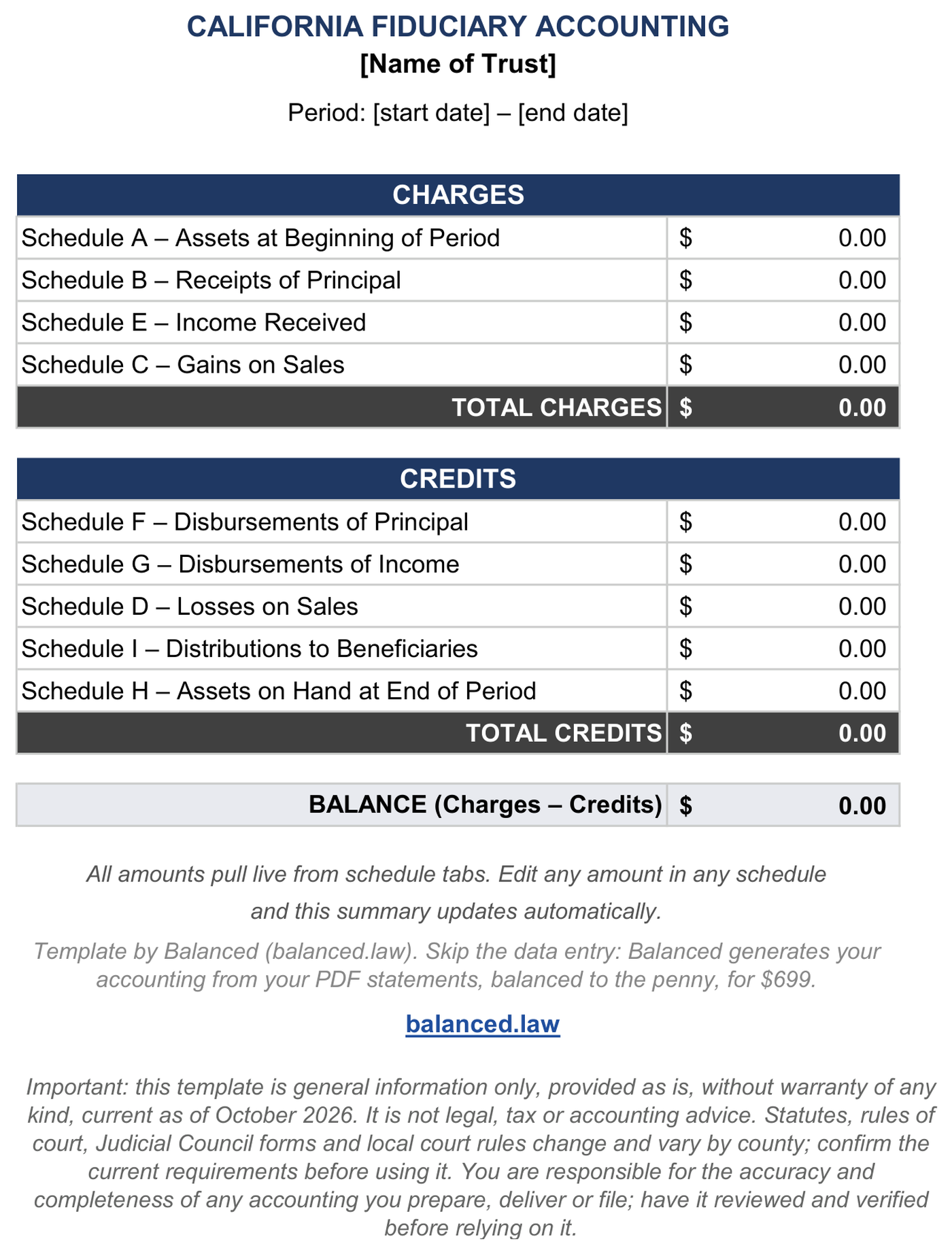
A California trustee generally must account at least annually, at the termination of the trust and on a change of trustee (§16062(a)), and the account must contain the items listed in §16063(a). This free Excel template, a trust accounting spreadsheet, lays the account out in the Probate Code §1061 format that a court-filed account follows (§16063(b)), with the summary linked to the schedules so the balance updates as you type.
Free: the template and a finished example. No email, no sign-up.
Your template is downloading.
This template is the format, not the work. The work is finding every transaction on every statement, placing each on the right schedule, following carry values lot by lot, and balancing each account to the penny. That takes days or weeks by hand, and one mistake throws off the whole summary. Balanced converts and organizes your statements into this same workbook for $699.
Have the statements? Balanced converts and organizes the data on them into this accounting, in the Probate Code format, as one editable Excel workbook balanced to the penny. Scanned or incomplete statements work.
- Developed by a California trusts and estates attorney
- Works with any PDF statement, downloaded or scanned
- Statement entries are cited to the PDF and page they
came from, for easy verification - A fully editable Excel workbook, emailed in about 1 hour
$699 Flat. No Subscription. No Install.
This has by far been the best user-experience and I’ve been really impressed with your product thus far.
Kelsey B. Cooper, Esq., California Estate Planning Services PC
What happens if the accounting is late
Courts take a late accounting seriously, and the consequences fall on you personally.
- A trustee must account at least once a year, when the trust ends, and when a trustee changes (Prob. Code §16062).
- If a beneficiary asks in writing and no account arrives within 60 days, and none was made in the six months before, the beneficiary can petition the court to compel one (§17200(b)(7)(C)).
- Failing to account when the law requires it is a breach of trust (§16400). The court can then remove you (§15642(b)(1)), order you to pay for any loss to the trust, or reduce or deny your compensation (§16420(a)).
Most Balanced accountings are delivered in about 1 hour. Add your statements
What the trust accounting spreadsheet is
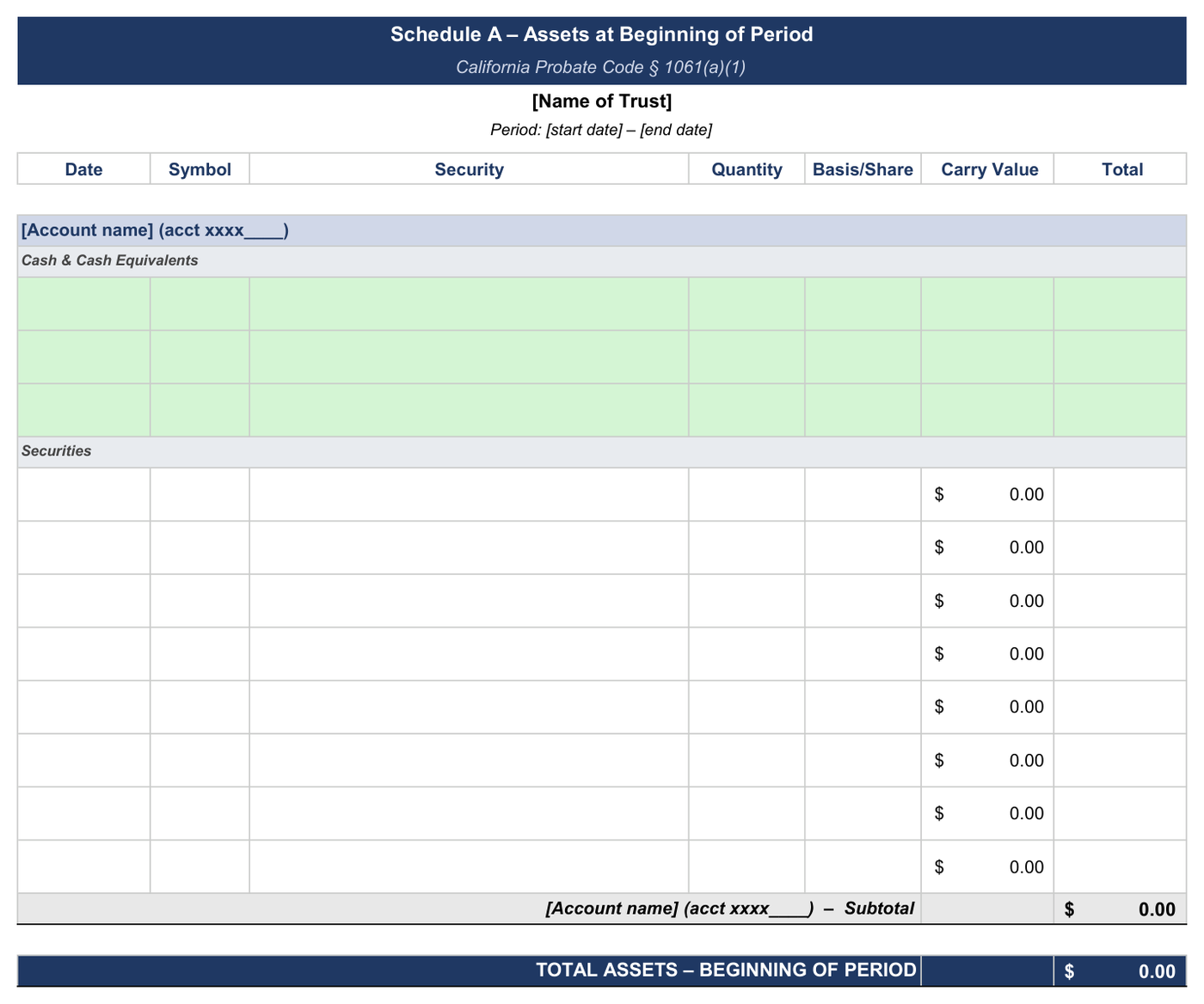
A free Excel workbook that serves as a trust accounting spreadsheet template for a trustee’s annual or final account. What the account must contain is set out in California trust accounting requirements. For an executor’s or administrator’s account, use the California probate accounting template. It is laid out the way a California court accounting is organized under Probate Code §§1060–1064: a summary of charges and credits, followed by a sheet for each supporting schedule. The summary is already linked to each schedule, so its totals and the balance line update as you enter amounts.
Download the free Excel template
Harder than it looks. Balanced converts your PDF statements into this workbook, balanced to the penny, for $699.
What is in it
- The summary of account: charges, credits and the balance
- Schedule A: property on hand at the beginning of the period
- Schedules B and E: receipts of principal and income received
- Schedules C and D: gains and losses on sales
- Schedules F and G: disbursements of principal and of income
- Schedule I: distributions
- Schedule H: property on hand at the end of the period
- Changes in form of assets
For a decedent’s estate, the free California probate accounting template adds a statutory compensation worksheet.
The work behind the template
A template supplies the format. The accounting itself requires each deposit, withdrawal, dividend, fee, purchase and sale on each statement for the period to be classified to its proper schedule; each security’s carry value to be followed, lot by lot, through purchases, sales and corporate actions; gains and losses to be calculated from carry value rather than the cost basis the brokerage reports; receipts and disbursements to be allocated between principal and income where the trust requires it; and the summary of charges and credits to balance exactly. For a trust with several accounts, that is days, weeks or even months of manual work, and an accounting that does not balance must be reconciled transaction by transaction until the discrepancy is found.
What a trustee’s account must contain
| The account must include | Where it lives in a 1061-format accounting |
|---|---|
| A statement of receipts and disbursements of principal and income (§16063(a)(1)) | The summary and its receipt, disbursement, gain and loss schedules |
| A statement of the trust’s assets and liabilities at the end of the period ((a)(2)) | Property on hand at the end, and a liabilities schedule |
| The trustee’s compensation for the last complete fiscal year of the trust or since the last account ((a)(3)) | A disclosures sheet |
| The agents hired by the trustee, their relationship to the trustee, and their compensation, for the last complete fiscal year of the trust or since the last account ((a)(4)) | A disclosures sheet |
| A statement that the recipient may petition the court under §17200 to obtain a court review of the account and of the acts of the trustee ((a)(5)) | A disclosures sheet |
| A statement that claims against the trustee for breach of trust may not be made after the expiration of three years from the date the beneficiary receives an account or report disclosing facts giving rise to the claim ((a)(6); see §16460) | A disclosures sheet |
When a trustee does not have to account
A trustee need not account to the extent the trust instrument waives the account, or as to a beneficiary who has waived the account in writing; even then a court can compel an account on a showing that a material breach of trust is reasonably likely (§16064). Nor is an account required to the beneficiary of a revocable trust for the period when it may be revoked, or where the beneficiary and the trustee are the same person (§16069(a)). But if no person holding the power to revoke is competent, the duty to account runs to the beneficiaries described in §15800(b)(2): each beneficiary to whom the trustee would be required or authorized to distribute income or principal if the settlor had died during the account period (§16069(b)). Some trusts created before July 1, 1987 are also outside the annual duty (§16062(b), (c)).
How to use the template
- Enter the property on hand at the beginning on Schedule A, at carry value. For a later account this is the prior account’s ending property.
- Enter receipts of principal on Schedule B and income on Schedule E, each with its source and date.
- Enter disbursements of principal on Schedule F and of income on Schedule G, with the payee and purpose.
- Enter gains and losses on sales, measured from carry value, on Schedules C and D, and distributions on Schedule I.
- Enter the property on hand at the end on Schedule H.
- Check the summary: total charges should equal total credits, and the balance should show zero.
- Complete the disclosures for the trustee’s compensation, agents and the §16063(a)(5) and (6) statements.
What to gather before you start
- Each account’s statements for the whole period, plus the statement for the month before the period begins, so the opening balances can be confirmed.
- For a later account, the prior account, because its ending property is this account’s beginning property; for a first account, a record of the property on hand when the account period begins, with its values.
- Records of sales and purchases of securities and real property, including closing statements.
- Records of distributions, and of fees paid to the fiduciary and to attorneys.
Principal and income
When a trust or a decedent’s estate will be distributed to an income beneficiary, the account allocates receipts and disbursements between principal and income (§1063(c)). California’s Uniform Fiduciary Income and Principal Act, Probate Code §§16320 to 16383, supplies the default rules, and the trust instrument can change them. That is why a 1061-format account has separate schedules for receipts of principal and income received, and for disbursements of principal and of income.
Checking your work
- Total charges equal total credits (§1061(c)).
- The property on hand at the end matches the closing statements, account by account.
- The beginning property matches the prior account’s ending property, or the inventory and appraisal for a first account.
- Each gain or loss is measured from carry value, not from the cost the brokerage reports.
- Transfers between the fiduciary’s own accounts appear on both sides, or on neither.
Praise for Balanced
“This has by far been the best user-experience and I’ve been really impressed with your product thus far.”
“I’d also just like to say that I was a trusts & estates paralegal for 6 years prior to becoming an attorney myself, so I’ve done hundreds of accountings manually. I’ve also tried countless other ‘trust accounting’ products. This has by far been the best user-experience and I’ve been really impressed with your product thus far. Myself and my firm will be repeat customers.”
California Estate Planning Services PC
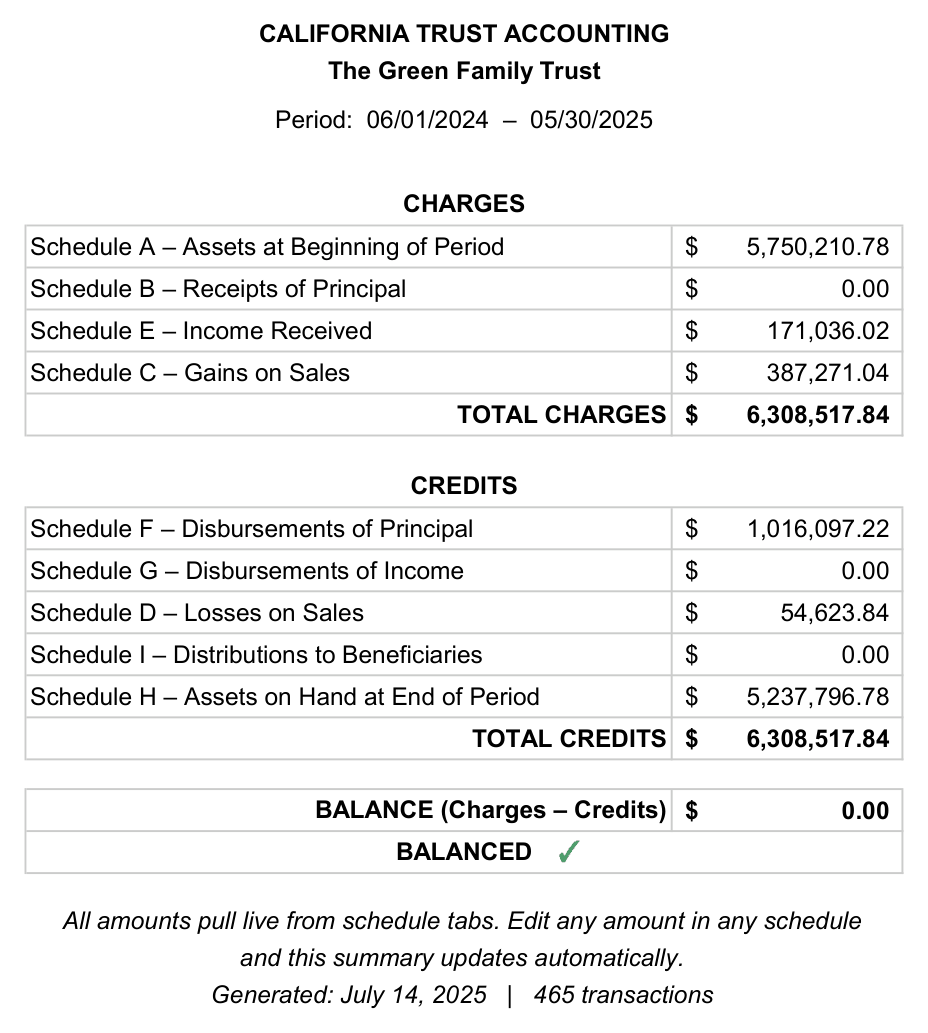
Inside a real Balanced workbook
Or have it generated from your statements, for $699
Review the workbook against your statements. Developed by a California trusts and estates attorney.
Balanced converts and organizes the data on the trust’s PDF bank and brokerage statements into this same format, delivered as one fully editable Excel workbook.
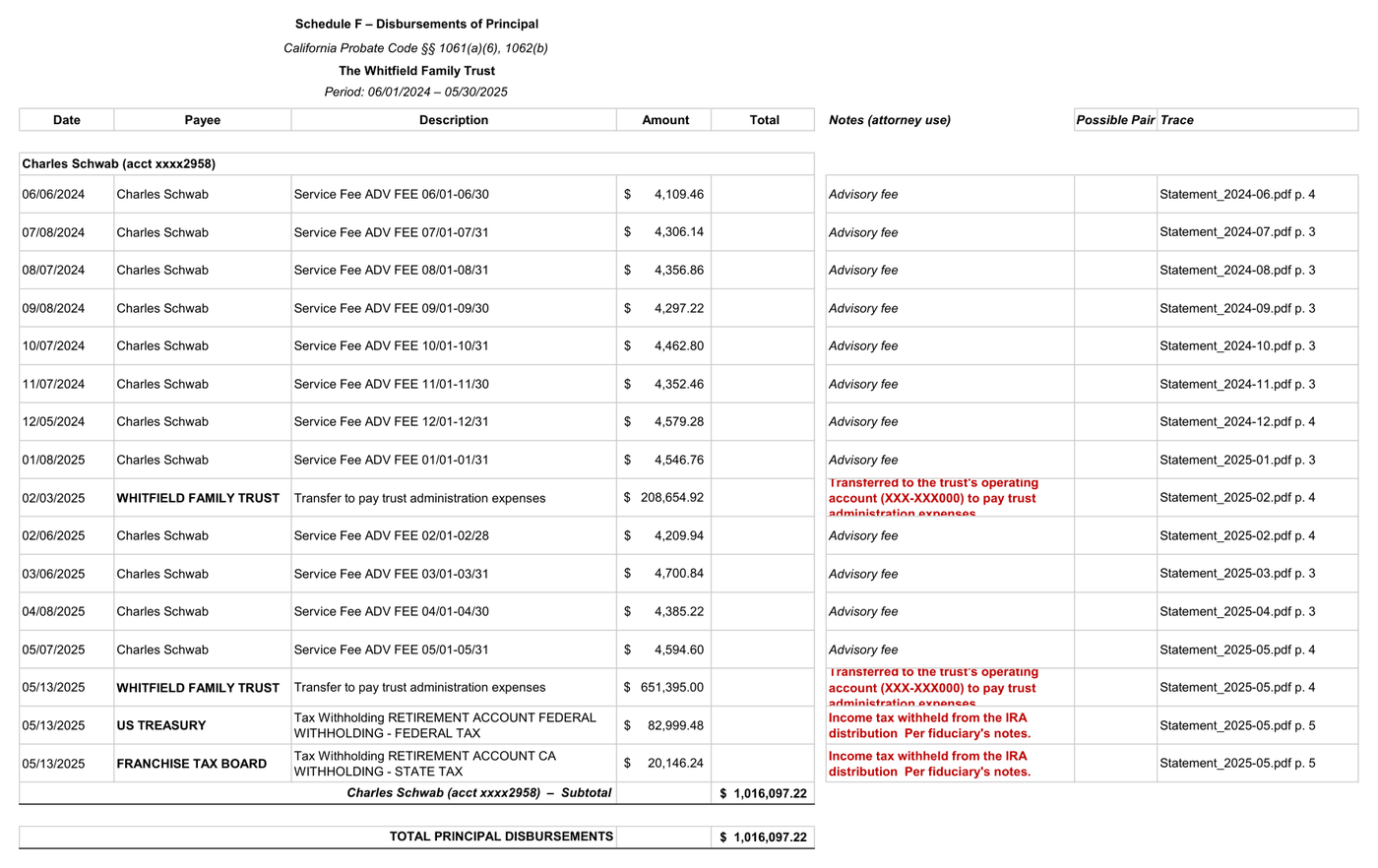
- Add your PDF statements. They are processed in your own web browser and never uploaded.
- Transactions are classified to their schedules, carry values tracked lot by lot, and the summary balanced to the penny.
- Each entry is cited to the statement and page it came from, so checking goes quickly.
- Scanned statements work, and so does an incomplete set. Any figure that may be unclear is flagged for your review, and any missing statements are listed so you can find them.
- Most are delivered in about 1 hour.
| The template, by hand | Balanced | |
|---|---|---|
| Every transaction, on its schedule | You find each one on each statement, work out which schedule it belongs on, and hope nothing was missed. | Converted from your PDF statements and sorted onto its schedule |
| Carry value, gains and losses | You follow each lot by hand | Tracked lot by lot |
| Balancing | You find any difference yourself | Balanced to the penny |
| Checking it | Back to the statements for each figure | Each entry cited to its statement and page |
| Time | Days to weeks, sometimes months | Most delivered in about 1 hour |
| Cost | Free, plus your time | $699 flat |
Accountings are usually billed by the hour, so the cost is not known until the work is done. Balanced is $699, known before you start.
Add your statements first. Your PDFs stay on your computer.
$699 flat.
Common questions
How often must a California trustee account?
At least once a year, at the termination of the trust, and on a change of trustee, to each beneficiary to whom income or principal is required or authorized in the trustee's discretion to be currently distributed (Probate Code section 16062(a)), unless an exception in sections 16064 or 16069 applies.
Does a trustee's account have to be filed with the court?
Not usually. The account goes to the beneficiaries. When an account is filed with the court, it must follow the format of Probate Code sections 1060 to 1064 (section 16063(b)).
Does the trustee of a revocable trust have to account?
Generally not to the beneficiaries for the period when the trust may be revoked (Probate Code section 16069(a)). But if no person holding the power to revoke is competent, the trustee must account to the beneficiaries described in section 15800(b)(2): each beneficiary to whom the trustee would be required or authorized to distribute income or principal if the settlor had died during the account period (section 16069(b)).
What is the three-year statement?
The account must state that claims against the trustee for breach of trust may not be made after the expiration of three years from the date the beneficiary receives an account or report disclosing facts giving rise to the claim (section 16063(a)(6); see section 16460 for how the period works).
Is this template for a probate estate too?
Use the California probate accounting template for a decedent's estate. It adds the statutory compensation worksheet an executor or administrator needs.
What is in the trust accounting spreadsheet?
A summary of charges and credits linked to a sheet for each schedule: property on hand at the beginning (Schedule A), receipts of principal and income received (B and E), gains and losses on sales (C and D), disbursements of principal and of income (F and G), distributions (I), property on hand at the end (H), changes in form of assets, and the trustee’s disclosures. The summary’s totals and balance line update as amounts are entered. The sample trust accounting shows the same format filled in.
Is the trust accounting spreadsheet free?
Yes. It is a free Excel download, with no email and no sign-up.
What work does the spreadsheet leave to be done?
The spreadsheet supplies the format. Each deposit, withdrawal, dividend, fee, purchase and sale on each statement still has to be classified to its schedule; each security’s carry value followed lot by lot; gains and losses calculated from carry value rather than the cost basis the brokerage reports; receipts and disbursements allocated between principal and income where the trust requires it; and the summary balanced exactly.
Generate the accounting with Balanced
Balanced does the conversion in a fraction of the time and cost. From the trust’s PDF bank and brokerage statements, Balanced converts and organizes the statement data into this format exactly as the statements show it, using disclosed, standard accounting conventions you can change, such as the default allocation between principal and income; everything beyond that, including any allocation the trust instrument requires, comes from your own instructions. Transactions are classified to their schedules, carry values tracked lot by lot, each account reconciled to its own statements, the summary balanced to the penny, and each entry cited to the statement and page it came from, delivered as one fully editable Excel workbook. $699 per accounting.
Ready to generate yours? Add the PDF statements for the accounting period. Your PDFs stay on your computer.
$699 Flat. No Subscription. No Install.