 Balanced
An Ohio estate closes with a final and distributive account on Form 13.0, due within six months after appointment unless an exception in R.C. 2109.301(B)(1) applies; a final account is due within thirty days after the administration is complete, or as the court orders. A sole heir or beneficiary who is also the executor or administrator may file a certificate of termination (Form 13.6) instead. The court sets the account for hearing; on approval it may discharge the fiduciary, who is otherwise discharged without further order twelve months after the final and distributive account is approved (R.C. 2109.32).
Have the statements? Balanced converts and organizes the data on them into Ohio’s Form 13.0 fiduciary’s account, as one editable Excel workbook balanced to the penny. Scanned or incomplete statements work.
- Works with any PDF statement, downloaded or scanned
- Statement entries are cited to the PDF and page they
came from, for easy verification - A fully editable Excel workbook, emailed in about 1 hour
$699 Flat. No Subscription. No Install.
Three ways an Ohio estate closes
| Filing | What it shows | Law |
|---|---|---|
| Final and distributive account | Complete administration and distribution of the assets: the usual closing account | R.C. 2109.30(B) |
| Final account, then an account of distribution | Complete administration before distribution, then a later account showing the distribution | R.C. 2109.30(B) |
| Certificate of termination (Form 13.6) | A sole legatee, devisee or heir who is also the executor or administrator certifies the estate is finished, instead of a final account | R.C. 2109.301(B)(2) |
What comes before the final account
- Creditors’ claims: claims are presented within six months after death; a claim presented late is barred (R.C. 2117.06). Courts look for every claim to be resolved before closing: Cuyahoga’s checklist lists “All claims have been resolved” (Accounts and Inventory page), and Hamilton’s Rule 62.1 keeps an estate open until every claim filed with the court is resolved (Local Rules (effective December 31, 2025)).
- Timing: the court does not approve a final account until three months have passed since the death and the surviving spouse has made the election under or against the will, or the time for it has expired (R.C. 2109.32(B)(3)).
- Distributions: assets may be distributed at any time after appointment, in cash or in kind; a distribution before the spouse’s election period or the claims period ends can leave the executor or administrator personally liable, within the limits of R.C. 2113.53.
- Fees: the executor’s commission (see Ohio executor fees) and attorney fees, which are not paid until the final account is prepared for filing unless the court approves earlier payment (Civ.R. 73.21(B)).
- Court costs: a final or distributive account is not approved until all court costs are paid (Civ.R. 73.15(E)).
A worked timeline
| Step | Date | Rule |
|---|---|---|
| Death | February 10, 2026 | |
| Executor appointed | March 16, 2026 | |
| Inventory due (three months after appointment) | June 16, 2026 | R.C. 2115.02 |
| Three months after death | May 10, 2026 | R.C. 2109.32(B)(3) |
| Claims period ends (six months after death) | August 10, 2026 | R.C. 2117.06 |
| Final and distributive account due (six months after appointment) | September 16, 2026 | R.C. 2109.301(B)(1) |
| Account filed, with Form 13.9 | September 8, 2026 | R.C. 2109.32(B) |
| Earliest hearing (thirty days after filing) | October 8, 2026 | R.C. 2109.32(A) |
| Account approved (in this example) | October 13, 2026 | |
| Discharge without further order (twelve months after approval) | October 13, 2027 | R.C. 2109.32(A) |
Here the claims period ends before the six-month account is due, so the estate can close on time. If it cannot, for example because a house has not sold, the executor files Form 13.8 to extend administration, and an account or waiver is then due within thirteen months; see the Ohio waiver of partial account.
What the final account shows
- Every receipt and every disbursement and distribution since the last account (or the inventory), and an itemized statement of what is left, with any changes in investments (R.C. 2109.301(A)). On a final and distributive account, the Form 13.2 assets remaining read zero; Cuyahoga’s checklist asks for “an itemized statement indicating a zero balance” (Accounts and Inventory page).
- A house sold during the period at its gross proceeds, with a copy of the closing statement itemizing the disbursements (Civ.R. 73.15(B)).
- Receipts for the distributions: courts look for signed receipts, cancelled checks or the beneficiaries’ waivers (Cuyahoga’s approval checklist; Hamilton Rule 64.1(D)).
- The fees paid: the executor’s commission on the line “Fiduciary fees this accounting period” and attorney fees on their own line of Form 13.0. Cuyahoga asks for a computation of the fiduciary’s and attorney’s fees with the final account.
Below, the Form 13.0 page of a fictional final and distributive account in a Balanced workbook.
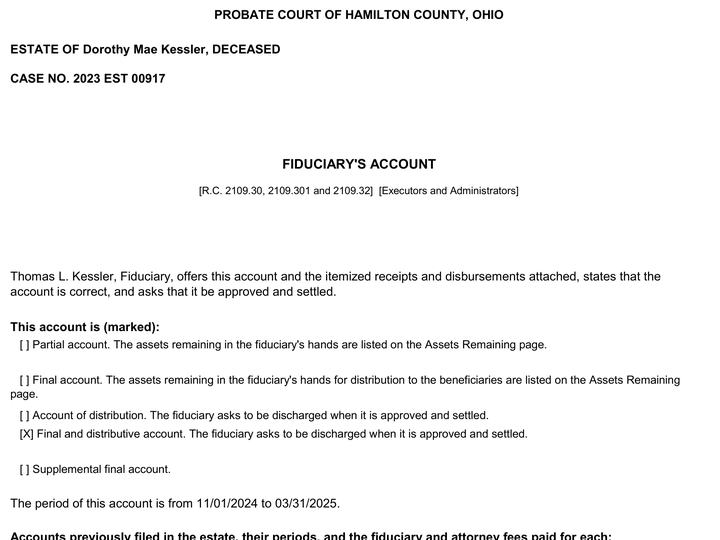
Rather not build it by hand? Balanced sorts every transaction on your statements into Ohio’s Form 13.0 fiduciary’s account, measures each sale against its starting value and balances the account to the penny, in one editable Excel workbook.
$699 Flat. No Subscription. No Install.
Copies, notice and the hearing
The executor or administrator gives a copy of the account to each heir (intestate) or beneficiary (testate) when it is filed, except an heir or beneficiary whose address is unknown and a specific beneficiary already paid whose receipt is on file, and files the certificate of service, Form 13.9, before or with the account (R.C. 2109.32(B)). Notice of the hearing (Form 13.5) or written waivers (Form 13.7) follow R.C. 2109.33, and a court may by local rule require notice of the final account hearing to all heirs or residuary beneficiaries; Cuyahoga’s Rule 64.2 requires the copy and notice by certified mail or commercial carrier unless waived (Local Rules of the Court). See Ohio account hearings and exceptions.
The certificate of termination (Form 13.6)
When the sole legatee, devisee or heir is also the executor or administrator, no partial accounts are required, and within thirty days after completing the administration the fiduciary may file a certificate of termination instead of a final account. It states that all debts and claims presented have been paid or settled, any estate tax return has been filed and the tax paid, attorney and fiduciary fees have been waived or paid (with the amounts), and the rest has been distributed to the sole beneficiary (R.C. 2109.301(B)(2)). A creditor who presents a claim afterward, within the time R.C. 2117.06 allows, may hold the sole beneficiary liable (R.C. 2109.301(B)(3)). On Form 13.6 the court’s entry discharges the fiduciary and any surety.
After approval
- On approving a final and distributive account the court may terminate the fiduciary’s bond and may discharge the fiduciary; otherwise discharge follows twelve months after approval (R.C. 2109.32(A)).
- An asset discovered after the final account is reported on a supplemental final account, with a copy to each heir or beneficiary (R.C. 2109.32(B)(4)).
- The order settling an account has the effect of a judgment and may be vacated only for fraud or for the other causes in R.C. 2109.35.
Or have Balanced generate it
Balanced is a new kind of software for fiduciary accountings. From the PDF bank and brokerage statements, it converts and organizes the statement data into the accounting: every transaction sorted to its schedule, sales measured against carry value, each account reconciled to its own statements, the summary balanced to the penny, and each entry cited to the statement and page it came from, delivered as one fully editable Excel workbook for you to review and verify. It works for California accountings today. For Ohio, it prepares Ohio’s Form 13.0 fiduciary’s account the same way. Scanned or incomplete statements work. Most are delivered in about 1 hour. $699 per accounting.
Common questions
How long does an Ohio executor have to close the estate?
A final and distributive account is due within six months after appointment unless an exception applies, such as an Ohio estate tax return, a will contest, a spouse’s election against the will, litigation, insolvency, or another reason the court approves (R.C. 2109.301(B)(1)). An estate that stays open files Form 13.8.
Can an Ohio estate close before the six-month creditor period ends?
The court cannot approve a final account until three months after the death (R.C. 2109.32(B)(3)); claims may be presented for six months after death (R.C. 2117.06), and distributing before then carries the liability set out in R.C. 2113.53.
What is an Ohio certificate of termination?
Form 13.6: a sole heir or beneficiary who is also the executor or administrator files it within thirty days after completing administration instead of a final account (R.C. 2109.301(B)(2)).
When is an Ohio executor discharged?
The court may discharge the fiduciary when it approves the final and distributive account; unless it orders otherwise, the fiduciary is discharged without further order twelve months after approval (R.C. 2109.32).
Does the final account need receipts from the beneficiaries?
Courts look for proof of each distribution: Cuyahoga lists receipts, cancelled checks or waivers from the heirs or beneficiaries, and Hamilton’s Rule 64.1(D) lists signed receipts and cancelled checks among acceptable proofs.
Ready to generate yours? Add the PDF statements for the accounting period. Your PDFs stay on your computer.
$699 Flat. No Subscription. No Install.