 Balanced
A fiduciary accounting is the report that a person managing someone else’s property (a trustee, an executor or administrator, a conservator or a guardian) gives of everything received, paid out, gained, lost and still on hand during a period. In California, an account filed with the court follows Probate Code sections 1060 to 1064: a summary of charges and credits, supported by schedules, in which total charges equal total credits (§1061(c)). Conservators and guardians present it on the Judicial Council’s GC-400 or GC-405 forms.
Have the statements? Balanced converts and organizes the data on them into this accounting, in the Probate Code format, as one editable Excel workbook balanced to the penny. Scanned or incomplete statements work.
- Developed by a California trusts and estates attorney
- Works with any PDF statement, downloaded or scanned
- Statement entries are cited to the PDF and page they
came from, for easy verification - A fully editable Excel workbook, emailed in about 1 hour
$699 Flat. No Subscription. No Install.
This has by far been the best user-experience and I’ve been really impressed with your product thus far.
Kelsey B. Cooper, Esq., California Estate Planning Services PC
What a fiduciary accounting is
A fiduciary holds property for someone else. A trustee holds it for the beneficiaries of a trust, an executor or administrator for the heirs and devisees of an estate, and a conservator or guardian of the estate for the conservatee or ward. The accounting is how the fiduciary shows, item by item, what happened to that property: what was on hand at the start, what came in, what went out, what was gained or lost on sales, what was distributed, and what is left at the end.
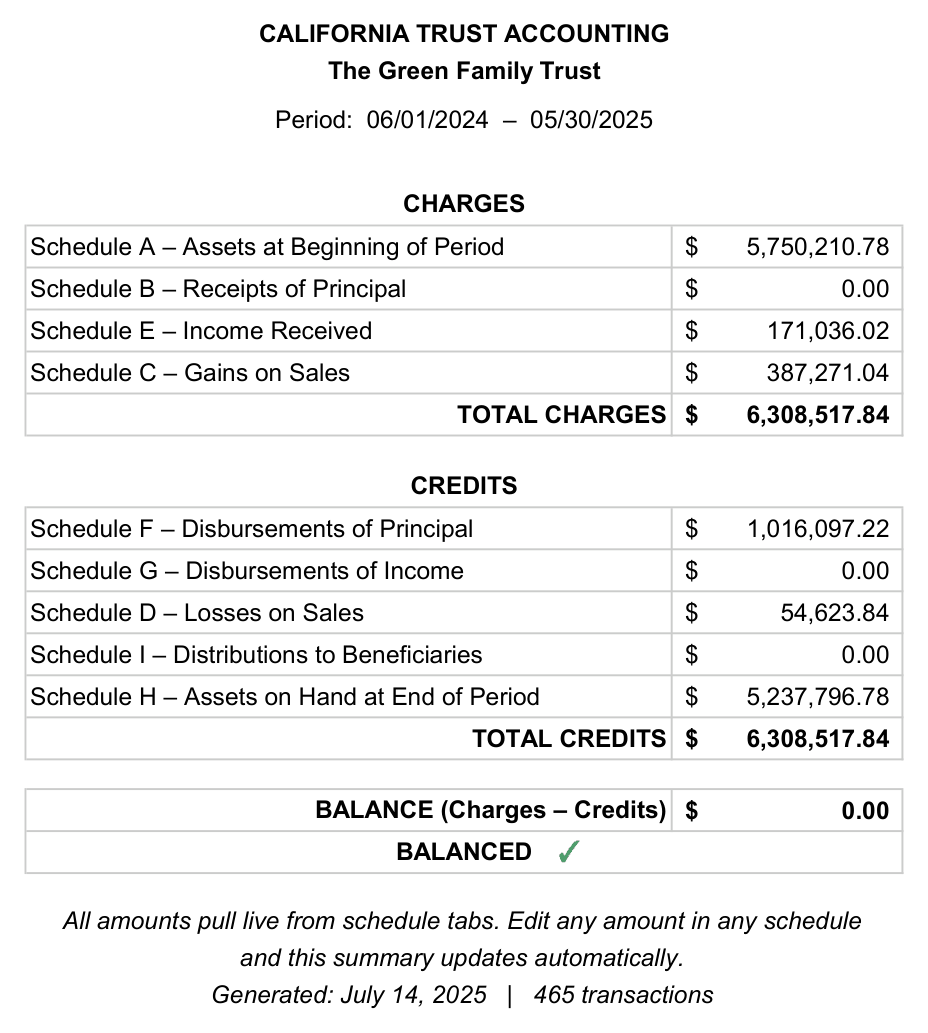
The California format is built as a ledger with two sides. The charges are everything the fiduciary is answerable for: the property on hand at the beginning, property received later, receipts of income and principal, gains on sales and net income from a business. The credits are everything the fiduciary can show for it: disbursements, losses on sales, net business losses, distributions, and the property still on hand at the end. The two totals must be equal (§1061(c)). When they are, every dollar the fiduciary was charged with is accounted for. When they are not, something is missing, counted twice or valued inconsistently, and the account is not finished.
The same idea runs through every kind of California fiduciary accounting. What changes from one kind to the next is who receives it, when it is due, and whether it goes to the court.
Who must prepare one in California
| Fiduciary | When an account is due | Format |
|---|---|---|
| Trustee | At least annually, at the termination of the trust, and on a change of trustee, to each beneficiary to whom income or principal is required or authorized to be currently distributed (§16062(a)), unless an exception in §16064 applies | The contents listed in §16063(a); an account filed with the court follows Probate Code 1060 to 1064 (§16063(b)) |
| Executor or administrator (personal representative) | A final account when the estate is in a condition to be closed (§10951), and any account the court orders (§10950); the account may be waived under §10954 | Probate Code 1060 to 1064, with a report of administration (§10900) |
| Conservator or guardian of the estate | One year after appointment, then at least every two years, or more often if the court orders (§2620(a)) | Probate Code 1060 to 1064 on the Judicial Council forms: the GC-400 standard account or the GC-405 simplified account (rule 7.575) |
A trustee’s account usually goes to the beneficiaries, not the court. It reaches the court when someone petitions: a beneficiary may ask the court to compel an account if the trustee has not provided a requested account within 60 days after a written request and no account was made in the six months before it (§17200(b)(7)(C)), and a trustee or beneficiary may petition to settle the accounts and pass on the trustee’s acts (§17200(b)(5)). A probate estate and a conservatorship account, by contrast, are filed with the court for approval. How that works is explained in court accounting in California.
Guides for each role: for trustees, for executors and for conservators; and by kind of account: California trust accounting, California probate accounting and conservatorship accounting.
The California format: Probate Code 1060 to 1064
Five short sections of the Probate Code set the format of every account filed with a California court (§1060). In plain English:
- The summary (§1061). The account states the period it covers and opens with a summary of the charges and credits listed above. For a first account, the property on hand at the beginning is the value of the property the fiduciary initially received; for a later account, it is the property on hand at the end of the prior account (§1061(a)(1)). The property on hand at the end is stated at its carry value (§1061(a)(10)).
- The supporting schedules (§1062). Receipts, with the nature or purpose, source and date of each; disbursements, with the nature or purpose, payee and date of each; net income or loss from a trade or business; the calculation of gains and losses on sales; distributions, with property at carry value; and an itemized list of the property on hand, each item at carry value.
- The schedules added when they apply (§1063). Market value at the end of the period (and at the beginning, for every account after the first); purchases and other changes in the form of assets; an allocation between principal and income when the estate or trust will be distributed to an income beneficiary; specifically devised property; interest on general pecuniary gifts; a proposed distribution; and liabilities at the end of the period.
- What the petition adds (§1064). The petition for approval, or a report filed with it, describes transactions that are not readily understandable from the schedules, explains unusual items, states compensation paid to the fiduciary or the fiduciary’s attorneys other than under a prior court order, discloses family or affiliate relationships with agents the fiduciary hired, and says whether all cash has been invested as the law allows.
Each section is explained in more depth in Probate Code 1061 to 1064: the California accounting format, and each schedule in California probate accounting schedules.
The GC-400 forms for conservatorships and guardianships
A conservator or guardian of the estate presents the same Probate Code 1060 to 1064 account on Judicial Council forms (§2620(a)). Under rule 7.575, every account is a standard account, with receipts and disbursements reported in subject-matter categories on the GC-400 forms, unless the estate qualifies for a simplified account on the GC-405 forms. The Summary of Account, form GC-400(SUM)/GC-405(SUM), is used in every account (rule 7.575(e)(5)). The other standard forms are optional, but a fiduciary who does not use them must report the same categories and information in the same general format (rule 7.575(e)(6)).
A simplified account is allowed only when the estate has no income-generating real property, no interest in a trade or business, an appraised value under $500,000 not counting the conservatee’s or ward’s personal residence, and the court has not directed a standard account (rule 7.575(d)(1)). See the GC-405 simplified account.
Every GC-400 form is listed by number on the GC-400 accounting template page; a completed set is in the GC-400 accounting example; and the forms are walked through one by one in how to fill out the GC-400.
The schedules at a glance
The Probate Code does not assign letters to the schedules; the Judicial Council forms do, and many trust and estate accounts use similar letters. What matters is that each line of the summary is supported by a schedule.
| Summary line | Probate Code | GC-400 form |
|---|---|---|
| Property on hand at the beginning | §1061(a)(1) | GC-400(PH)(1), GC-400(PH)(2) |
| Additional property received | §1061(a)(2) | GC-400(AP) |
| Receipts of income and principal | §1061(a)(3), §1062(a) | GC-400(A)(1) to (6), or GC-405(A) |
| Gains on sales | §1061(a)(5), §1062(d) | GC-400(B) |
| Net income from a trade or business | §1061(a)(4), §1062(c) | GC-400(NI) |
| Disbursements | §1061(a)(6), §1062(b) | GC-400(C)(1) to (11), or GC-405(C) |
| Losses on sales | §1061(a)(7), §1062(d) | GC-400(D) |
| Net loss from a trade or business | §1061(a)(8), §1062(c) | GC-400(NL) |
| Distributions | §1061(a)(9), §1062(e) | GC-400(DIST) |
| Property on hand at the end, at carry value | §1061(a)(10), §1062(f) | GC-400(E)(1), GC-400(E)(2) |
| (supporting) Changes in form of assets | §1063(b) | GC-400(F) |
| (supporting) Liabilities at the end | §1063(g) | GC-400(G) |
Carry value and market value
Every asset in a California accounting carries two numbers, and mixing them up is the most common reason an account will not balance.
Carry value is the value the account carries an asset at. An asset on hand at the start of a first account enters at the value the fiduciary received it at, which in a decedent’s estate is the inventory and appraisal value at the date of death (§8802); an asset bought during the period enters at what was paid for it. A later account starts each asset at the carry value the prior account ended with (§1061(a)(1)). The property on hand at the end, and any property distributed, are stated at carry value (§§1061(a)(10), 1062(e), (f)), and a gain or loss on a sale is the difference between the proceeds and the carry value of what was sold. That is often different from the cost basis a brokerage statement reports, because the brokerage tracks the cost for tax purposes, not the value the account carries.
Market value is reported separately, on its own schedule: the estimated market value of the assets at the end of the period, and, for every account after the first, at the beginning (§1063(a)). For real estate, a closely held business or another asset without a ready market, the fiduciary’s good faith estimate is enough. Market value is information for the reader; it does not change the summary.
More on both in carry value in a California accounting.
Principal and income
When an estate or trust will be distributed to an income beneficiary, the account must also show how each receipt and disbursement was allocated between principal and income (§1063(c)). In California, the rules for that allocation are in the Uniform Fiduciary Income and Principal Act (§16320 and the sections after it), subject to the terms of the trust. A dividend, for example, is generally income, while proceeds from selling a stock are principal. See trust accounting income vs. principal.
Deadlines that drive the account
| Event | Deadline |
|---|---|
| Trustee’s account | At least annually, at termination and on a change of trustee (§16062(a)) |
| Probate inventory and appraisal (the first account’s starting values) | Within four months after letters first issue, unless the court allows more time (§8800(b)) |
| Probate: petition for final distribution or status report | Within one year after letters issue, or 18 months if a federal estate tax return is required (§12200) |
| Personal representative who resigns or is removed | An account within 60 days after their authority ends, unless the court extends the time (§10952) |
| Conservatorship or guardianship inventory and appraisal | Within 90 days after appointment, made as of the date of appointment (§2610(a)) |
| Conservator’s or guardian’s account | One year after appointment, then at least every two years (§2620(a)) |
To work out your own dates, use the free California accounting deadline calculator. If a conservatorship account is already late, see what happens when a conservatorship accounting is overdue; if a beneficiary has demanded a trust account, see responding to a demand for a trust accounting.
What to gather
- Every statement for each bank, brokerage and retirement account for the whole period, with no month missing, plus the statement for the month before the period begins: its ending balance is the period’s opening balance. See why the prior statement matters.
- The starting values: the inventory and appraisal for a first account, or the prior account for a later one.
- Court orders, including orders authorizing fees, sales and distributions.
- Escrow closing statements for any real property sold, and bills for a care facility in a conservatorship.
- Check images or a check register, for the payee and purpose of each check.
Statements that arrive as PDFs, including scans, can be converted directly; see from PDF statements to a court accounting.
Common mistakes
- Counting transfers twice. Money moved from checking to savings is not a receipt or a disbursement of the estate. Transfers between cash accounts at financial institutions need not be reported as changes in form (§1063(b)), but they must not appear as both a disbursement in one account and a receipt in the other.
- Using the brokerage cost basis for gains and losses. The account measures gains and losses from carry value, not from the tax basis on the statement.
- A missing month. The statements on either side of a gap show how the balance changed, but not the receipts and disbursements in between, so the account cannot be completed until that month is found.
- A beginning that does not tie. The first account must start from the inventory values; a later account must start exactly where the last one ended (§1061(a)(1)).
- Reinvested dividends and interest left out. A dividend that buys more shares is still a receipt, and the new shares are still a purchase.
- Fees paid without an order, not disclosed. Compensation paid to the fiduciary or the attorneys other than under a prior court order must be stated in the petition or report (§1064(a)(3)).
- No market value schedule. Every account has one for the end of the period, and every later account one for the beginning as well (§1063(a)).
For an account that is close but not equal, see why a fiduciary accounting won’t balance.
Fiduciary accounting in other states
Every state sets its own rules for when a fiduciary must account and in what form, and the forms, schedules and reviewers differ from state to state. This guide covers California, where Balanced works today. If your trust, estate or conservatorship is administered under another state’s law, follow that state’s statutes and court rules. Guides for North Carolina are collected in fiduciary accounting by state.
Free templates and examples
- California trust accounting template and trust accounting example
- California probate accounting template and probate accounting example
- GC-400 accounting template and GC-400 accounting example
- Deadline calculator and what a California accounting costs
Praise for Balanced
“This has by far been the best user-experience and I’ve been really impressed with your product thus far.”
“I’d also just like to say that I was a trusts & estates paralegal for 6 years prior to becoming an attorney myself, so I’ve done hundreds of accountings manually. I’ve also tried countless other ‘trust accounting’ products. This has by far been the best user-experience and I’ve been really impressed with your product thus far. Myself and my firm will be repeat customers.”
California Estate Planning Services PC
Inside a real Balanced workbook
$699 Flat. No Subscription. No Install.
Common questions
What is a fiduciary accounting?
A report by a trustee, executor, administrator, conservator or guardian of everything received, paid out, gained, lost, distributed and still on hand during a period. In California it is a summary of charges and credits, supported by schedules, in which the two totals are equal (Probate Code section 1061).
Who has to prepare a fiduciary accounting in California?
Trustees (at least annually, at termination and on a change of trustee, unless an exception applies; Probate Code sections 16062 and 16064), personal representatives of probate estates (a final account unless waived; sections 10951 and 10954), and conservators and guardians of the estate (one year after appointment, then at least every two years; section 2620).
Is a fiduciary accounting filed with the court?
Probate estate accounts and conservatorship and guardianship accounts are filed with the court for approval. A trustee's account usually goes to the beneficiaries; it reaches the court when a trustee or beneficiary petitions, for example to settle the account or to compel one (Probate Code section 17200).
What is the difference between carry value and market value?
Carry value is the value the account carries an asset at: its inventory or starting value, or its purchase price, and it is what gains and losses are measured from. Market value is the estimated value at the end of the period (and at the beginning for later accounts), shown on its own schedule (Probate Code section 1063(a)).
What is the GC-400?
The Judicial Council's set of forms for a conservator's or guardian's standard account. The Summary of Account, GC-400(SUM)/GC-405(SUM), is required in every account; the GC-405 forms are for the simplified account (California Rules of Court, rule 7.575).
Does a fiduciary accounting have to balance?
Yes. Total charges must equal total credits (Probate Code section 1061(c)).
Do these rules apply in other states?
No. This guide covers California law. Other states have their own statutes, forms and deadlines for fiduciary accountings.
Or have Balanced generate it
Balanced is a new kind of software for California fiduciary accountings. From the PDF bank and brokerage statements, Balanced converts and organizes the statement data into the California format for a trust, a probate estate or a GC-400 conservatorship or guardianship account, exactly as the statements show it, using disclosed, standard accounting conventions you can change; everything beyond that comes from your own instructions. Transactions are classified to their schedules, carry values tracked lot by lot, gains and losses measured from carry value, each account reconciled to its own statements, the summary balanced to the penny, and each entry cited to the statement and page it came from, delivered as one fully editable Excel workbook for you to review and verify. Scanned or incomplete statements work. Most are generated and delivered in about 1 hour. $699 per accounting.
For a finished estate accounting example, see the sample first and final account for a fictional decedent’s estate, every schedule filled in; a blank probate accounting template in Excel is free.
Ready to generate yours? Add the PDF statements for the accounting period. Your PDFs stay on your computer.
$699 Flat. No Subscription. No Install.