 Balanced
This is a fictional sample of a California conservatorship accounting in the layout of the Judicial Council’s GC-400 standard account: the Summary of Account, GC-400(SUM), and the schedules that have entries, over six months with a bank account and the conservatee’s residence. Total charges equal total credits, and categories with no entries are left out, as the Summary of Account directs.
Free: the template and a finished example. No email, no sign-up.
Have the statements? Balanced converts and organizes the data on them into this accounting, in the GC-400 format, as one editable Excel workbook balanced to the penny. Scanned or incomplete statements work.
- Developed by a California trusts and estates attorney
- Works with any PDF statement, downloaded or scanned
- Statement entries are cited to the PDF and page they
came from, for easy verification - A fully editable Excel workbook, emailed in about 1 hour
$699 Flat. No Subscription. No Install.
This has by far been the best user-experience and I’ve been really impressed with your product thus far.
Kelsey B. Cooper, Esq., California Estate Planning Services PC
Is the account due soon? Check your deadline.
What happens if the accounting is late
Courts take a late accounting seriously, and the consequences fall on you personally.
- Your first account is due one year after appointment, then at least every two years (Prob. Code §2620(a)).
- When an account is late, the court sends written notice: file it and set it for hearing within 30 days (§2620.2(a)).
- Missing that deadline is contempt of court (§2620.2(b)).
- If it is still not filed, the court must do one or more of these: remove you, cite you for contempt, suspend your powers and appoint a temporary conservator or guardian whose fees can be charged to you, or appoint a lawyer for the conservatee or ward. It reports what it did to the Professional Fiduciaries Bureau (§2620.2(c)).
Most Balanced accountings are delivered in about 1 hour. Add your statements
The sample GC-400 account, schedule by schedule
This is a sample standard account for a fictional conservatorship, the Conservatorship of the Estate of Eleanor R. Pratt, generated by Balanced in the layout of the Judicial Council’s GC-400 forms: six months, a bank account and the conservatee’s residence. The conservatorship, the people and the account numbers are made up. Schedules with no entries are left out, as the Summary of Account directs. Click any schedule to see the whole sheet. To build one yourself, see how to fill out the GC-400, form by form.
Download the sample accounting (PDF)
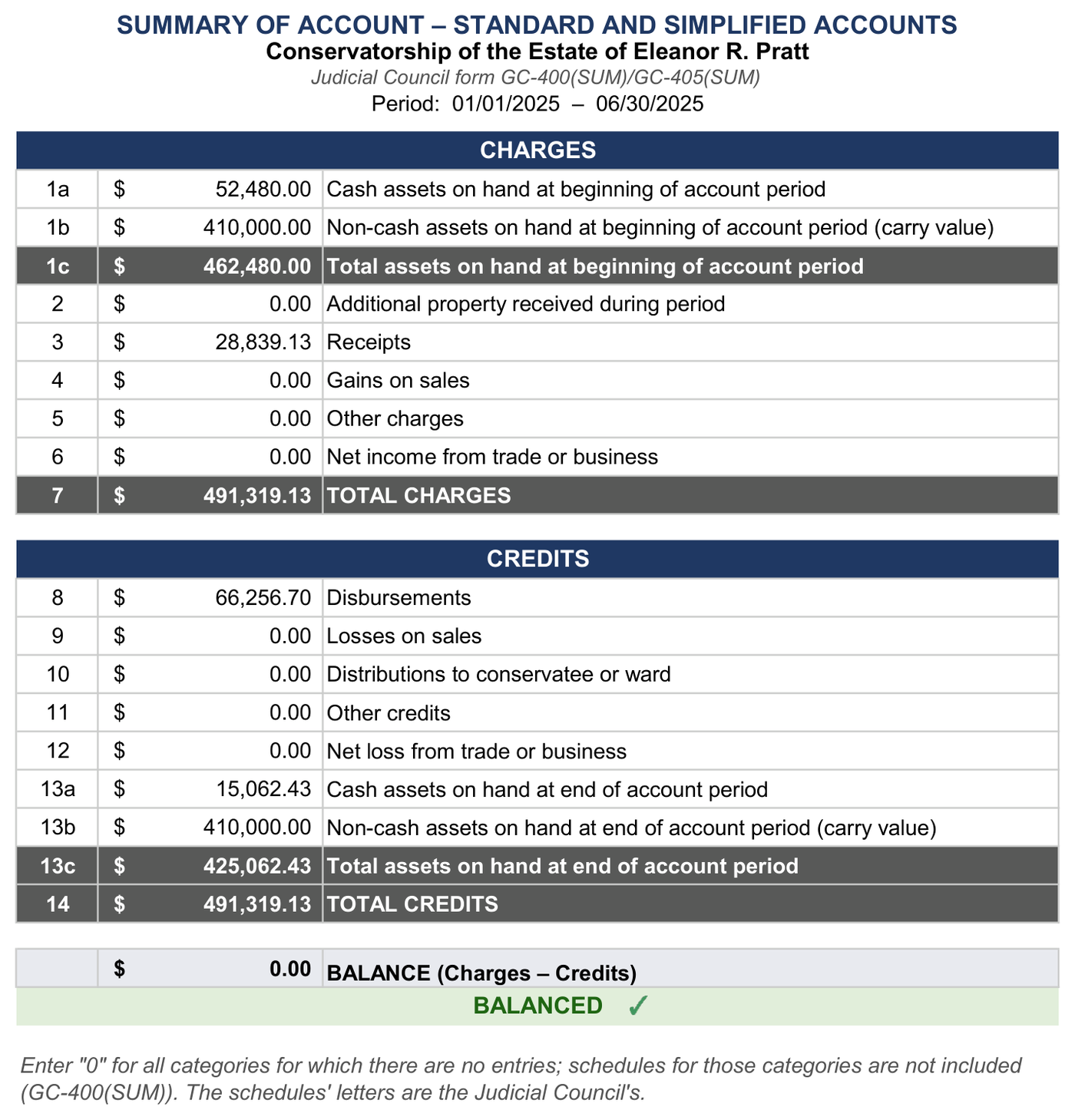
Summary of Account, GC-400(SUM)
The Judicial Council’s Summary of Account, line by line: cash and non-cash assets at the beginning, receipts, gains, disbursements, losses, distributions, and cash and non-cash assets at the end. Total charges equal total credits.
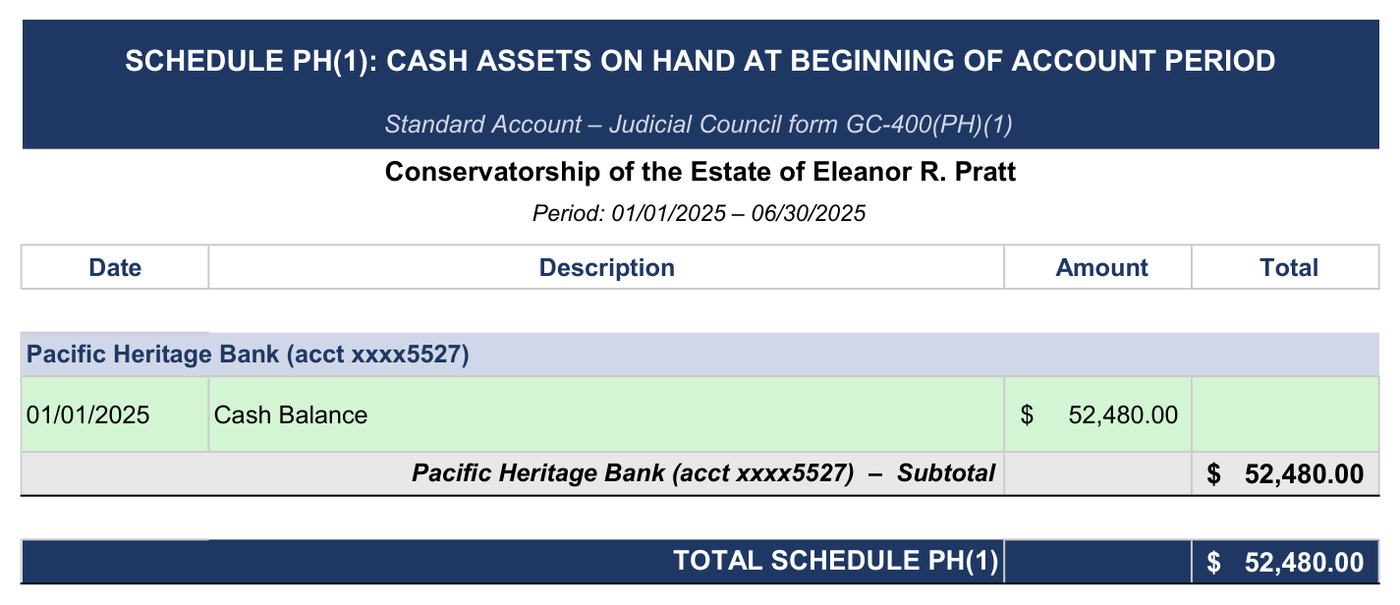
GC-400(PH)(1): cash assets on hand at the beginning
Each account’s cash balance on the first day of the period.
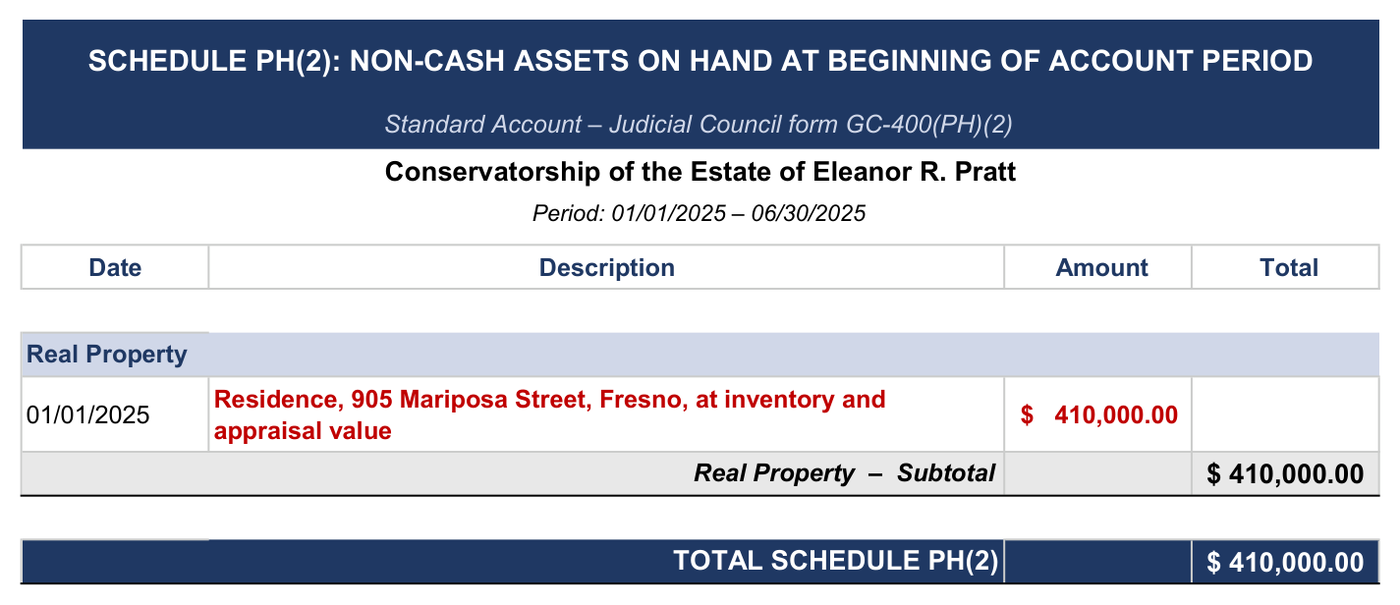
GC-400(PH)(2): non-cash assets on hand at the beginning
Non-cash assets, such as the residence, at carry value, with estimated market value.
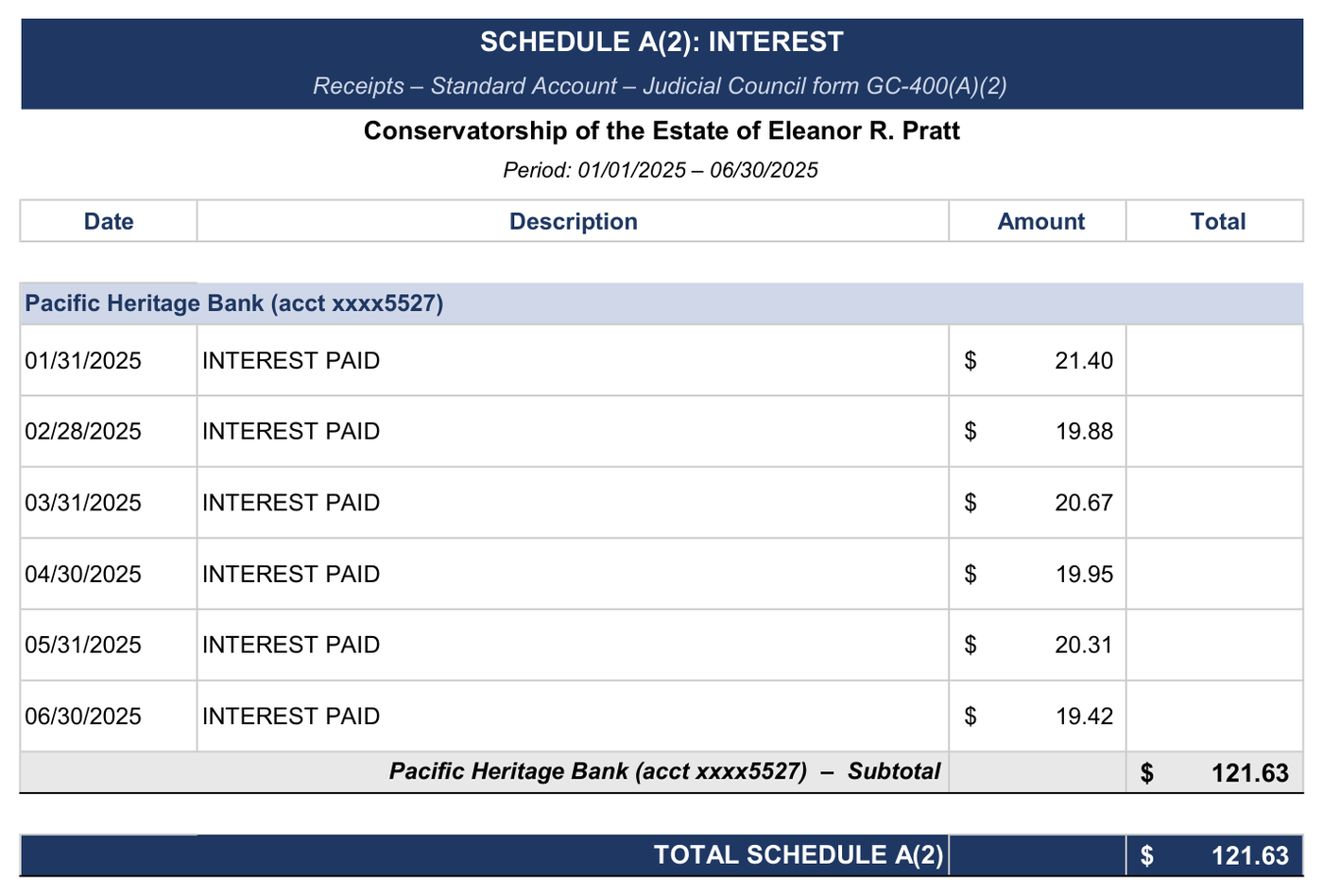
GC-400(A)(2): interest
Each interest payment received.
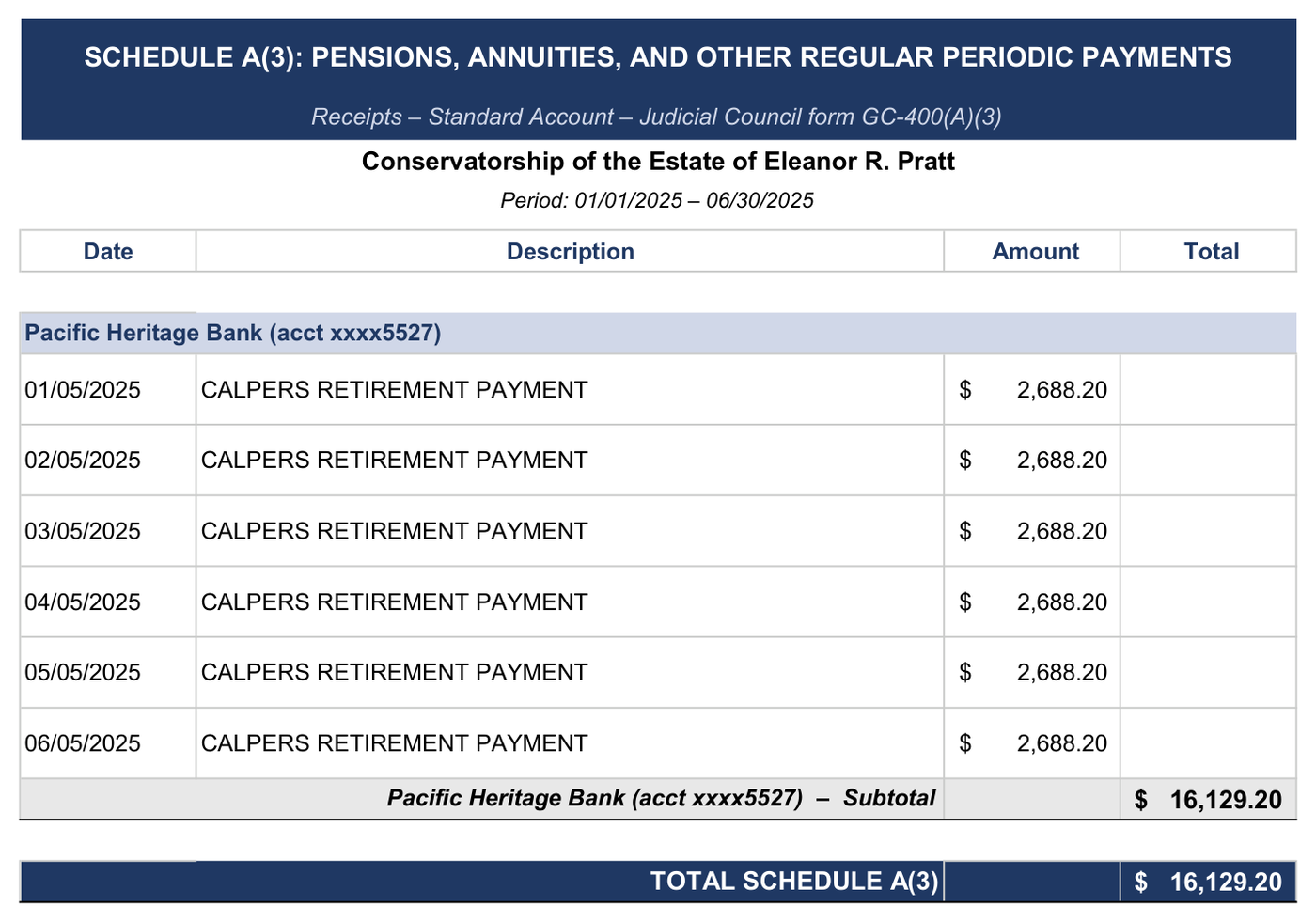
GC-400(A)(3): Pensions, Annuities, and Other Regular Periodic Payments
Each pension, annuity and other regular periodic payment received.
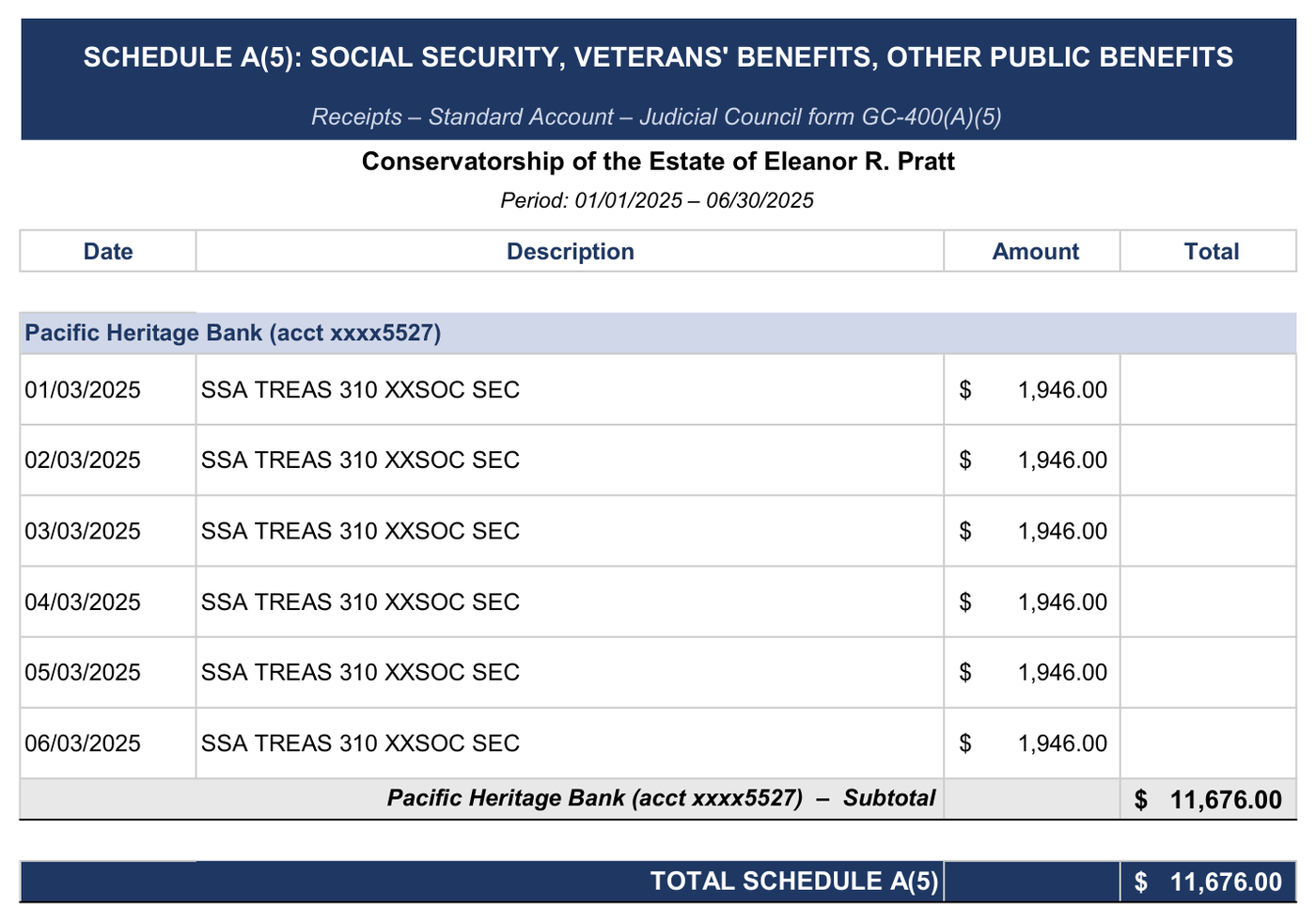
GC-400(A)(5): Social Security and other public benefits
Each Social Security, veterans’ and other public benefit payment received.
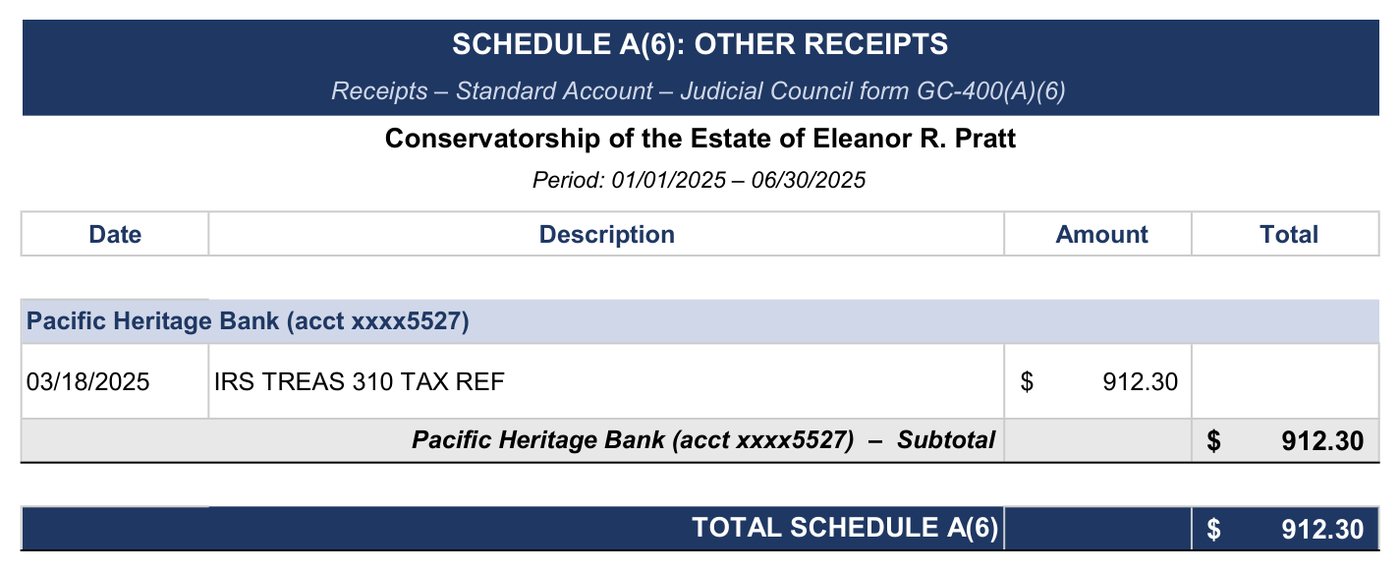
GC-400(A)(6): other receipts
Receipts that fit none of the categories above.
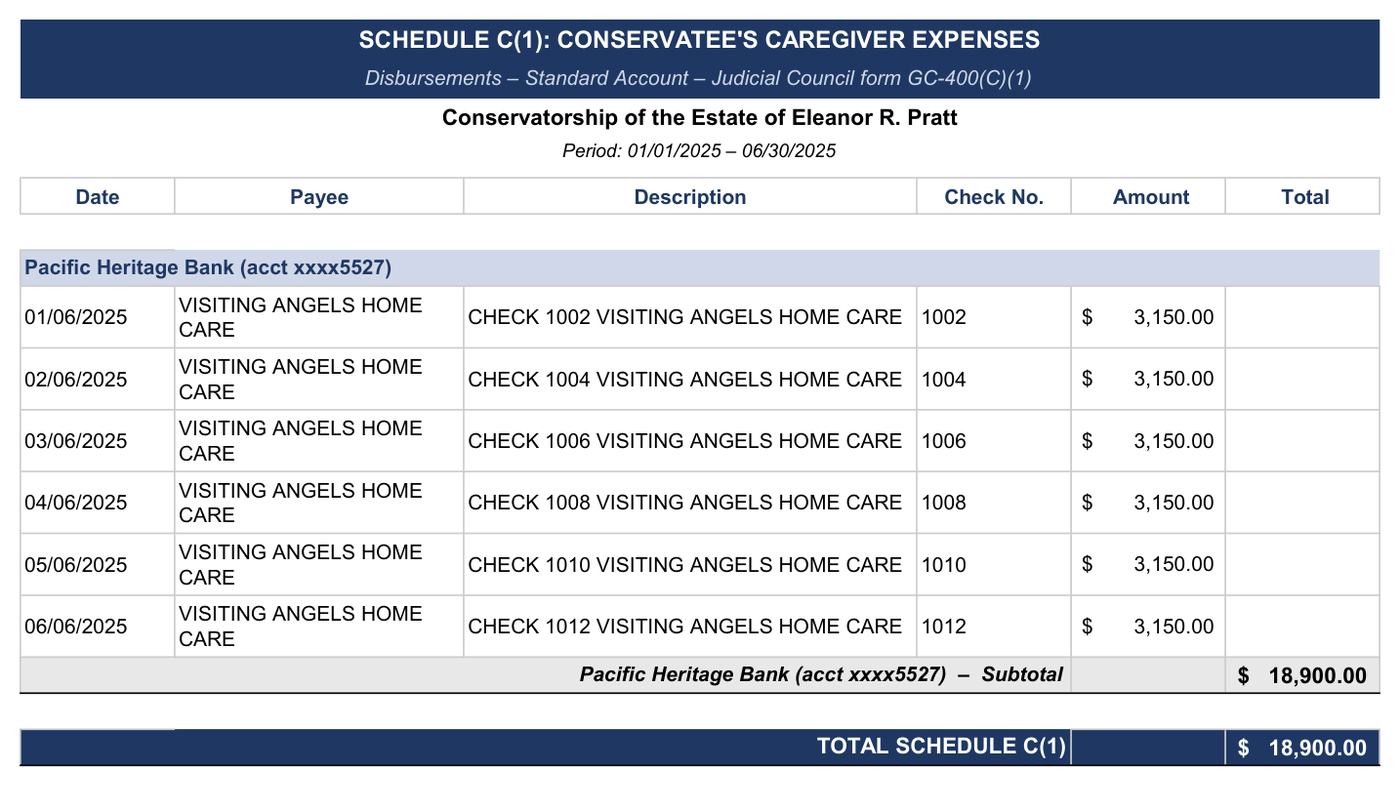
GC-400(C)(1): caregiver expenses
Each payment for the conservatee’s caregivers, with the check number.
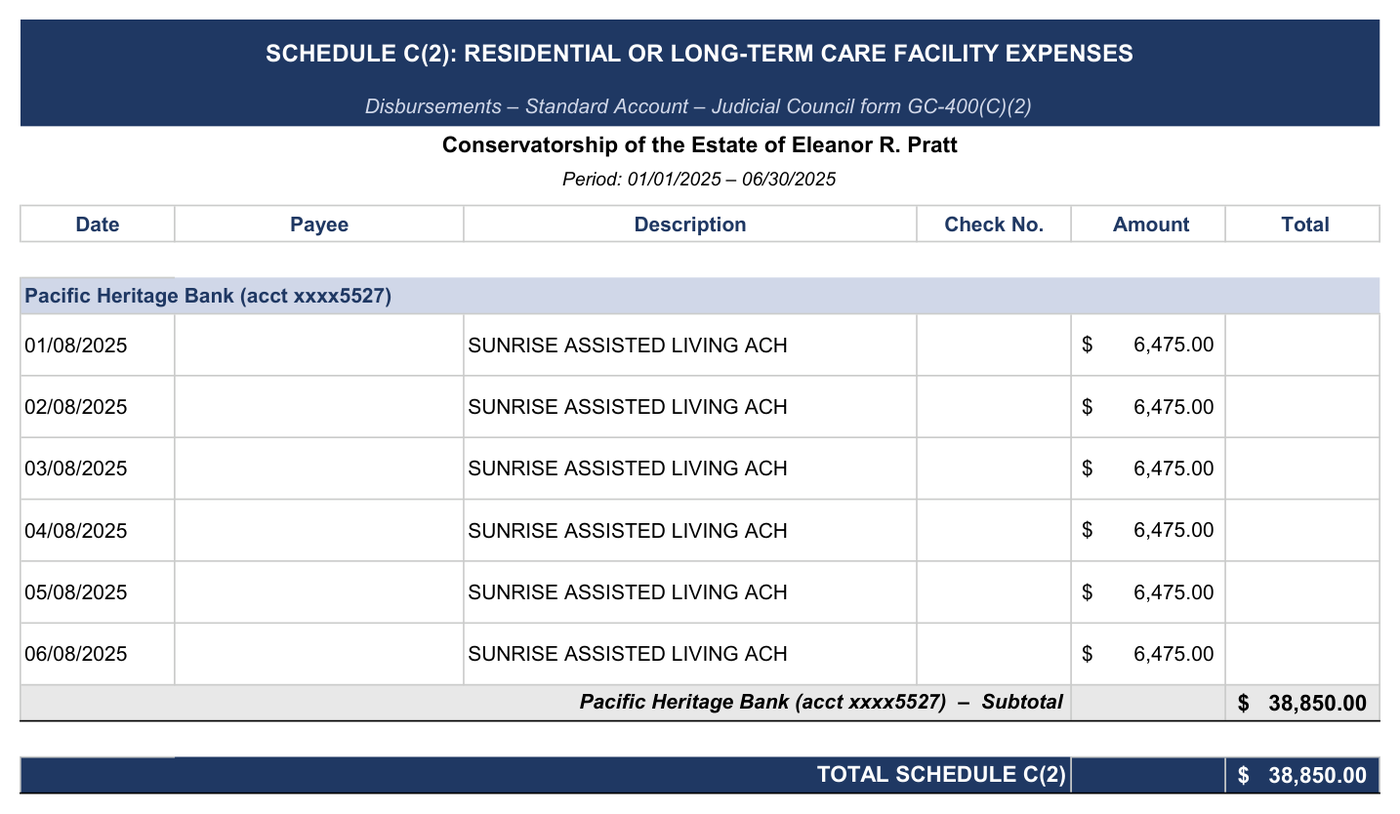
GC-400(C)(2): residential or long-term care facility
Each payment to a residential or long-term care facility.
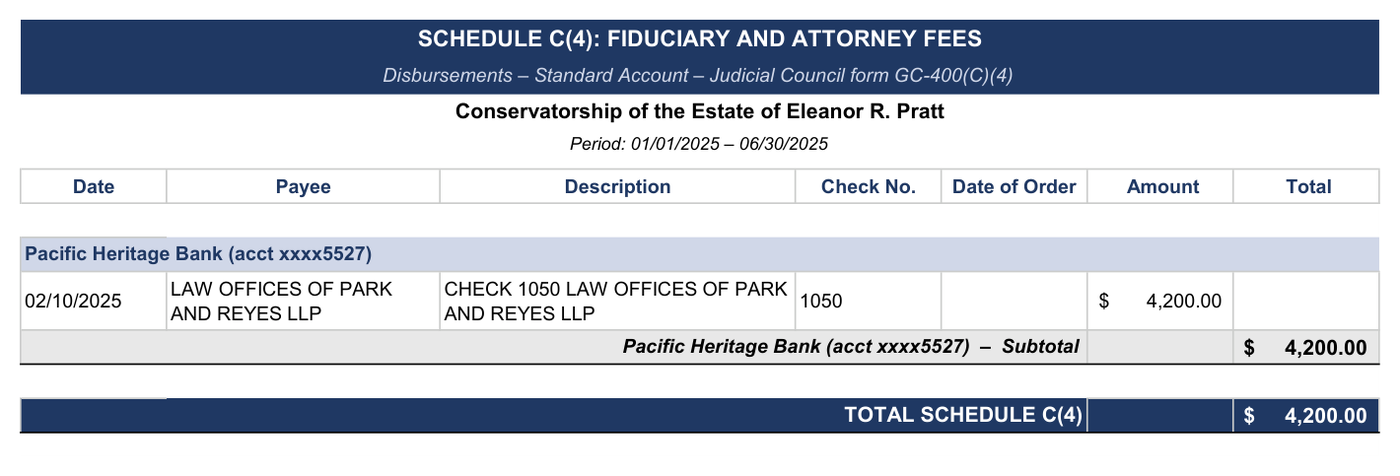
GC-400(C)(4): fiduciary and attorney fees
Each fee paid, with the date of the court order that authorized it.
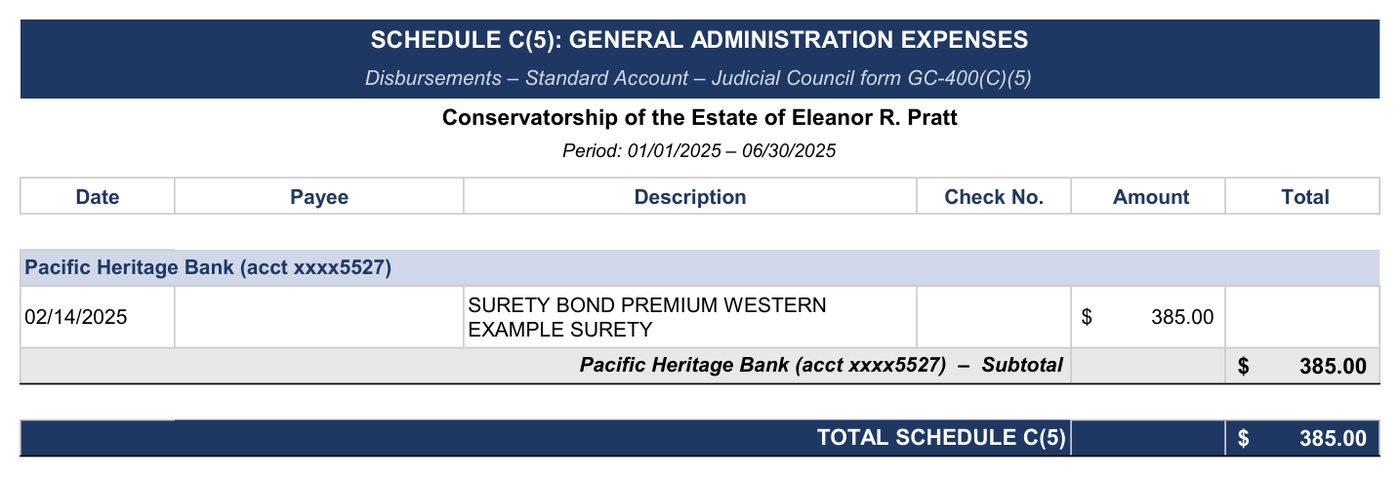
GC-400(C)(5): general administration expenses
Bond premiums, court costs and other administration expenses.
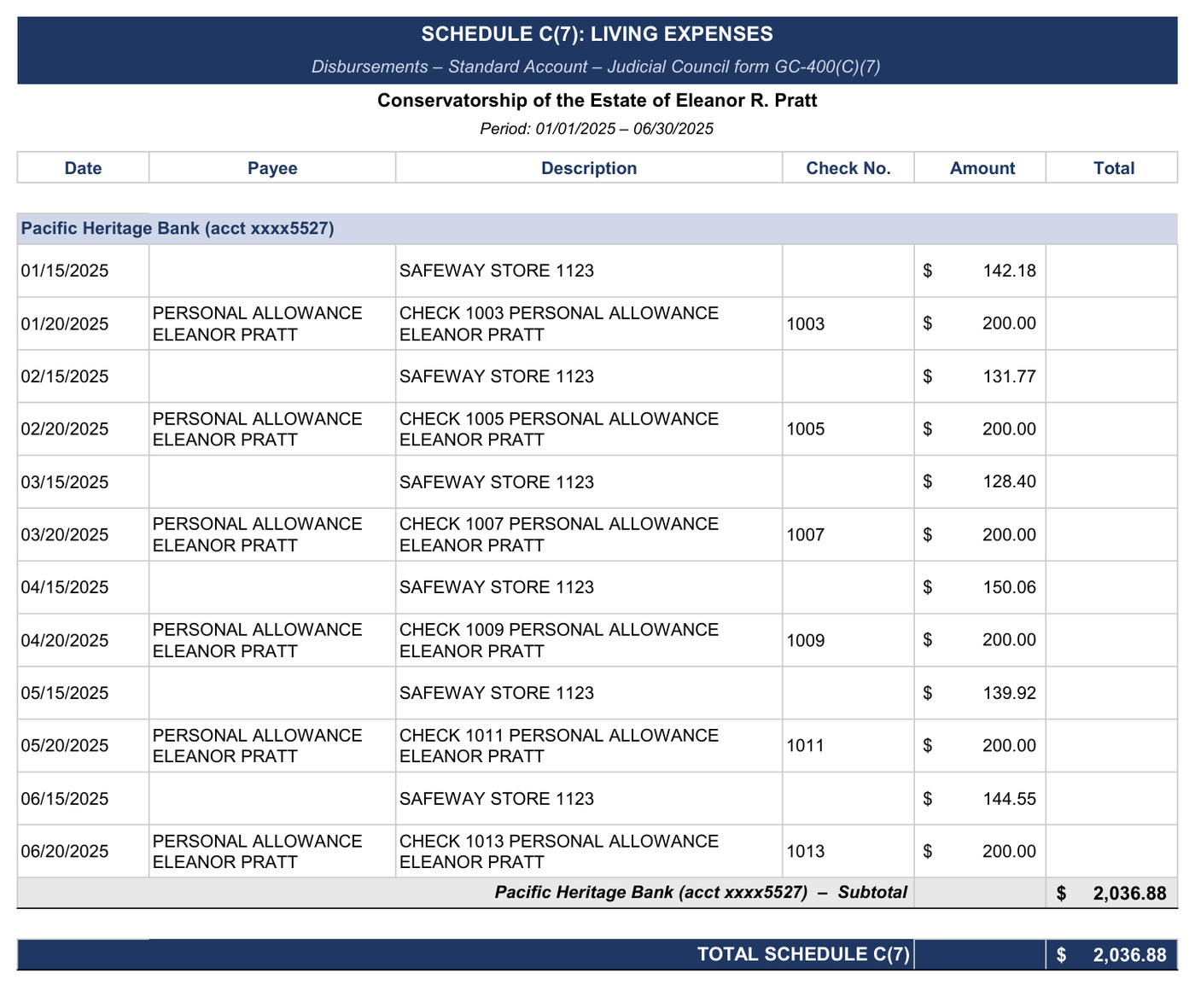
GC-400(C)(7): living expenses
Housing, food, utilities and other living expenses.
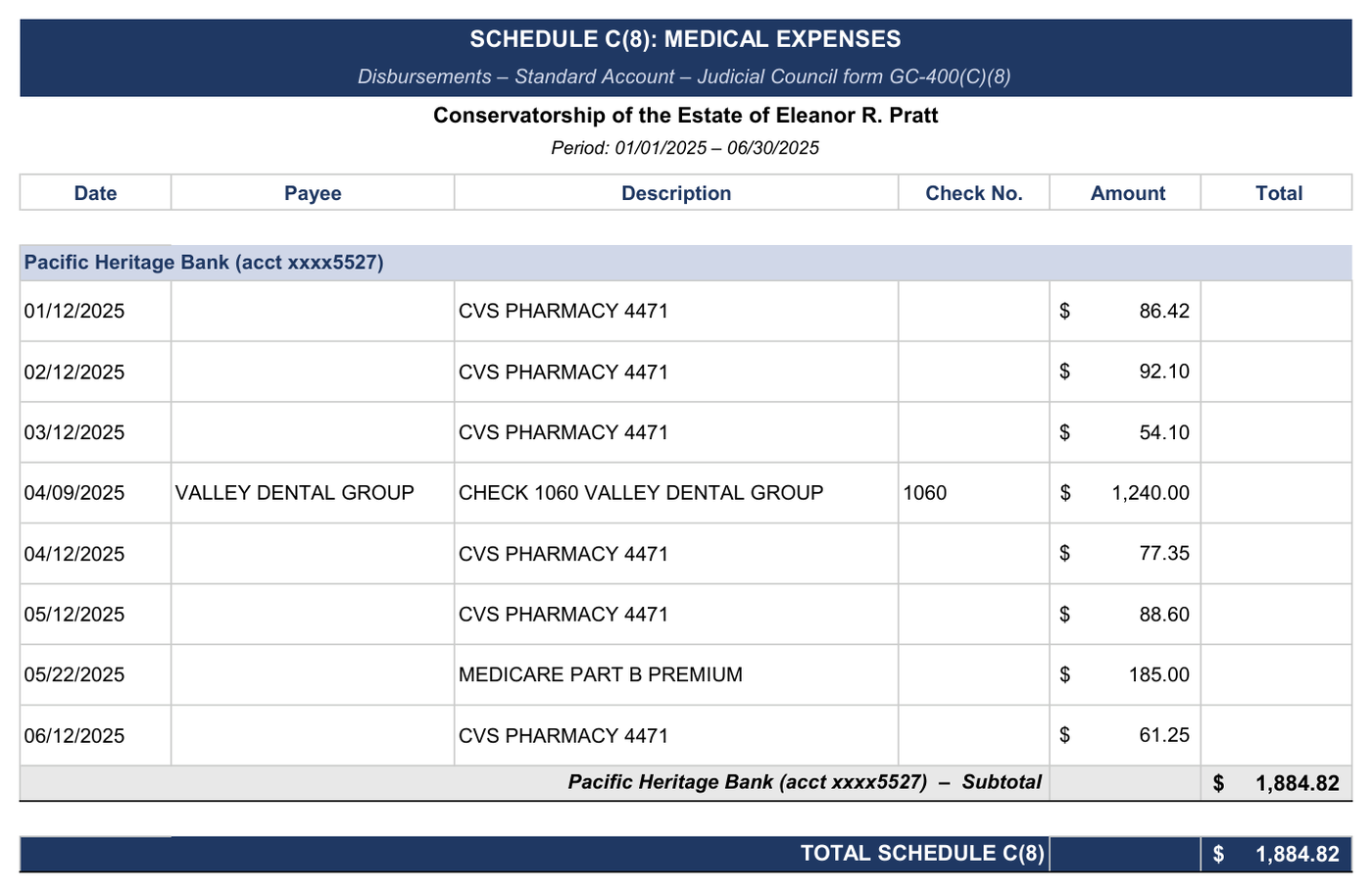
GC-400(C)(8): medical expenses
Doctors, pharmacies, insurance premiums and other medical expenses.
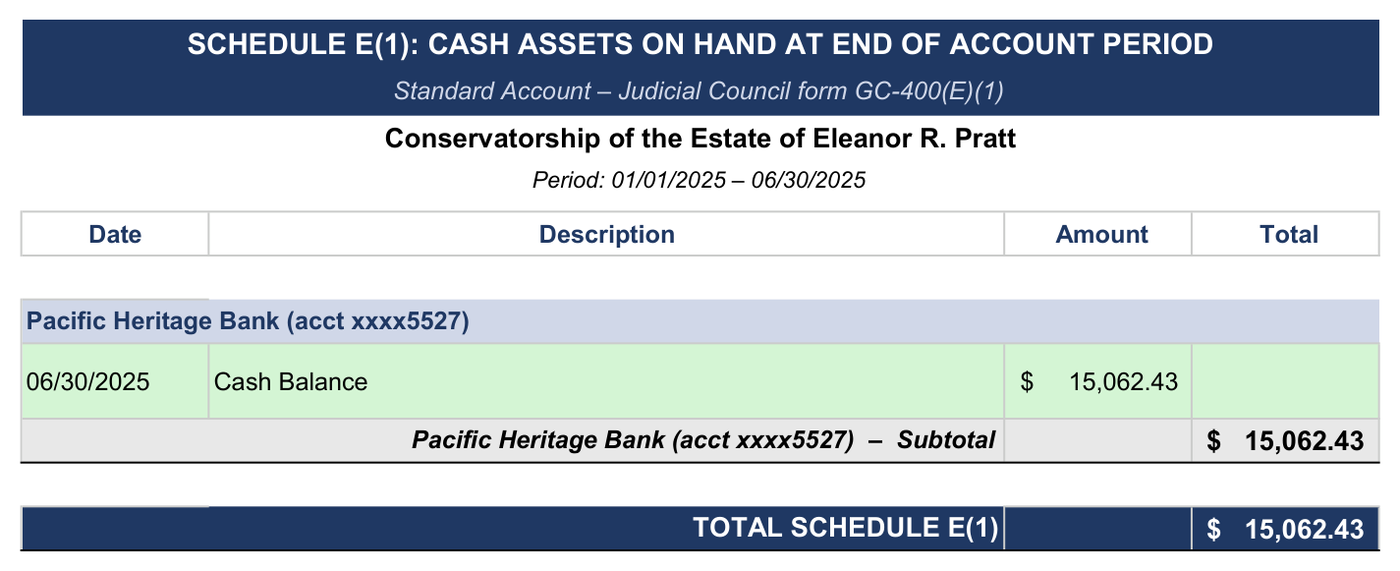
GC-400(E)(1): cash assets on hand at the end
Each account’s cash balance on the last day of the period.
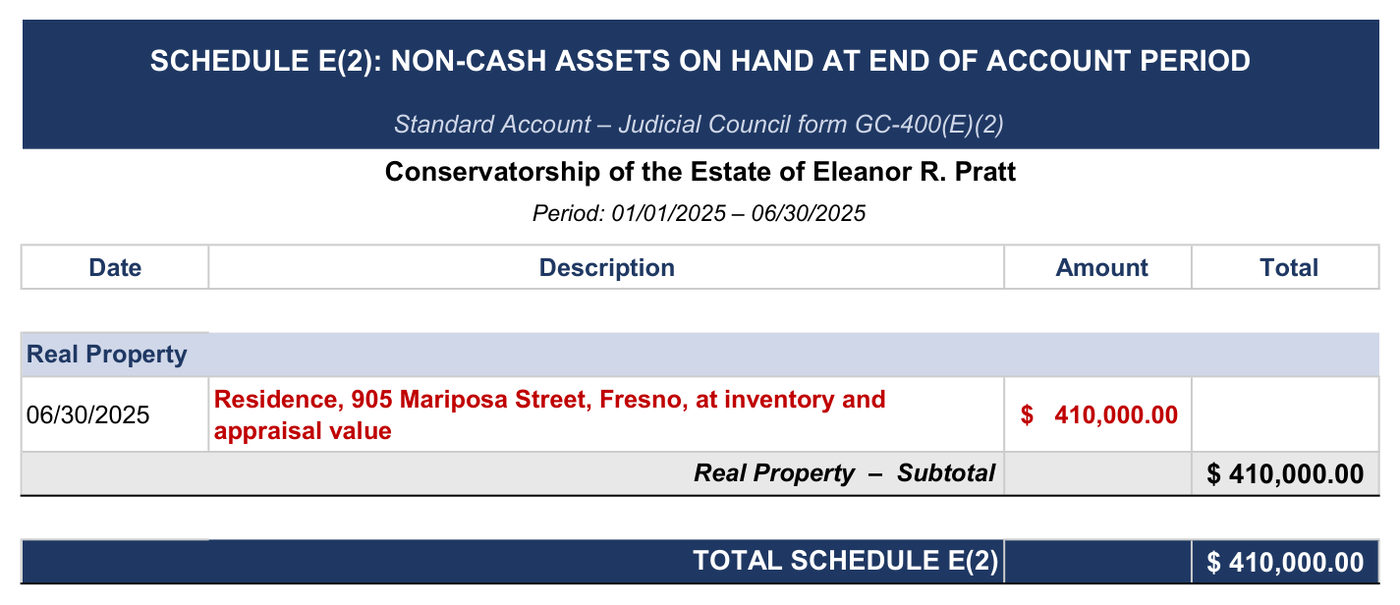
GC-400(E)(2): non-cash assets on hand at the end
Non-cash assets at the close of the period, at carry value.
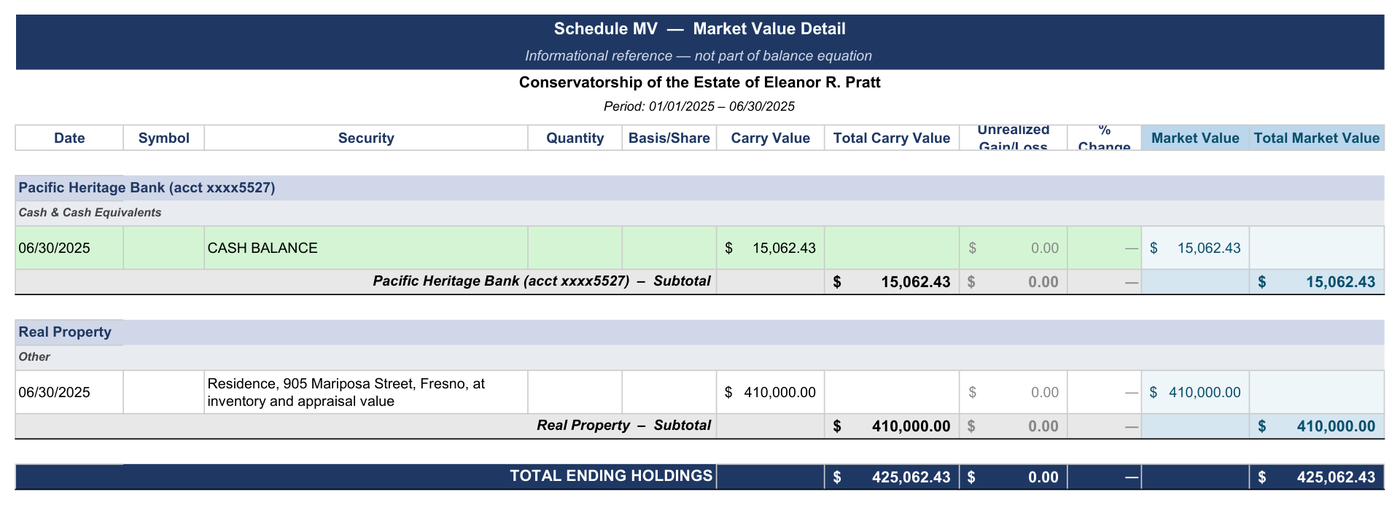
Market value at the end of the period
Each holding at carry value and at market value (§1063(a)). For reference; it is not part of the balance.
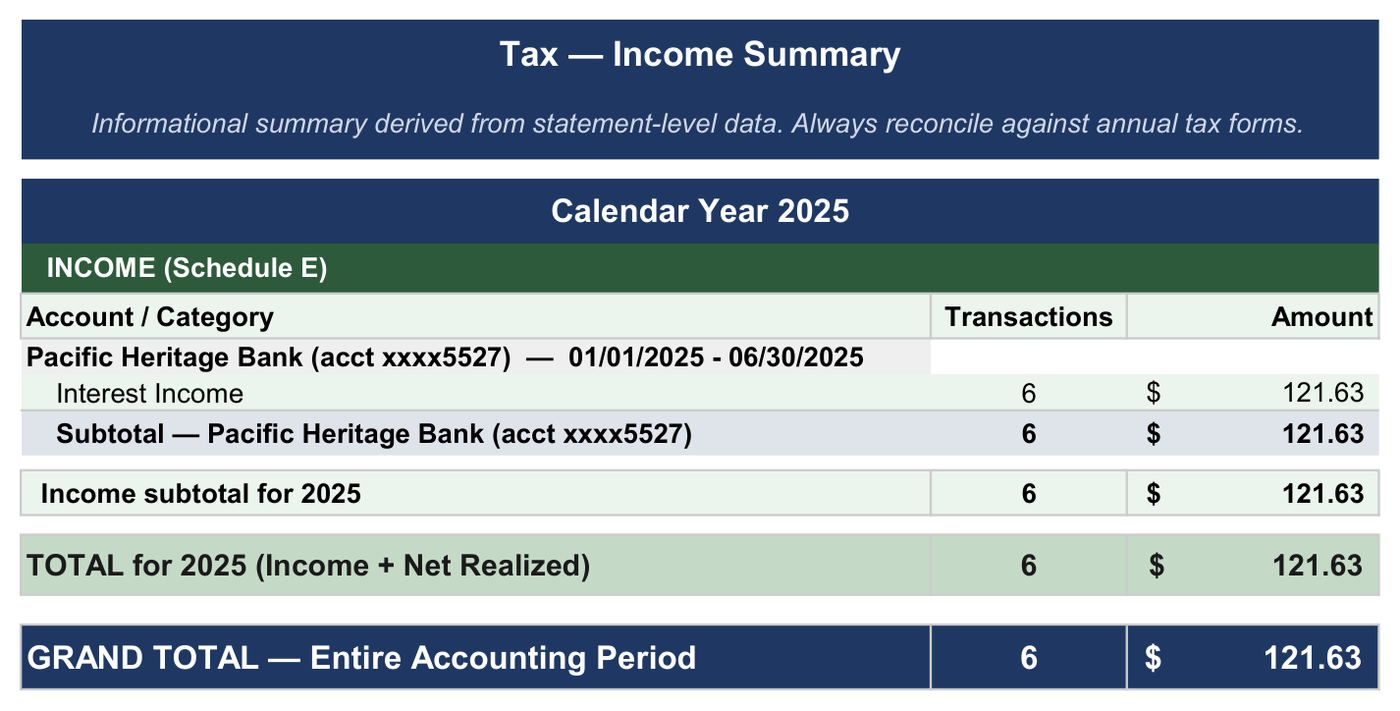
Tax summary for the CPA
Income and realized gains and losses by calendar year and account. For the fiduciary income tax return; not part of the accounting.
How to read this sample
Start with the Summary of Account. The charges are the cash and non-cash assets on hand at the beginning, the receipts and any gains; the credits are the disbursements, losses, distributions and the cash and non-cash assets on hand at the end. The two totals are equal.
Then follow a line into its schedule. Receipts are grouped by category on the A schedules and disbursements on the C schedules, each subtotaled, so a reviewer can test one category at a time against the statements. Fees paid to the conservator or the attorney show the date of the order that authorized them.
The GC-400 schedules and what goes on them
| Form | What goes on it |
|---|---|
| GC-400(SUM) | Summary of Account. Carries each schedule’s total; total charges equal total credits. Required in all accountings (rule 7.575(e)). |
| GC-400(PH)(1), GC-400(PH)(2) | Cash, and non-cash assets, on hand at the beginning of the period. |
| GC-400(AP) | Additional property received during the period. |
| GC-400(A)(1) to GC-400(A)(6) | Receipts by category: dividends, interest, pensions and annuities, rent, Social Security and other public benefits, other receipts. |
| GC-400(B) | Gains on sales. |
| GC-400(NI) | Net income from a trade or business. |
| GC-400(NL) | Net loss from a trade or business. |
| GC-400(OCH) | Other charges. |
| GC-400(C)(1) to GC-400(C)(11) | Disbursements by category: caregiver, care facility, education, fiduciary and attorney fees, general administration, investment, living, medical, property sale, rental property, other. |
| GC-400(D) | Losses on sales. |
| GC-400(DIST) | Distributions to the conservatee or ward. |
| GC-400(OCR) | Other credits. |
| GC-400(E)(1), GC-400(E)(2) | Cash, and non-cash assets, on hand at the end of the period. |
| GC-400(F) | Changes in form of assets, such as purchases of securities. |
| GC-400(G) | Liabilities at the end of the period. |
Every form in the GC-400 series
This sample uses the forms its estate needs. The full series, every GC-400 and GC-405 form by number with its official title, is listed on the GC-400 accounting template page, with a checklist for a first accounting. To build the account form by form, see how to fill out the GC-400; for when it is due and what the court checks, see court accounting in California.
A first account and a later account
The layout is the same for both; what changes is where the beginning property comes from. A first account generally starts from the inventory and appraisal, and the statements filed with it include the ones showing each balance immediately before appointment (§2620(c)(2)). A later account starts from the prior account’s ending property, at the same carry values, and also states the market value of the assets at the beginning of the period (§1063(a)). The first account is due one year after appointment; later accounts at least every two years (§2620(a)). When the conservatee dies, the account is split at the date of death (§2620(b)); see the final accounting when a conservatee dies.
Reviewing an account like this as a professional fiduciary
A reviewer tests the account one schedule at a time. Each receipt category on the A schedules and each disbursement category on the C schedules has its own subtotal, so a reviewer can tie a category to the statements without re-adding the whole account. Fees show the date of the order that authorized them, and each account’s ending cash ties to the closing statement filed with the account. In a Balanced workbook every entry also cites the statement and page it came from. To build your own from a blank layout, use the free GC-400 template.
Standard GC-400 or simplified GC-405?
Under rule 7.575(c) and (d), the standard GC-400 account is the default. The simplified GC-405 account is allowed only when all of the conditions in the right-hand column are met. More on when the GC-405 simplified account may be used.
| Standard account, GC-400 | Simplified account, GC-405 | |
|---|---|---|
| When used | The default; required unless the simplified account is allowed | Only if all four conditions below are met |
| Estate value | Any | Appraised value, excluding the conservatee’s or ward’s personal residence, is less than $500,000 |
| Income-generating real property | Allowed | None |
| Interest in a trade or business | Allowed | None, whole or partial |
| Court order | Can be required by the court | The court has not directed a standard account |
| Long schedules | Not applicable | If the receipts or disbursements schedule would exceed five pages, the standard form is used for that schedule |
| Summary of Account | GC-400(SUM)/GC-405(SUM), required | GC-400(SUM)/GC-405(SUM), required |
What is filed with an account like this
Section §2620(c) requires these supporting documents to be filed with the account:
- Account statements showing the balance as of the closing date of the period, and for a first account the statements showing the balance immediately before appointment as well ((c)(2))
- The original closing escrow statement for any sale of the estate’s real property ((c)(3))
- The original billing statements of a residential or long-term care facility, if the conservatee or ward lives in one ((c)(4))
Statements that show Social Security numbers or similar personal information are attached to a separate affidavit captioned “CONFIDENTIAL FINANCIAL STATEMENT”, which the clerk keeps confidential (§2620(c)(6)).
What to gather before you start
- Each account’s statements for the whole period, with no month missing. For a first account, add the statements from immediately before appointment (§2620(c)).
- For a first account, the inventory and appraisal; for a later account, the prior account as filed, because its ending property is this account’s beginning property.
- The court orders that authorized fees or distributions, for their dates.
- Check registers or copies of checks, for check numbers and payees.
- The closing escrow statement for any real property sold, and the bills of any residential or long-term care facility (§2620(c)).
Checking an account like this
- The Summary of Account balances: total charges equal total credits.
- The cash on hand at the end, account by account, matches the closing statements filed with the account.
- The beginning values match the prior account’s ending values, or for a first account the inventory and appraisal.
- A transfer between two of the estate’s own accounts shows on both sides, or on neither.
- Fees and distributions carry the date of the order that authorized them.
Praise for Balanced
“This has by far been the best user-experience and I’ve been really impressed with your product thus far.”
“I’d also just like to say that I was a trusts & estates paralegal for 6 years prior to becoming an attorney myself, so I’ve done hundreds of accountings manually. I’ve also tried countless other ‘trust accounting’ products. This has by far been the best user-experience and I’ve been really impressed with your product thus far. Myself and my firm will be repeat customers.”
California Estate Planning Services PC
Inside a real Balanced workbook
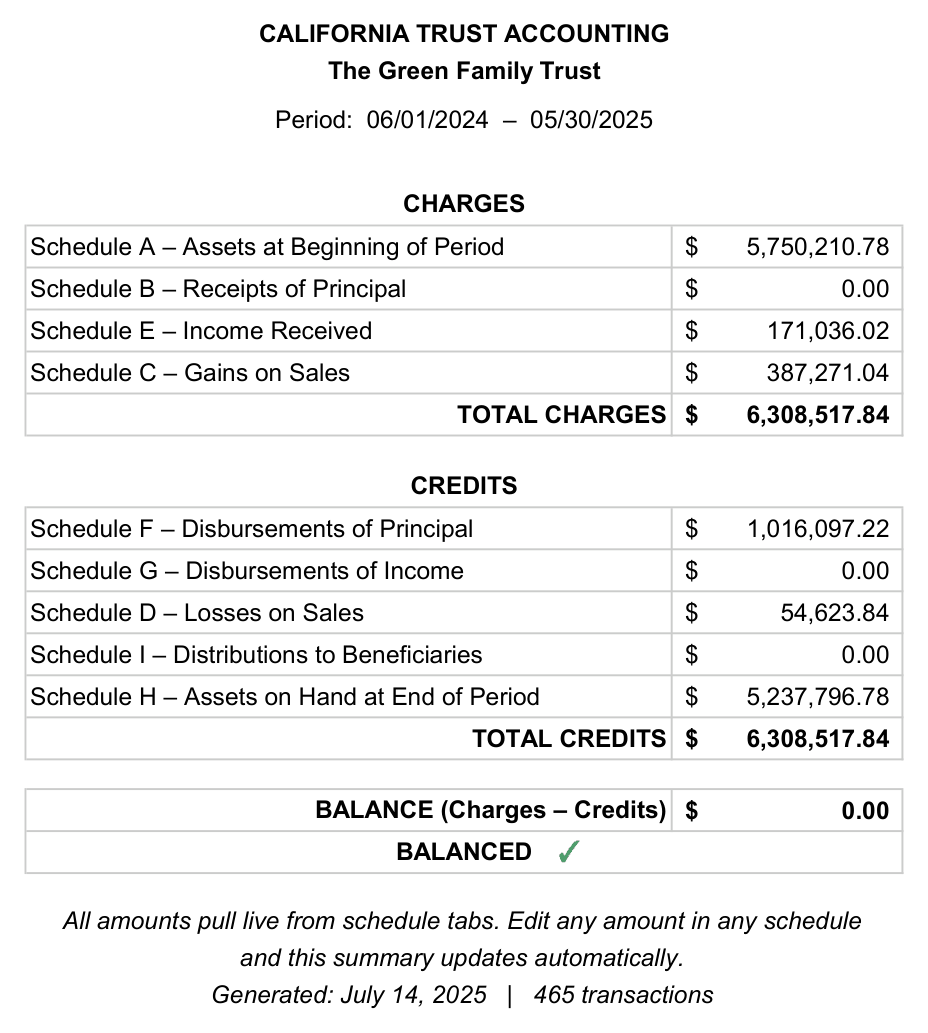
Or have it generated from your statements, for $699
Review the workbook against your statements. Developed by a California trusts and estates attorney.
Balanced converts and organizes the data on the conservatee’s or ward’s PDF bank and brokerage statements into this same format, delivered as one fully editable Excel workbook.
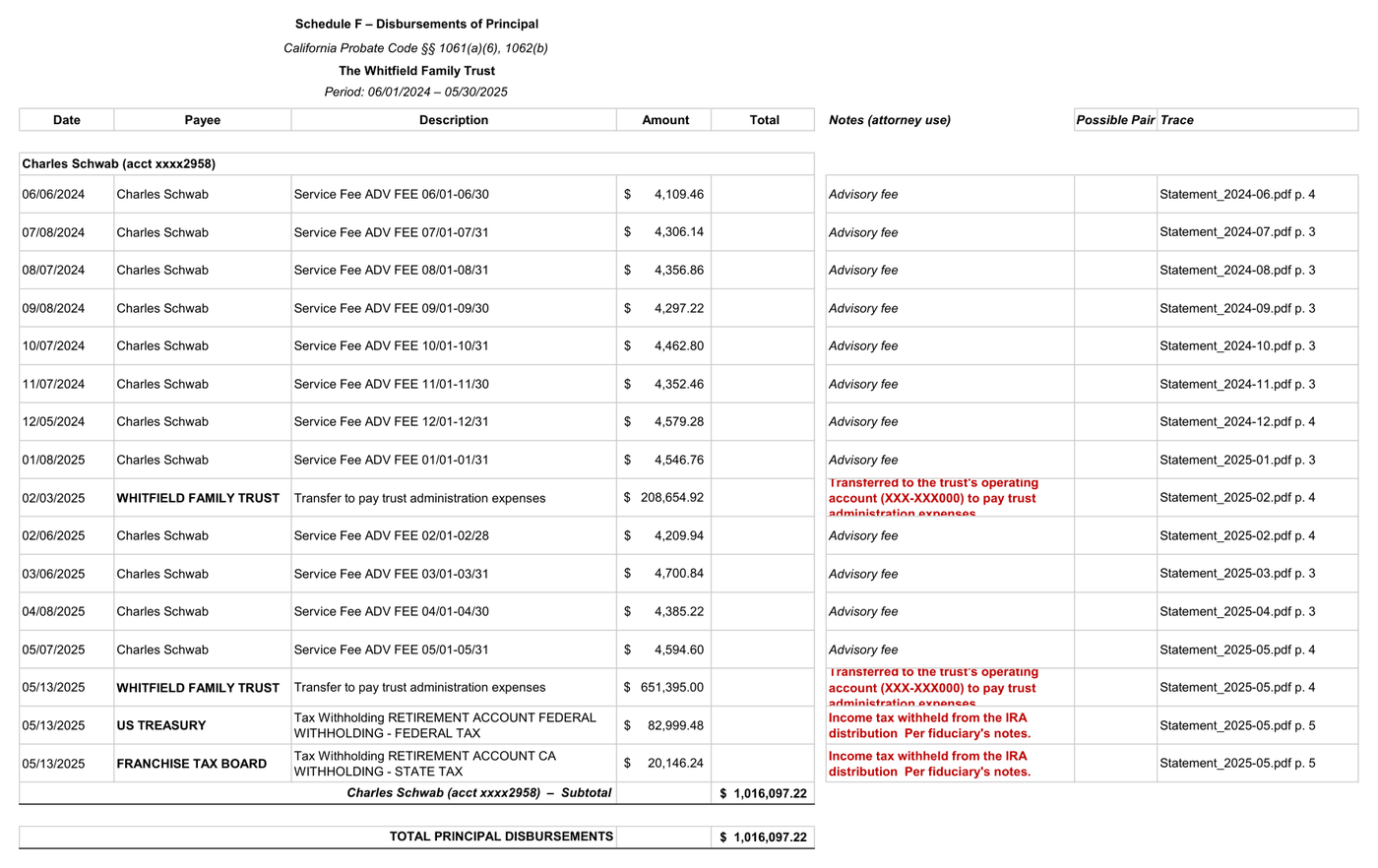
- Add your PDF statements. They are processed in your own web browser and never uploaded.
- Transactions are classified to their schedules, carry values tracked lot by lot, and the summary balanced to the penny.
- Each entry is cited to the statement and page it came from, so checking goes quickly.
- Scanned statements work, and so does an incomplete set. Any figure that may be unclear is flagged for your review, and any missing statements are listed so you can find them.
- Most are delivered in about 1 hour.
| The template, by hand | Balanced | |
|---|---|---|
| Every transaction, on its schedule | You find each one on each statement, work out which schedule it belongs on, and hope nothing was missed. | Converted from your PDF statements and sorted onto its schedule |
| Sorting into GC-400 categories | You assign each receipt and disbursement | Assigned to the form’s categories and subtotaled |
| Carry value, gains and losses | You follow each lot by hand | Tracked lot by lot |
| Balancing | You find any difference yourself | Balanced to the penny |
| Checking it | Back to the statements for each figure | Each entry cited to its statement and page |
| Time | Days to weeks, sometimes months | Most delivered in about 1 hour |
| Cost | Free, plus your time | $699 flat |
Accountings are usually billed by the hour, so the cost is not known until the work is done. Balanced is $699, known before you start.
Add your statements first. Your PDFs stay on your computer.
$699 flat.
Common questions
Is this a real accounting?
No. The fiduciary, the people, the institutions and the account numbers are fictional. The sample was generated by Balanced's workbook builder from made-up statements, to show the format.
Can I download it?
Yes. The sample is available as a PDF on this page, and a blank template in the same format is a free Excel download.
Why are some GC-400 schedules missing from the sample?
The Summary of Account directs that schedules are not included for categories with no entries; their lines show zero. This sample has no dividends, rent or gains, for example.
How often does a conservator file this account?
One year after appointment and then at least every two years, or more often if the court orders (Probate Code section 2620(a)).
Is the Summary of Account form required?
Yes. Form GC-400(SUM)/GC-405(SUM) must be used in all accountings. In a standard account the other GC-400 forms are optional if your own schedules match their categories, information and format; a simplified account uses the GC-405 forms that apply to it (Cal. Rules of Court, rule 7.575(e)).
Generate yours
From the fiduciary’s PDF bank and brokerage statements, Balanced converts and organizes the statement data into an accounting of this kind exactly as the statements show it, using disclosed, standard accounting conventions you can change; everything beyond that comes from your own instructions. Transactions are classified to their schedules, carry values tracked lot by lot, each account reconciled to its own statements, the summary balanced to the penny, and each entry cited to the statement and page it came from, delivered as the GC-400 layout, in one fully editable Excel workbook for review and verification. $699 per accounting.
Prefer to fill it in yourself? Use the free GC-400 accounting template. More on GC-400 accountings.
Ready to generate yours? Add the PDF statements for the accounting period. Your PDFs stay on your computer.
$699 Flat. No Subscription. No Install.