 Balanced
An Ohio guardian of the estate files an account with the probate court at least once in each two years, and a final account within thirty days after completing the administration of the ward’s estate (R.C. 2109.302). The account is filed on the Supreme Court’s standard Form 15.8, Guardian’s Account: the balance from the previous account, every receipt and disbursement itemized with its voucher number, a recapitulation of total receipts, total disbursements and the balance remaining, and an itemized statement of all funds, assets and investments.
Have the statements? Balanced converts and organizes the data on them into Ohio’s Form 15.8 guardian’s account, as one editable Excel workbook balanced to the penny. Scanned or incomplete statements work.
- Works with any PDF statement, downloaded or scanned
- Statement entries are cited to the PDF and page they
came from, for easy verification - A fully editable Excel workbook, emailed in about 1 hour
$699 Flat. No Subscription. No Install.
Account or report: two different filings
| Filing | What it covers | Form | Law |
|---|---|---|---|
| Guardian’s account | The ward’s money and property: receipts, disbursements and what is on hand | Form 15.8 | R.C. 2109.302 |
| Guardian’s report | The ward’s person: living situation, care and condition | Form 17.7 | R.C. 2111.49 |
A guardian of the person files the report; a guardian of the estate files the account; a guardian of both files both. The statute sets the first report two years after letters are issued and then every two years, and the court may require one at other times by motion or rule (R.C. 2111.49). A guardian of the person renders an account only when the court orders one for good cause (R.C. 2109.302(B)(3)).
When the account is due
| Filing | When |
|---|---|
| Inventory | Within three months after appointment (Form 15.5; R.C. 2111.14) |
| Account | At least once in each two years, and at other times the court orders for good cause (R.C. 2109.302) |
| Final account | Within thirty days after completing the administration of the ward’s estate, or within another period the court orders (R.C. 2109.302) |
| Hearing | Not earlier than thirty days after the account is filed (R.C. 2109.32) |
The statute’s floor is one account in each two years. A county probate court may set its own schedule by rule or order, so the court’s own guardianship page is the place its local timing is published.
Franklin County requires a guardian’s first account within one year after appointment, then annually unless the court orders otherwise (Loc.R. 64.7(B), Local Rules of Court), and Hamilton County requires a guardian’s current accounts at least annually (Rule 64.1(K), Local Rules (effective December 31, 2025)). See Franklin County Probate Court accounts and Hamilton County Probate Court accounts.
Form 15.8, line by line
- The heading: the county, the ward’s name, the case number, and which account it is (first, second, and so on).
- The period: from the day after the last account ended (or the date of appointment) to the closing date.
- Balance from previous account: the first line. For a first account, the inventory on Form 15.5 is the starting point.
- Receipts and disbursements: each item with its date, a voucher number and its amount. Disbursements and distributions must be verified by vouchers or proof (R.C. 2109.302).
- Recapitulation: total receipts, total disbursements and the balance remaining.
- Itemized statement of all funds, assets and investments: what is on hand at the end, account by account and asset by asset, with any changes in investments since the last account. Its total must equal the balance remaining.
- Signatures: the guardian and the attorney, with the attorney registration number. The court completes the entry setting the hearing.
A worked recap
A fictional ward in a nursing facility, a second account for a twelve-month period. The figures follow the order of the recapitulation on Form 15.8:
| Line | Amount |
|---|---|
| Balance from previous account | $48,250.00 |
| Social Security benefits (12 months) | $21,840.00 |
| Pension (12 months) | $14,460.00 |
| Interest and dividends | $612.37 |
| Total receipts | $85,162.37 |
| Nursing facility | $58,200.00 |
| Pharmacy and medical | $2,318.45 |
| Personal needs allowance and clothing | $1,340.00 |
| Guardian’s bond premium | $150.00 |
| Court costs | $75.00 |
| Total disbursements | $62,083.45 |
| Balance remaining | $23,078.92 |
| On hand: Checking account | $6,874.56 |
| On hand: Savings account | $16,204.36 |
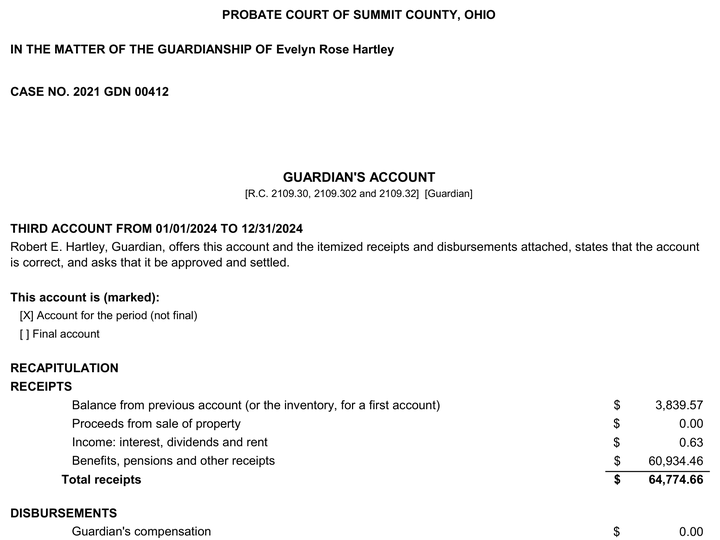
Total receipts of $85,162.37 minus total disbursements of $62,083.45 leaves $23,078.92, and the two accounts on hand at the end of the period add up to exactly that figure. Below, the recapitulation page of a fictional Ohio guardianship account in a Balanced workbook.
What makes a guardian’s account balance
- Start from the exact balance on the previous account, not from a bank statement.
- A transfer between two of the ward’s own accounts is neither a receipt nor a disbursement.
- A sale brings in the proceeds as a receipt, and the asset sold leaves the statement of assets at the end.
- Spending the court authorized (the application on Form 15.7, Application for Authority to Expend Funds) is shown as disbursements like any other.
- The cash on the statement of assets must match each account’s closing statement for the last day of the period.
Rather not build it by hand? Balanced sorts every transaction on your statements into Ohio’s Form 15.8 guardian’s account, measures each sale against its starting value and balances the account to the penny, in one editable Excel workbook.
$699 Flat. No Subscription. No Install.
What the court examines
When the account is filed, the guardian exhibits to the court the securities shown in the account (or the certificate of whoever holds them) and a passbook or certified bank statement for each depository, and the court may examine the guardian under oath about the account (R.C. 2109.302(A)). At the hearing the court inquires into the account and the way the guardian has administered the estate, and may approve and settle it (R.C. 2109.32).
When an account can be waived
- The court may waive, by order, an account of a guardian of the estate (other than one the court ordered) when the estate is entirely real property (R.C. 2109.302(B)(1)(a)).
- Or when the estate is entirely personal property held by a bank, savings and loan association or trust company under R.C. 2109.13, and the court has authorized spending of not more than $10,000 a year for the ward’s support, maintenance or education (R.C. 2109.302(B)(1)(b)).
- Or a mix of the two: real property plus personal property held that way, with the same $10,000 limit (R.C. 2109.302(B)(1)(c)).
If an account is late
The court may issue a citation, and on an interested party’s application must. If the account is still not filed, the court may remove the guardian, deny all or part of the fees, assess a penalty of $100 and costs of $25, or find the guardian in contempt (R.C. 2109.31).
Estates and trusts
An executor or administrator files Form 13.0 instead: see how to fill out Ohio Form 13.0, the worked example and Ohio account deadlines. The rules for every Ohio fiduciary are on the Ohio probate accounting guide.
Or have Balanced generate it
Balanced is a new kind of software for fiduciary accountings. From the PDF bank and brokerage statements, it converts and organizes the statement data into the accounting: every transaction sorted to its schedule, sales measured against carry value, each account reconciled to its own statements, the summary balanced to the penny, and each entry cited to the statement and page it came from, delivered as one fully editable Excel workbook for you to review and verify. It works for California accountings today. For Ohio, it prepares Ohio’s Form 15.8 guardian’s account the same way. Scanned or incomplete statements work. Most are delivered in about 1 hour. $699 per accounting.
Common questions
How often does an Ohio guardian file an account?
At least once in each two years, and the court may order an account at other times; a final account is due within thirty days after the administration of the ward’s estate is complete (R.C. 2109.302).
What form does an Ohio guardian use for the account?
The Supreme Court’s standard Form 15.8, Guardian’s Account. Some county probate courts publish their own version of the same form with local additions.
Is the guardian’s report the same as the account?
No. The report (Form 17.7) is about the ward’s person and care (R.C. 2111.49); the account (Form 15.8) is about the ward’s money and property (R.C. 2109.302).
Does a guardian of the person file an account?
Only when the court orders one, for good cause, on its own or on the motion of an interested person (R.C. 2109.302(B)(3)).
Can the court excuse a guardian from filing an account?
Yes, in the cases the statute lists: an estate entirely of real property, or of personal property held by a bank or trust company with court-authorized spending of not more than $10,000 a year (R.C. 2109.302(B)).
Ready to generate yours? Add the PDF statements for the accounting period. Your PDFs stay on your computer.
$699 Flat. No Subscription. No Install.