
The court accounting format
A personal representative’s account filed with a California probate court follows Probate Code §§1060–1064. The account opens with a summary that shows the property the representative is charged with, the credits claimed, and the balance on hand, and the summary is supported by schedules that show each item in detail.
The summary of charges and credits
The charges are the property on hand at the beginning of the period, the receipts during the period, and any gains on sales. The credits are the disbursements, any losses on sales, distributions, and the property on hand at the end of the period. The two sides must balance: every dollar the representative started with or received is accounted for as paid out, distributed, or still on hand.
The schedules behind it
Each line of the summary is supported by a schedule listing the individual items: assets at the beginning of the period, receipts of principal, income received, gains and losses on sales, disbursements, distributions, and assets on hand at the end of the period, each carried at the proper value. Probate Code §1063 adds what the schedules must show when they apply, such as liabilities and the interest on general pecuniary gifts.
What a finished accounting looks like
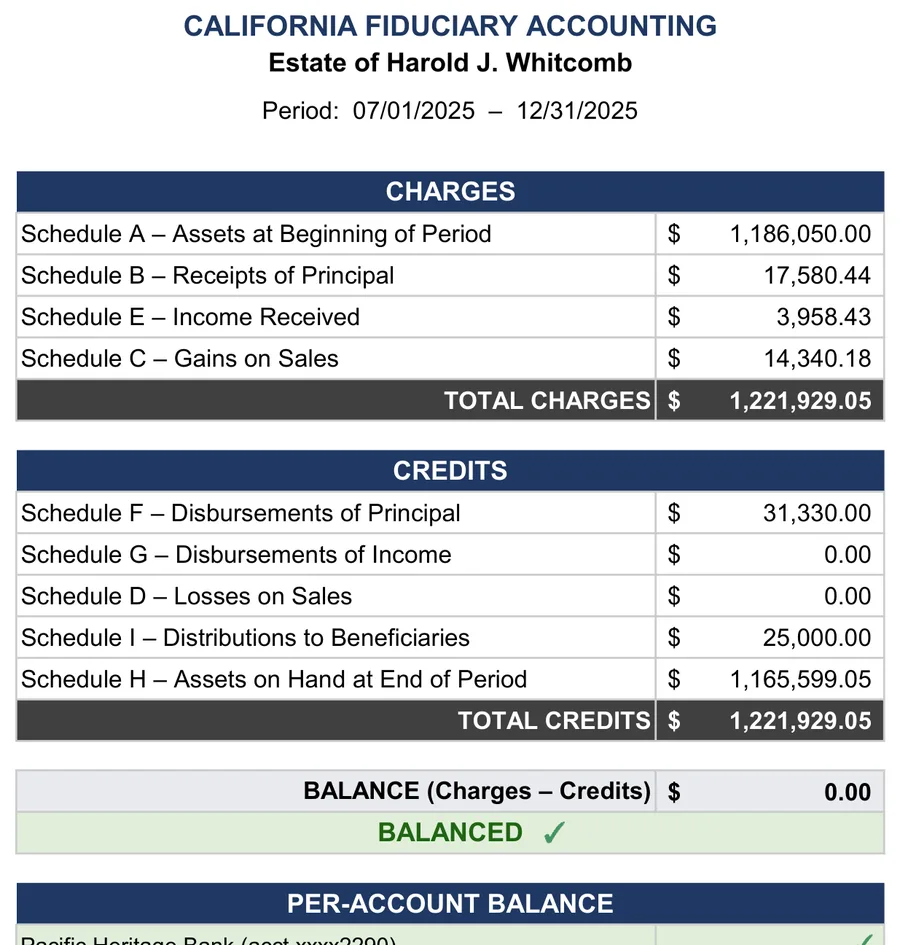
For probate attorneys: the fee is fixed, the time is not
In a California probate estate, the attorney’s compensation for ordinary services is set by statute from the value of the estate accounted for, not from the hours spent (Prob. Code §10810). The hours a paralegal spends building the account by hand are hours the fee does not grow to cover. Balanced generates the account from the estate’s statements in hours, for $699, so the same staff can handle more estates, and the final account and petition can be filed sooner.
An automated way to generate it
Balanced is a new kind of probate accounting software: automated California fiduciary accounting technology. Add the estate’s PDF bank and brokerage statements, and Balanced returns the summary and its schedules as one fully editable Excel workbook, each account reconciled to its own statements and the summary balanced to the penny:
- Every schedule linked to the summary, so it updates when you edit any amount
- Securities carried lot by lot, with gains and losses computed from carry value
- Sales of real property from the settlement statement, with each cost of sale itemized
- Liabilities, creditor claims, specific gifts, interest on general pecuniary gifts, and the statutory fee computation when they apply
- A tax summary for the estate’s CPA
Each row cites the statement and page it came from. Add a memo or the prior accounting to tailor it. $699 per accounting.