
The facts
Walter Brandt died on February 2. His trust passed to a successor trustee, his niece, to be held for his two grandchildren. Among the trust's assets were 300 shares of a large industrial company, worth $50 a share on the date of death, or $15,000. In June the trustee bought 200 more shares of the same company at $80, for $16,000, as part of a rebalancing her investment adviser recommended. In November she sold 300 shares at $90, for $27,000, to fund a distribution.
When she prepared her first account, she found that three documents told her three different things. The brokerage statement listed the shares in two lots, with the sale drawn from the older lot. The year-end tax form reported a gain measured from the date-of-death lot. And the accounting template she had been given told her to average the cost of every share and carry each one at the average. Her question was simple: what is the carry value of the 300 shares she sold?
Two accepted methods
Two methods are in common use, and both are accepted in California practice:
- Lot by lot, first in first out. Each acquisition is carried as its own lot at its own value, and the oldest lot is treated as sold first. Here, the 300 shares sold are the 300 shares held at death, carried at $50 each. Carry value of the shares sold: $15,000. Gain: $27,000 less $15,000, or $12,000. Still held: 200 shares at $80, carried at $16,000.
- Averaging. Every share in the position is carried at the average carry value of all the shares, recalculated after each purchase. Here, all 500 shares are pooled at $31,000, or $62 each. Carry value of the shares sold: 300 at $62, or $18,600. Gain: $27,000 less $18,600, or $8,400. Still held: 200 shares at $62, carried at $12,400.
Neither method loses a dollar. In both, the carry value of the shares sold plus the carry value of the shares kept is $31,000, every dollar the trustee took on. Over the life of the holding the gain is also the same: if the last 200 shares later sell at $100, the first method reports a further gain of $4,000 and the second a further gain of $7,600, for $16,000 in total either way. The method decides how the gain is divided between this account and a later one.
That is why the choice matters and why it must be made deliberately. A preparer who mixes the methods, averaging on the schedules while the statements and tax forms follow lots, produces an account whose figures match nothing the reader can check.
The law
The account must show carry value and the gain on each sale. The summary includes gains and losses on sales and property on hand at the end, "stated at its carry value" (Prob. Code § 1061(a)(5), (7), (10)). The supporting schedules show the "Calculation of gains or losses on sale or other disposition" and an "Itemized list of property on hand, describing each item at its carry value" (§ 1062(d), (f)).
The Probate Code never defines carry value, and no statute prescribes a method. Nothing in sections 1060 through 1064, in the definitions of the Uniform Fiduciary Income and Principal Act (§ 16321) or in the Rules of Court says how to measure the carry value of part of a position. Either method is lawful. The method is the fiduciary's to choose, and it must be explained: the report describes any sales and purchases "not otherwise readily understandable from the schedule" and explains "any unusual items" (§ 1064(a)(1), (2)).
The Judicial Council's forms describe carry value by acquisition. The conservatorship and guardianship accounting form for property on hand states: "The carry value of an asset that is included in an inventory is its appraised value. The carry value of an asset purchased for the estate after appointment of the conservator or guardian is its purchase price." It lists after-acquired assets "in order of their purchase dates" (form GC-400(PH)(2)). The form for gains on sales defines a gain as a "gross sale price higher than carry value" and asks for "each property's Inventory and Appraisal item number" (form GC-400(B)).
The probate fee statute measures gains from the appraisal value. In a decedent's estate, the base for statutory compensation includes "gains over the appraisal value on sales" and subtracts "losses from the appraisal value on sales" (§ 10810(b)).
Federal tax law sells the oldest shares first. When shares bought on different dates or at different prices are sold and the lot sold "cannot be adequately identified," the shares are charged against the earliest lot acquired (Treas. Reg. § 1.1012-1(c)(1)). Brokers report basis "in accordance with the first-in first-out method unless the customer notifies the broker by means of making an adequate identification" (26 U.S.C. § 6045(g)(2)(B)(i)). Inherited property takes a basis equal to its value at the date of death (26 U.S.C. § 1014(a)(1)), and a beneficiary who receives property in kind generally takes the trust's or estate's basis in it (26 U.S.C. § 643(e)). Tax law does not govern a Probate Code accounting, but it governs the records the accounting is checked against.
The case for averaging
Averaging is widely taught and widely used, and many practitioners regard it as the standard method for a fiduciary accounting. Its case deserves to be stated fairly:
- One holding, one figure. Shares of the same company held in the same account are interchangeable. Averaging treats the position as a single asset with a single per-share carry value, rather than as a collection of purchases.
- Independence from tax rules. Carry value is a creature of state fiduciary accounting law, not federal tax law. Averaging keeps the accounting from simply borrowing the ordering convention that brokers use for tax reporting.
- Simpler schedules for many small lots. A fund with years of reinvested dividends can hold dozens of tiny lots. One average is easier to present than a long list of lots drawn down in order.
- Familiarity. Because the method is widely taught, many reviewers expect to see it, and an account that uses it raises fewer questions from them.
An account prepared by averaging, applied consistently and explained in the report, is a lawful account. We do not suggest otherwise.
The problems with averaging
We nonetheless think averaging is the weaker method, for these reasons:
1. The average is a figure that appears on no document. Every share the trustee held came from an identifiable event: the date-of-death appraisal or a dated purchase. Averaging replaces those documented values with a computed one. In our example, $62 is not the appraised value of any share and not the price paid for any share. Under the Judicial Council's own description, the inventoried shares carry their appraised value and the purchased shares their purchase price. Averaging carries none of them at either.
2. It breaks the visible link between the schedules. The opening schedule shows the inherited shares at $50. After the June purchase, an averaged account shows the sale at $62 and the closing holding at $62, figures that match neither the opening schedule nor the purchase. A reader cannot check them against anything in the account without a separate running calculation for every holding, recomputed after every purchase. Lot-by-lot carry needs no such calculation: each figure on the sale and closing schedules is the opening value or an actual purchase price.
3. It departs from how the gain is measured elsewhere in the law. The fee statute counts "gains over the appraisal value on sales" (§ 10810(b)), and the Judicial Council's gains form asks for the inventory item number of each property sold (form GC-400(B)). A sale of inventoried shares, carried lot by lot, is measured from exactly that appraisal value and belongs to exactly that item. An averaged sale is measured from a blend of appraised and purchased shares and belongs to no item.
4. It matches no tax record. For a trust or estate after a death, an inherited lot's carry value and its tax basis are usually the same number (26 U.S.C. § 1014(a)(1)), and so are a purchased lot's. Averaging produces gains that match neither the broker's year-end report nor the fiduciary's income tax return, so beneficiaries, accountants and reviewers are handed two different gains for the same sale and must be told why. The carry value shown for shares distributed in kind also stops matching the basis the beneficiary actually receives (26 U.S.C. § 643(e)).
5. Its central premise does not hold up. The usual justification is that the fiduciary is accountable for the position as a whole, so each share should carry an equal part of it. But both methods account for the whole position: the carry value of the shares sold plus the shares kept is identical under either, and so is the total gain over time. Averaging does not measure what the fiduciary is accountable for any better. It only redistributes gain between accounts, at the price of figures no one can trace. And the fact that the shares are interchangeable does not make the fiduciary's acquisitions of them interchangeable: they happened on different dates, at different values, and each is documented.
6. "It is a tax method" is not a reason to reject lot-by-lot carry. First in first out is an ordering rule, not a tax concept. Tax law adopted it as the default for the same problem an accounting faces when no lot was identified. Where lot carry and lot basis are the same number, as they usually are after a death, the distinction between state accounting law and federal tax law makes no difference to the figures.
Why we carry each lot at its own value
For those reasons, Balanced carries each acquisition as its own lot and treats the oldest lot as sold first:
- Each lot carries a real figure: the appraised or date-of-death value for inherited shares, the purchase price for shares bought later, as the Judicial Council's forms describe carry value.
- Every figure can be traced to a source: each per-share figure on the gains schedule and the closing schedule is printed on a statement or in the inventory, so a reviewer can check any line against its document.
- In an estate, it computes the gain the fee statute names: "gains over the appraisal value on sales" (§ 10810(b)).
- It agrees with the tax record: the accounting's gains reconcile to the broker's report and the fiduciary's income tax return, and the carry value of shares distributed in kind matches the basis the beneficiary receives. The trustee in our example can hand her accountant one set of numbers.
- It is a fixed rule: first in first out leaves the preparer no choice to make after the fact, which is what makes a method consistent and defensible.
The finer points
When the fiduciary chose the shares. If the trustee instructed the broker to sell particular lots and the trade confirmation shows it, that identification is the most accurate record of what was sold, and it should control. Tax law recognizes it (Treas. Reg. § 1.1012-1(c)), and a trustee or executor may also identify the shares sold in the books and records of the trust or estate (Treas. Reg. § 1.1012-1(c)(4)). First in first out is the rule when no identification was made.
Mutual funds. Federal law permits average basis for shares of a regulated investment company and certain dividend reinvestment plans (Treas. Reg. § 1.1012-1(e)), and some brokers report fund shares that way. Where they do, the year-end tax figures for those funds are averages, and the account should say how its fund carry values relate to them.
Conservatorships and lifetime trusts. Opening carry value is the value when the fiduciary took charge: on appointment, or when the property was transferred to the trust. The conservatee's or settlor's tax basis is usually different, so the dollar match with the tax record does not hold for opening lots. Lot-by-lot carry still matches the broker on which shares were sold, and the other reasons above apply in full.
Estate fees in a rising market. Selling the oldest, lowest-valued shares first realizes gain sooner, which raises the section 10810(b) base in the account where the sale occurs. In a falling market it does the opposite. The method is a fixed rule chosen before the result is known, it measures gain from the appraisal value exactly as the statute describes, and it should be disclosed and applied consistently.
Consistency across accounts. The closing carry value of one account is the opening carry value of the next. If an earlier, approved account averaged, carry the next account forward from its figures, and explain any change of method in the report (§ 1064(a)(1), (2)).
The sample accounting
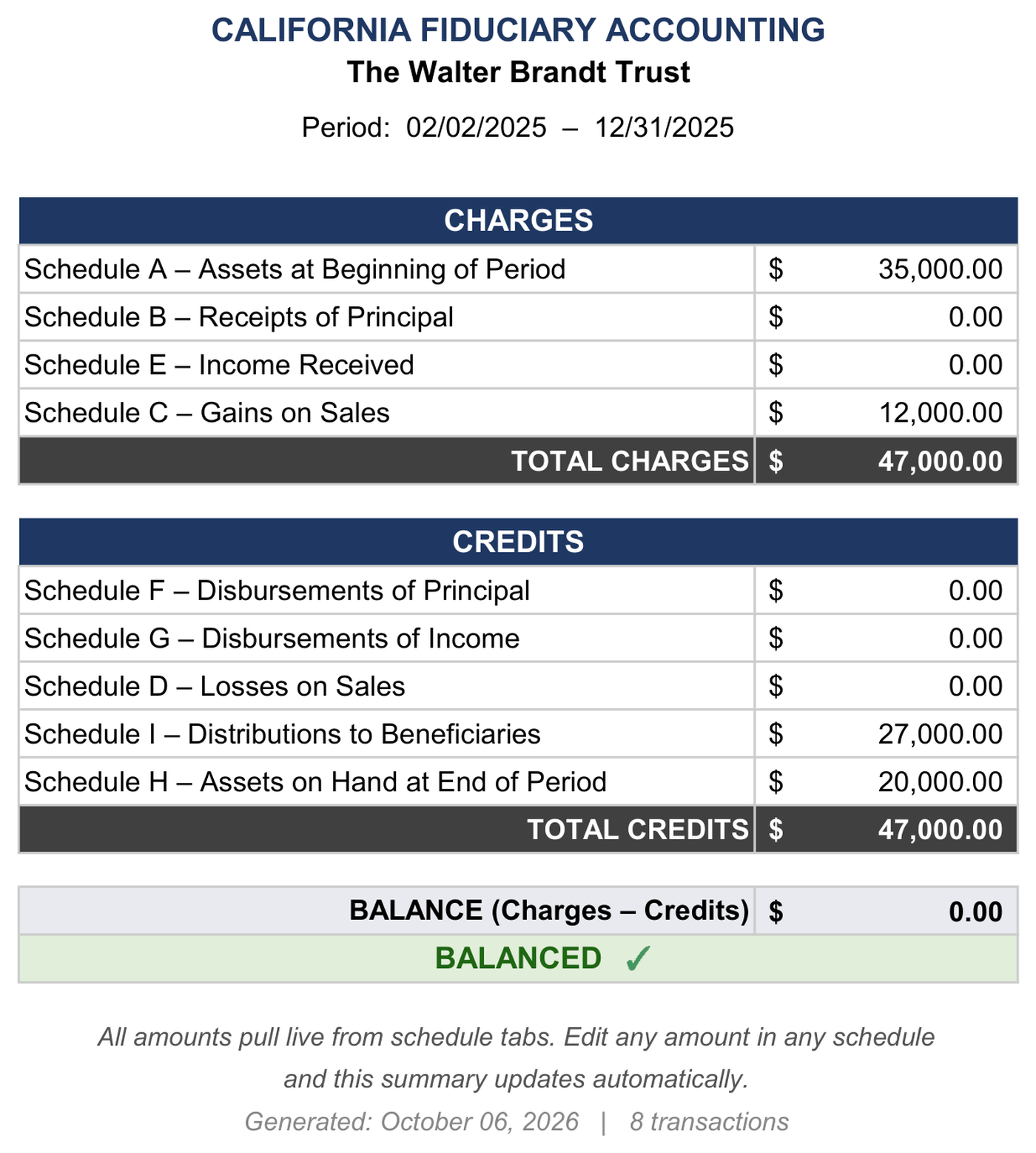
The facts above, as Balanced builds them: a sample accounting for this fictional trust. Select any sheet to see it full size.
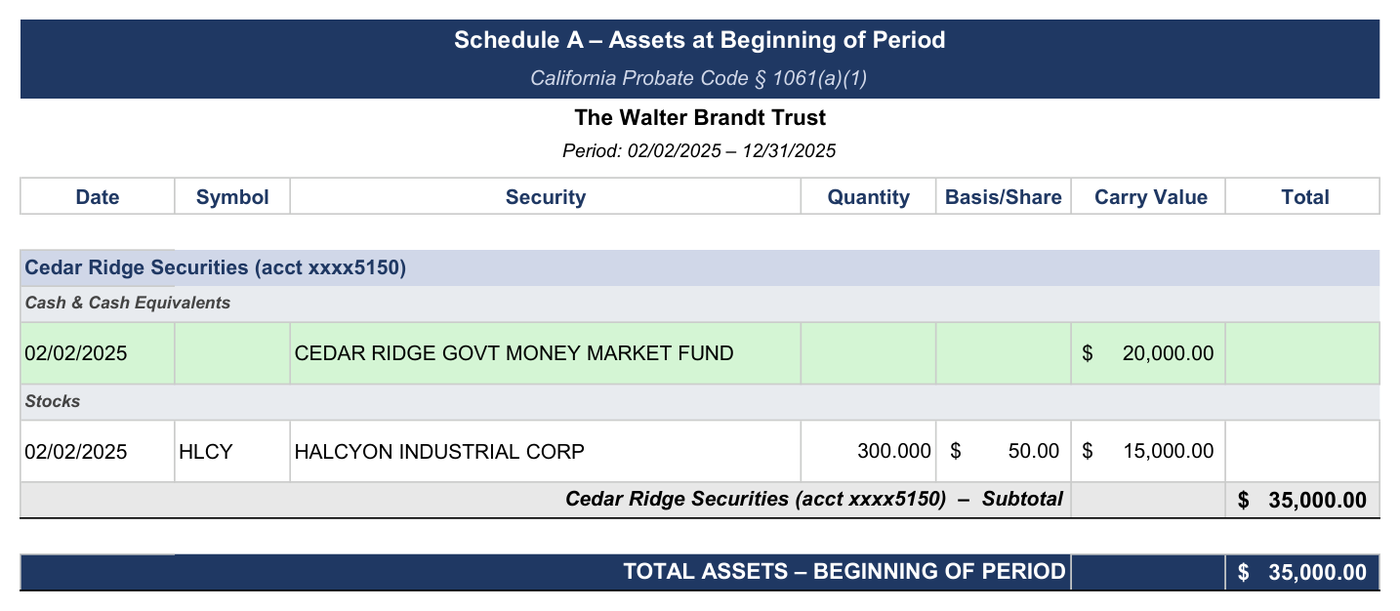
Schedule A: the 300 shares held at death
The opening schedule: 300 shares carried at $50, their value on the date of death.
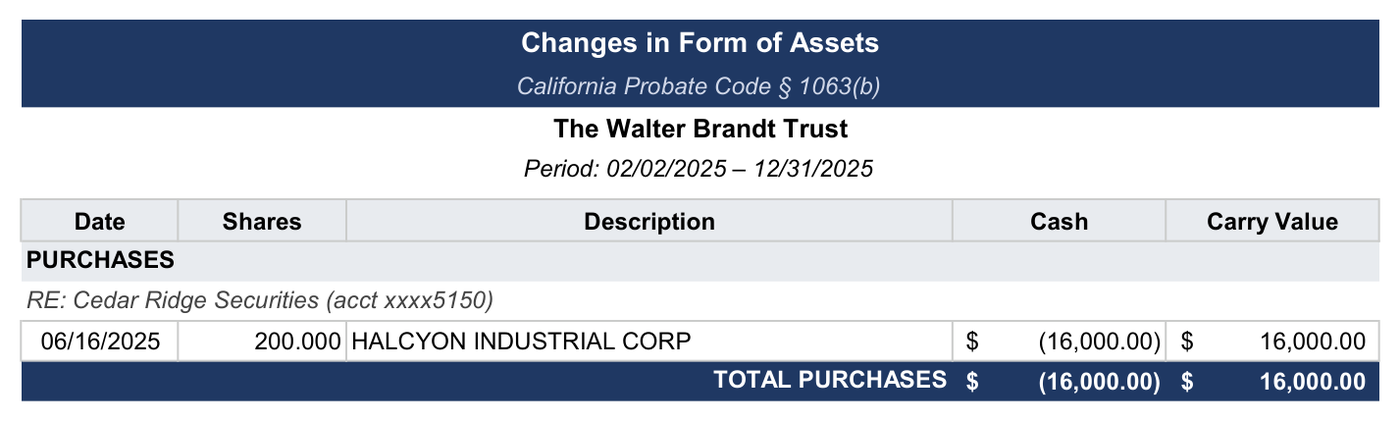
Changes in form: the June purchase
The 200 shares bought in June enter at their purchase price, $80, as their own lot.
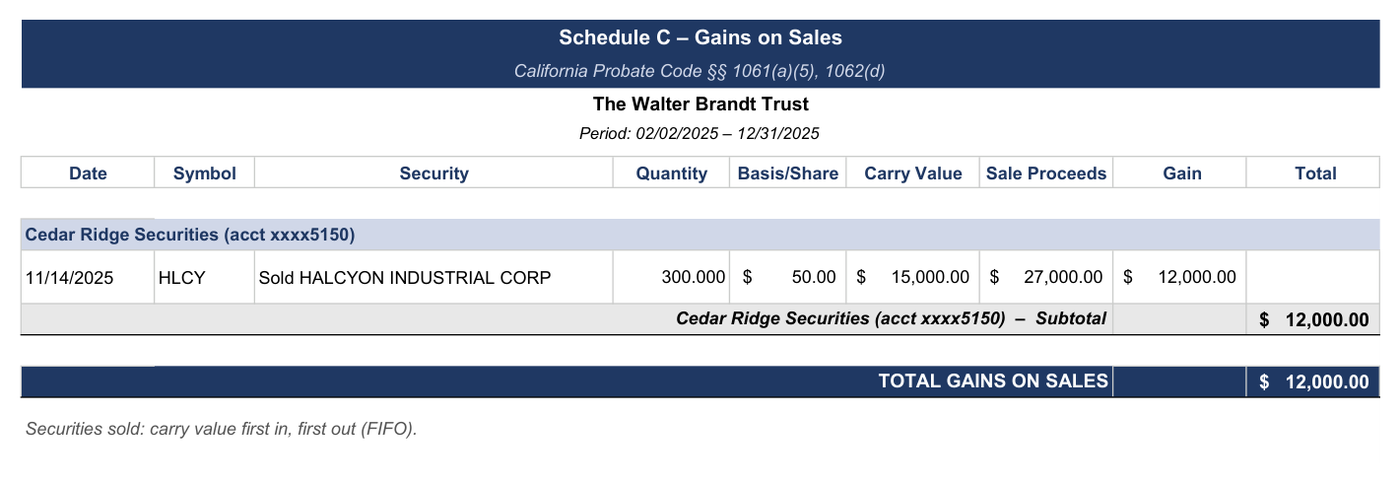
Schedule C: the November sale, first in, first out
The 300 shares sold are the 300 held at death: carry $15,000 against $27,000, a gain of $12,000. The method is stated on the schedule.
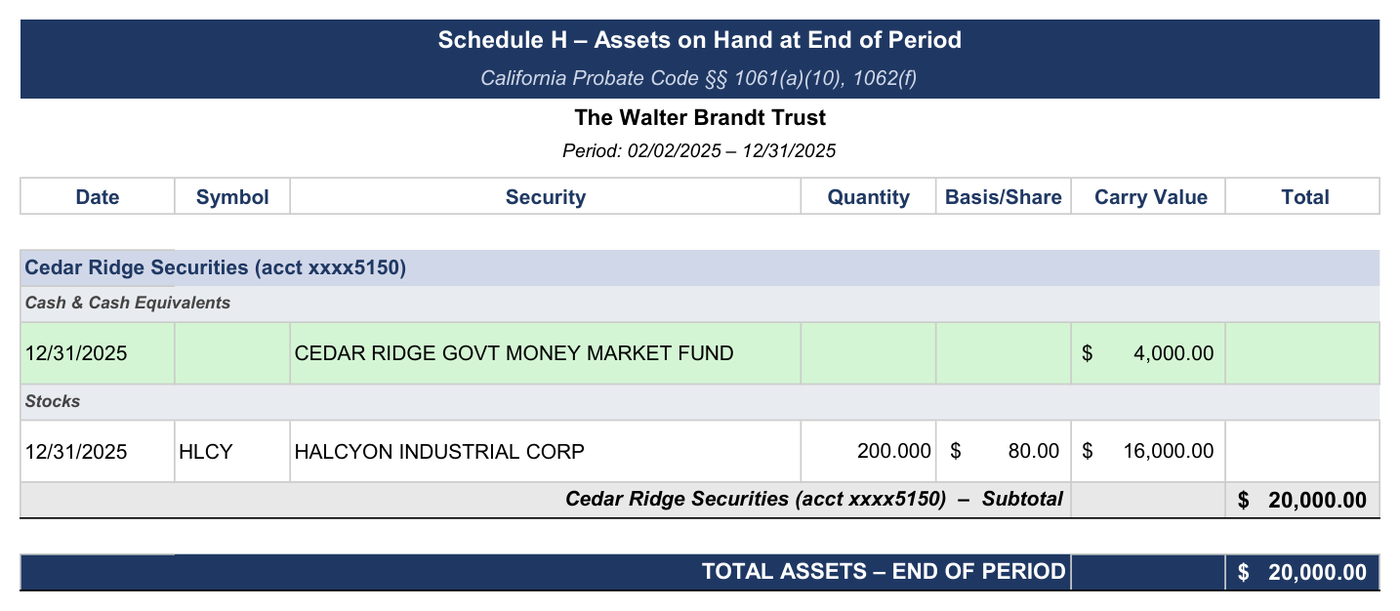
Schedule H: what is left
The 200 shares still held are the June lot, at its own carry value of $80 a share.
The summary
Charges and credits balance, with every figure above traced to its source.
Download the sample accounting (PDF)
Checklist
- Choose one method and apply it to every sale in the account; both lot-by-lot carry and averaging are lawful if consistent and explained (§ 1064(a)(1), (2)).
- Lot by lot: carry each acquisition at its own value, inventoried shares at appraised value and purchased shares at cost (form GC-400(PH)(2)).
- Treat the oldest lot as sold first unless the trade confirmation shows the fiduciary identified the shares sold (Treas. Reg. § 1.1012-1(c)).
- Measure each gain or loss from the gross sale price against the carry value of the shares sold (§ 1062(d); form GC-400(B)).
- Show each lot still held at its own carry value on the closing schedule (§ 1062(f)).
- If averaging is used, show the running calculation for each holding so a reader can trace every average.
- Note where the broker reports fund shares at average basis (Treas. Reg. § 1.1012-1(e)).
- Keep the method from one account to the next, and explain any change.
The Law and the Art of Fiduciary Accounting is a series by Balanced Legal Technology, LLC on complex California fiduciary accountings. General information only, current as of October 2026; not legal, tax or accounting advice. Statutes and rules change; confirm current law before relying on it.
About the author
Marc Joyce is a licensed, practicing California trusts and estates attorney, and the founder and developer of Balanced. He brings both sides to the problem: as a lawyer, and as an engineer. The Law and the Art of Fiduciary Accounting is his series on the hard cases where the two meet.