
The facts
Rosa Delgado built a small winery in Sonoma County over thirty years. She ran it herself as a sole proprietorship, in her own name. Her estate plan left the winery out of her trust by oversight, so at her death the winery passed through her probate estate. Her will pours the estate into her trust, which pays all net income to her husband, Luis, for life, with the remainder to her three children.
Separately, her trust owned 100 percent of Delgado Properties, LLC, which owns the building that houses the tasting room and leases it to the winery.
Her son Marco was appointed executor and is also the successor trustee. He kept the winery running through two harvests. During administration:
- The winery bought a new bottling line for $185,000 and repaired the crush pad for $22,000.
- A smoke-damaged harvest produced a loss in the second year.
- Delgado Properties took out a new $1.2 million loan on its building, worth about $3 million, and distributed $900,000 of the proceeds to the trust.
- In the third year Marco sold the winery's brand and inventory to a regional producer.
That is two accounts, not one. Marco accounts as executor for the probate estate, which holds the winery, and as trustee for the trust, which holds the LLC and will eventually receive the estate. Luis wants the income. The other two children want the principal protected. Marco is on both sides of every decision, and a court will read both accounts line by line.
Why this goes wrong
Business activity breaks most fiduciary accountings because preparers try to run every sale of wine and every payroll check through the ordinary schedules of receipts and disbursements. The result is thousands of lines that obscure what matters.
The opposite mistake is just as common: dropping in the bottom line from a tax return. That figure includes non-cash items, depreciation above all, without adjusting the assets they relate to, so the account no longer balances. It also blurs the two things the beneficiaries care about: how the business did, and who owns what it produced.
The law
A business has its own line on the summary. The summary includes "Net income from a trade or business" and "Net loss from trade or business" (Prob. Code § 1061(a)(4), (8)), placed among the charges and the credits respectively in the statutory format (§ 1061(b)). The ordinary receipts line excludes "receipts from a trade or business," and the ordinary disbursements line excludes "disbursements for a trade or business or distributions" (§ 1061(a)(3), (6)).
The supporting schedule can be modest. The schedule of net income or loss from a trade or business "shall be sufficient if it provides the information disclosed on Schedule C or F of the federal income tax return" (§ 1062(c)).
But the measure is not the tax return. "Net income" and "net loss" are used "in accordance with general accounting principles," and nothing requires them to match "'net income' and 'net loss' as reflected in the tax returns governing the period of the account" (§ 1061(d)).
An executor's authority to run the business is time-limited. A personal representative "with or without court authorization, may continue the operation of the decedent's business," but not "for a period of more than six months from the date letters are first issued to a personal representative unless a court order has been obtained" (§ 9760(b)). A personal representative with authority under the Independent Administration of Estates Act has the power to continue operating an unincorporated business (§ 10534(b)), and beyond six months must at least give notice of proposed action (§ 10534(d)); a court order under section 9760 remains available.
The income and principal act lets the fiduciary account for a business separately. The act applies to estates as well as trusts, and a "fiduciary" includes a personal representative (§§ 16322, 16321(h)). Where the fiduciary determines it is "in the interests of the beneficiaries to account separately for the business or other activity" (§ 16342(a)), the fiduciary:
- "May determine the extent to which the net money receipts of the business or other activity shall be retained for any of the following purposes: (A) Working capital. (B) The acquisition or replacement of fixed assets. (C) Other reasonably foreseeable needs of the business or other activity" (§ 16342(c)(1)).
- "May determine the extent to which the remaining net money receipts are accounted for as principal or income" (§ 16342(c)(2)).
- "Shall account for the net amount received from the sale of an asset of the business or other activity, other than a sale in the ordinary course ... as principal" to the extent it is no longer required in the business (§ 16342(c)(4)).
The act speaks of "net money receipts." It does not use the term "net profit."
Distributions from an entity follow a different section. A company the trust owns is an "entity" (§ 16340(a)(2)). Money it distributes is generally income (§ 16340(c)), but money the fiduciary "determines or estimates is a capital distribution" is principal (§ 16340(d)(3)). Two provisions decide this case:
- A fiduciary may usually rely on the entity's own characterization of a distribution, but not if "The fiduciary owns or holds more than 50 percent of the voting interest in the entity" (§ 16340(e)(1)(B)).
- A fiduciary may treat a distribution as a capital distribution where the money and property received "is, or will be, greater than 20 percent of the fair market value of the fiduciary's interest in the entity" (§ 16340(e)(2)).
Depreciation transfers do not apply to a separately accounted business. A fiduciary "may transfer to principal a reasonable amount of the net money receipts from a principal asset that is subject to depreciation" (§ 16362(b)), but not for an asset accounted for under section 16342 (§ 16362(b)(3)(B)).
The solution
1. Make the threshold decision, and record it. Separate business accounting under section 16342 starts with a determination that it is in the beneficiaries' interests (§ 16342(a)). For an operating winery it plainly is: the alternative is thousands of transactions in the general schedules. Marco should record that determination at the outset, in writing, because every later retention and allocation rests on it.
2. Keep the business in its own schedule and its own bank account. The winery gets one schedule of net income or loss for each year, at Schedule C or F level of detail (§ 1062(c)). The summary shows only the net figure on the trade or business line (§ 1061(a)(4), (8)). The individual sales and expenses live in the winery's own books, which should be available but are not reproduced in the account.
The assets of the business are still the estate's assets. The vineyard equipment, the wine in barrel and the winery's bank balance appear among property on hand at the beginning and end of the period at carry value (§ 1061(a)(1), (10); § 1062(f)), and in the market value schedule at estimated market value (§ 1063(a)). For "a closely held business, or other assets without a ready market," the estimate "may be satisfied by a good faith estimate by the fiduciary" (§ 1063(a)).
3. The bottling line is a change in form on the account. Buying a $185,000 bottling line converts cash into equipment. On the account it belongs on the schedule of purchases and other changes in form of assets (§ 1063(b)), not as a disbursement that reduces the year's net income. The $22,000 crush pad repair is different: it maintains the business and is an operating expense of the business.
Whether the bottling line is ultimately paid for from income or principal is a separate question, and the statute answers it with discretion: Marco may retain net money receipts for "The acquisition or replacement of fixed assets" (§ 16342(c)(1)(B)). If he funds the bottling line from retained operating receipts, income that might have gone to Luis has bought an asset that will serve the remainder beneficiaries for years. That may be entirely proper, but it is a decision, and it must be recorded with its reasons.
4. Reconcile the business result to the business's cash and assets. This is where the art meets arithmetic. A business schedule built from the tax return includes items that move no cash in the period: depreciation, but also changes in inventory such as wine in barrel, receivables and payables. Each of those changes the reported result without changing the cash or the carry values shown elsewhere in the account, and the summary then fails to balance (§ 1061(c)).
In our practice, two approaches work:
- Report the business on a cash basis. The business result is then the change in the business's cash from operations, and equipment, inventory and other business assets stay at carry value. This tracks the act's own measure, "net money receipts" (§ 16342(c)).
- Report it on an accrual basis, as general accounting principles permit (§ 1061(d)), and carry the non-cash items on the property-on-hand schedules: reduce equipment by the depreciation taken, and carry the business's working capital (inventory and receivables, less the business's own payables) as one business asset line at its year-end amount, with a supporting note. Every non-cash change in the result is then matched by a change in property on hand. Netting the business's trade payables inside its working capital line is different from netting trust-level debt such as a margin loan, which should be shown gross and disclosed: trade payables are part of how the business itself is measured.
Mixing the two, accrual figures in the business schedule and cash-basis carry values in the property schedules, is the most common reason a business account will not balance. Whichever approach is used, state it (§ 1064(a)(2)).
5. The income beneficiary's share is a decision, and the decision must be recorded. Section 16342(c) gives Marco discretion: he may hold back net money receipts for working capital, equipment and foreseeable needs, then decide how much of the rest is income. The second-year smoke loss shows why this matters. A fiduciary who paid out every dollar of the first year's results may have nothing left to keep the business alive through a bad harvest.
Marco's retentions are "presumed to be fair and reasonable to all beneficiaries" (§ 16325(b)), and a court will not change them unless they were "an abuse of the fiduciary's discretion" (§ 16326(b)). That presumption is far stronger when the account shows the decision: how much was retained, for what purpose, and how the remainder was divided. The schedule allocating receipts and disbursements between principal and income is required where an estate or trust "will be distributed to an income beneficiary" (§ 1063(c)). Here the estate is distributed to a trust rather than directly to Luis, but in our view the schedule belongs in the estate account too, because Luis takes his income through the trust, and the allocation made in the estate determines what the trust later receives as income and as principal (§ 16341). The estate's allocation schedule matters as much as the trust's. And because Marco is both fiduciary and a remainder beneficiary, every retention will be read as possibly self-interested. Explaining each one is his best protection.
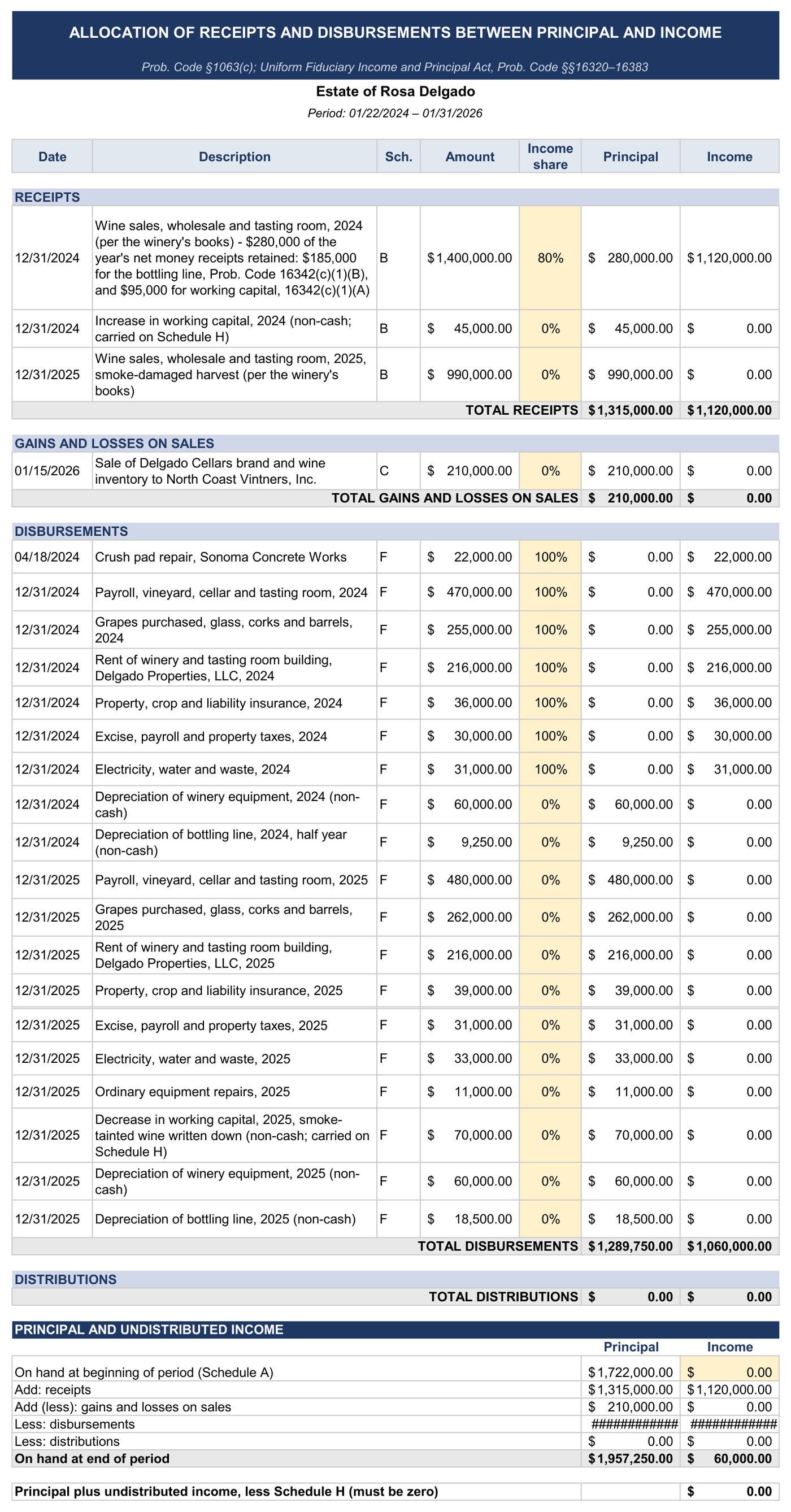
Who bears a loss is a choice too, and it moves value between beneficiaries. Section 16342(c) speaks of "net money receipts": how much to retain, and how much of the rest is income. It does not say what happens when a year produces a net money loss. In the sample accounting below, the winery paid out $82,000 more than it took in during the smoke-damaged year. Marco could charge that shortfall against the working capital he retained the year before, which is principal: Luis keeps the $60,000 of income allocated to him for year one, and the children's principal absorbs the loss. Or he could charge it to income: Luis's year-one income is gone, and the remaining $22,000 reduces later years' income until it is recovered, leaving principal whole. Either choice can be defended on its facts, and either one takes money from one side and gives it to the other. A trustee must "deal impartially" with beneficiaries whose interests differ (§ 16003), Marco's choices as executor become the trust's income and principal (§ 16341), and as a remainder beneficiary he gains from every dollar charged to income. Whatever he decides, the account should show the loss, say whom it was charged to, and explain why. The sample charges it to the working capital retained in year one, the purpose for which that capital was held back.
6. The refinancing distribution: Marco must characterize it himself. Delgado Properties called its $900,000 payment a "distribution to members." A trustee holding 50 percent or less of the voting interest could usually rely on that label. Marco cannot: the trust owns 100 percent of the company (§ 16340(e)(1)(B)).
The 20 percent test resolves it. The measure is the fair market value of the trust's interest in the company: the company's assets less its debts, not the building alone. The statute does not say when to measure it. Just before the distribution, the company held the $3 million building plus $1.2 million of loan cash and owed $1.2 million, so the trust's interest was worth about $3 million, and $900,000 is 30 percent of it. Measured just after, the interest was worth about $2.1 million, and $900,000 is about 43 percent. Either way, the 20 percent threshold is exceeded (§ 16340(e)(2)). The trustee may therefore treat it as a capital distribution, which is principal (§ 16340(d)(3)), and the facts support doing so: the money came from borrowing against the company's only significant asset, not from operations. (Had the 20 percent test not applied, the act's list of factors would still have pointed the same way; it includes "The amount of money the entity has borrowed," § 16340(f)(3)(F).)
Luis's counsel will argue it should be income. The answer is in the statute and the arithmetic, and both belong in the report. The company's regular monthly distributions of its rental profits, by contrast, are income (§ 16340(c)).
7. The sale of the business is principal. The sale of the brand and inventory to the regional producer is not a sale in the ordinary course. Its net proceeds, to the extent no longer needed in the business, are principal (§ 16342(c)(4)), and the gain or loss is calculated against the carry value of the assets sold (§ 1062(d)). The petition should describe the sale, the buyer, the price and how it was reached (§ 1064(a)(1)).
8. Show the authority to operate. Running the winery beyond six months after letters issued required either a court order (§ 9760(b)) or, if Marco has independent administration authority, a notice of proposed action (§ 10534(d)). The account should make that authority easy to find: the order or notice, its date and any conditions.
A note for conservatorships and trusts on the simplified form
The same winery in a conservatorship would change the paperwork, not the principles. A simplified accounting is allowed only if, among other conditions, "The estate or trust contains neither a whole nor a partial interest in a trade or business" (Cal. Rules of Court, rule 7.575(d)(1)(B)). A business therefore requires the standard account. The Judicial Council's Summary of Account carries the same trade or business lines that section 1061 requires.
The sample accountings
Marco's account as executor of Rosa's estate
The estate holds the winery. This account shows two years of operation on an accrual basis (depreciation and working capital carried on the property schedules), the bottling line, the retention, the smoke loss and the sale. The winery's own books and the estate's administration expenses are not shown. Select any sheet to see it full size.
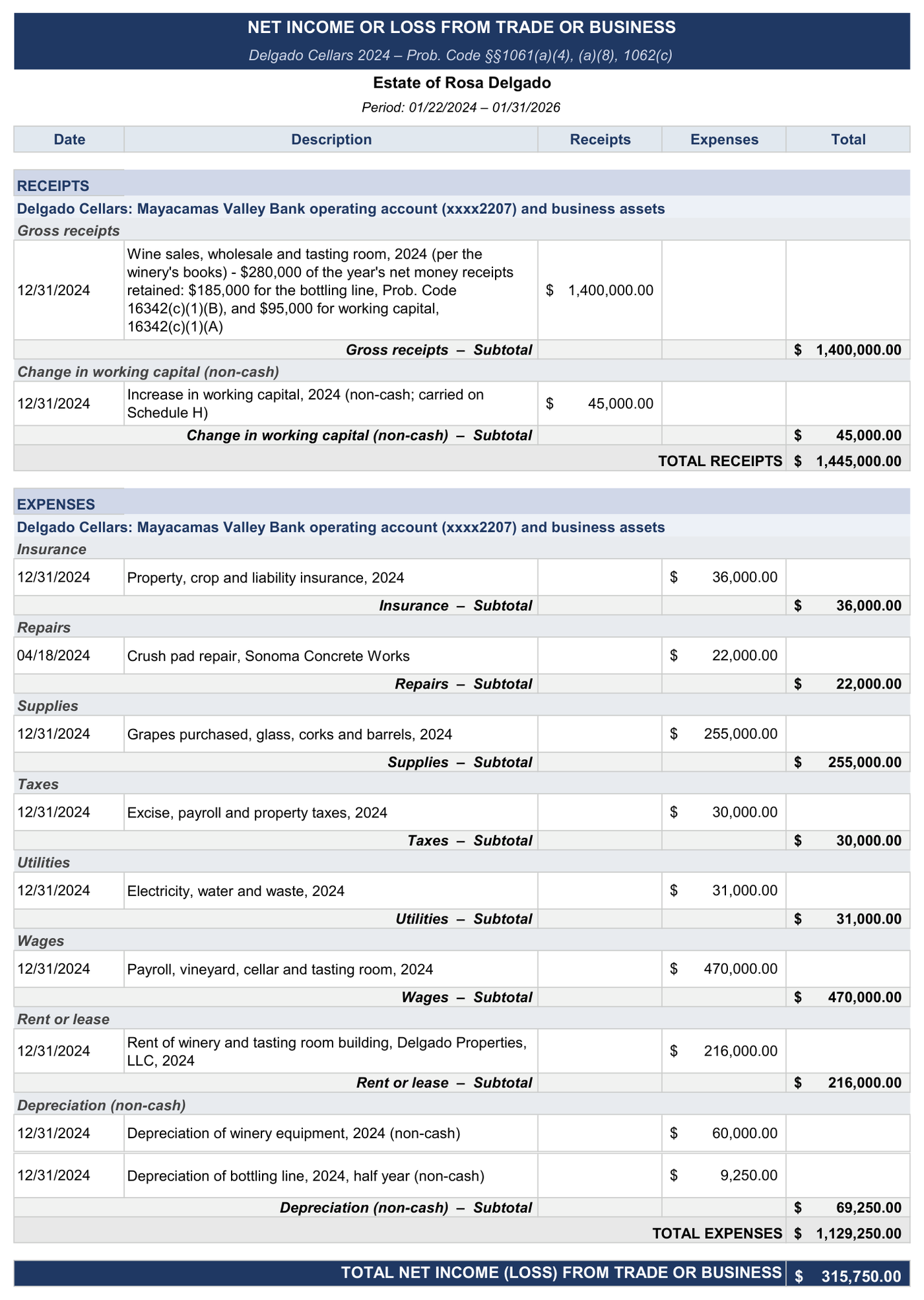
The winery's first year
One schedule for the year, at Schedule C detail, not every sale and payroll check. The $22,000 crush pad repair is an operating expense. Depreciation and the growth in working capital are the non-cash items. Net income: $315,750.
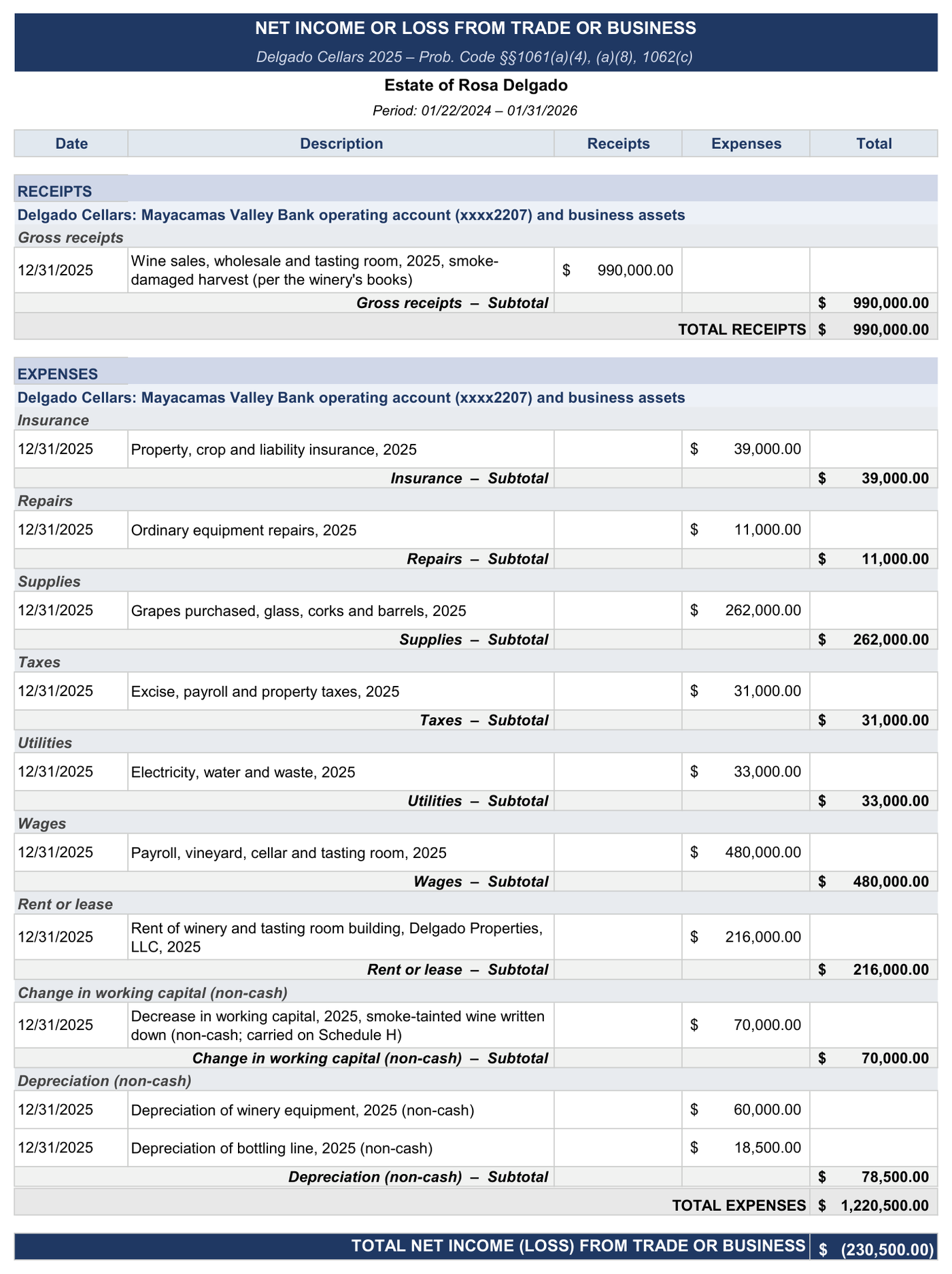
The smoke-damaged harvest
Year two: $82,000 less cash came in than went out, and with the written-down wine and depreciation the year is a net loss of $230,500.
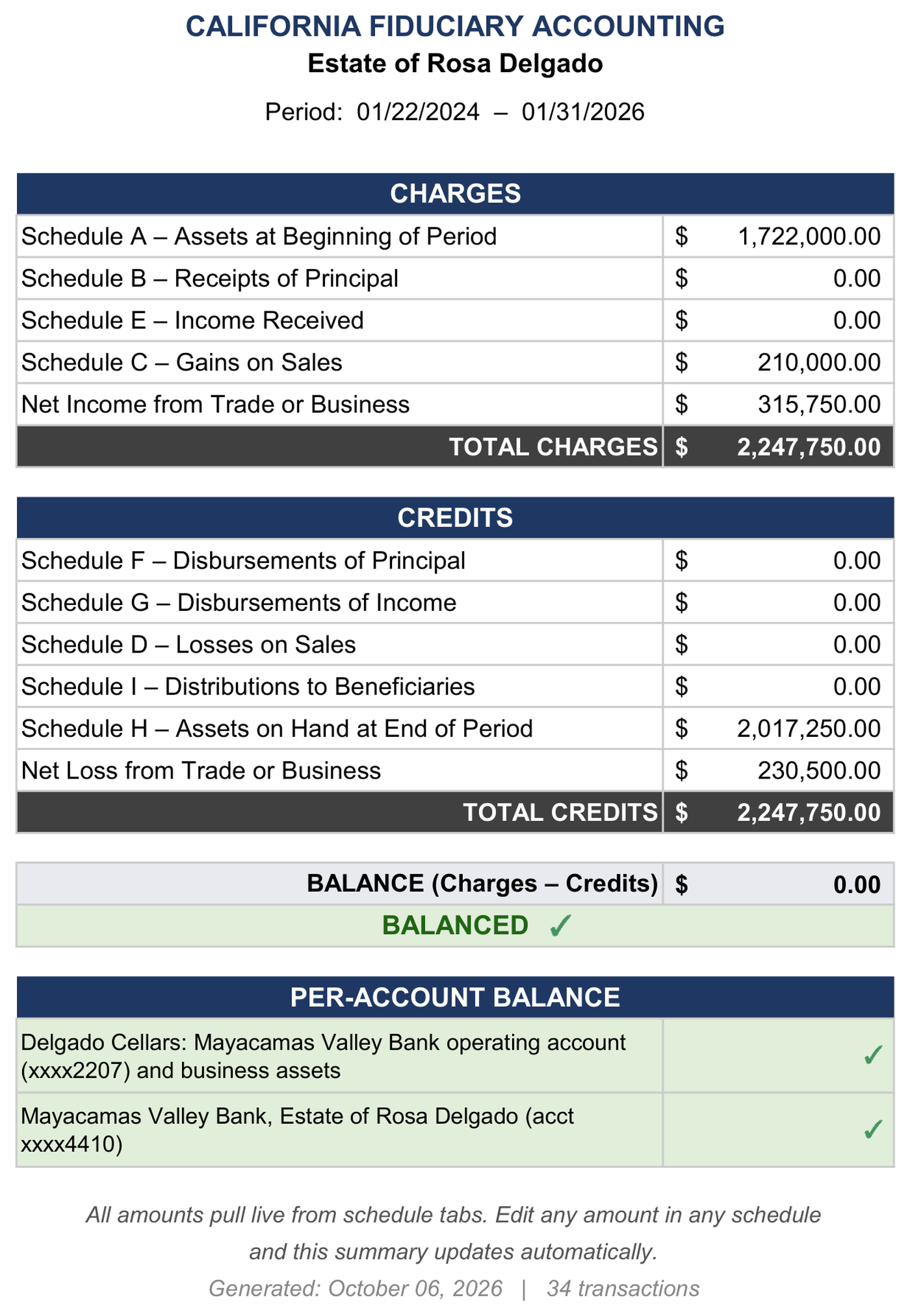
The summary
Only the two net figures reach the summary, on the trade or business lines: net income among the charges, net loss among the credits. Charges and credits balance.
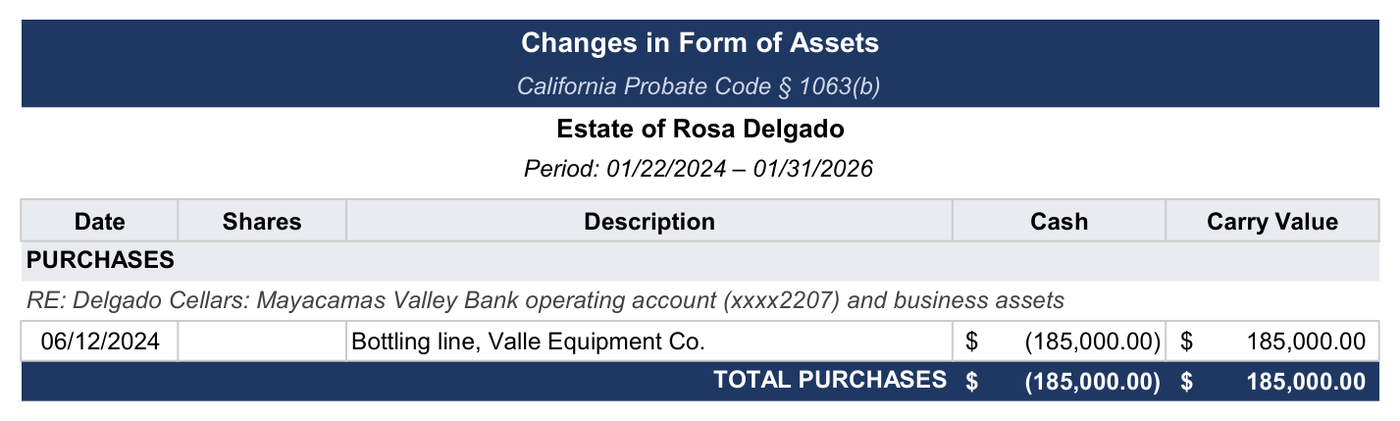
Changes in form: the bottling line
The $185,000 bottling line turns cash into equipment. It is a change in form, not a disbursement that reduces the year's result.
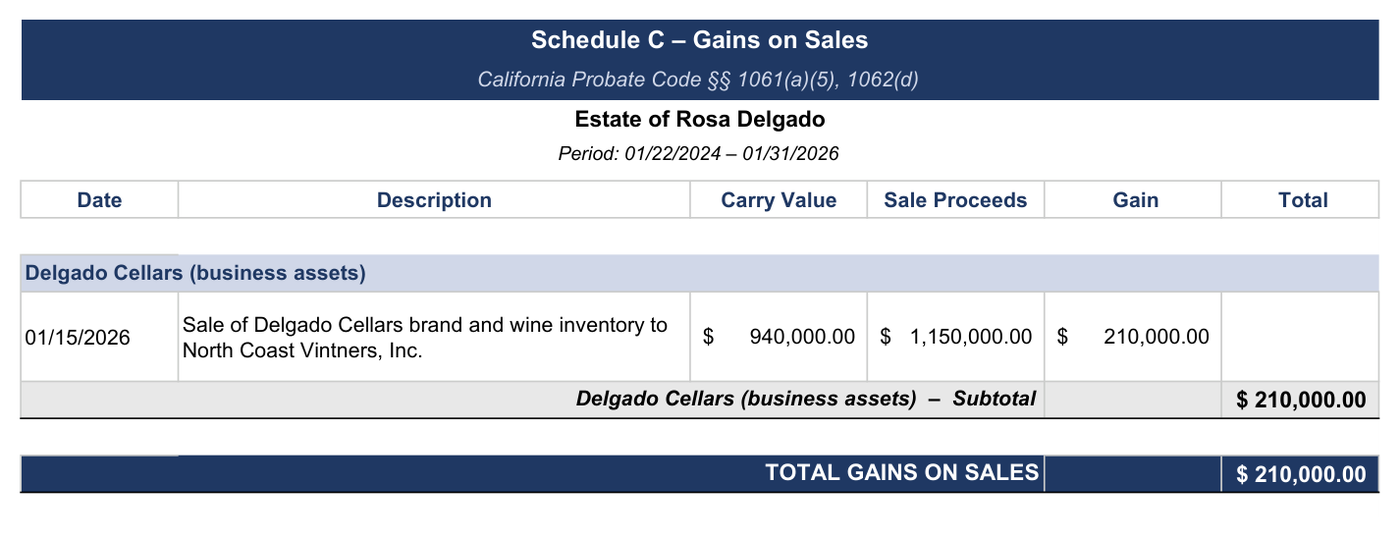
Schedule C: the sale of the business
The brand and inventory sold for $1,150,000 against a carry value of $940,000, a gain of $210,000. It is principal.
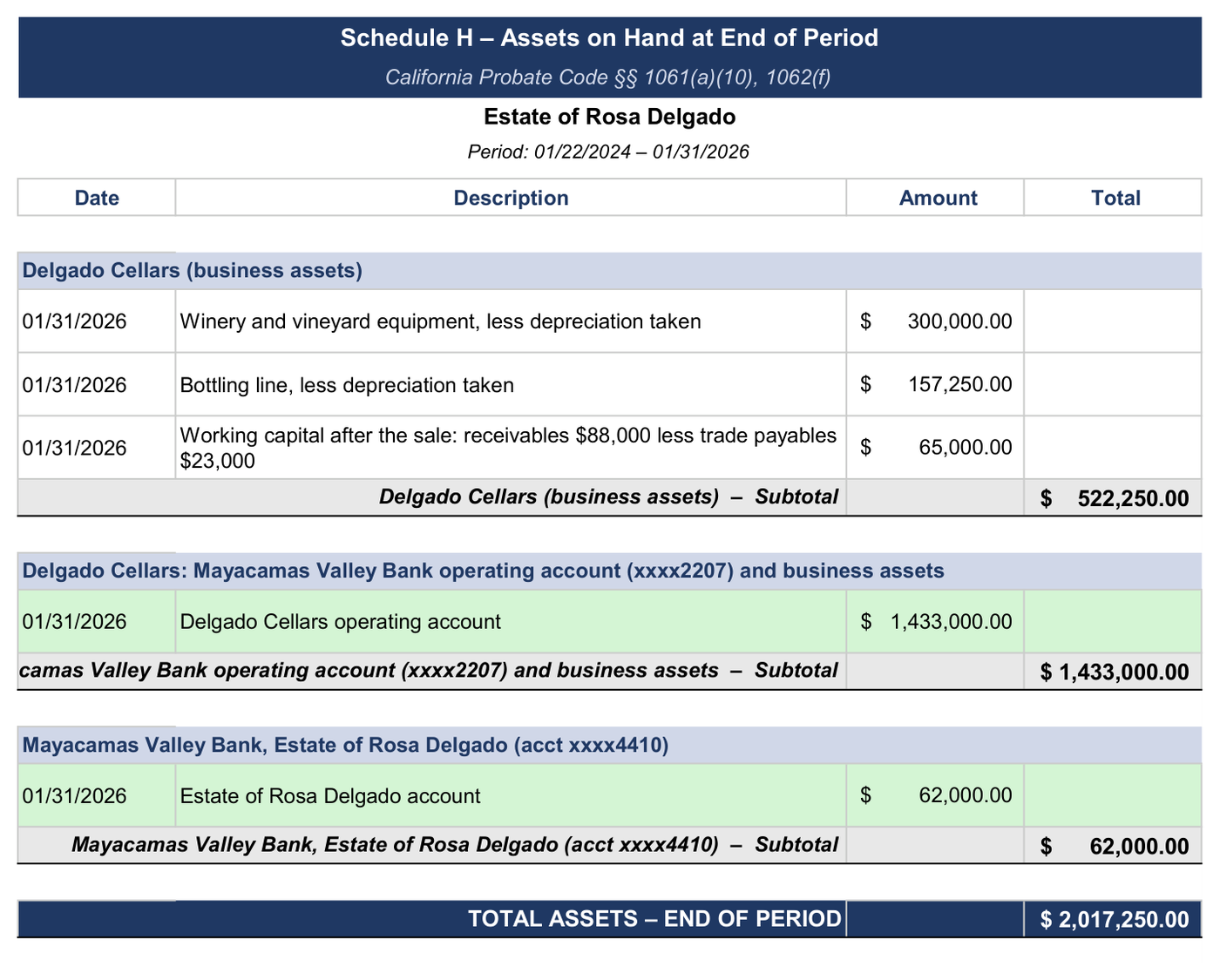
Schedule H: what the estate still holds
The equipment is carried less the depreciation taken, and the working capital left after the sale, $65,000, is one line, so every non-cash item in the business result is matched here.
Principal and income: the retention, recorded
Of year one's $340,000 net money receipts, Marco retained $280,000: $185,000 for the bottling line and $95,000 for working capital, leaving $60,000 of income. Year two's $82,000 cash loss is charged to that working capital, so the income is untouched. The non-cash items stay with principal.
Download this sample accounting (PDF)
The trustee's account of the Rosa Delgado Trust
Marco's account as trustee of Rosa's trust, which owns Delgado Properties: the company's monthly distributions, its $900,000 refinancing distribution and Luis's income. The company's own books are not shown. Select any sheet to see it full size.
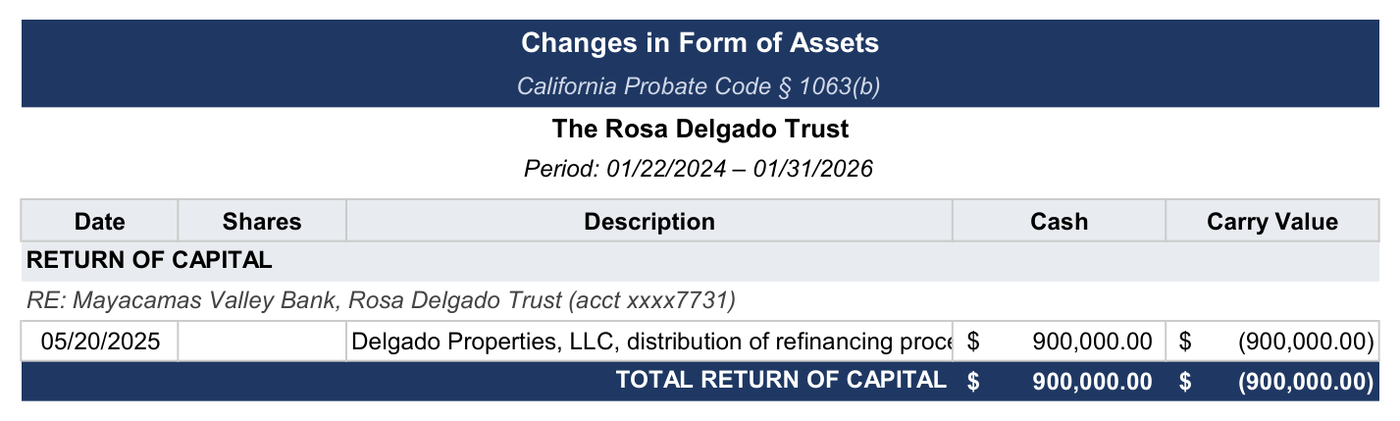
Changes in form: the refinancing distribution
The company called its $900,000 payment a distribution to members. The trust owns all of it, so Marco characterizes it himself: 30 percent of the value of the trust's interest just before, about 43 percent just after. It is a capital distribution and principal, so it reduces the interest's carry value instead of appearing as a receipt.
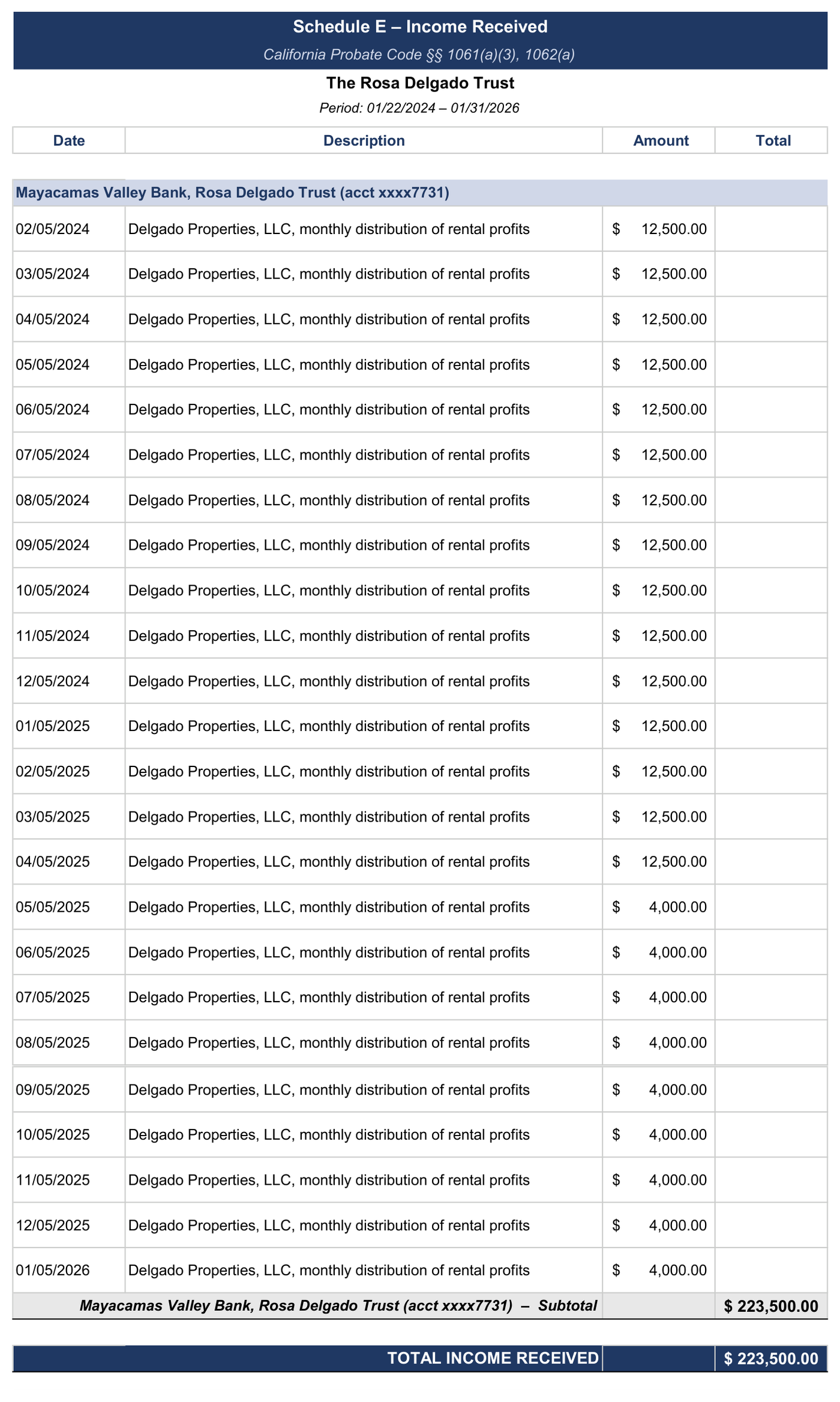
Schedule E: the monthly distributions
The company's regular distributions of its rental profits are income.
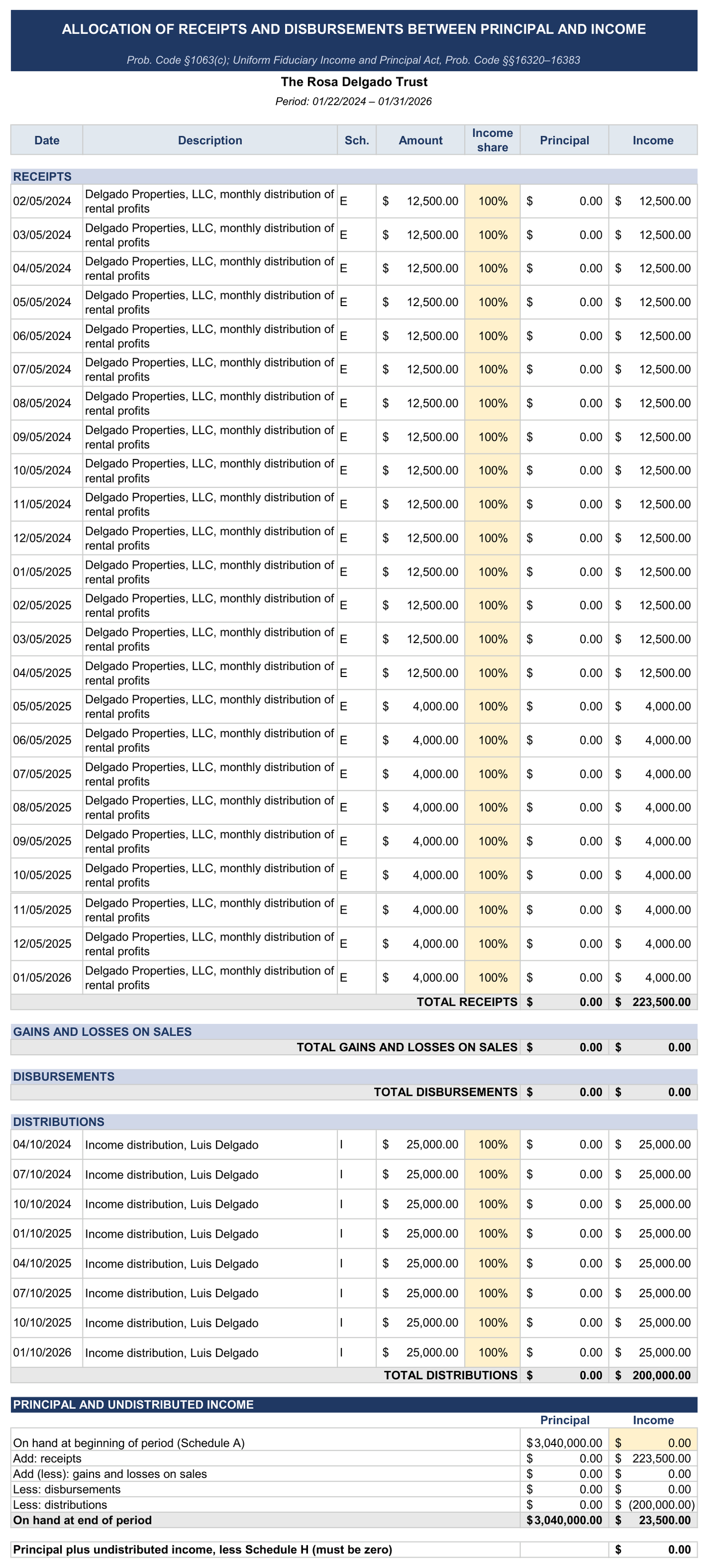
Principal and income
The monthly distributions, $223,500, are income, of which $200,000 was paid to Luis. The $900,000 is principal and never enters income.
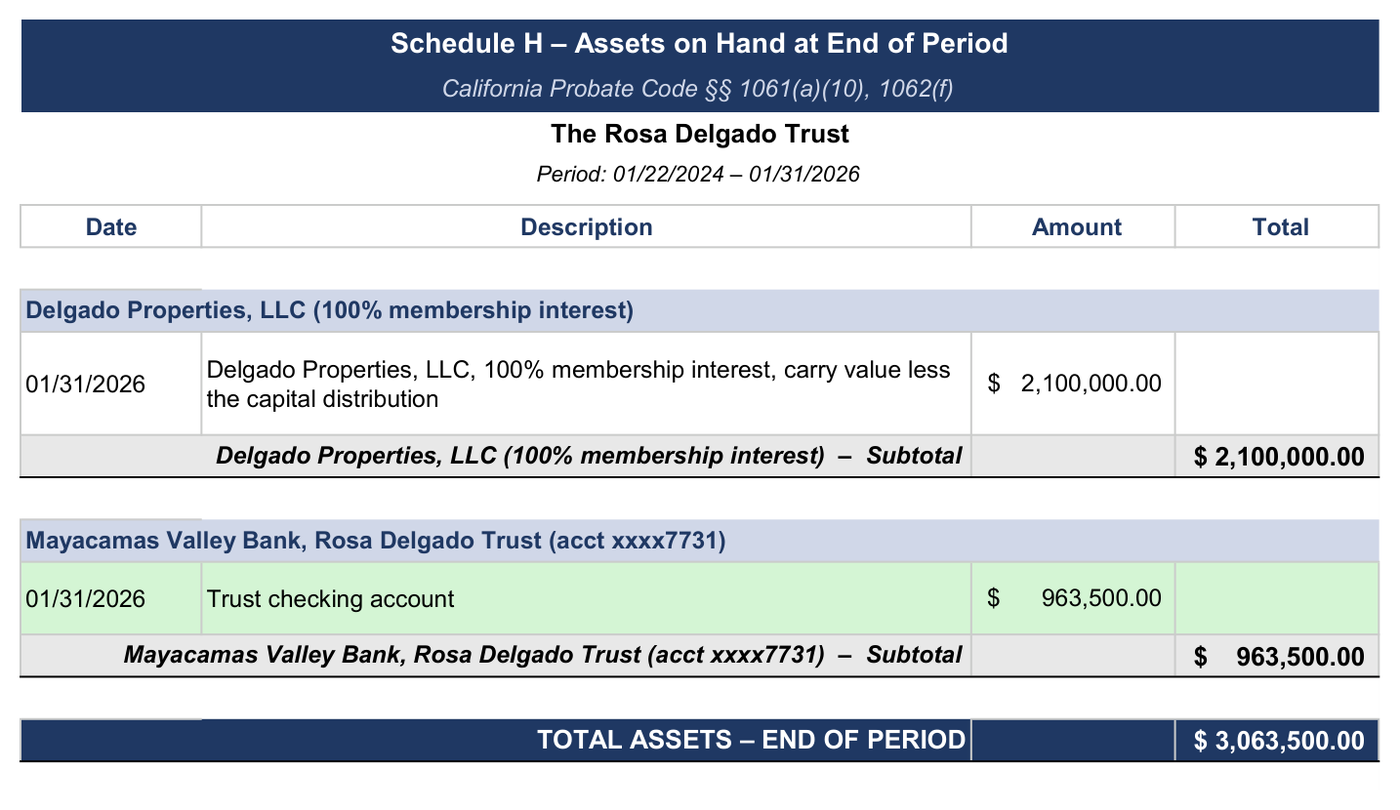
Schedule H: the company after the loan
The trust's interest is carried at $2,100,000: its $3,000,000 value at death less the $900,000 returned.
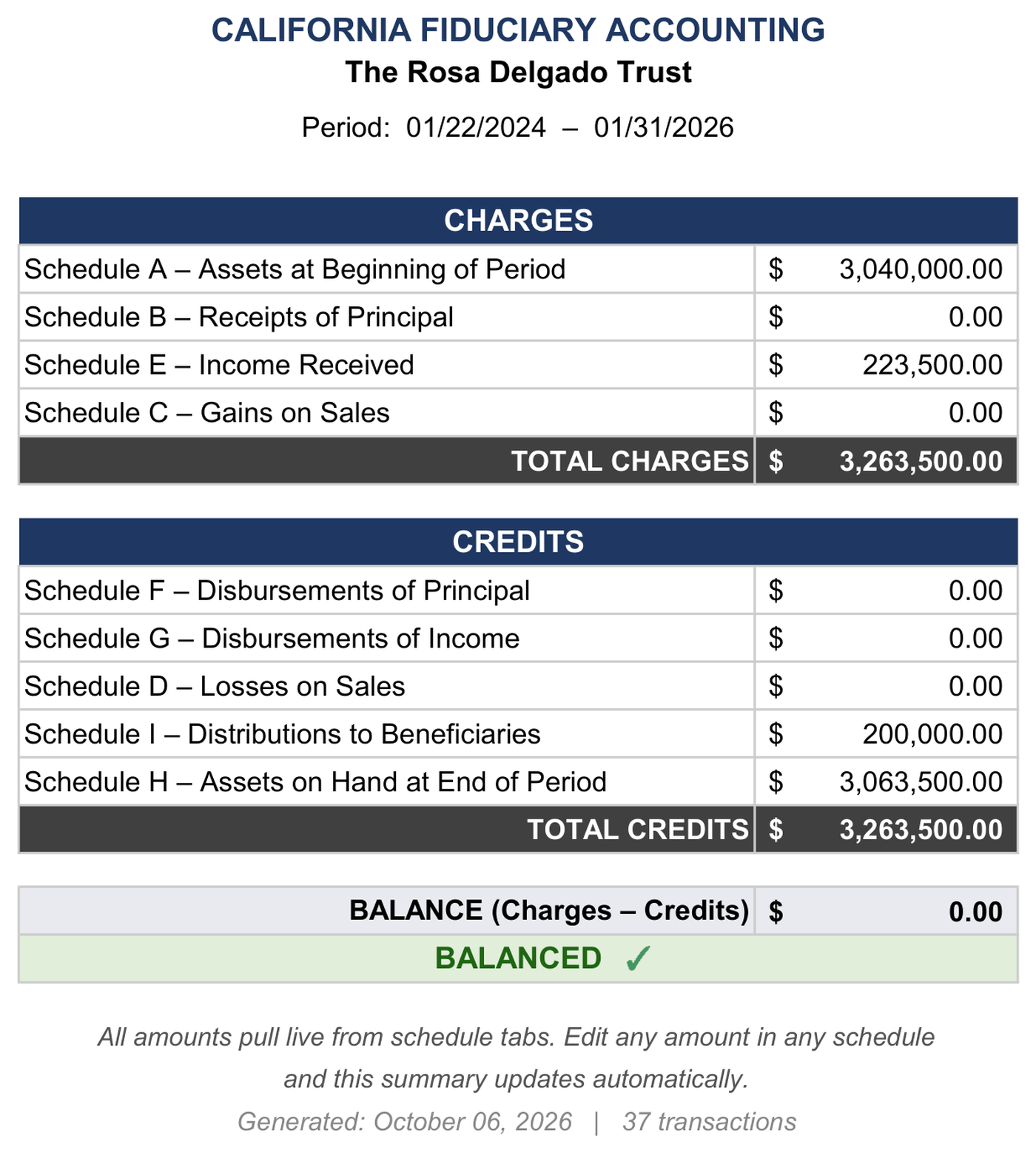
The summary
Charges and credits balance.
Download this sample accounting (PDF)
Checklist
- Threshold determination under § 16342(a) recorded at the outset.
- Business shown as one net line on the summary (§ 1061(a)(4), (8)), supported at Schedule C or F detail (§ 1062(c)).
- Business assets on the property-on-hand schedules at carry value and on the market value schedule at a good-faith estimate (§ 1063(a)).
- Capital purchases as changes in form (§ 1063(b)); funding from retained receipts (§ 16342(c)(1)(B)) recorded as a decision; repairs as operating expenses.
- Business result on one consistent basis, cash or accrual, reconciled to the property-on-hand schedules.
- Retentions under § 16342(c)(1) stated with their purpose; the allocation of the rest stated in the principal and income schedule (§ 1063(c)).
- Distributions from a controlled entity characterized by the trustee, not the entity (§ 16340(e)(1)(B)); the 20 percent test applied to the value of the trust's interest.
- Sale of the business to principal (§ 16342(c)(4)); authority to operate beyond six months shown (§ 9760(b) or § 10534(d)).
The Law and the Art of Fiduciary Accounting is a series by Balanced Legal Technology, LLC on complex California fiduciary accountings. General information only, current as of October 2026; not legal, tax or accounting advice. Statutes and rules change; confirm current law before relying on it.
About the author
Marc Joyce is a licensed, practicing California trusts and estates attorney, and the founder and developer of Balanced. He brings both sides to the problem: as a lawyer, and as an engineer. The Law and the Art of Fiduciary Accounting is his series on the hard cases where the two meet.