 Balanced
A California conservator or guardian of the estate files a court account one year after appointment and at least every two years after that, or more often if the court orders (§2620(a)). The account follows the Judicial Council’s GC-400 standard account; smaller estates that meet the conditions of rule 7.575 may use the simplified GC-405. The Summary of Account form, GC-400(SUM)/GC-405(SUM), must be used in all accountings. In a standard account the other GC-400 forms are optional (rule 7.575(e)(5)–(6)); a simplified account must use the GC-405 forms that apply to it (rule 7.575(e)(7)–(8)).
Have the statements? Balanced converts and organizes the data on them into this accounting, in the GC-400 format, as one editable Excel workbook balanced to the penny. Scanned or incomplete statements work.
- Developed by a California trusts and estates attorney
- Works with any PDF statement, downloaded or scanned
- Statement entries are cited to the PDF and page they
came from, for easy verification - A fully editable Excel workbook, emailed in about 1 hour
$699 Flat. No Subscription. No Install.
This has by far been the best user-experience and I’ve been really impressed with your product thus far.
Kelsey B. Cooper, Esq., California Estate Planning Services PC
When the account is due
Under California Probate Code §2620, the conservator or guardian of the estate files an account one year after appointment and at least every two years after that, and more often if the court orders. Under rule 7.575 of the California Rules of Court, the Summary of Account, GC-400(SUM)/GC-405(SUM), must be on the Judicial Council form in all accountings. In a standard account, the other GC-400 forms are optional, but schedules prepared without them must use the same categories, give the same information and follow the same general format (rule 7.575(e)(5)–(6)). A simplified account must use the GC-405 forms that apply to it (rule 7.575(e)(7)–(8)).
The GC-400 standard account
The GC-400 series is the Judicial Council’s set of California conservatorship accounting forms, and it lays out the standard account for conservators and guardians. The account opens with the Summary of Account, GC-400(SUM), supported by schedules that:
- Group receipts and disbursements into the form’s subject-matter categories, each subtotaled
- Show cash and non-cash assets separately
- List check numbers, and the date of the order authorizing each fee or distribution
Rule 7.575 of the California Rules of Court applies the standard account to conservatorships and guardianships, even where the forms themselves are not used.
Standard account or simplified account?
Rule 7.575 makes the standard account, GC-400, the default. A conservator or guardian may file the simplified account, GC-405, only when all of these are true:
- The estate’s appraised value, not counting the conservatee’s or ward’s personal residence, is less than $500,000
- The estate holds no income-generating real property
- The estate holds no interest, whole or partial, in a trade or business
- The court has not ordered a standard account
Even then, if the simplified receipts schedule, GC-405(A), or the simplified disbursements schedule, GC-405(C), would be longer than five pages, the standard receipt or disbursement forms must be used for that part; the rest may stay simplified (rule 7.575(d)(2)). More on the GC-405 simplified account.
All other estates file the standard GC-400 account. That is the format Balanced organizes statement data into.
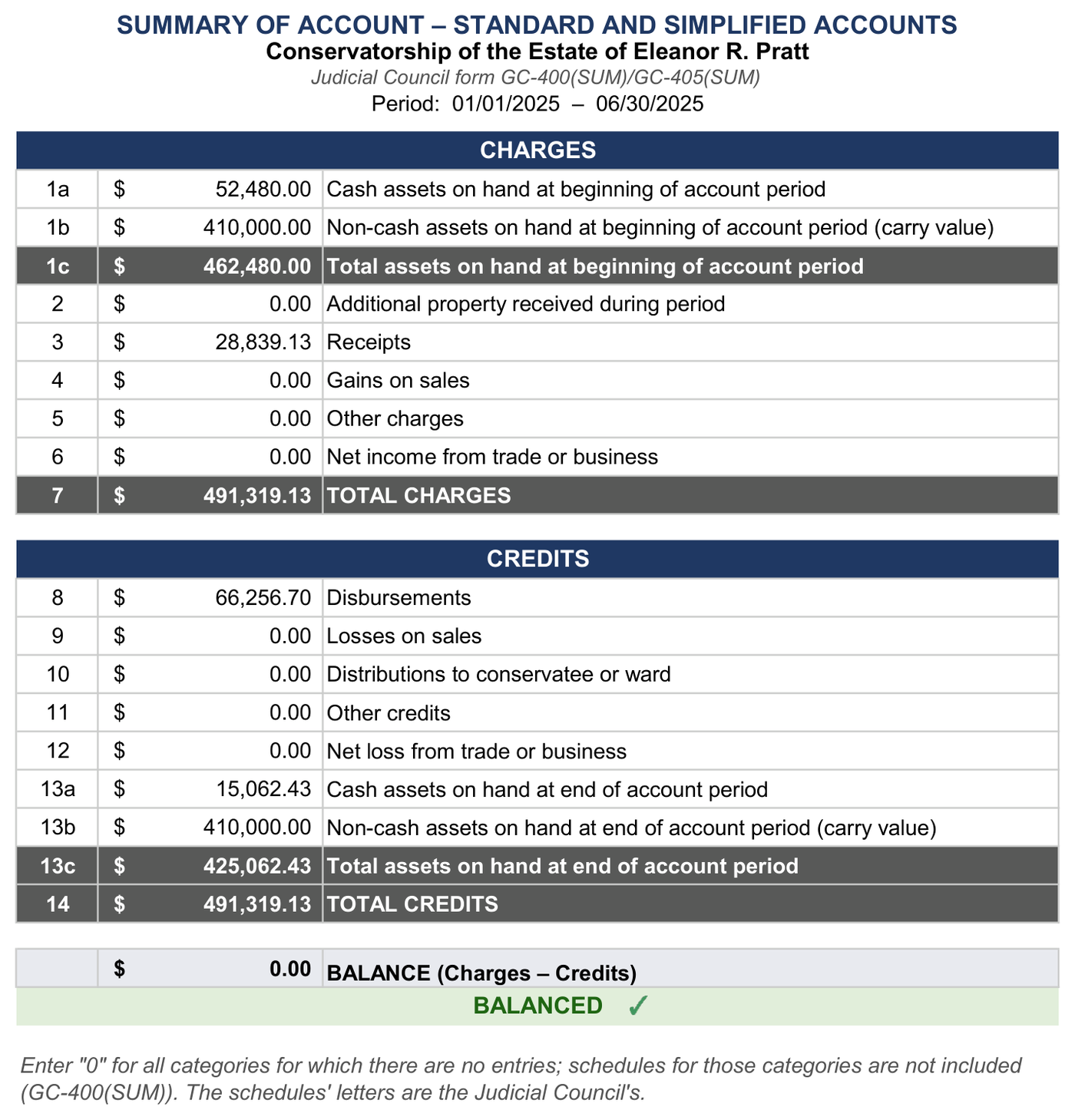
A sample GC-400 account
See a sample GC-400 account, schedule by schedule, or download the free GC-400 accounting template in Excel.
The first account and later accounts
The first account covers the period from appointment. For a first account, the property on hand at the beginning generally comes from the inventory and appraisal, and the account statements filed with it include the statements from immediately before appointment (§2620(c)).
Each later account starts where the last one ended: the property on hand at the end of one account is the property on hand at the beginning of the next, at the same carry values. A later account also states the estimated market value of the assets at the beginning of the period (§1063(a)).
If the conservatee or ward dies
The account then covers two separate periods: one that ends on the date of death and a separate accounting for the period after the date of death (§2620(b)). See the final accounting when the conservatee dies, step by step.
What is filed with the account
Section §2620(c) requires these supporting documents to be filed with the account:
- Account statements showing the balance as of the closing date of the period, and for a first account the statements showing the balance immediately before appointment as well ((c)(2))
- The original closing escrow statement for any sale of the estate’s real property ((c)(3))
- The original billing statements of a residential or long-term care facility, if the conservatee or ward lives in one ((c)(4))
Statements that show Social Security numbers or similar personal information are attached to a separate affidavit captioned “CONFIDENTIAL FINANCIAL STATEMENT”, which the clerk keeps confidential (§2620(c)(6)).
The court may review any account in full or in part (§2620(d)).
The GC-400 schedules at a glance
The standard account is a Summary of Account supported by schedules for each category. A schedule with no entries is left out, and its line on the summary shows zero.
| Form | What goes on it |
|---|---|
| GC-400(SUM) | Summary of Account. Carries each schedule’s total; total charges equal total credits. Required in all accountings (rule 7.575(e)). |
| GC-400(PH)(1), GC-400(PH)(2) | Cash, and non-cash assets, on hand at the beginning of the period. |
| GC-400(AP) | Additional property received during the period. |
| GC-400(A)(1) to GC-400(A)(6) | Receipts by category: dividends, interest, pensions and annuities, rent, Social Security and other public benefits, other receipts. |
| GC-400(B) | Gains on sales. |
| GC-400(NI) | Net income from a trade or business. |
| GC-400(NL) | Net loss from a trade or business. |
| GC-400(OCH) | Other charges. |
| GC-400(C)(1) to GC-400(C)(11) | Disbursements by category: caregiver, care facility, education, fiduciary and attorney fees, general administration, investment, living, medical, property sale, rental property, other. |
| GC-400(D) | Losses on sales. |
| GC-400(DIST) | Distributions to the conservatee or ward. |
| GC-400(OCR) | Other credits. |
| GC-400(E)(1), GC-400(E)(2) | Cash, and non-cash assets, on hand at the end of the period. |
| GC-400(F) | Changes in form of assets, such as purchases of securities. |
| GC-400(G) | Liabilities at the end of the period. |
If the account is late
When a conservator or guardian has not filed a required account, the court must require written notice to the conservator or guardian and the attorney of record, directing the conservator or guardian to file the account and set it for hearing within 30 days of the date of the notice, or within 45 days if the conservator or guardian is a public agency (§2620.2(a)). Failing to file within that time, or within 45 days of actually receiving the notice, whichever is later, is a contempt of the authority of the court (§2620.2(b)). When the account is not filed and set for hearing as required, the court must also take one or more of these steps: removal, a citation to show cause why the conservator or guardian should not be punished for contempt, suspension of the conservator’s or guardian’s powers with a temporary appointment, or appointment of counsel for the conservatee or ward (§2620.2(c)). More on an overdue conservatorship accounting.
What to gather before you start
- Each account’s statements for the whole period, with no month missing. For a first account, add the statements from immediately before appointment (§2620(c)).
- For a first account, the inventory and appraisal; for a later account, the prior account as filed, because its ending property is this account’s beginning property.
- The court orders that authorized fees or distributions, for their dates.
- Check registers or copies of checks, for check numbers and payees.
- The closing escrow statement for any real property sold, and the bills of any residential or long-term care facility (§2620(c)).
Checking the account before it is filed
- The Summary of Account balances: total charges equal total credits.
- The cash on hand at the end, account by account, matches the closing statements filed with the account.
- The beginning values match the prior account’s ending values, or for a first account the inventory and appraisal.
- A transfer between two of the estate’s own accounts shows on both sides, or on neither.
- Fees and distributions carry the date of the order that authorized them.
Praise for Balanced
“This has by far been the best user-experience and I’ve been really impressed with your product thus far.”
“I’d also just like to say that I was a trusts & estates paralegal for 6 years prior to becoming an attorney myself, so I’ve done hundreds of accountings manually. I’ve also tried countless other ‘trust accounting’ products. This has by far been the best user-experience and I’ve been really impressed with your product thus far. Myself and my firm will be repeat customers.”
California Estate Planning Services PC
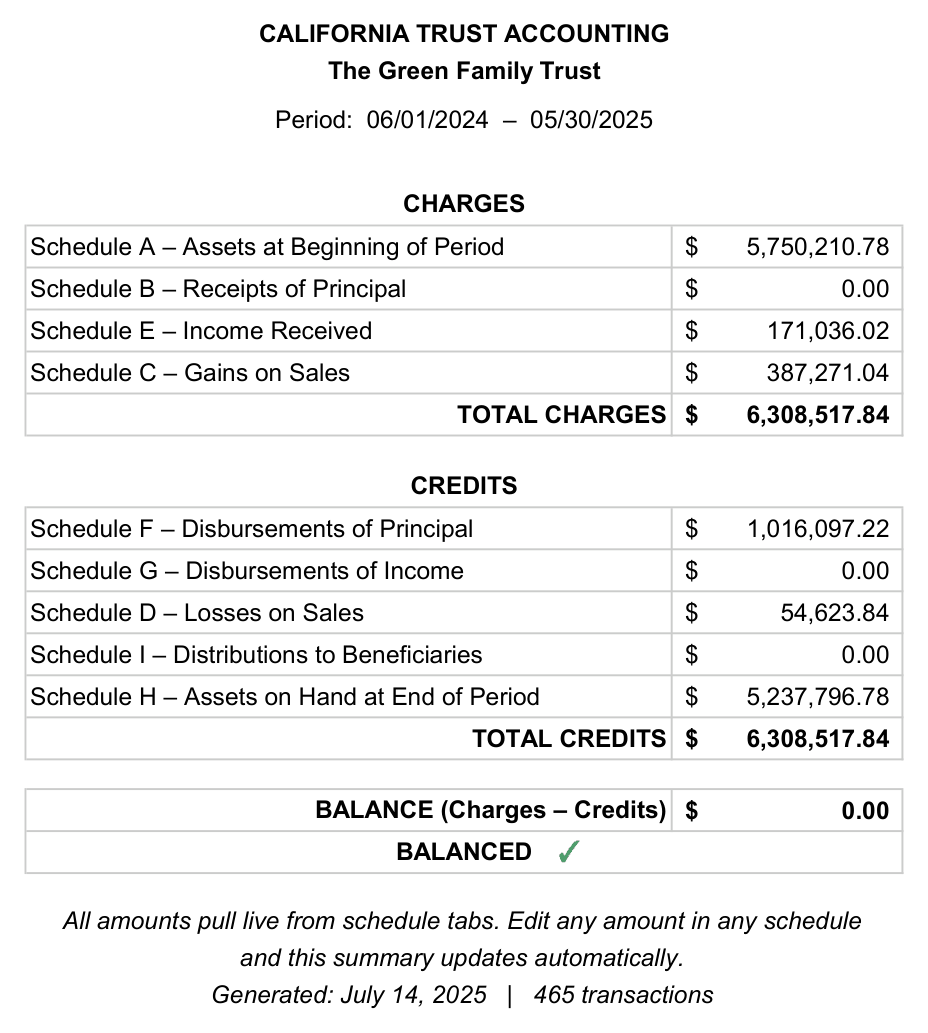
Inside a real Balanced workbook
$699 Flat. No Subscription. No Install.
Common questions
How often must a California conservator file an accounting?
At the end of one year from appointment, and then at least every two years, unless the court orders accountings more often (Probate Code section 2620(a)).
Do I have to use the GC-400 forms?
The Summary of Account, GC-400(SUM)/GC-405(SUM), must be used in all accountings. In a standard account, the other GC-400 standard-account forms are optional, but schedules prepared without them must use the same subject-matter categories, give the same information and follow the same general format (Cal. Rules of Court, rule 7.575(e)(5)-(6)). A simplified account must use the GC-405 forms that apply to it, including GC-405(A) for receipts and GC-405(C) for disbursements unless a schedule would run past five pages (rule 7.575(e)(7)-(8)).
When can I use the simplified GC-405 account?
Only when the estate has no income-generating real property and no interest in a trade or business, its appraised value excluding the conservatee's or ward's residence is less than $500,000, and the court has not ordered a standard account. If the receipts or disbursements schedule would run past five pages, the standard form is used for that schedule (rule 7.575(d)).
Which bank statements are filed with the account?
The statements showing each account's balance at the close of the period, and for a first account the statements from immediately before appointment too. Escrow closing statements and care facility bills are filed when they apply (Probate Code section 2620(c)).
Does a guardian of a minor's estate use the same accounting?
Yes. Section 2620 applies to guardians and conservators of the estate alike, and rule 7.575 and the GC-400 and GC-405 forms cover both.
What happens if the conservatee dies during the account period?
The account is split into two periods: one ending on the date of death and a separate one for the period after it (Probate Code section 2620(b)).
An automated way to generate it
Balanced is a new kind of conservatorship accounting software: automated California fiduciary accounting technology. Add the conservatorship or guardianship estate’s PDF bank and brokerage statements, and Balanced converts and organizes the statement data exactly as the statements show it, using disclosed, standard accounting conventions you can change; everything beyond that comes from your own instructions. It returns the account in the GC-400 layout as one fully editable Excel workbook, each account reconciled to its own statements and the summary balanced to the penny:
- The Summary of Account, with each schedule linked to it
- Receipts and disbursements grouped into the form’s categories and subtotaled
- Cash and non-cash assets at the beginning and end of the period
- Securities carried lot by lot, with gains and losses computed from carry value
Each row cites the statement and page it came from. Choose Conservatorship or Guardianship as the type of accounting and Balanced uses the GC-400 format. $699 per accounting.
Ready to generate yours? Add the PDF statements for the accounting period. Your PDFs stay on your computer.
$699 Flat. No Subscription. No Install.