 Balanced
Two different jobs
Accounting for a trust or estate means two different jobs. The titles fiduciary CPA, fiduciary accountant and fiduciary tax accountant are used for both:
- The court accounting (or the trustee’s account to beneficiaries): the summary of charges and credits and its schedules, in the California Probate Code §§1060–1064 format or the Judicial Council GC-400 layout, balanced to the penny. See a complete example.
- The fiduciary income tax returns, federal and California, prepared by a CPA or other tax professional.
Some probate accountants, estate accountants and trust CPAs do both; many do one. Before you hire an estate CPA, a trust accountant or a CPA for trust accounting, confirm which job they do.
Have the statements? Balanced converts and organizes the data on them into this accounting, in the Probate Code format, as one editable Excel workbook balanced to the penny. Scanned or incomplete statements work.
- Developed by a California trusts and estates attorney
- Works with any PDF statement, downloaded or scanned
- Statement entries are cited to the PDF and page they
came from, for easy verification - A fully editable Excel workbook, emailed in about 1 hour
$699 Flat. No Subscription. No Install.
This has by far been the best user-experience and I’ve been really impressed with your product thus far.
Kelsey B. Cooper, Esq., California Estate Planning Services PC
A court accounting is not a tax return
The court accounting and the fiduciary income tax returns are built from many of the same statements, but they answer different questions. The court accounting follows Probate Code sections 1060 to 1064, the chapter that governs all accounts filed with the court (§1060). It shows what the fiduciary started with, what was received and paid out, what was distributed, and what is on hand at the end, each asset at its carry value, and total charges must equal total credits (§1061(c)). It covers the period of the account, which need not match a calendar or tax year.
The income tax returns of an estate or trust are the federal Form 1041, U.S. Income Tax Return for Estates and Trusts, and the California Form 541, the California fiduciary income tax return. They report taxable income for a tax year, under tax rules. A gain on a tax return is measured from tax basis; a gain on the court accounting is measured from carry value (§1062(d)), and the two can differ. Trust accounting income, the measure that decides what an income beneficiary receives, is different again; see trust accounting income vs. principal. One professional may do both jobs, but they are separate pieces of work, usually priced separately.
Accountant, CPA, professional fiduciary or the attorney’s paralegal?
For the court accounting itself, an executor, administrator or trustee usually has four choices:
- The attorney’s office. Many probate and trust attorneys prepare the accounting in house, usually with a paralegal doing the work under the attorney’s supervision. The attorney already has the court file, the petition and the deadlines, and the account is filed with the petition. In a probate estate, the court may allow compensation for extraordinary services by a paralegal performing them under the direction and supervision of an attorney; the petition must set forth the hours spent and services performed by the paralegal (§10811(b)).
- A CPA. A CPA who prepares fiduciary accountings knows the bookkeeping, and can often prepare the tax returns from the same records. Ask whether they prepare California court accountings in the Probate Code or GC-400 format, because a tax practice does not always do so.
- An accountant or bookkeeper who is not a CPA. Some prepare court accountings regularly. The same questions apply: experience with the California format, how the fee works, and who reviews the work.
- A professional fiduciary. A professional fiduciary serves as the trustee, executor, administrator or conservator, and the accounting is part of that role. A family member serving as fiduciary does not usually hire a professional fiduciary only to prepare an accounting; the question is whether to have one serve instead.
The law allows the help. A trustee has the power to hire accountants, attorneys, auditors and other agents to advise or assist the trustee in the performance of administrative duties (§16247), and a personal representative may hire accountants and other tax experts for the estate’s tax work and pay them from the funds of the estate (§10801(b)). Whoever prepares it, the account is the fiduciary’s own, and the fiduciary remains responsible for it.
What drives the fee for the accounting
A court accounting is usually billed by the hour, and the hours depend on the number of accounts, the activity in them, securities and corporate actions, transfers between accounts, and whether it balances on the first pass. That is why the accounting is often the single largest cost of an administration, and so hard to predict. More on what an accounting really costs.
Questions to ask before you hire
- Have you prepared California court accountings in the §1060–1064 or GC-400 format before?
- Is the fee fixed, or hourly with an estimate? What happens to it if the accounting does not balance or needs revisions?
- What is included: every schedule, market values, the principal and income allocation, a tax summary?
- How long will it take, and who reviews it?
What to give whoever prepares it
- Every statement for each bank, brokerage and retirement account for the whole period, plus the statement for the month before it begins. See why the prior month’s statement matters.
- For a first account, the starting values: the inventory and appraisal in a probate estate or conservatorship, or the date-of-death values of a trust that became irrevocable at a death. For a later account, the prior account, because its ending property is the next account’s beginning property (§1061(a)(1)).
- The will or the trust instrument and every amendment
- Court orders: letters, and any orders for fees, sales or preliminary distributions
- Escrow closing statements for real property bought or sold
- Check registers or check images, so each disbursement can show its payee and purpose (§1062(b))
- Records of what was paid to the fiduciary, the attorneys and any agents, which the petition or report must disclose (§1064(a)(3), (4))
- Receipts for expenses the fiduciary paid personally and was reimbursed for
- A note of anything unusual: a missing statement, an account opened or closed, an asset distributed in kind
In a conservatorship or guardianship, the account statements are also filed with the accounting: the statements showing each account’s balance at the closing date of the period, and, for the first accounting, the statements showing the balance immediately before the appointment (§2620(c)(2)).
How to check the finished accounting
Whoever prepares it, check it before it is relied on, delivered or filed:
- It balances. Total charges equal total credits (§1061(c)).
- Each account ties to its statements. The opening balance matches the statement before the period, and the ending balance matches the last statement of the period.
- It starts in the right place. For a first account, the beginning property matches the inventory values; for a later account, the ending property of the prior account (§1061(a)(1)).
- Transfers are not counted twice. Moves between the fiduciary’s own accounts are not shown as receipts or disbursements.
- Gains and losses are calculated from carry value, with the calculation shown for each sale (§1062(d)).
- The schedules show what the code requires. Each receipt shows its nature or purpose, source and date, and each disbursement its nature or purpose, payee and date (§1062(a), (b)).
- Spot checks. Pick a handful of entries at random and find each one on the statement page it came from.
- The disclosures are there. Unusual items are explained, and compensation paid to the fiduciary or the attorneys other than under a prior court order is stated (§1064(a)).
If the numbers will not meet, see why a fiduciary accounting won’t balance.
Praise for Balanced
“This has by far been the best user-experience and I’ve been really impressed with your product thus far.”
“I’d also just like to say that I was a trusts & estates paralegal for 6 years prior to becoming an attorney myself, so I’ve done hundreds of accountings manually. I’ve also tried countless other ‘trust accounting’ products. This has by far been the best user-experience and I’ve been really impressed with your product thus far. Myself and my firm will be repeat customers.”
California Estate Planning Services PC
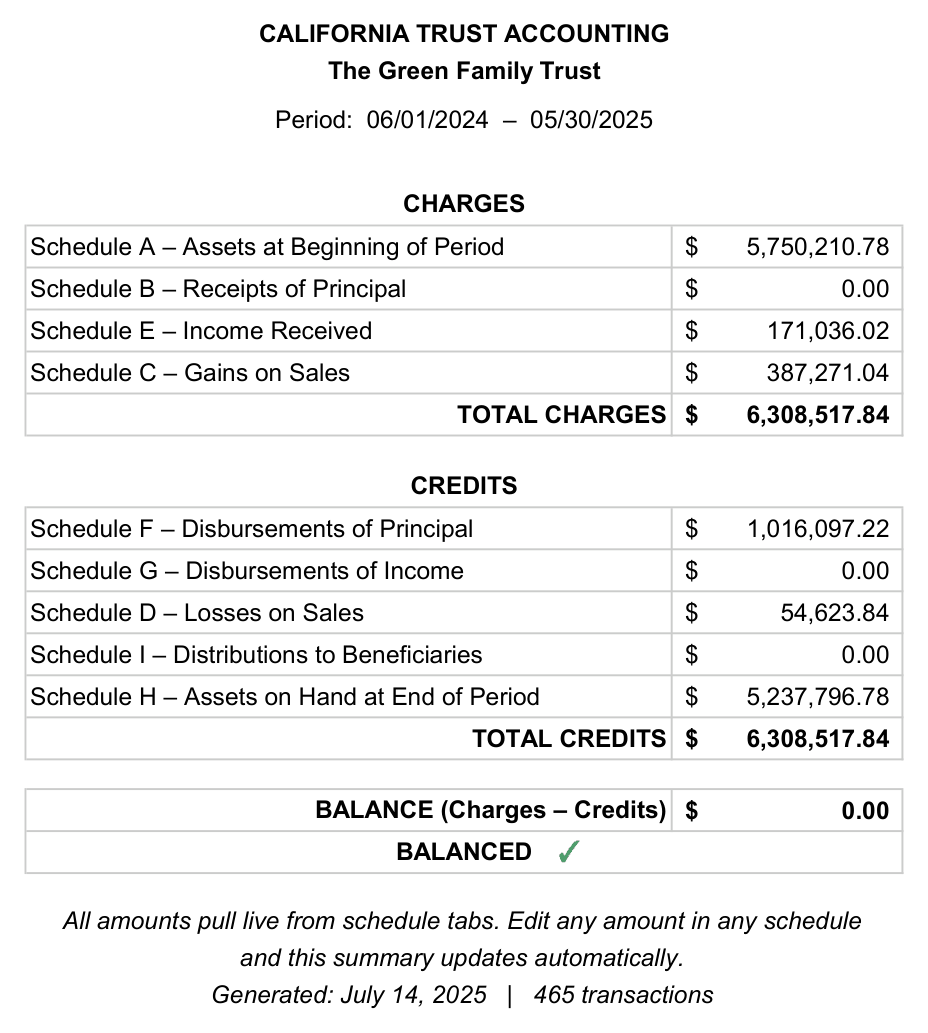
Inside a real Balanced workbook
$699 Flat. No Subscription. No Install.
Common questions
Is a probate accountant the same as a CPA?
Not necessarily. Probate accountant describes the work, not a license. A CPA is licensed; some CPAs prepare court accountings and some prepare only tax returns. Ask which job they do.
Is the court accounting the same as the estate's tax return?
No. The court accounting follows Probate Code sections 1060 to 1064 and covers the period of the account. The fiduciary income tax returns are federal Form 1041 and California Form 541, which report taxable income for a tax year.
Can an accountant's fee be paid from the estate or trust?
A personal representative may pay accountants and other tax experts for the estate's tax work from the funds of the estate (Probate Code section 10801(b)) and is allowed all necessary expenses of administration (section 11004). A trustee has the power to hire accountants and to pay the reasonable compensation of agents of the trust (sections 16247 and 16243).
What should I give the person preparing the accounting?
Every statement for the period and the month before it, the inventory and appraisal or the prior account, the will or trust, court orders, escrow closing statements, check registers or images, and records of what was paid to the fiduciary, the attorneys and any agents.
A technology alternative for the accounting
Balanced is a new kind of software for California fiduciary accountings. From the PDF bank and brokerage statements, Balanced converts and organizes the statement data into the accounting exactly as the statements show it, using disclosed, standard accounting conventions you can change; everything beyond that comes from your own instructions. Most are generated and delivered in about 1 hour, rather than the days, weeks or months of manual work an accounting otherwise takes. Transactions are classified to their schedules, carry values tracked lot by lot, each account reconciled to its own statements, the summary balanced to the penny, and each entry cited to the statement and page it came from, delivered as one fully editable Excel workbook. $699 per accounting.
A fiduciary can keep their CPA for the tax returns and use Balanced for the accounting itself; Balanced’s workbook includes a tax summary by year for the CPA.
For a finished estate accounting example, see the sample first and final account for a fictional decedent’s estate, every schedule filled in; a blank probate accounting template in Excel is free.
Ready to generate yours? Add the PDF statements for the accounting period. Your PDFs stay on your computer.
$699 Flat. No Subscription. No Install.