
When a trustee must account (Probate Code §16062)
Under California Probate Code §16062, a trustee must account at least annually, at the termination of the trust, and on a change of trustee, to each beneficiary to whom income or principal is required or authorized to be currently distributed. A beneficiary may waive an account in writing, subject to the limits in §16064.
What the account must contain (Probate Code §16063)
Probate Code §16063 sets out what a trustee’s account must include:
- The receipts and disbursements of principal and income during the period
- The assets and liabilities of the trust at the end of the period
- The trustee’s compensation for the period
- The agents hired by the trustee, their relationship to the trustee, and their compensation
- A statement that the recipient of the account may petition the court under §17200 to obtain a court review of the account and of the acts of the trustee
- A statement that claims against the trustee for breach of trust may not be made more than three years after the beneficiary receives an account or report disclosing facts giving rise to the claim (§16460)
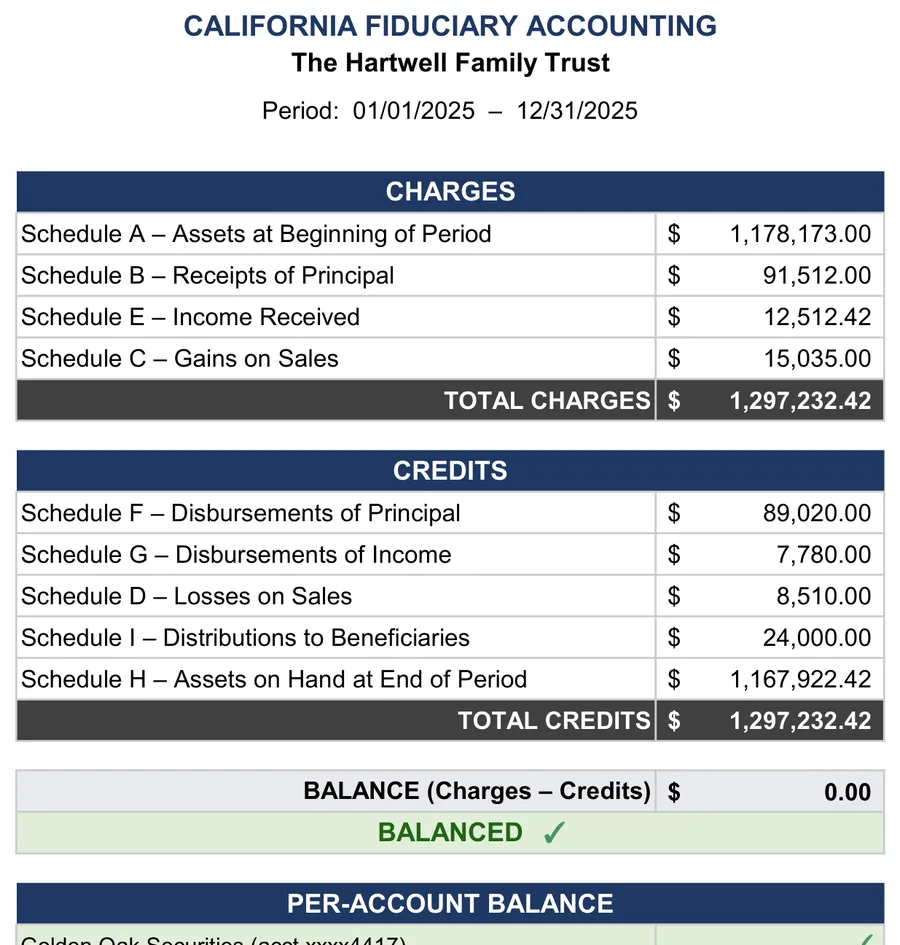
A trust accounting filed with the court is a formal accounting of the trust, and it follows the court format of Probate Code §§1060–1064: a summary of charges and credits, supported by schedules. A trust final accounting at termination uses the same format.
Revocable and irrevocable trust accounting
While a trust is revocable, the trustee generally has no duty to account to the other beneficiaries (Prob. Code §16069). The exception: if no person holding the power to revoke is competent, the trustee must account at least annually to each beneficiary who would receive income or principal if the settlor had died during the account period (§§15800(b), 16069(b)). Once a family trust becomes irrevocable, most often at the settlor’s death, §16062 applies: the trustee of an irrevocable trust accounts at least once a year, at termination and on a change of trustee, to each beneficiary to whom income or principal is currently distributable.
Why it takes so long by hand
Every deposit, withdrawal, dividend, purchase and sale on every statement has to be classified, totaled and tied back to the opening and closing balances. For a trust with brokerage accounts, each security’s carry value has to be followed lot by lot through the period to compute gains and losses. For a trust with several accounts, that is days, weeks or even months of manual work.
What a finished accounting looks like
An automated way to generate it
Balanced is a new kind of trust accounting software: automated California fiduciary accounting technology. Add the trust’s PDF bank and brokerage statements, and Balanced returns the accounting in the Probate Code format as one fully editable Excel workbook, each account reconciled to its own statements and the summary balanced to the penny:
- The summary of charges and credits, with every schedule linked to it
- Assets on hand at the beginning and end of the period
- Receipts, disbursements, gains and losses, with carry values tracked lot by lot, first-in, first-out
- Allocation between principal and income when the trust has an income beneficiary
- A tax summary for the trust’s CPA
Each row cites the statement and page it came from, so the accounting can be checked line by line. Add a memo or the prior accounting to tailor it. $699 per accounting.