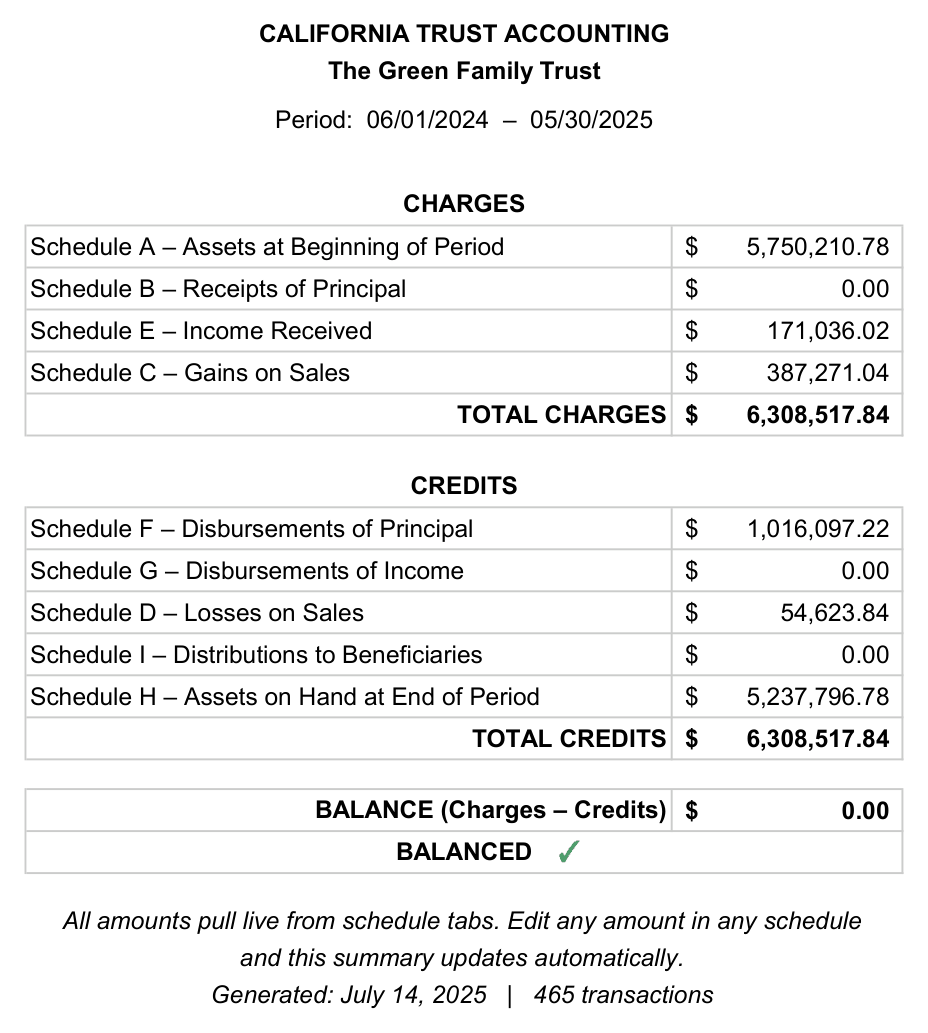
 Balanced
What a fiduciary accounting service does
A fiduciary accounting service prepares the accounting a trustee, executor, administrator, conservator or guardian must deliver to beneficiaries or file with the court. For a California court accounting, that means the summary of charges and credits and its supporting schedules in the Probate Code §§1060–1064 format, or the Judicial Council GC-400 standard account for a conservatorship or guardianship. Trust accounting services, probate accounting services and conservatorship accounting services are offered by CPAs, specialized accounting firms, and the staff of law firms and professional fiduciaries. If you are looking for a CPA in particular, see probate accountants and fiduciary CPAs.
Have the statements? Balanced converts and organizes the data on them into this accounting, in the Probate Code format, as one editable Excel workbook balanced to the penny. Scanned or incomplete statements work.
- Developed by a California trusts and estates attorney
- Works with any PDF statement, downloaded or scanned
- Statement entries are cited to the PDF and page they
came from, for easy verification - A fully editable Excel workbook, emailed in about 1 hour
$699 Flat. No Subscription. No Install.
This has by far been the best user-experience and I’ve been really impressed with your product thus far.
Kelsey B. Cooper, Esq., California Estate Planning Services PC
Who needs California fiduciary accounting services
- Trustees. Except as otherwise provided, a trustee must account at least annually, at the termination of the trust, and upon a change of trustee, to each beneficiary to whom income or principal is required or authorized in the trustee’s discretion to be currently distributed (§16062(a); see §16064 for when an account is not required). Most trustee accounts go to the beneficiaries, not the court. An account filed to be approved by a court is presented in the format of sections 1060 and following (§16063(b)). More on California trust accounting requirements.
- Executors and administrators. The court may order an account at any time, and must order one on the petition of an interested person made more than one year after the last account, or after letters issued if there has been none (§10950). The personal representative files a final account and petition for final distribution when the estate is in a condition to be closed (§10951), unless the account is not required under §10954. See how to do a probate accounting in California.
- Conservators and guardians of the estate. The accounting is presented to the court one year after appointment and at least every two years after that, unless the court orders it more often, in the manner of sections 1060 and following, on the Judicial Council form (§2620(a)). When the conservatee or ward dies, the final accounting covers the period that ended on the date of death and, separately, the period after it (§2620(b)).
The three California formats
1. The Probate Code format, for trusts and estates. Probate Code sections 1060 to 1064 govern all accounts filed with the court (§1060): a summary of charges and credits in which total charges equal total credits (§1061), detailed schedules behind it (§1062), further schedules when they apply, such as market values and the allocation between principal and income (§1063), and the disclosures in the petition or report (§1064). Each section is explained in Probate Code 1060 to 1064, section by section.
2. The GC-400 standard account, for conservatorships and guardianships. The Judicial Council’s standard account groups receipts and disbursements into subject-matter categories, with its own Summary of Account and schedules (rule 7.575). See GC-400 conservatorship and guardianship accountings and how to fill out the GC-400.
3. The GC-405 simplified account. A simplified accounting reports individual receipts and disbursements chronologically, by receipt or payment date, without separating them into subject-matter categories (rule 7.575(d)). It may be filed only if the estate contains no income-generating real property, no whole or partial interest in a trade or business, and has an appraised value, excluding the conservatee’s or ward’s personal residence, of less than $500,000, and the court has not directed a standard accounting (rule 7.575(d)(1)). If the simplified receipts schedule, GC-405(A), or the simplified disbursements schedule, GC-405(C), would be longer than five pages, the standard receipt or disbursement forms are used for that part, and the rest may stay simplified (rule 7.575(d)(2)). More on the GC-405 simplified account.
A trustee’s account that goes only to the beneficiaries must contain what Probate Code §16063(a) lists. An account in the court format can also serve as that account, as long as it includes the statements §16063(a) requires.
How accounting services are priced
Most accounting services bill by the hour. The hours depend on the number of accounts, the activity in them, securities and corporate actions, transfers between accounts, and whether the accounting balances on the first pass. That is why the accounting is often the single largest cost of an administration, and so difficult to predict unless the service quotes a fixed fee. More on what an accounting really costs.
What any accounting must deliver
- The correct format for the matter: Probate Code §§1060–1064 or GC-400
- Property on hand at the beginning and end of the period at carry value, with market value reported separately
- Gains and losses calculated from carry value, and principal and income allocated where the trust or estate requires it
- A summary that balances exactly, with each figure traceable to a statement
- Delivery before the deadline; see the deadline calculator
What a good service delivers beyond the format
- Each account reconciled to its own statements, not only a summary that balances
- Every figure traceable to the statement and page it came from, so the fiduciary and the attorney can check it
- A file the attorney can edit, so a correction or a late item does not mean starting over
- A list of anything that needs explaining: missing statements, unusual items, transactions the schedules do not make clear (§1064(a)(1), (2))
- For a conservatorship or guardianship, a list of the account statements that must be filed with the accounting (§2620(c))
- A summary of income and expenses by year for the CPA who prepares the fiduciary income tax returns
Turnaround
With an hourly service, the time depends on the size of the accounting, how complete the statements are, and how much other work is ahead of it, so ask for a delivery date in writing. Then allow time for the fiduciary and the attorney to review the accounting, for any corrections, and for the petition and notice: when notice of a hearing is required, it is delivered at least 15 days before the hearing (§1220(a)). Balanced generates most accountings and delivers them in about 1 hour after the statements are added. To work back from a due date, use the deadline calculator.
The software alternative
Balanced is a new kind of software for California fiduciary accountings: automated fiduciary accounting. From the PDF bank and brokerage statements, Balanced converts and organizes the statement data into the accounting exactly as the statements show it, using disclosed, standard accounting conventions you can change; everything beyond that comes from your own instructions. Most are generated and delivered in about 1 hour, rather than the days, weeks or months of manual work an accounting otherwise takes. Transactions are classified to their schedules, carry values tracked lot by lot, each account reconciled to its own statements, the summary balanced to the penny, and each entry cited to the statement and page it came from, delivered as one fully editable Excel workbook. $699 per accounting.
Balanced is software, not a preparation service: the accounting is generated from the statements, and the fiduciary or their attorney reviews and verifies it. See a full trust accounting example or an estate accounting example.
Praise for Balanced
“This has by far been the best user-experience and I’ve been really impressed with your product thus far.”
“I’d also just like to say that I was a trusts & estates paralegal for 6 years prior to becoming an attorney myself, so I’ve done hundreds of accountings manually. I’ve also tried countless other ‘trust accounting’ products. This has by far been the best user-experience and I’ve been really impressed with your product thus far. Myself and my firm will be repeat customers.”
California Estate Planning Services PC
Inside a real Balanced workbook
$699 Flat. No Subscription. No Install.
Common questions
Who needs a fiduciary accounting in California?
Trustees accounting to beneficiaries (Probate Code section 16062), executors and administrators when the court orders an account and at the close of the estate (sections 10950 and 10951), and conservators and guardians of the estate, one year after appointment and at least every two years after that (section 2620).
What is the difference between the GC-400 and the GC-405?
The GC-400 standard account groups receipts and disbursements into subject-matter categories. The GC-405 simplified account lists them by date, and may be used only for an estate under $500,000 excluding the residence, with no income-generating real property and no interest in a trade or business, when the court has not directed a standard accounting (California Rules of Court, rule 7.575(d)).
How long does a fiduciary accounting take?
With an hourly preparer, it depends on the number of accounts, months and transactions, and how complete the statements are. Balanced generates and delivers most accountings in about 1 hour.
Do conservators file the bank statements with the accounting?
Yes. Along with each accounting, a conservator or guardian files the account statements showing the balance as of the closing date of the period, and for the first accounting also those showing the balance immediately before the appointment (Probate Code section 2620(c)). Check the local rules for anything more.
When to involve a professional as well
Software produces the accounting; it does not replace professional judgment. Contested matters, objections and surcharge proceedings call for an attorney, and the fiduciary income tax returns call for a CPA. Many matters combine the two: the accounting generated by Balanced, reviewed by the attorney, with the tax summary in the workbook handed to the CPA. More on working with a probate accountant or fiduciary CPA.
Ready to generate yours? Add the PDF statements for the accounting period. Your PDFs stay on your computer.
$699 Flat. No Subscription. No Install.