
The facts
Walter Ashby died on March 14 with a revocable trust that became irrevocable at his death. His wife, Helen, is entitled to all of the trust's net income for life. On her death the remainder passes to his two children from a prior marriage, who do not get along with Helen.
Walter was an active investor. His brokerage account, titled in the trust, held at his death:
- Domestic stocks worth about $2.1 million.
- Shares of a German industrial company traded in euros and a Japanese automaker traded in yen, held in the local markets rather than as American depositary receipts.
- Cash balances of €41,300 and ¥3,850,000.
- A margin loan with a debit balance of $612,000.
- An open short sale of 4,000 shares of a technology stock, entered two months before his death.
In April the market fell. The broker issued a margin call, and when the successor trustee did not meet it within the deadline, the broker sold domestic stocks to bring the account into compliance. In June the trustee bought back the 4,000 shares to close the short position at a loss. Through the year the foreign holdings paid dividends net of German and Japanese withholding tax, and the trustee converted most of the foreign cash to dollars in September.
Helen's attorney has asked for the trustee's account. The children's attorney has made clear that every figure will be examined. Few documents in trust litigation carry more weight than the account. It is the record from which a court decides whether the trustee did the job.
Why this goes wrong
Most preparers take the brokerage statement at face value: one net "account value" at death, one net value at year end, and a list of activity in between. That approach fails here in at least five ways:
- The margin loan disappears into a net number, and with it the fact that the trust was leveraged.
- The short position is either ignored or shown as a negative asset, which misstates what the trust owned and owed.
- Foreign dividends are reported net of withholding, so the account understates income and hides a tax that may be recoverable.
- Currency movement is either lost or counted twice.
- The forced sales in April are reported like ordinary sales, without the explanation that the children's attorney will demand first.
The law
The format. A trust account filed with the court "shall be presented in the manner provided in Chapter 4 (commencing with Section 1060)" (Prob. Code § 16063(b)). That chapter requires a summary of charges and credits in which "Total charges shall equal total credits" (§ 1061(c)), supported by schedules of receipts, disbursements, gains and losses, distributions and property on hand (§ 1062). The beginning figure is "the value of the property initially received by the fiduciary" in a first account (§ 1061(a)(1)), and property on hand at the end is "stated at its carry value" (§ 1061(a)(10)).
Liabilities at the end of the period are shown separately. If "at the end of the accounting period, there are liabilities," other than recurring expenses, "there shall be a schedule" showing, among other things, "All liabilities which are a lien on estate or trust assets," "All notes payable," and "Any other material liability" (§ 1063(g)(1), (3), (5)).
Market value is shown separately. Every account includes "an additional schedule showing the estimated market value of the assets on hand as of the end of the accounting period" (§ 1063(a)).
Interest is an income expense; repaying debt is a principal expense. The trustee disburses from income "Another ordinary expense ... including interest" (§ 16360(c)), and from principal "A payment on the principal of a trust debt" (§ 16361(a)(4)).
Dividends are income. Money received in an entity distribution is income (§ 16340(c)) unless an exception applies.
Taxes follow the receipt. "A tax required to be paid by a fiduciary that is based on receipts allocated to income shall be paid from income" (§ 16365(a)).
Proceeds of sales are principal. "Money or other property received from the sale, exchange, liquidation, or change in form of a principal asset" is principal (§ 16343(b)).
What the act does not say. California's Uniform Fiduciary Income and Principal Act (Prob. Code §§ 16320 to 16383, effective January 1, 2024) never mentions foreign currency, foreign withholding tax or short sales. Two provisions fill gaps. For receipts from financial instruments the act does not otherwise address, "The allocation shall be consistent with the principles of Sections 16353 and 16354" (§ 16355), the derivatives and asset-backed securities rules. And where neither the trust nor the act allocates a receipt or a disbursement, the trustee must "Add a receipt to principal" and "Charge a disbursement to principal" (§ 16325(c)(1), (2)).
The solution
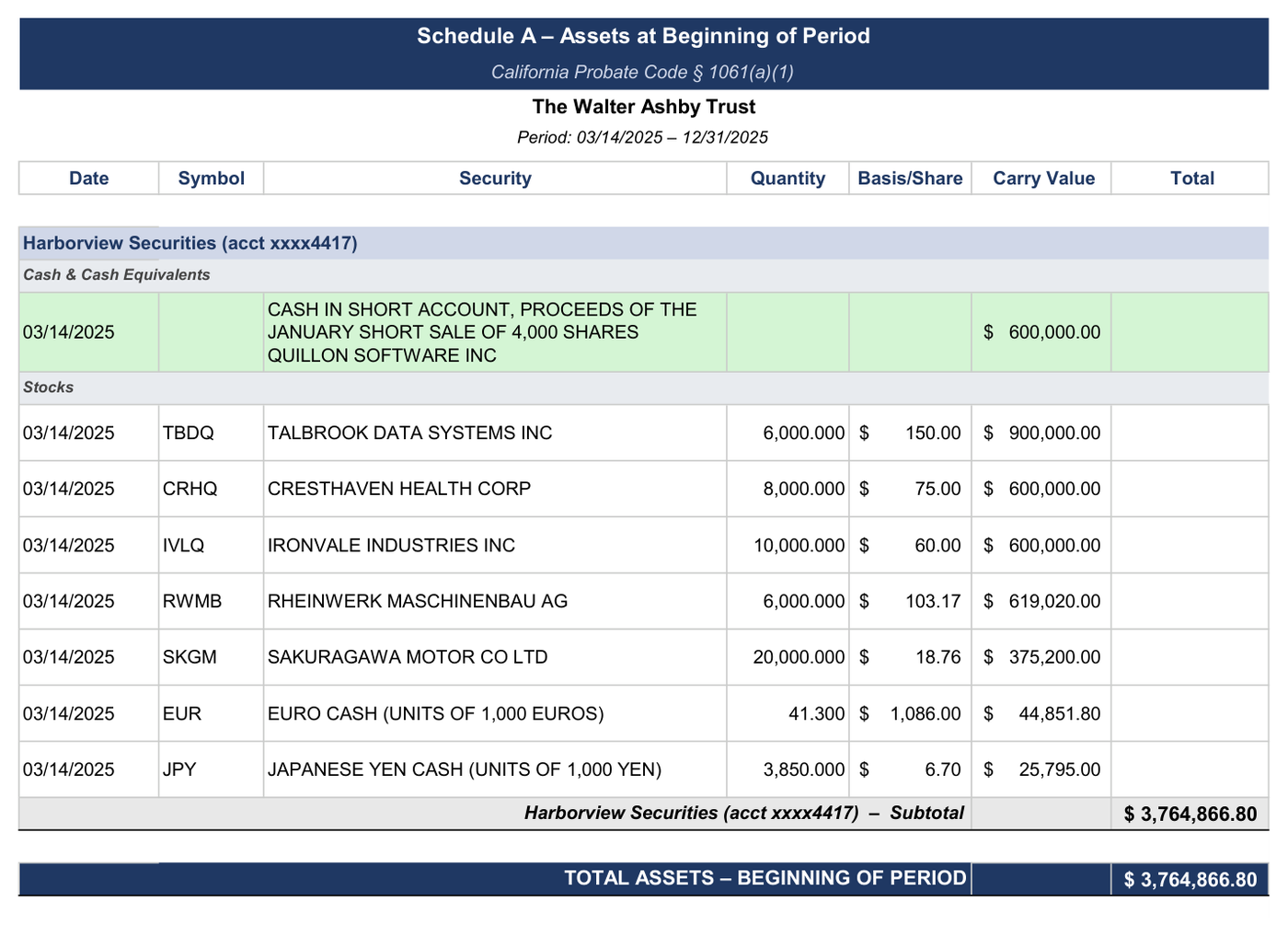
1. Present the account gross, not net. The schedule of property on hand at the beginning of the period (Schedule A in the format used here; the statute assigns no letters) lists every asset Walter owned at death at its date-of-death value in dollars, including the foreign shares and the foreign cash. Section 1061(a)(1) calls for "the value of the property initially received by the fiduciary," and what the trust received was the securities, not the securities net of a loan. The $612,000 margin balance at death is disclosed in a note and in the report, so the reader sees the leverage from the first page (§ 1064(a)(2)).
A net presentation can be made to balance too, so the reason for gross is disclosure, not arithmetic. But the gross method balances only if it is applied completely:
- Every repayment of margin debt, whether by deposit or by the broker applying sale proceeds, is a principal disbursement (§ 16361(a)(4)).
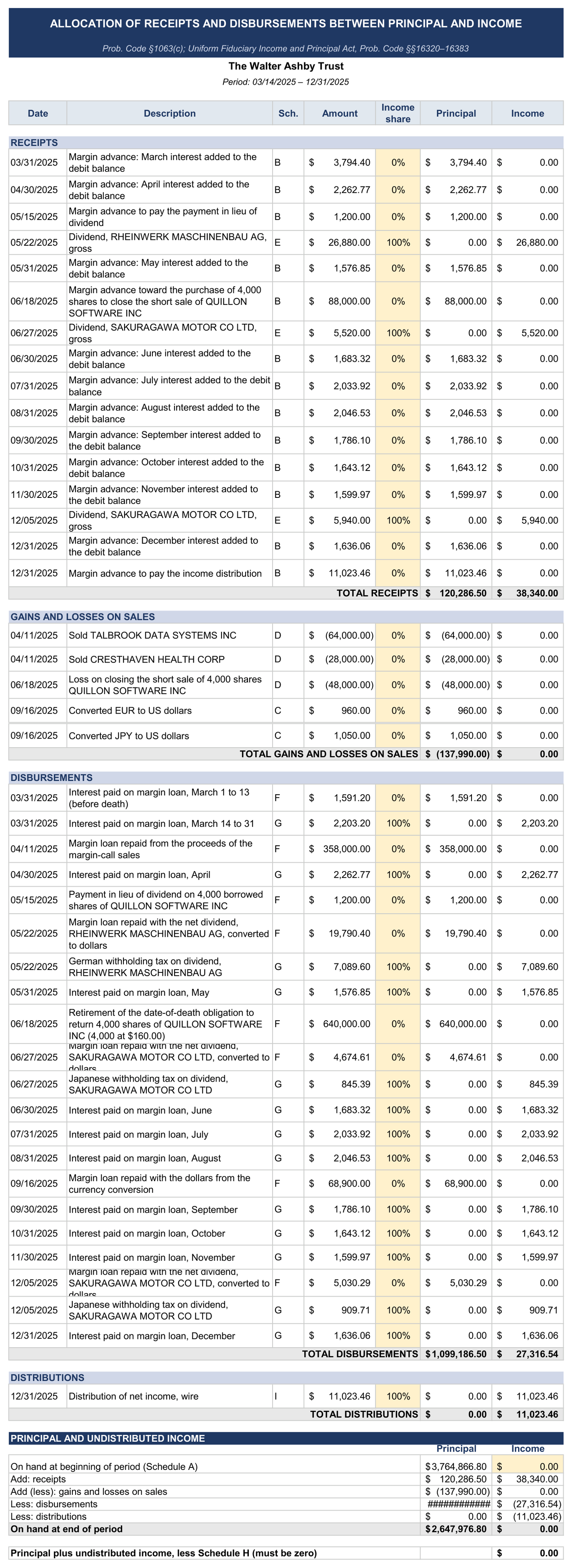
- Every new margin borrowing, including purchases made on margin and interest the broker adds to the debit balance, is a principal receipt. The act does not address loan proceeds, so they default to principal (§ 16325(c)(1)).
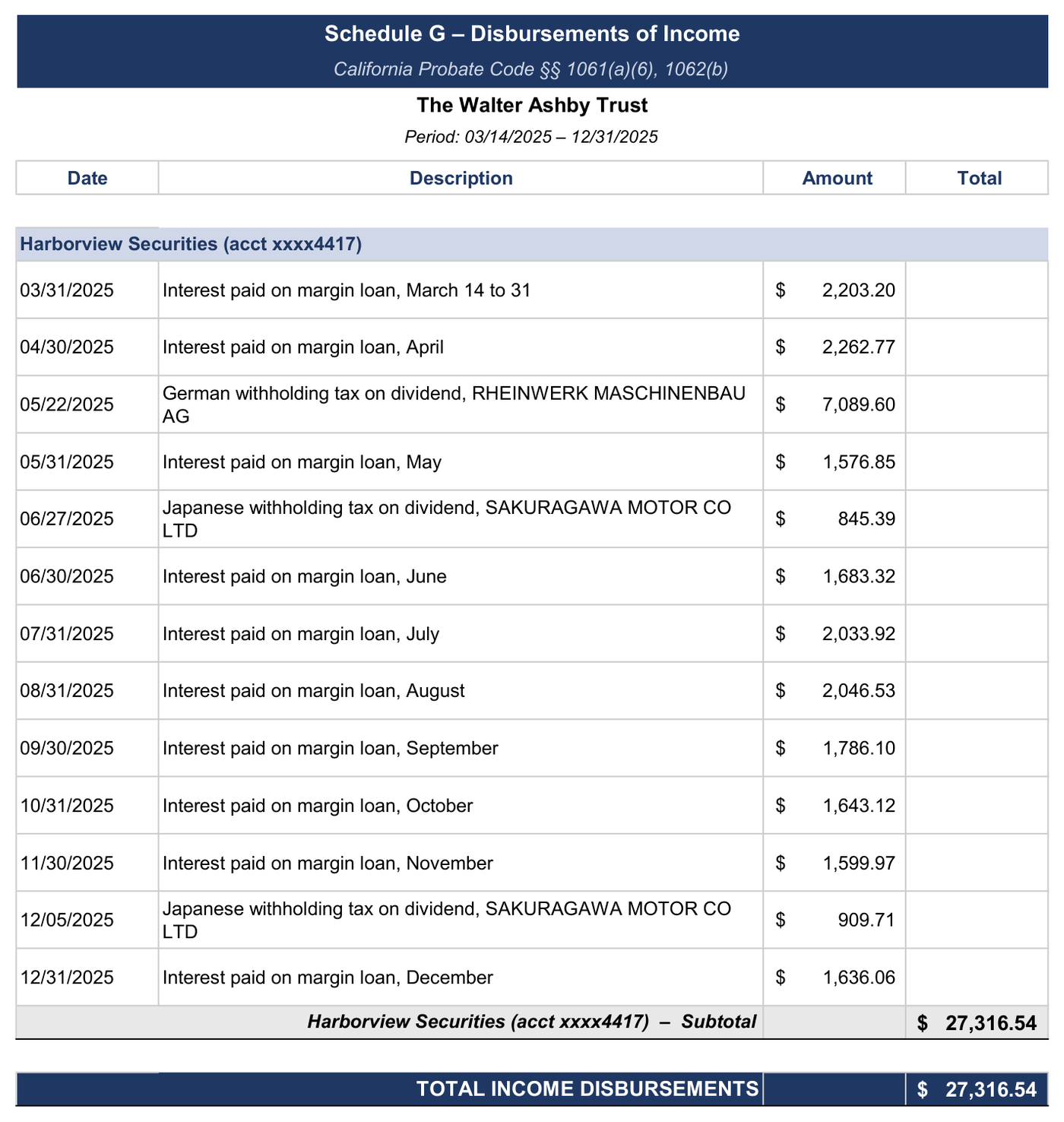
- Margin interest that the broker adds to the debit balance is an income charge paid with principal's borrowing. When principal later repays it, principal has paid income's expense. Show income's obligation to reimburse principal in the principal and income schedule (§ 1063(c)); the act permits that reimbursement for "An amount chargeable to income but paid from principal because income is not sufficient" (§ 16364(b)(1)).
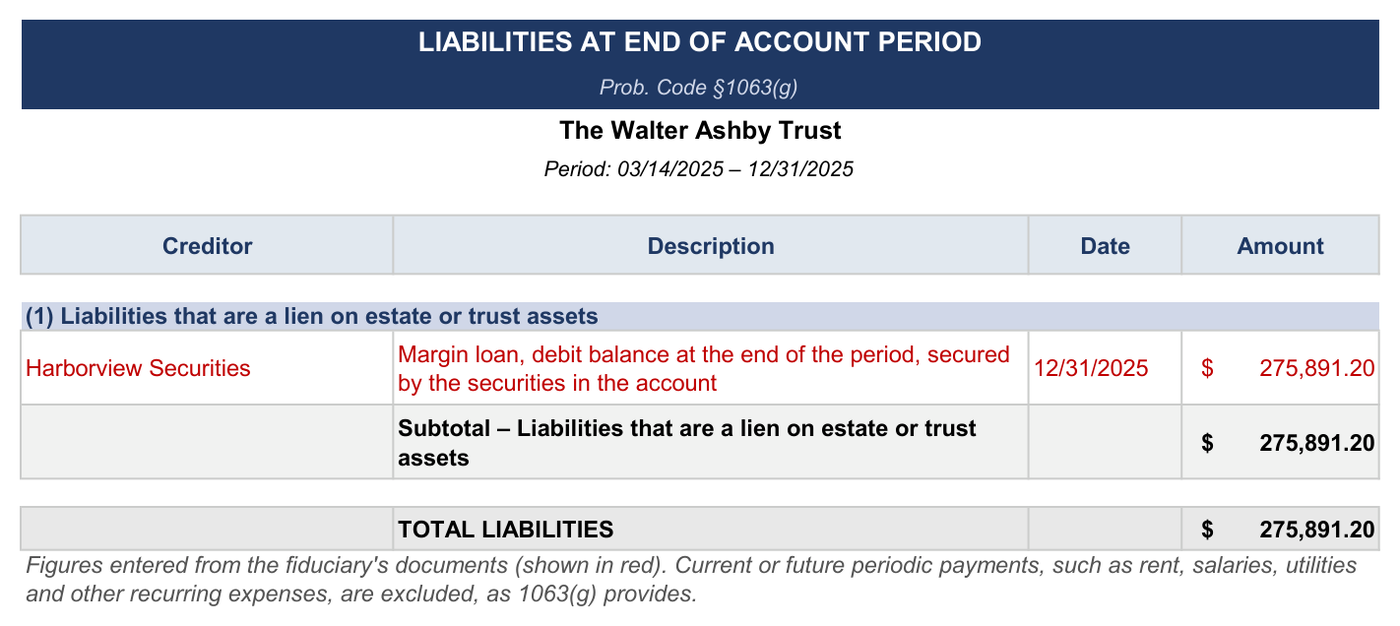
- Any balance still owed at the end of the period appears in the liabilities schedule, which speaks only to liabilities "at the end of the accounting period" (§ 1063(g)).
Done this way, a reader sees what the trust owned, what it owed, every dollar borrowed and every dollar repaid.
2. Margin interest goes to income; the first charge after death is a judgment call. Margin interest is interest, so it is an income disbursement (§ 16360(c)). But the first charge after death covers days before death. The act apportions by due date: a disbursement due before the income interest begins is principal, and a periodic item due on or after that date is income (§ 16376(a), (b)). An asset received because of a death becomes subject to the trust on the date of death (§ 16375(b)(2)).
Whether margin interest has a due date depends on the account agreement. An item is due "on the date the payor is required to make a payment. If a payment date is not stated, there is no due date" (§ 16376(e)). If the agreement fixes a monthly payment date, the first post-death charge belongs to income in full. Many brokers simply add interest to the debit balance with no required payment date. The item then accrues "from day to day," and the portion for the days before death is principal (§ 16376(c)). Read the agreement, apply the matching rule, and explain it, because Helen's counsel will look (§ 1064(a)(2): "An explanation of any unusual items appearing in the account").
3. The open short sale is an obligation, and the cash it produced is an asset. A short sale leaves the account holding cash from the sale and an obligation to return borrowed shares. At death, the cash is on the beginning schedule of property on hand. The obligation to deliver 4,000 shares is disclosed at the shares' value on the date of death. It is not a negative asset.
When the trustee buys the shares back in June, split the payment into its two parts so nothing is counted twice:
- The amount equal to the date-of-death value of the obligation retires a liability that existed at death. Report it as a principal disbursement.
- Any excess is the trust's loss on closing the position (if the repurchase cost less, the difference is a gain). Report it with its calculation on the gains or losses schedule (§ 1062(d)).
Measuring against the date-of-death value is a fiduciary-accounting method, not a tax rule. The income tax basis rule for inherited property (26 U.S.C. § 1014(a)(1)) applies to property, and a short obligation is not property, so the account result and the tax result will differ. Tell the CPA.
Payments the trust made to the share lender in place of dividends while the short was open are disbursements, shown with their nature and payee (§ 1062(b)) and allocated under whichever reading below the trustee adopts.
The art: allocating the short sale between income and principal. The act does not name short sales. Two readings are defensible, and the choice is the trustee's:
- The derivative reading. A short position is an arrangement whose value is "dependent on or derived from an underlying tangible or intangible asset," so it is itself a derivative (§ 16353(a)). The act's catch-all for unnamed instruments (§ 16355) speaks only to receipts, and every short-sale item in the trust period here is a disbursement, so this reading rests on section 16353 applying directly: 10 percent of disbursements in connection with the transaction go to income (§ 16353(b)). Be precise about what the 10 percent applies to. Applied literally to the whole June repurchase price, it would charge Helen with a tenth of retiring a liability that existed before her interest began. In our judgment the better application, a reasoned departure from the literal text that should be disclosed as such, is to the amounts that arose during the trust period: the excess cost of closing and the payments in lieu of dividends.
- The principal reading. Closing the short retires a liability of principal, and a disbursement the act does not allocate is charged to principal (§ 16325(c)(2)).
The derivative definition is broad enough to include "stocks" themselves (§ 16353(a)), so the fit alone does not settle the question. Whichever reading is chosen, apply it consistently and state it in the report. A trustee's allocation "is presumed to be fair and reasonable to all beneficiaries" (§ 16325(b)), and a court may not change it unless it was "an abuse of the fiduciary's discretion" (§ 16326(b)). That presumption protects a trustee who explained the choice far better than one whose choice is discovered by opposing counsel.
4. Foreign dividends: report the gross dividend and the tax. Each foreign dividend is reported as a receipt at its gross amount, converted to dollars, with the foreign withholding shown as a separate disbursement. The dividend is income (§ 16340(c)). The withholding is a tax based on a receipt allocated to income, so it is paid from income (§ 16365(a)). Reporting the net figure understates income, understates taxes paid, and buries any claim for a refund under a tax treaty. If a refund later arrives, the logic of section 16365 points to income, because the tax it reverses was charged to income. Explain the treatment in the report, since the act does not address foreign taxes directly.
5. Currency: one method, applied the same way everywhere. The account is kept in dollars. The working rules we apply:
- Foreign assets on hand at death are valued in dollars at the exchange rate on the date of death. That value is their carry value. (For income tax purposes the basis of property acquired from a decedent is generally its fair market value at the date of death, 26 U.S.C. § 1014(a)(1), which keeps the account and the tax records aligned for these assets.)
- When foreign shares are sold, the gain or loss is the dollar proceeds at the sale date's rate less the dollar carry value. The result captures both price and currency movement in one figure on the gains or losses schedule (§ 1062(d)). If the currency effect is large, a short note splitting the two helps the reader.
- Foreign cash is itself an asset with a carry value. When €41,300 carried at the date-of-death rate is converted to dollars in September at a different rate, the difference is a gain or a loss on a change in form of a principal asset, reported like any other (§ 16343(b), § 1062(d)).
- Foreign dividends are converted at the rate on the day they are received. If income is held in foreign currency for months before conversion, the act does not say who bears the currency gain or loss on that income cash. It is a judgment call: one view follows the cash, so the income beneficiary bears the gain or loss on her own cash; another treats it as principal by default. The far better practice is to convert income promptly, or segregate it, and say what was done.
Do not import the federal tax treatment into the trust accounting. For income tax, foreign currency gain or loss "attributable to a section 988 transaction" is computed separately and treated as ordinary income or loss (26 U.S.C. § 988(a)(1)(A)). The trust accounting answers a different question: what belongs to principal and what to income. The Probate Code makes the separation explicit for business income, where net income and net loss are used "in accordance with general accounting principles" and the summary need not reflect "'net income' and 'net loss' as reflected in the tax returns" (§ 1061(d)). Keep the tax analysis in the tax summary for the CPA.
6. The April margin call: disclose it before anyone asks. The broker's forced sales were sales by the trust. Each is reported on the gains and losses schedule with its date, proceeds, carry value and result (§ 1062(d)). The petition or report must describe transactions "not otherwise readily understandable from the schedule" and explain "any unusual items" (§ 1064(a)(1), (2)). A margin liquidation is both. Say when the call was issued, its amount, what the trustee did and why, and what the broker sold.
Disclosure and the three-year clock
This account will be read by an adversary. Under section 16460(a)(1), a beneficiary's claim for breach of trust is barred unless brought within three years after receiving an account or report that "adequately discloses the existence of a claim," meaning one that "provides sufficient information so that the beneficiary knows of the claim or reasonably should have inquired into the existence of the claim." An account that shows the margin loan, the short position, the currency conversions and the forced sales plainly starts that clock. A net, unexplained account may not; the period then runs only from when the beneficiary "discovered, or reasonably should have discovered, the subject of the claim" (§ 16460(a)(2)).
Where the trust instrument allows it, the trustee may go further: serve the account with the statutory notice in "12-point boldface type" and an objection period of "not less than 180 days," which bars later objections to items "adequately disclosed" (§ 16461(c), (e)). Gross presentation and full explanation are not only good practice. They are what makes those protections work.
The sample accounting
The facts above, as Balanced builds them: Walter's account shown gross, every margin advance and repayment, the interest split at the date of death, the margin-call sales, the short sale closed in June, the foreign dividends with their withholding, and the September currency conversion. The trust, the broker and every security are fictional. Select any sheet to see it full size.
Schedule A: everything Walter owned, gross
Every asset at its date-of-death value in dollars, $3,764,866.80 in all: the foreign shares and foreign cash at that day's rates, and the $600,000 cash from the open short sale. The $612,000 margin loan and the obligation to return 4,000 borrowed shares, worth $640,000 at death, are disclosed in the notes, not netted.
Schedule F: repayments and the short sale, charged to principal
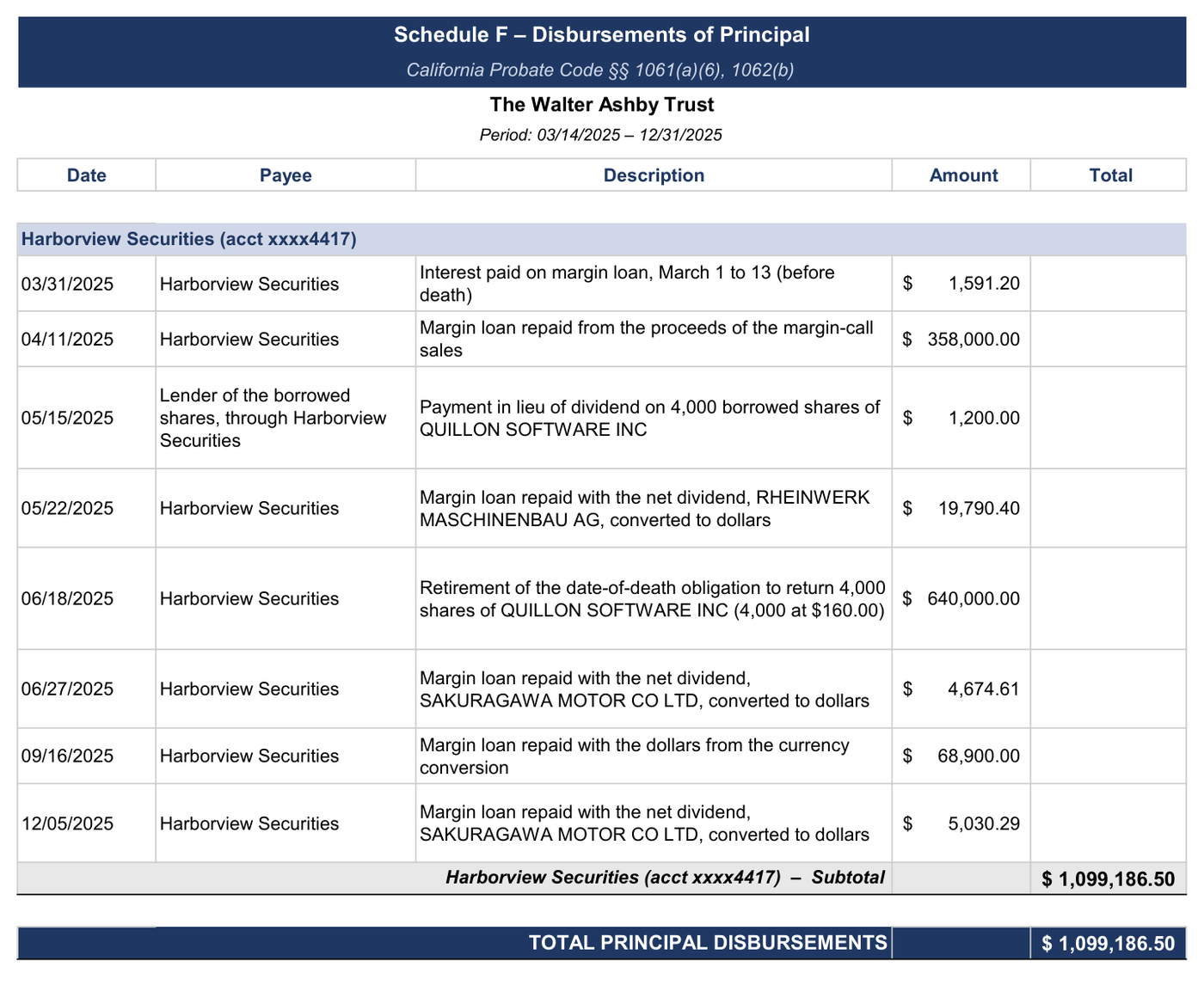
Every repayment of margin debt, the $640,000 that retired the short-sale obligation that existed at death, the $1,200 payment in lieu of a dividend, and the $1,591.20 of March interest for the days before death, which accrued day to day.
Schedule D: the margin-call sales and closing the short
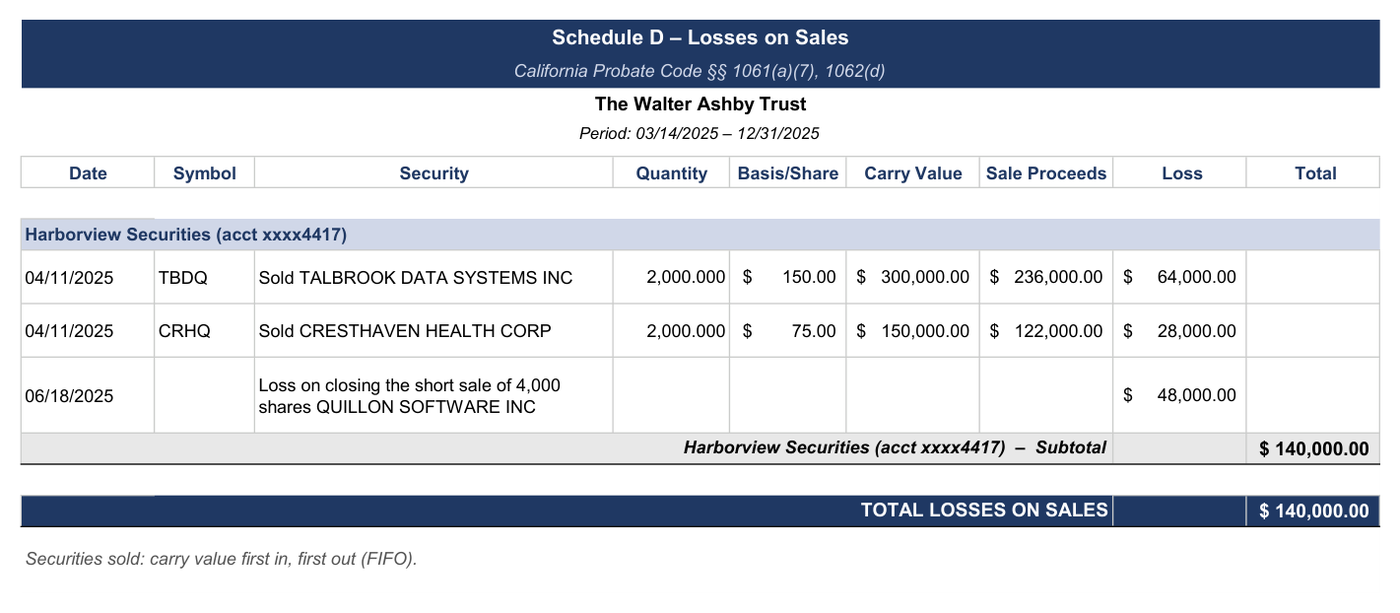
The broker's April sales, each at its carry value, with losses of $64,000 and $28,000. Then the short: $688,000 to buy back the shares, less the $640,000 obligation at death, a loss of $48,000.
Schedule C: converting the foreign cash
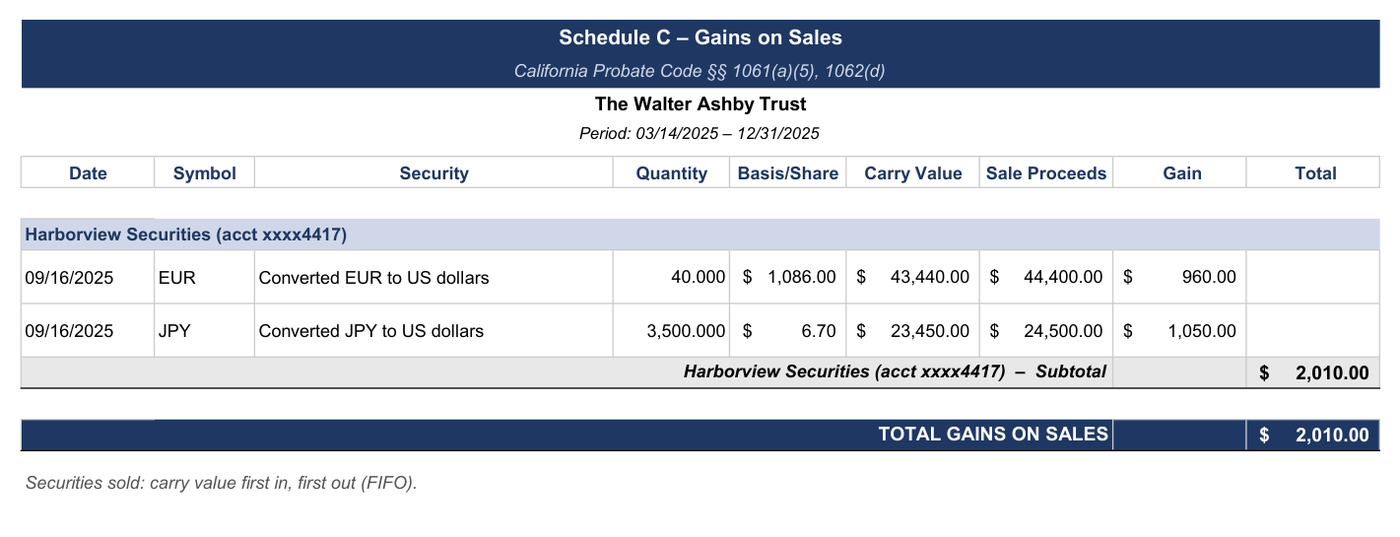
Euros and yen carried at the date-of-death rate and converted in September, for gains of $960 and $1,050.
Schedule G: margin interest and foreign tax, charged to income
Margin interest after death, month by month, and the tax withheld from each foreign dividend, shown on its own line. The German dividend is reported at its gross $26,880; the $7,089.60 withheld appears here.
Principal and income
Margin advances are principal receipts; interest and withholding are charged to income; every short-sale item is charged to principal, the reading this trustee chose. Helen's net income, $11,023.46, is distributed at year end.
The margin loan still owed
The balance owed to the broker at year end, $275,891.20, on the liabilities schedule.
Download the sample accounting (PDF)
Checklist
- Beginning property at gross date-of-death value in dollars (§ 1061(a)(1)); margin balance at death disclosed; debt still owed at year end in the liabilities schedule (§ 1063(g)).
- New borrowings as principal receipts; repayments as principal disbursements (§ 16361(a)(4)); margin interest to income (§ 16360(c)), with the first charge after death apportioned under § 16376 according to the account agreement.
- Short position: repurchase split between retiring the date-of-death obligation and the gain or loss on closing; allocation reading chosen (§§ 16353 and 16355, or § 16325(c)(2)), applied consistently and stated.
- Foreign dividends gross, withholding as a separate income disbursement (§ 16365(a)).
- Currency converted at the rate on each event date; conversion gains and losses reported (§ 1062(d)).
- Market values at year end, including foreign holdings at the year-end rate (§ 1063(a)).
- Report explains the margin call, the forced sales, the short sale and every judgment call (§ 1064(a)(1), (2)).
The Law and the Art of Fiduciary Accounting is a series by Balanced Legal Technology, LLC on complex California fiduciary accountings. General information only, current as of October 2026; not legal, tax or accounting advice. Statutes and rules change; confirm current law before relying on it.
About the author
Marc Joyce is a licensed, practicing California trusts and estates attorney, and the founder and developer of Balanced. He brings both sides to the problem: as a lawyer, and as an engineer. The Law and the Art of Fiduciary Accounting is his series on the hard cases where the two meet.