
This free Excel template is for the account of a California decedent’s estate, in the Probate Code §1061 format: a summary of charges and credits that must be equal, linked to a sheet for each schedule, plus a worksheet for the statutory compensation of the personal representative and the attorney (§10800, §10810). The final account is filed with the petition for final distribution when the estate is in a condition to be closed (§10951).
What the template is
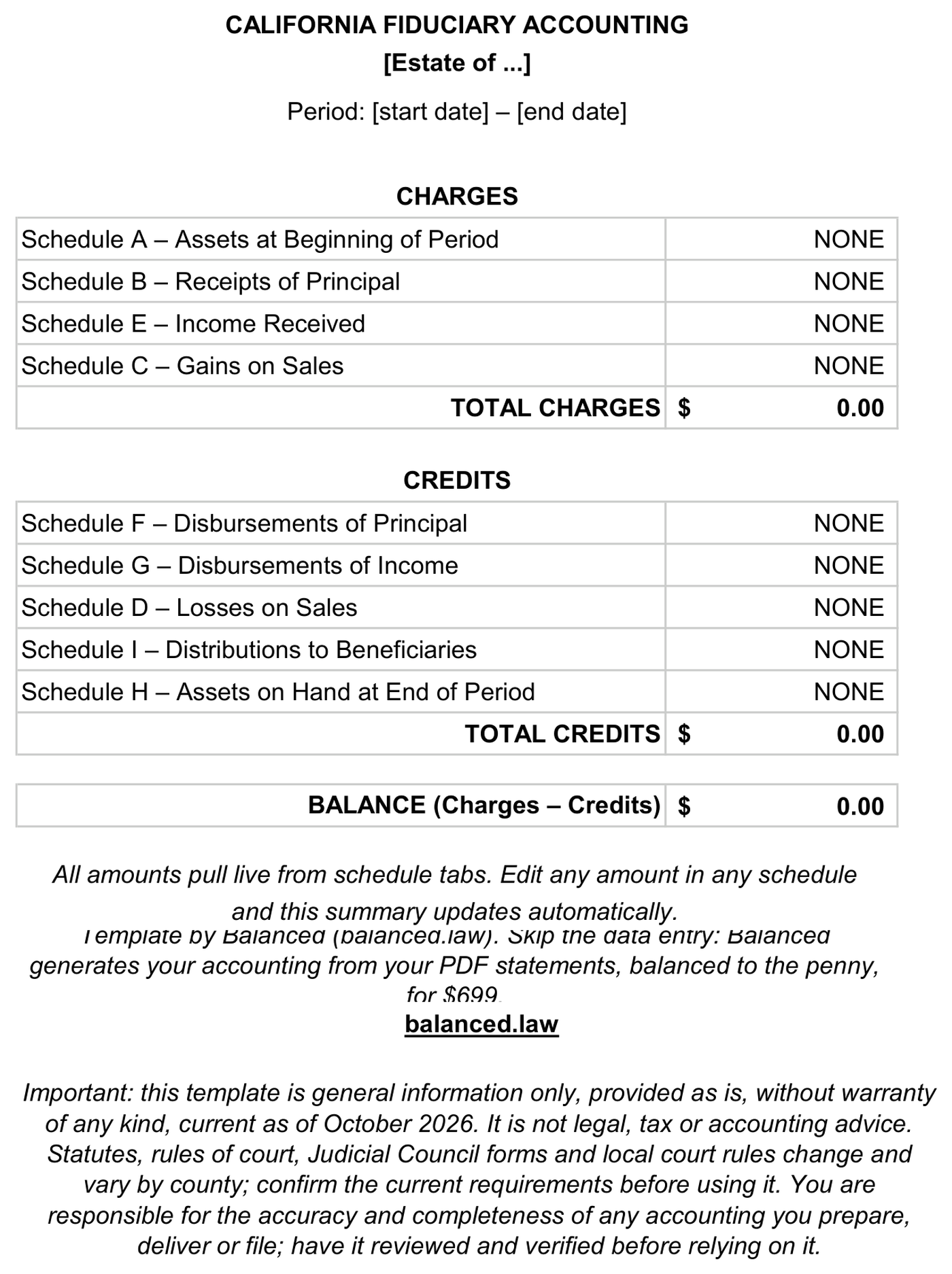
A free Excel workbook for the account of a decedent’s estate: the final account an executor or administrator files with the petition for final distribution when the estate is in a condition to be closed (Prob. Code §10951), or an account the court orders during administration (§10950). It is laid out the way a California court accounting is organized under Probate Code §§1060–1064: a summary of charges and credits, followed by a sheet for each supporting schedule. The summary is already linked to each schedule, so its totals and the balance line update as you enter amounts.
Download the free Excel template
What is in it
- The summary of account: charges, credits and the balance
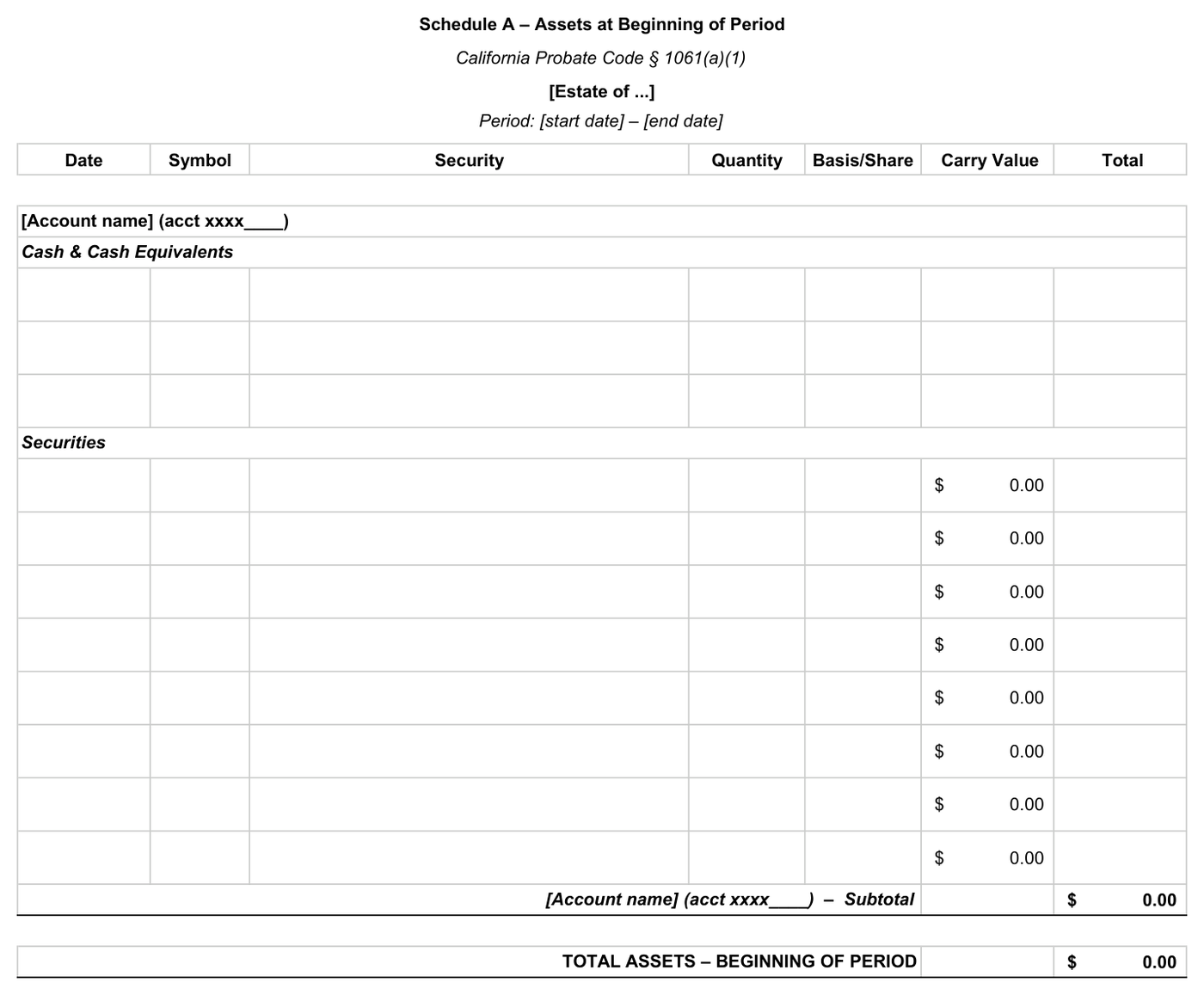
- Schedule A: property on hand at the beginning of the period
- Schedules B and E: receipts of principal and income received
- Schedules C and D: gains and losses on sales
- Schedules F and G: disbursements of principal and of income
- Schedule I: distributions
- Schedule H: property on hand at the end of the period
- Changes in form of assets (§1063(b))
- A statutory compensation worksheet: the fee base, which is the value of the estate accounted for (§10800(b)), and the statutory percentages for the personal representative and the attorney (§§10800(a), 10810)
Schedules an estate account may also need
Depending on the will and the estate, the account may also need a schedule of specifically devised property (§1063(d)), interest paid or payable on general pecuniary gifts, annuities and similar gifts (§1063(e)), the proposed distribution (§1063(f)) and the estate’s liabilities (§1063(g)), and an allocation between principal and income if the estate will be distributed to an income beneficiary (§1063(c)). They depend on the facts of each estate, so the blank template leaves them out. See the sample probate accounting for how they look.
When an account is not required
The personal representative is not required to file an account if, as to each person entitled to distribution, one of the conditions of §10954(a) is met, such as a written waiver of account, or a written acknowledgment that the person’s interest has been satisfied, executed and filed by or for that person (§10954(b)). Even then, a final report of administration must be filed at the time the final account would otherwise have been required (§10954(c)).
The work behind the template
A template supplies the format. The account itself requires each deposit, withdrawal, dividend, fee, purchase and sale on each statement for the period to be classified to its proper schedule; each security’s carry value to be followed, lot by lot, through purchases, sales and corporate actions; gains and losses to be calculated from carry value rather than the cost basis the brokerage reports; and the summary of charges and credits to balance exactly. For an estate with several accounts, that is days, weeks or even months of manual work, and an account that does not balance must be reconciled transaction by transaction until the discrepancy is found.
The summary, line by line
| Side | Summary line | Where the law requires it |
|---|---|---|
| Charges | Property on hand at the beginning of the period | §1061(a)(1) |
| Charges | Assets received during the period that were not on hand when administration began | §1061(a)(2) |
| Charges | Receipts of income or principal | §1061(a)(3); detail §1062(a) |
| Charges | Net income from a trade or business | §1061(a)(4); detail §1062(c) |
| Charges | Gains on sales or other dispositions | §1061(a)(5); detail §1062(d) |
| Credits | Disbursements | §1061(a)(6); detail §1062(b) |
| Credits | Losses on sales or other dispositions | §1061(a)(7); detail §1062(d) |
| Credits | Net loss from a trade or business | §1061(a)(8); detail §1062(c) |
| Credits | Distributions | §1061(a)(9); detail §1062(e) |
| Credits | Property on hand at the end of the period | §1061(a)(10); detail §1062(f) |
How to use the template
- For a first account, enter the property on hand at the beginning from the inventory and appraisal; for a later account, from the prior account’s ending property.
- Enter each receipt with its nature or purpose, source and date, and each disbursement with its nature or purpose, payee and date.
- Enter sales that produced a gain or a loss, measured from carry value.
- Enter distributions, with property at its carry value.
- Enter the property on hand at the end, itemized at carry value.
- Check that total charges equal total credits.
- Complete the compensation worksheet from the estate accounted for: the inventory value, plus gains over appraisal value on sales, plus receipts (shown on the rule 7.705(a) fee computation as receipts excluding principal), less losses from appraisal value on sales.
When the account is filed
The court may order an account at any time, and must order one on the petition of an interested person if more than a year has passed since the last account or, with no prior account, since letters were issued (§10950). The final account goes with the petition for final distribution when the estate is in a condition to be closed (§10951). Within one year after letters, or 18 months if a federal estate tax return is required, the personal representative petitions for final distribution or reports on the status of administration (§12200).
What to gather before you start
- Each account’s statements for the whole period, plus the statement for the month before the period begins, so the opening balances can be confirmed.
- For a first account of an estate, the inventory and appraisal; for any later account, the prior account, because its ending property is this account’s beginning property.
- Records of sales and purchases of securities and real property, including closing statements.
- Records of distributions, and of fees paid to the fiduciary and to attorneys.
Checking your work
- Total charges equal total credits (§1061(c)).
- The property on hand at the end matches the closing statements, account by account.
- The beginning property matches the prior account’s ending property, or the inventory and appraisal for a first account.
- Each gain or loss is measured from carry value, not from the cost the brokerage reports.
- Transfers between the fiduciary’s own accounts appear on both sides, or on neither.
Common questions
When is the final account due?
It is filed with the petition for final distribution when the estate is in a condition to be closed (Probate Code section 10951). Within one year after letters, or 18 months if a federal estate tax return is required, the personal representative petitions for final distribution or reports on the status of administration (section 12200).
Can the beneficiaries waive the account?
Yes, under the conditions of Probate Code section 10954(a), such as a written waiver of account executed and filed by each person entitled to distribution. A final report of administration is then filed instead (section 10954(c)).
How is the statutory fee computed?
As a percentage of the estate accounted for: 4 percent of the first $100,000, 3 percent of the next $100,000, 2 percent of the next $800,000, 1 percent of the next $9 million and one half of one percent of the next $15 million, with a reasonable amount set by the court above $25 million (Probate Code sections 10800 and 10810).
Why are some estate schedules not in the blank template?
Schedules such as specifically devised property, interest on general pecuniary gifts, the proposed distribution and liabilities depend on the will and the estate (Probate Code section 1063), so the blank template leaves them out. The sample probate accounting shows how they look.
Generate the accounting with Balanced
Balanced does the conversion in a fraction of the time and cost. From the estate’s PDF bank and brokerage statements, Balanced converts and organizes the statement data into this format exactly as the statements show it, using disclosed, standard accounting conventions you can change; everything beyond that comes from your own instructions. Transactions are classified to their schedules, carry values tracked lot by lot, each account reconciled to its own statements, the summary balanced to the penny, and each entry cited to the statement and page it came from, delivered as one fully editable Excel workbook. $699 per accounting.