 Balanced
A California court accounting is a fiduciary’s account filed with the superior court for approval: a probate estate’s account, a conservator’s or guardian’s account, or a trustee’s account brought before the court. It follows Probate Code sections 1060 to 1064, filing it is treated as a petition for its approval (§1064(b)), notice of the hearing goes to the interested persons, and the court approves it by order once any objections are resolved.
Have the statements? Balanced converts and organizes the data on them into this accounting, in the Probate Code format, as one editable Excel workbook balanced to the penny. Scanned or incomplete statements work.
- Developed by a California trusts and estates attorney
- Works with any PDF statement, downloaded or scanned
- Statement entries are cited to the PDF and page they
came from, for easy verification - A fully editable Excel workbook, emailed in about 1 hour
$699 Flat. No Subscription. No Install.
This has by far been the best user-experience and I’ve been really impressed with your product thus far.
Kelsey B. Cooper, Esq., California Estate Planning Services PC
The three kinds of court accounting
| Probate estate | Conservatorship or guardianship | Trust | |
|---|---|---|---|
| Who accounts | The executor or administrator | The conservator or guardian of the estate | The trustee |
| When it reaches the court | A final account when the estate can be closed (§10951), and any account the court orders (§10950) | One year after appointment, then at least every two years (§2620(a)) | Only on a petition, for example to settle the account or to compel one (§17200(b)(5), (b)(7)(C)) |
| Format | Probate Code 1060 to 1064, with a report of administration (§10900) | Probate Code 1060 to 1064 on the GC-400 or GC-405 forms (rule 7.575) | Probate Code 1060 to 1064 (§16063(b)) |
| Notice of hearing | At least 15 days (§1220, §11000) | At least 15 days (§2621, §1460) | At least 30 days (§17203) |
The account itself, its summary and schedules, is the same in all three; see fiduciary accounting for how it is built. This page is about what happens around it in court. For the estate side step by step, see how to do a probate accounting in California.
When the court requires an accounting
Probate estates
The personal representative files a final account and a petition for final distribution when the estate is in a condition to be closed (§10951). The court may order an account at any time, on its own motion or on an interested person’s petition, and must order one on a petition made more than one year after the last account was filed or, if none has been filed, more than one year after letters issued (§10950(a), (b)). A personal representative who resigns or is removed accounts within 60 days after their authority ends, unless the court extends the time (§10952). Within one year after letters issue (18 months if a federal estate tax return is required), the personal representative must petition for final distribution or report on the status of administration (§12200). The account may be waived if each person entitled to distribution signs and files a written waiver or acknowledges in writing that their interest is satisfied, among other conditions, but a final report of administration is still filed (§10954).
Conservatorships and guardianships
The conservator or guardian of the estate presents an account one year after appointment and at least every two years after that, or more often if the court orders (§2620(a)). For a very small estate the court may waive the account: the net value, not counting the residence, must be under $15,000 at the beginning and end of the period, the monthly income (not counting public benefits) under $2,000, and all income not kept must have been spent for the conservatee or ward (§2628(a)). When an account is not filed on time, the court must give written notice directing the conservator or guardian to file the account and set it for hearing within 30 days (§2620.2(a)); a continued failure can lead to contempt, removal, suspension of powers or other orders (§2620.2(b), (c)).
Trusts
Most trustees account to the beneficiaries without a court. A beneficiary may petition to compel an account if the trustee has not provided a requested account within 60 days after a written request and no account was made in the six months before (§17200(b)(7)(C)), and a trustee or beneficiary may petition the court to settle the accounts and pass on the trustee’s acts (§17200(b)(5)). An account presented for court approval follows the Probate Code 1060 to 1064 format (§16063(b)). See California trust accounting and responding to a beneficiary’s demand.
The papers the court receives
- The account: the summary of charges and credits and its supporting schedules, in the format of Probate Code 1060 to 1064, with total charges equal to total credits (§1061(c)).
- The petition or report, which must describe transactions that are not readily understandable from the schedules, explain unusual items, state compensation paid to the fiduciary or the attorneys other than under a prior court order, disclose family or affiliate relationships with agents the fiduciary hired, and say whether all cash has been invested as the law allows (§1064(a)). Filing the account is treated as a petition for its approval, and requests such as fees may be joined with it (§1064(b)).
- In a probate estate, a report of administration, including a statement of liabilities: whether notice to creditors was given, each creditor claim filed and what was done with it, and any claim not yet paid (§10900).
- In a conservatorship or guardianship, the supporting documents: the statements showing each account’s balance at the closing date; for a first account, also the statements showing each balance immediately before appointment; the escrow closing statement for any real property sold; and the bills of a residential or long-term care facility (§2620(c); rule 7.575(b)).
Probate estates often file one account at the end, as the first and final account and report.
Notice of the hearing
In a probate estate, notice of the hearing on the account is delivered at least 15 days before the hearing (§1220(a)) to the persons listed in §11000: those named in §1220, each known heir and devisee whose interest would be affected, the Attorney General if part of the estate would escheat to the state, and, in an insolvent estate, each creditor with an allowed or approved claim that is unpaid. If the petition asks for compensation, or the account is a final account filed with a petition for final distribution, the notice must say so (§11000(b), (c)).
In a conservatorship or guardianship, notice is given as provided in §1460 and following (§2621): at least 15 days before the hearing, to the conservator or guardian, the conservatee or ward, the spouse or domestic partner, and anyone who has requested special notice (§1460(a), (b)).
On a trust petition, notice of the hearing is delivered at least 30 days before the hearing to all trustees and all beneficiaries, and to the Attorney General for a charitable trust subject to the Attorney General’s jurisdiction (§17203(a)).
Delivery is by first-class mail, personal delivery or, for a person who has consented, electronic delivery (§1215). Your court’s local rules may add requirements.
Objections
An interested person may object to an account in writing at or before the hearing, or orally at the hearing; the court then either decides the objection at the hearing or continues the hearing so it can be made in writing (§1043). In a probate estate, any matter relating to the account may be contested for cause shown, including an allowed or approved claim not reported in a previous account, the value of property for distribution, and acts the personal representative took without prior court authorization, subject to the Independent Administration of Estates Act (§11001).
An account that is clear, complete and traced to its statements leaves less to object to. Each figure an objector can tie to a statement page is one that does not need to be argued.
What the judge and the probate examiner look for
Before the hearing, the court reviews the file; in some courts a probate examiner does this first. The Judicial Council was directed to develop guidelines to help investigators and examiners review accountings and detect fraud (§2620.1). The checks follow the statute. A reviewer will typically look at:
- Whether the summary balances: total charges equal total credits (§1061(c)).
- Whether the beginning ties: to the inventory and appraisal for a first account, or to the prior account’s ending property for a later one (§1061(a)(1)).
- Whether the ending cash ties to the statements filed with the account, in a conservatorship (§2620(c)(2)).
- Whether every receipt and disbursement shows what the schedules require: the nature or purpose, the source or payee, and the date (§1062(a), (b)).
- Whether fees were paid under a court order, and whether any paid without one are disclosed (§1064(a)(3)).
- Whether cash was kept invested, unusual items explained, and transactions that are hard to follow described (§1064(a)).
- Whether the market value schedule is there (§1063(a)), and, in a conservatorship, whether the right form set was used (rule 7.575).
- Whether notice was given to the right people, for the right number of days.
Some courts post the examiner’s notes before the hearing so that defects can be corrected first. The Superior Court in Stanislaus County, for example, aims to post its probate notes five calendar days before the hearing, says defects must be corrected before the papers are approved, and asks that documents curing them be filed no later than five court days before the hearing. Practice differs by county: check your own court’s website and local rules.
At the hearing and after
In a probate estate, the court may hold any hearing needed to settle the account, may cite the personal representative to appear for examination, and may appoint a referee to examine the account and report on it (§11002). When the court is satisfied, it approves the account by order, together with any requests joined with the petition, such as fees or, on a final account, distribution. If the examiner’s notes or an objection raise something that cannot be resolved at the hearing, the court may continue it to give time for a supplement or a corrected account.
Preparing the account
Most of the work in a court accounting is the account itself: every statement for the period and the one before it, each transaction classified to its schedule, carry values tracked asset by asset, gains and losses measured from carry value, each bank and brokerage account reconciled to its own statements, and a summary in which the two sides are equal. The guides for each kind:
- California probate accounting and the probate accounting example
- Conservatorship accounting, how to fill out the GC-400 and the GC-400 accounting example
- California trust accounting and the trust accounting example
To check dates, use the deadline calculator; for the money side, see what a California court accounting costs. If you are the fiduciary, start from your role: executors, trustees, conservators. To prepare and check the account step by step, use the printable California court accounting checklist.
Praise for Balanced
“This has by far been the best user-experience and I’ve been really impressed with your product thus far.”
“I’d also just like to say that I was a trusts & estates paralegal for 6 years prior to becoming an attorney myself, so I’ve done hundreds of accountings manually. I’ve also tried countless other ‘trust accounting’ products. This has by far been the best user-experience and I’ve been really impressed with your product thus far. Myself and my firm will be repeat customers.”
California Estate Planning Services PC
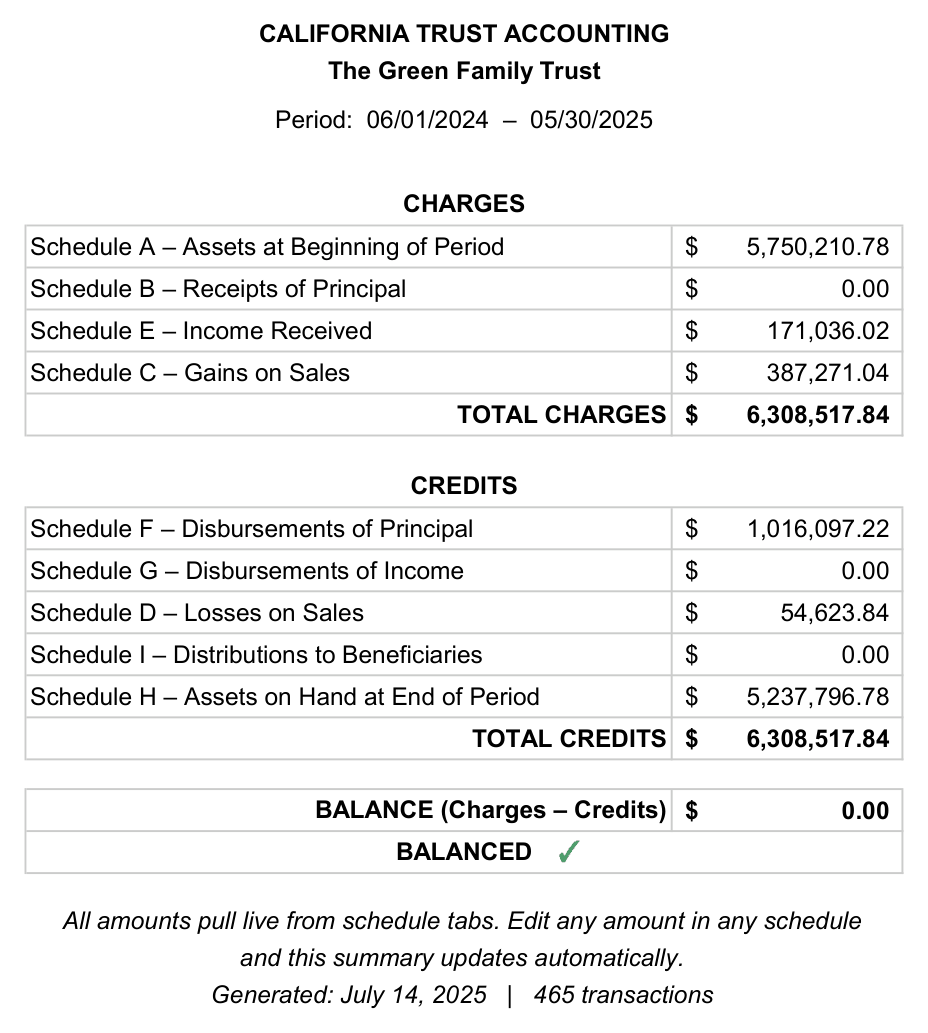
Inside a real Balanced workbook
$699 Flat. No Subscription. No Install.
Common questions
What is a court accounting in California?
A fiduciary's account filed with the superior court for approval: a probate estate's account, a conservator's or guardian's account, or a trustee's account brought before the court. It follows Probate Code sections 1060 to 1064.
When does a California court require an accounting?
In a probate estate, a final account when the estate can be closed and any account the court orders (Probate Code sections 10950 and 10951). In a conservatorship or guardianship, one year after appointment and then at least every two years (section 2620). A trust account comes before the court on a petition (section 17200).
How much notice is required before the hearing on an account?
At least 15 days in a probate estate (Probate Code section 1220) and in a conservatorship or guardianship (sections 2621 and 1460); at least 30 days on a trust petition (section 17203).
Can someone object to an account?
Yes. An interested person may object in writing at or before the hearing, or orally at the hearing (Probate Code section 1043).
What are probate examiner notes?
Some superior courts review each petition before the hearing and post notes listing anything missing or defective, so it can be corrected before the hearing. Timing and procedure vary by county; check your court's website.
What documents are filed with a conservatorship account?
The statements showing each account's balance at the closing date (and, for a first account, immediately before appointment), the escrow closing statement for any real property sold, and care facility bills (Probate Code section 2620(c)).
Is a trust accounting filed with the court?
Usually not. A trustee accounts to the beneficiaries. A trust account goes to the court when a trustee or beneficiary petitions to settle it or to compel one (Probate Code section 17200).
Or have Balanced generate the account
Balanced is a new kind of software for California fiduciary accountings. From the PDF bank and brokerage statements, Balanced converts and organizes the statement data into the Probate Code format, or the GC-400 format for a conservatorship or guardianship, exactly as the statements show it, using disclosed, standard accounting conventions you can change; everything beyond that comes from your own instructions. Transactions are classified to their schedules, carry values tracked lot by lot, gains and losses measured from carry value, each account reconciled to its own statements, the summary balanced to the penny, and each entry cited to the statement and page it came from, delivered as one fully editable Excel workbook for you to review and verify. Scanned or incomplete statements work. Most are generated and delivered in about 1 hour. $699 per accounting.
For a finished estate accounting example, see the sample first and final account for a fictional decedent’s estate, every schedule filled in; a blank probate accounting template in Excel is free.
Ready to generate yours? Add the PDF statements for the accounting period. Your PDFs stay on your computer.
$699 Flat. No Subscription. No Install.