 Balanced
To do a California probate accounting, gather every statement for the period and the statement before it, start from the inventory and appraisal, and build a summary of charges and credits supported by schedules in the format of Probate Code sections 1060 to 1064, with each asset at its carry value and the two sides equal. The account is filed with a report of administration, usually with the petition for final distribution, and notice of the hearing is given at least 15 days ahead.
Have the statements? Balanced converts and organizes the data on them into this accounting, in the Probate Code format, as one editable Excel workbook balanced to the penny. Scanned or incomplete statements work.
- Developed by a California trusts and estates attorney
- Works with any PDF statement, downloaded or scanned
- Statement entries are cited to the PDF and page they
came from, for easy verification - A fully editable Excel workbook, emailed in about 1 hour
$699 Flat. No Subscription. No Install.
This has by far been the best user-experience and I’ve been really impressed with your product thus far.
Kelsey B. Cooper, Esq., California Estate Planning Services PC
Step 1: Confirm which account is due, and when
A personal representative (an executor or administrator) files an account when the court orders one, and a final account when the estate is in a condition to be closed (§10950, §10951). The court may order an account at any time, on its own motion or on the petition of an interested person, and must order one on a petition made more than one year after the last account was filed, or, if none has been filed, more than one year after letters issued (§10950(a), (b)). A personal representative who resigns or is removed files an account within 60 days after their authority ends, unless the court extends the time (§10952). And within one year after letters issue, or 18 months if a federal estate tax return is required, the personal representative must either petition for final distribution or make a report of the status of administration (§12200).
Most estates file one account, at the end: the first and final account and report, filed with the petition for final distribution. The account can be waived only under the conditions of §10954, and even then a final report of administration is filed (§10954(c)). To check a date, use the deadline calculator.
Step 2: Set the period the account covers
Every account states the period it covers (§1061(a)). For a first account, the property on hand at the beginning is the value of the property the personal representative initially received; for a later account, it is the property on hand at the end of the prior account (§1061(a)(1)). The summary form in §1061(b) labels that first line “Property on hand at beginning of account (or Inventories).” In a decedent’s estate, those values come from the inventory and appraisal, which lists each item at its fair market value at the time of the decedent’s death (§8802). It is due within four months after letters are first issued, unless the court allows more time (§8800(b)).
The end of the period is usually a recent statement date, so that every account’s closing balance can be tied to a statement.
Step 3: Gather every statement, and the one before the period
The account is built from the statements, so the statements decide what can be shown. For each bank, brokerage and retirement account the estate holds, gather:
- The statement for the month before the period begins. Its ending balance is the opening balance of the period. See why the prior month’s statement matters.
- Every statement in the period, with no month missing. A missing month leaves a gap: the statements on either side show how the balance changed, but not the receipts and disbursements in between. See missing statements and gaps.
- The statement that closes the period.
Also gather the inventory and appraisal and any supplemental inventories; the will; court orders, including orders for fees, sales and preliminary distributions; the creditor claims and what was done with each; escrow closing statements for real property sold; check registers or check images, for payees and purposes; and the prior account, if one was filed.
Every step on one printable page: the California court accounting checklist.
Step 4: Build the summary of charges and credits
The account opens with a summary in the form set out in §1061(b). The two sides:
| Charges | Credits |
|---|---|
| Property on hand at the beginning of the period (§1061(a)(1)) | Disbursements (§1061(a)(6)) |
| Assets received during the period that were not on hand when administration began (§1061(a)(2)) | Losses on sales (§1061(a)(7)) |
| Receipts of income or principal (§1061(a)(3)) | Net loss from a trade or business (§1061(a)(8)) |
| Net income from a trade or business (§1061(a)(4)) | Distributions to beneficiaries (§1061(a)(9)) |
| Gains on sales (§1061(a)(5)) | Property on hand at the end of the period, at carry value (§1061(a)(10)) |
Categories that do not apply need not be shown (§1061(b)). Total charges must equal total credits (§1061(c)): every dollar the estate started with or received is shown as paid out, distributed, or still on hand.
Step 5: Fill in the schedules
Each line of the summary is supported by a schedule (§1062):
- Receipts: each with its nature or purpose, its source and its date (§1062(a))
- Disbursements: each with its nature or purpose, the payee and the date (§1062(b))
- Net income or loss from a trade or business (§1062(c))
- Gains and losses: the calculation for each sale or other disposition (§1062(d))
- Distributions: the date and amount of each, with property distributed at carry value (§1062(e))
- Property on hand at the end: an itemized list, each item at carry value (§1062(f))
When they apply, §1063 adds schedules for the market value of the assets at the end of the period (and at the beginning, for every account after the first), purchases and other changes in the form of assets, an allocation between principal and income when the estate will be distributed to an income beneficiary, specifically devised property, interest paid or payable on certain gifts, the proposed distribution, and liabilities. No change-in-form reporting is required for transfers between cash accounts at financial institutions or money market mutual funds (§1063(b)). Each schedule is shown, with an example, in California probate accounting schedules.
Step 6: Classify every transaction
Work through each statement line by line. A dividend or interest payment is a receipt. A check to a creditor or for an expense of administration is a disbursement. A payment to a beneficiary is a distribution. A purchase of a security turns cash into another asset: a change in form, not a disbursement. A transfer from one estate account to another is neither a receipt nor a disbursement. Getting these wrong is a common reason a draft will not balance. See transfers between the estate’s own accounts and sweep activity on a brokerage statement.
The personal representative is allowed all necessary expenses in the administration of the estate, including necessary expenses in the care, management, preservation and settlement of the estate (§11004). Each one belongs on the disbursements schedule with its purpose, payee and date.
Step 7: Carry each asset at its carry value, and compute gains and losses
The property on hand at the beginning and at the end is stated at carry value, not at market value (§1061(a)(1), (a)(10)). Carry value starts from the value at which the personal representative took the property, usually the inventory and appraisal; purchases are added at cost; and an asset keeps the same carry value until something happens to it, such as a sale. When an asset is sold, the gain or loss is the difference between the proceeds and the carry value of what was sold, and the schedule shows the calculation (§1062(d)). That can differ from the gain the brokerage reports, which is measured from the brokerage’s own cost basis. Market value goes on its own schedules (§1063(a)). More on carry value, and on the carry value of shares sold, lot by lot.
Step 8: Balance the account and tie it to the statements
Two tests. First, total charges must equal total credits (§1061(c)). Second, for each account the estate holds, the opening balance plus that account’s receipts, less its disbursements and distributions, adjusted for its transfers, purchases and sales, must equal the ending balance on its closing statement. A summary that balances only because the ending figure was forced to fit has not passed the second test. If the numbers will not meet, see why a fiduciary accounting won’t balance.
Step 9: Figure the statutory compensation
The petition with the final account commonly asks for the personal representative’s and the attorney’s statutory compensation for ordinary services. Both are figured on the same base, the value of the estate accounted for: the total appraisal of the property in the inventory, plus gains over the appraisal value on sales, plus receipts, less losses from the appraisal value on sales, without reference to encumbrances or other obligations on the property (§10800(b)). The rates are the same for the attorney (§10810):
| Value of the estate accounted for | Rate (§10800(a)) |
|---|---|
| First $100,000 | 4 percent |
| Next $100,000 | 3 percent |
| Next $800,000 | 2 percent |
| Next $9,000,000 | 1 percent |
| Next $15,000,000 | One-half of 1 percent |
| Above $25,000,000 | A reasonable amount determined by the court |
For example, on an estate accounted for at $500,000, the statutory compensation is $4,000 plus $3,000 plus $6,000, or $13,000, for the personal representative, and the same for the attorney. Extraordinary services are compensated separately, in an amount the court determines is just and reasonable (§10801 for the personal representative, §10811 for the attorney). The free California probate accounting template includes a compensation worksheet.
Step 10: Add the report of administration and the petition
An account has two parts: a financial statement in the format of sections 1060 to 1064, and a report of administration (§10900(a)). The report’s statement of liabilities says whether notice to creditors was given under §9050; lists each creditor claim filed, with the date filed, the claimant, the amount and the action taken; and, for each claim not paid, satisfied or adequately provided for, says whether it is due and when, the date any notice of rejection was given, whether the creditor has sued, and any property that secures it (§10900(b)).
The petition, or a report filed with it, also describes sales, purchases, changes in the form of assets and other transactions that are not readily understandable from the schedules; explains any unusual items; states the compensation paid from the estate to the personal representative or the attorneys other than under a prior court order; discloses any family or affiliate relationship between the personal representative and an agent they hired; and says whether all cash has been kept in interest-bearing accounts or other authorized investments, apart from what was reasonably needed for administration (§1064(a)). Filing the account is treated as a petition for its approval, and requests such as compensation can be joined with it (§1064(b)). See a complete sample probate accounting.
Step 11: Give notice of the hearing
Notice of the hearing on the account goes to each person named in §1220, each known heir and each known devisee whose interest in the estate would be affected by the account, the Attorney General if any part of the estate is to escheat to the state and the state’s interest would be affected, and, if the estate is insolvent, each creditor whose allowed or approved claim is unpaid in whole or in part (§11000(a)). If the petition asks for compensation of the personal representative or the attorney, or the account is a final account filed with a petition for final distribution, the notice must say so (§11000(b), (c)).
The notice is delivered at least 15 days before the hearing (§1220(a)), by mail, by personal delivery, or by electronic delivery to a person who has consented to it on the Judicial Council form (§1215). Check your court’s local rules for anything more. What the court checks before approving the account is set out in court accounting in California.
Step 12: At the hearing
Any matter relating to an account may be contested for cause shown, including the validity of an allowed or approved claim not reported in a previous account and not established by judgment, the value of property for purposes of distribution, and acts taken without prior court authorization, subject to §10590 (§11001). The court may conduct any hearing needed to settle the account, may cite the personal representative to appear for examination, and may appoint referees to examine the account and report on it (§11002). A contest brought, or opposed, without reasonable cause and in bad faith can lead to an award of costs and attorney’s fees against the party responsible (§11003).
What a finished accounting looks like
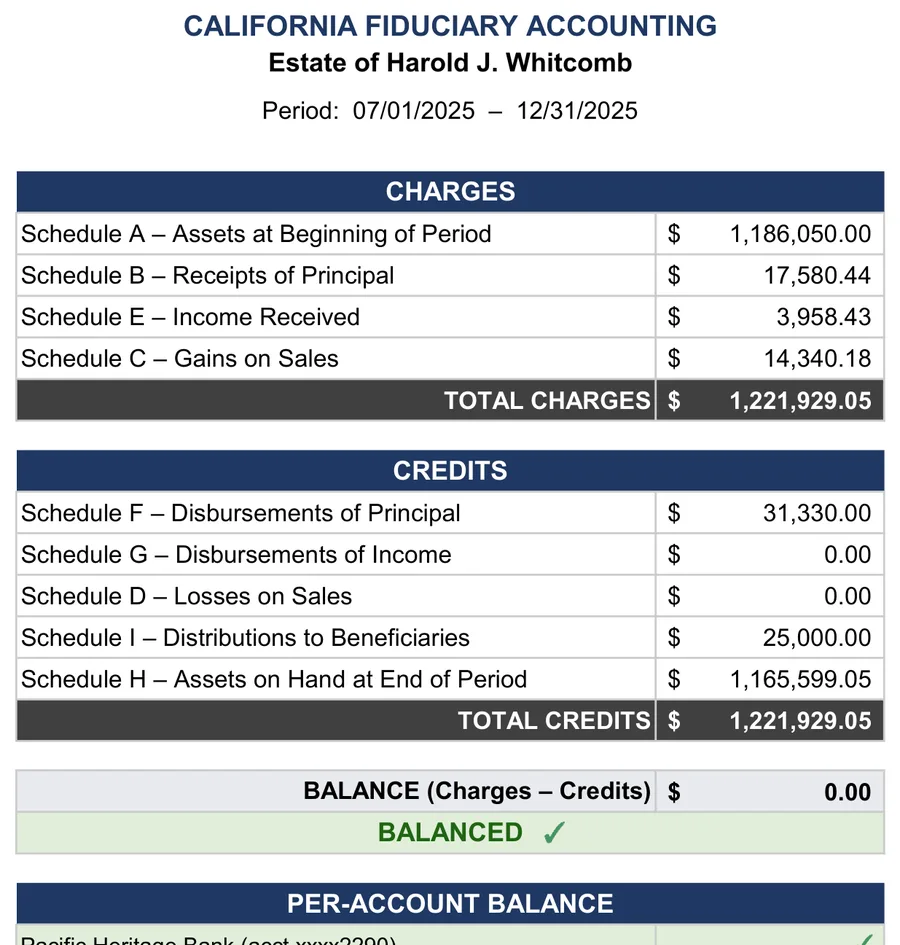
To build one by hand, start from the free California probate accounting template. The law behind each step is set out in California probate accounting: what the court requires and Probate Code 1061 to 1064.
Praise for Balanced
“This has by far been the best user-experience and I’ve been really impressed with your product thus far.”
“I’d also just like to say that I was a trusts & estates paralegal for 6 years prior to becoming an attorney myself, so I’ve done hundreds of accountings manually. I’ve also tried countless other ‘trust accounting’ products. This has by far been the best user-experience and I’ve been really impressed with your product thus far. Myself and my firm will be repeat customers.”
California Estate Planning Services PC
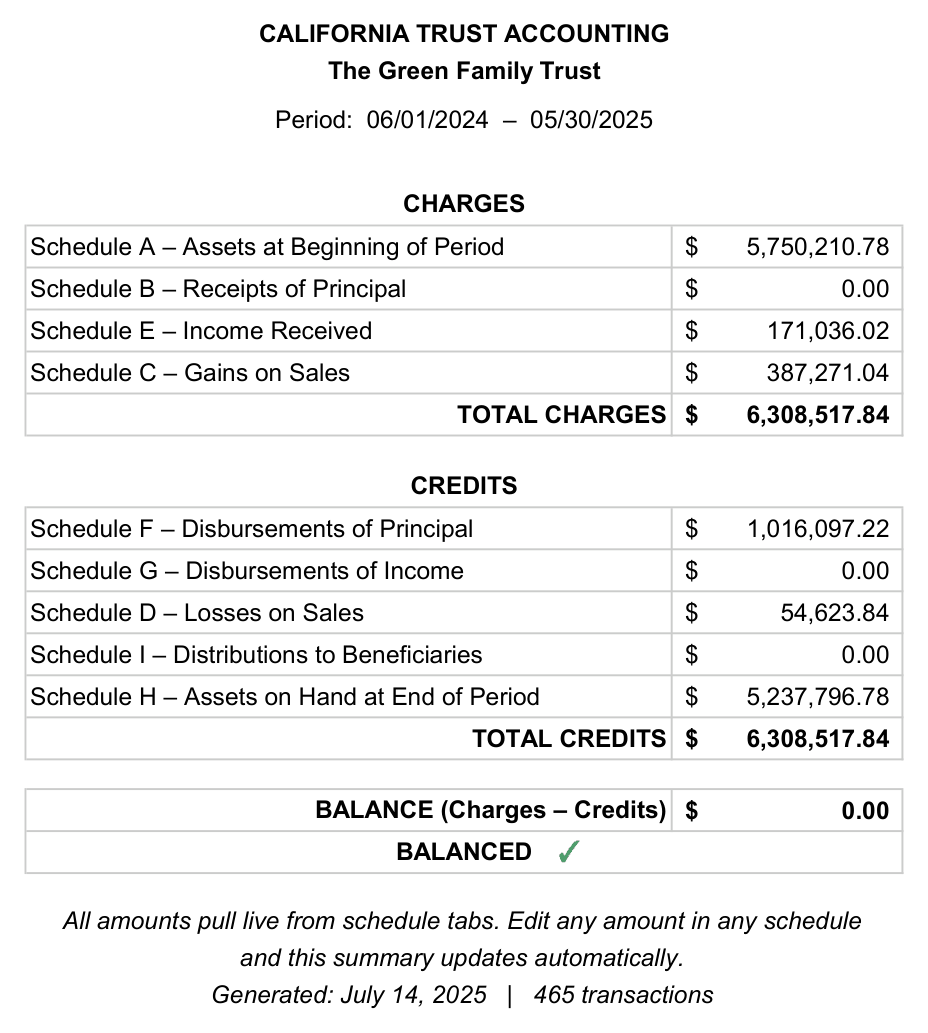
Inside a real Balanced workbook
$699 Flat. No Subscription. No Install.
Common questions
What statements do I need for a California probate accounting?
Every statement for each account for the whole period, the statement for the month before the period begins (its ending balance is the opening balance), and the statement that closes the period.
Where do the starting values come from?
For a first account, the property on hand at the beginning is the value of the property the personal representative initially received (Probate Code section 1061(a)(1)). In a decedent's estate that is the inventory and appraisal, which values each item at the time of death (section 8802).
Does a probate accounting have to balance?
Yes. Total charges must equal total credits (Probate Code section 1061(c)).
How is the executor's statutory fee calculated?
On the value of the estate accounted for: 4 percent of the first $100,000, 3 percent of the next $100,000, 2 percent of the next $800,000, 1 percent of the next $9 million and one-half of 1 percent of the next $15 million, with a reasonable amount set by the court above $25 million (Probate Code section 10800). The attorney's statutory fee uses the same rates (section 10810).
How much notice is required before the hearing?
At least 15 days (Probate Code section 1220), to the persons listed in section 11000.
Can the beneficiaries waive the accounting?
Yes, under the conditions of Probate Code section 10954, for example a written waiver of account filed by each person entitled to distribution. A final report of administration is still filed (section 10954(c)).
Or have Balanced generate it
Balanced is a new kind of probate accounting software: automated California fiduciary accounting technology. From the estate’s PDF bank and brokerage statements, Balanced converts and organizes the statement data into the Probate Code format exactly as the statements show it, using disclosed, standard accounting conventions you can change; everything beyond that comes from your own instructions. Transactions are classified to their schedules, carry values tracked lot by lot, each account reconciled to its own statements, the summary balanced to the penny, and each entry cited to the statement and page it came from, delivered as one fully editable Excel workbook. Add the inventory and appraisal or the prior accounting to tailor it. Most are generated and delivered in about 1 hour. $699 per accounting.
For a finished estate accounting example, see the sample first and final account for a fictional decedent’s estate, every schedule filled in; a blank probate accounting template in Excel is free.
Ready to generate yours? Add the PDF statements for the accounting period. Your PDFs stay on your computer.
$699 Flat. No Subscription. No Install.