 Balanced
The statements
The pictures in this article come from a real January 2024 statement for a large fixed income account: more than eleven million dollars of certificates of deposit, Treasury notes and agency bonds. The account's name and number, the adviser and the name of the custodian have been changed. Every security, date, price and amount is exactly as printed.
A bond line on a statement carries more numbers than a stock line, and more of them are traps. The cash amount of a purchase includes interest that belongs to the seller. The price is a percentage of face value, not a dollar price. The holdings page shows a cost that is not the cash paid, and a trade date that is not the date on the activity page. A preparer who takes the cash amount as cost, or the face value as value, will be wrong at purchase, wrong at the next coupon and wrong again at maturity.
Have the statements? Balanced converts and organizes the data on them into this accounting, in the Probate Code format, as one editable Excel workbook balanced to the penny. Scanned or incomplete statements work.
- Developed by a California trusts and estates attorney
- Works with any PDF statement, downloaded or scanned
- Statement entries are cited to the PDF and page they
came from, for easy verification - A fully editable Excel workbook, emailed in about 1 hour
$699 Flat. No Subscription. No Install.
This has by far been the best user-experience and I’ve been really impressed with your product thus far.
Kelsey B. Cooper, Esq., California Estate Planning Services PC
What the law asks for
Carry value. An investment the fiduciary buys is carried at its cost, and gains and losses on sale or maturity are measured against carry value (Prob. Code §§ 1062(d), 1063(a)). Purchases during the period appear on the changes in form schedule (§ 1063(b)).
Interest is income, without amortizing premium. The act allocates to income "an amount received as interest," and does so "without provision for amortization of premium" (§ 16345(b)). The fiduciary does not shave a little off each coupon to make up for a premium paid; principal simply carries the bond at what it paid and absorbs any loss at maturity.
Accrued interest paid at purchase is not addressed. The act has no rule for the interest a buyer pays the seller for the days since the last coupon. Our article on corporate actions and carry value explains the gap and a defensible treatment: record the accrued interest paid as an asset of principal, separate from the bond's cost, and return that amount to principal out of the first coupon, explaining it in the report.
Purchases, a maturity and the month's totals
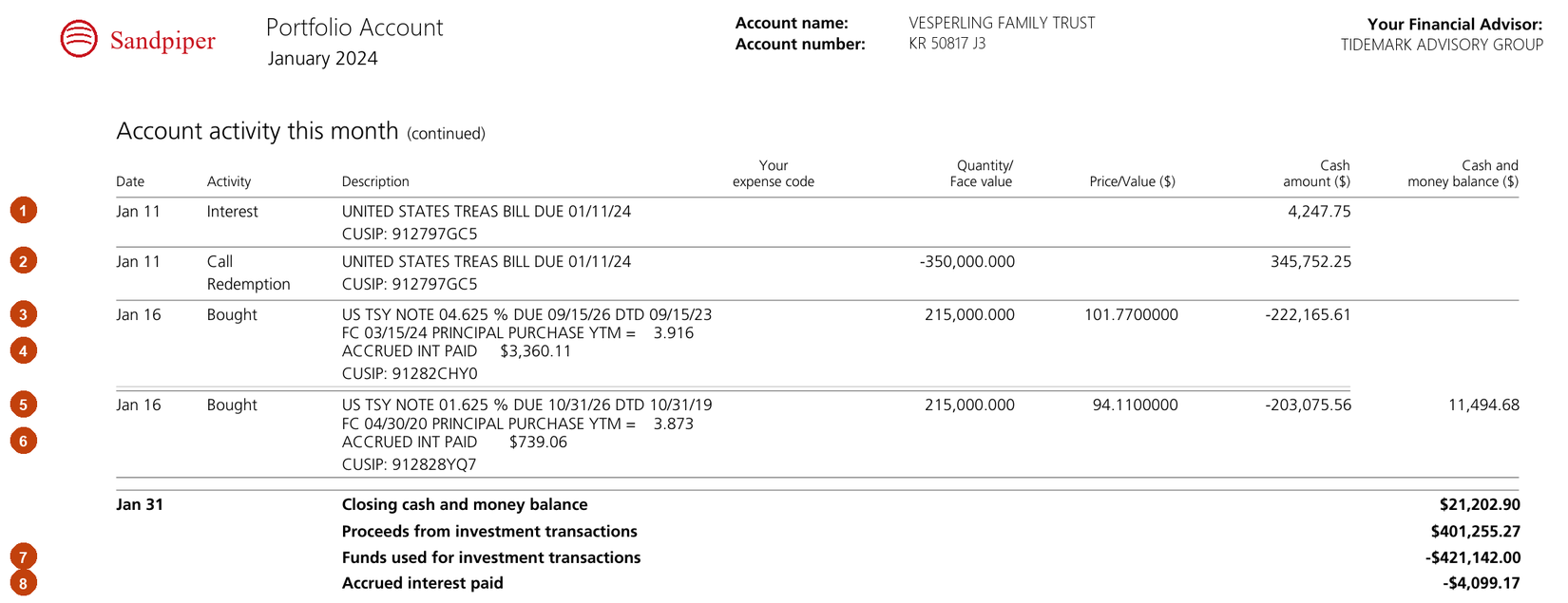
1. Jan 11, "Interest," Treasury bill due 01/11/24, $4,247.75. A Treasury bill pays no coupon. It is bought below face and repaid at face, and the difference is its interest. This custodian splits the maturity into two lines and labels the discount as interest. It is income of the period, on the income schedule.
2. Jan 11, "Call Redemption," face 350,000, $345,752.25. The other part of the maturity: the cost returned. $345,752.25 plus $4,247.75 is $350,000.00, the face value. Against a carry value of $345,752.25 there is no gain or loss; principal gets back what it paid. If the custodian had printed a single line of $350,000.00, the account would have to split it the same way.
3. Jan 16, "Bought," US Treasury note 4.625% due 09/15/26, face 215,000, price 101.77, cash ($222,165.61). The price is a percentage of face: 215,000 at 101.77 percent is $218,805.50. That is the bond's cost and its carry value. The bond was bought at a premium of $3,805.50 over face.
4. "ACCRUED INT PAID $3,360.11." The rest of the cash: $218,805.50 plus $3,360.11 is $222,165.61. The note pays interest on March 15 and September 15, and the seller had earned the interest from September 15 to the settlement date. The trust paid it back to the seller in the price and will receive it again in the March coupon. It is not part of the bond's cost, and it is not an income expense. Record it as accrued interest purchased, an asset of principal, and recover it from the first coupon.
5. Jan 16, "Bought," US Treasury note 1.625% due 10/31/26, face 215,000, price 94.11, cash ($203,075.56). 215,000 at 94.11 percent is $202,336.50, the carry value. This one was bought at a discount of $12,663.50 below face.
6. "ACCRUED INT PAID $739.06." $202,336.50 plus $739.06 is $203,075.56. The same treatment as callout 4.
7. "Funds used for investment transactions," ($421,142.00). The custodian's total of the month's purchases at price: $218,805.50 plus $202,336.50. It matches the two carry values exactly.
8. "Accrued interest paid," ($4,099.17). The custodian keeps the accrued interest out of the purchase total: $3,360.11 plus $739.06. A statement that reports it separately is telling you the same thing the law does: it is not part of cost.
The holdings page: cost, accrued interest and a different date

9. "ACCRUED INTEREST $3,769.87." Interest earned on the 4.625% note but not yet paid at January 31, including the $3,360.11 the trust bought. The custodian includes accrued interest in the account's total value. Of this amount, $3,360.11 is the interest the trust paid for at purchase, already on the account as accrued interest purchased (callout 4). The other $409.76 has been earned since but not paid. It is not a receipt, and it does not belong on the receipts schedule or in the carry value of property on hand. Where the schedules also show market value, treat accrued interest the same way for every bond, either always included or always left out.
10. Trade date "Jan 12, 24," adjusted cost basis $218,805.50. Two points. First, the cost is the price paid without accrued interest, the same figure as callout 3; the custodian agrees with the carry value. Because the act does not amortize premium (§ 16345(b)), the carry value stays $218,805.50 until the note matures at $215,000.00, and principal then reports a $3,805.50 loss. Second, the holdings page dates the purchase January 12, the trade date, while the activity page dates it January 16, the settlement date, when the cash left. They are the same trade.
11. The 1.625% note, trade date Jan 12, 24, adjusted cost basis $202,336.50. At maturity principal will receive $215,000.00 and report a $12,663.50 gain on the gains schedule. The coupons in between, at 1.625 percent, are income.
Trade date and settlement date
Every purchase and sale has two dates: the trade date, when the order was executed and the price fixed, and the settlement date, when cash and securities changed hands, usually one business day later for stocks and Treasury securities, sometimes more for other bonds. The activity page usually shows settlement; the holdings and realized gain pages usually show the trade date.
For most lines the difference does not matter. It matters at the edges of a period. A sale traded on December 31 and settled January 2 is, by trade date, a December sale; by settlement date, the cash arrives in January and the security is still in December's holdings. Our article on as of dates and dividends not yet paid explains why one convention, used the same way at both ends of every period, is what keeps a transaction from being counted twice or lost. For trades, the settlement date is usually the better choice, because it is the date on which the cash, and so the account's cash balance, actually changed. Whichever is used, the gain or loss is the same, and the account should say which date it follows.
Where each line lands
- Changes in form: each purchase at price times face, the carry value, never the cash amount including accrued interest.
- Accrued interest paid at purchase: an asset of principal, recovered from the first coupon, explained in the report.
- Income: coupons as received, at their full amount without amortizing premium; the discount on a Treasury bill when it matures.
- Gains and losses: maturities and sales against carry value: a loss at par for a premium bond, a gain at par for a discount bond.
- Property on hand: each bond at carry value, plus any accrued interest purchased and not yet recovered; interest earned but not yet paid is not a receipt.
- Nowhere: the custodian's adjusted or amortized cost, where it differs from carry value, and its estimated annual income.
Common mistakes
- Using the cash amount as cost. It includes the seller's interest and overstates carry value.
- Using face value as cost. Face is what will be repaid, not what was paid.
- Expensing the accrued interest. It is not a cost of the trust; it comes back with the coupon.
- Amortizing premium. The act does not, so the full coupon is income and principal takes the loss at maturity.
- Taking a maturity as all principal. The discount on a bill is interest.
- Mixing dates. Trade dates from one page and settlement dates from another, at the edge of a period, move a trade into the wrong account.
Checklist
- For each purchase, compute price times face and confirm it equals the cash amount less accrued interest.
- Record accrued interest purchased separately and match it against the first coupon.
- For each maturity, confirm the custodian's split between cost and interest, or make it yourself.
- Carry premium and discount bonds at cost until they mature or are sold.
- Pick trade or settlement date, use it at both edges of the period, and say which in the report.
Praise for Balanced
“This has by far been the best user-experience and I’ve been really impressed with your product thus far.”
“I’d also just like to say that I was a trusts & estates paralegal for 6 years prior to becoming an attorney myself, so I’ve done hundreds of accountings manually. I’ve also tried countless other ‘trust accounting’ products. This has by far been the best user-experience and I’ve been really impressed with your product thus far. Myself and my firm will be repeat customers.”
California Estate Planning Services PC
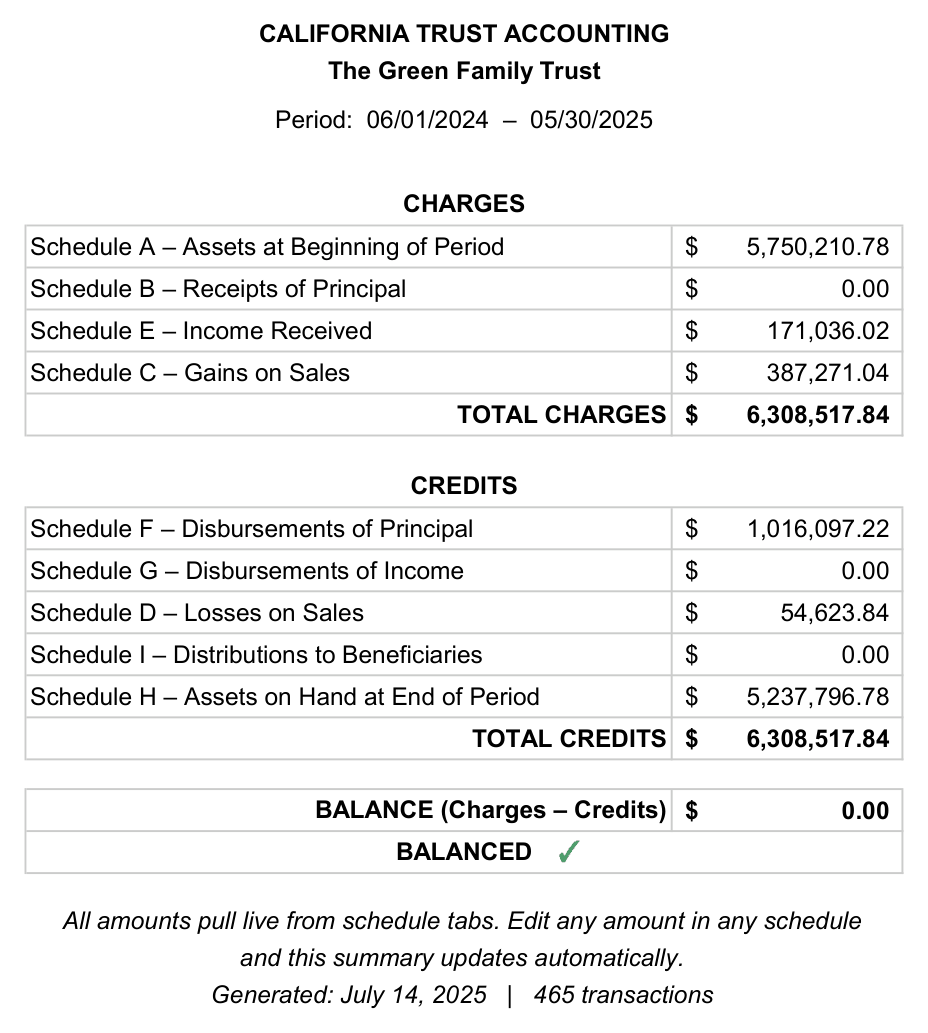
Inside a real Balanced workbook
$699 Flat. No Subscription. No Install.
Let Balanced do the reading
A fixed income account can hold dozens of bonds and certificates, each bought at its own price with its own accrued interest, maturing on its own date. Splitting every purchase into cost and accrued interest, and every maturity into cost and interest, is hard, technical work. It is also what Balanced does. Add the PDF statements for the accounting period, including scanned or incomplete ones, and Balanced converts and organizes the data on them into the Probate Code schedules, each line traced to its page, as one editable Excel workbook balanced to the penny. It is $699 flat. Review the workbook against your statements. Start an accounting.
The Law and the Art of Fiduciary Accounting is a series by Balanced Legal Technology, LLC on complex California fiduciary accountings. General information only, current as of November 2026; not legal, tax or accounting advice. Statutes and rules change; confirm current law before relying on it.
About the author
Marc Joyce is a licensed, practicing California trusts and estates attorney, and the founder and developer of Balanced. He brings both sides to the problem: as a lawyer, and as an engineer. The Law and the Art of Fiduciary Accounting is his series on the hard cases where the two meet.
To see entries like these in a finished account, see the sample trust accounting and the estate accounting example, each with every schedule filled in.
Ready to generate yours? Add the PDF statements for the accounting period. Your PDFs stay on your computer.
$699 Flat. No Subscription. No Install.