 Balanced
California Probate Code section 1060 makes sections 1060 to 1064 the rules for every account filed with the court: a decedent’s estate, a conservatorship or guardianship, and a trust account that is filed. It also sets a limit: unless another part of the Probate Code requires more, or good cause is shown, an account need not contain anything beyond what those sections require.
Have the statements? Balanced converts and organizes the data on them into this accounting, in the Probate Code format, as one editable Excel workbook balanced to the penny. Scanned or incomplete statements work.
- Developed by a California trusts and estates attorney
- Works with any PDF statement, downloaded or scanned
- Statement entries are cited to the PDF and page they
came from, for easy verification - A fully editable Excel workbook, emailed in about 1 hour
$699 Flat. No Subscription. No Install.
This has by far been the best user-experience and I’ve been really impressed with your product thus far.
Kelsey B. Cooper, Esq., California Estate Planning Services PC
What section 1060 says
1060. This chapter governs all accounts to be filed with the court. Except as specifically provided elsewhere in this code, or unless good cause is shown therefore, no information in addition to that required in this chapter need be in an account.
In plain English, the section does two things. First, it makes the chapter, sections 1060 to 1064, the format for every account filed with a California court, whoever the fiduciary is. Second, it works as a ceiling: an account that gives what the chapter requires is complete, unless another section of the Probate Code asks for something more for that kind of account, or the court finds good cause to require more.
Which accounts it covers
- A decedent’s estate. An executor’s or administrator’s account filed with the probate court, including the first and final account filed with the petition for final distribution. See California probate accounting.
- A conservatorship or guardianship. The conservator’s or guardian’s account, which is presented on the Judicial Council’s GC-400 or GC-405 forms (rule 7.575). See GC-400 conservatorship and guardianship accountings.
- A trust, when its account is filed. A trustee’s account to the beneficiaries that is never filed is governed by §16063; an account that is filed with the court follows this chapter (§16063(b)). Many trustees use the same format either way. See California trust accounting.
When more is required
The limit in section 1060 gives way in two cases. Another section of the Probate Code may add requirements for a particular kind of account: a conservator or guardian, for example, files with the account the statements described in §2620(c), such as the account statements showing the balances at the start and end of the period. And the court may require more information for good cause. Within the chapter itself, §1063 adds schedules when the estate or trust calls for them, and §1064 lists what the petition or report filed with the account must add.
Praise for Balanced
“This has by far been the best user-experience and I’ve been really impressed with your product thus far.”
“I’d also just like to say that I was a trusts & estates paralegal for 6 years prior to becoming an attorney myself, so I’ve done hundreds of accountings manually. I’ve also tried countless other ‘trust accounting’ products. This has by far been the best user-experience and I’ve been really impressed with your product thus far. Myself and my firm will be repeat customers.”
California Estate Planning Services PC
Inside a real Balanced workbook
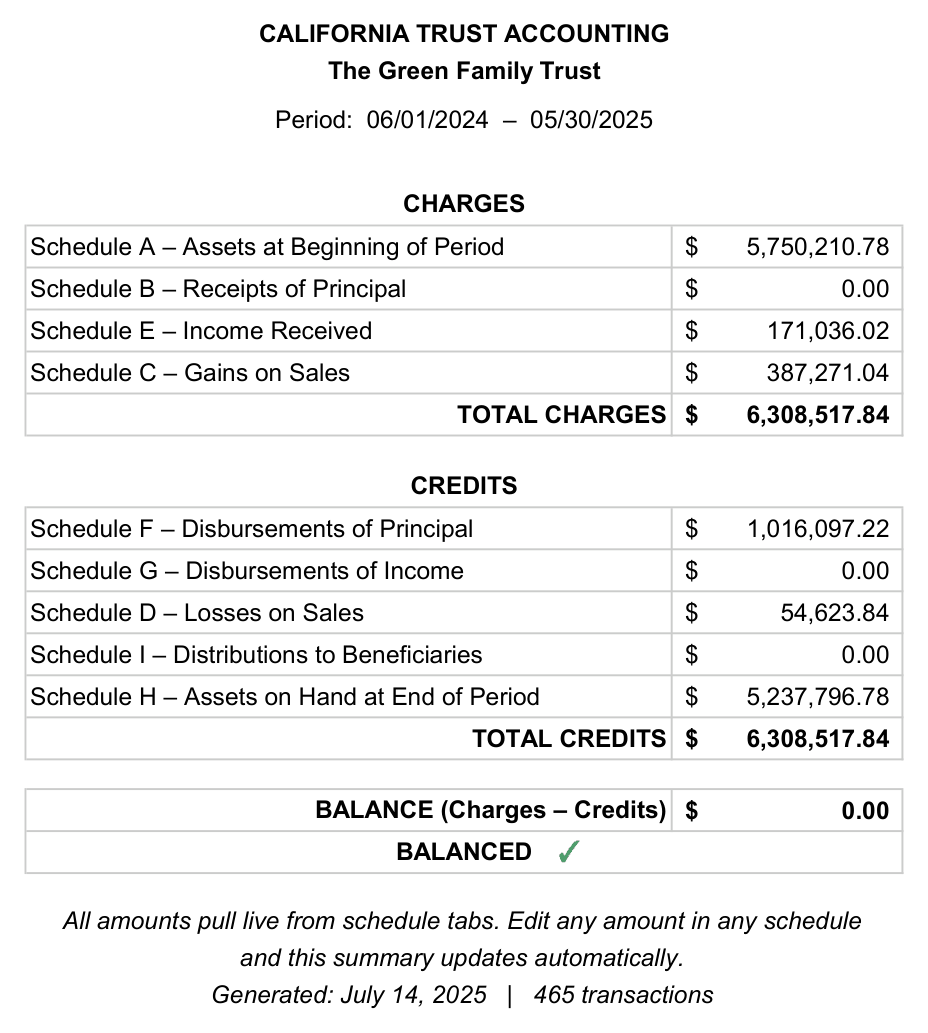
$699 Flat. No Subscription. No Install.
Sections 1060 to 1064 at a glance
Chapter 4 of Part 1 of Division 3 of the Probate Code, five short sections, sets the format of every account filed with a California court:
| Section | What it covers |
|---|---|
| 1060 | Which accounts the rules govern |
| Section 1061 | The summary of account |
| Section 1062 | The supporting schedules |
| Section 1063 | Market value and the additional schedules |
| Section 1064 | What the petition or report must add |
All five together, with the reasoning behind the format and the mistakes that keep an account from balancing, are in Probate Code 1061 to 1064: the California accounting format. Each schedule, with what goes on it, is in California probate accounting schedules, and the whole format filled in is in the estate accounting example and the trust accounting example.
History of section 1060
Chapter 4 (sections 1060 to 1064) was added by Stats. 1996, ch. 862, sec. 4. Section 1060: Amended by Stats. 1997, ch. 724, sec. 5, effective January 1, 1998. The official text is at leginfo.legislature.ca.gov. Statutes change; confirm the current text before relying on it.
Common questions
What does California Probate Code section 1060 say?
It makes sections 1060 to 1064 govern all accounts filed with the court, and says no information beyond what those sections require need be in an account, unless another part of the Probate Code requires it or good cause is shown.
Does section 1060 apply to a trust accounting?
It applies to a trust account that is filed with the court (Probate Code section 16063(b)). A trustee’s account to the beneficiaries that is not filed is governed by section 16063, though many trustees follow the same format.
Does section 1060 apply to conservatorship accounts?
Yes. A conservator’s or guardian’s account is filed with the court, so the chapter applies; the account is presented on the Judicial Council’s GC-400 or GC-405 forms under rule 7.575.
Generate it with Balanced
Balanced is a new kind of software for California fiduciary accountings. From the PDF bank and brokerage statements, Balanced converts and organizes the statement data into the Probate Code 1060 to 1064 format for a trust or a probate estate, or the GC-400 format for a conservatorship or guardianship, exactly as the statements show it, using disclosed, standard accounting conventions you can change; everything beyond that comes from your own instructions. Most are generated and delivered in about 1 hour, rather than the days, weeks or months of manual work an accounting otherwise takes. Transactions are classified to their schedules, carry values tracked lot by lot, each account reconciled to its own statements, the summary balanced to the penny, and each entry cited to the statement and page it came from, delivered as one fully editable Excel workbook. $699 per accounting.
For a finished estate accounting example, see the sample first and final account for a fictional decedent’s estate, every schedule filled in; a blank probate accounting template in Excel is free.
Ready to generate yours? Add the PDF statements for the accounting period. Your PDFs stay on your computer.
$699 Flat. No Subscription. No Install.