 Balanced
The statements
The pictures in this article come from three consecutive real monthly checking statements for a living trust, for the periods ending June 5, July 7 and August 6, 2025. The account number has been changed; everything else pictured is exactly as printed. For this article, imagine that the middle statement, the one ending July 7, is missing from the file, as statements so often are. Then look at what the file would still tell you, and at what the missing statement actually held.
A missing statement is the most common gap in a fiduciary accounting, and the most tempting one to paper over. The statements on either side give an ending balance and a beginning balance; the difference looks like everything that happened in between. It is not. It is the net of everything that happened in between, and an account is made of receipts and disbursements, not net changes.
Have the statements? Balanced converts and organizes the data on them into this accounting, in the Probate Code format, as one editable Excel workbook balanced to the penny. Scanned or incomplete statements work.
- Developed by a California trusts and estates attorney
- Works with any PDF statement, downloaded or scanned
- Statement entries are cited to the PDF and page they
came from, for easy verification - A fully editable Excel workbook, emailed in about 1 hour
$699 Flat. No Subscription. No Install.
This has by far been the best user-experience and I’ve been really impressed with your product thus far.
Kelsey B. Cooper, Esq., California Estate Planning Services PC
What the law asks for
Every receipt and every disbursement. The account reports the receipts and disbursements of the whole period (Prob. Code §§ 1062(a), 1062(b); § 16063(a)(1)), and its summary must balance, "Total charges shall equal total credits" (§ 1061(c)). A month with no statement is still a month of the period.
Original statements in a conservatorship. A guardian or conservator must also file the original account statements with the account (Prob. Code § 2620(c)), so a missing statement there is a missing filing as well.
Disclosure. Where something cannot be documented, the account should say so plainly, in the report, rather than present a figure as more certain than it is.
The statements on either side
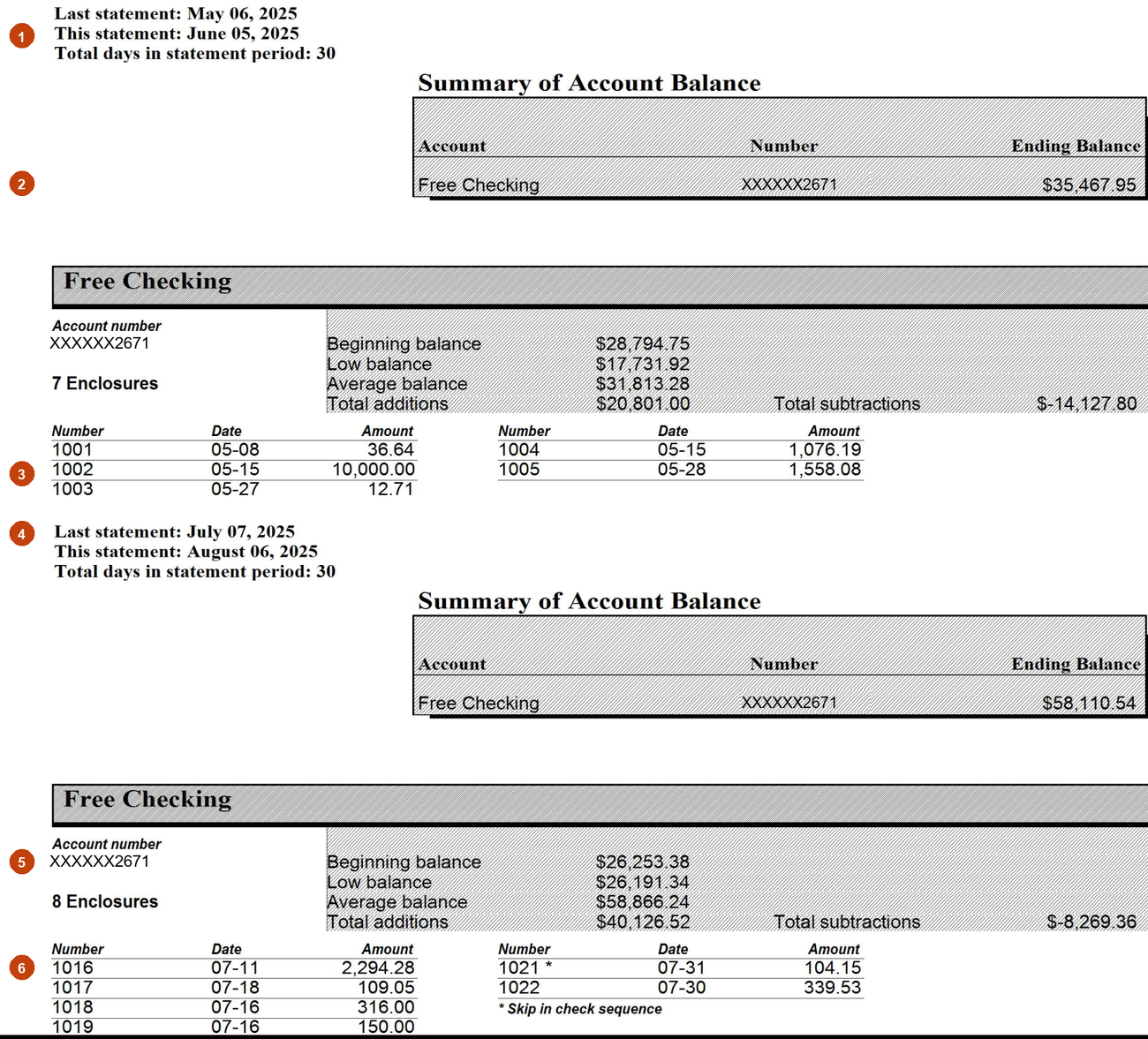
1. "This statement: June 05, 2025." The earlier statement's period ends June 5.
2. Ending balance, $35,467.95. What the account held on June 5.
3. Checks 1001 to 1005. The last check paid in that period was number 1005.
4. "Last statement: July 07, 2025." The later statement tells you its predecessor ended July 7. This line alone proves a statement is missing: the period from June 6 to July 7 is covered by neither statement in the file. Read the "last statement" or "previous balance" line on every statement and confirm it matches the statement before it.
5. Beginning balance, $26,253.38. What the account held on July 7. The balance fell by $9,214.57 in the missing month.
6. Checks from 1016. The first check paid in the later period is number 1016. Checks 1006 to 1015 were written somewhere in between and are accounted for on neither statement.
What the gap proves, and what it does not
The two statements prove three things: a statement is missing, the account's balance fell by exactly $9,214.57 over the missing month, and as many as ten checks, numbers 1006 to 1015, belong to that gap or are still outstanding. That is a great deal, and it is not an account. A fall of $9,214.57 could be one check for $9,214.57, or ten checks and a deposit, or a $50,000 withdrawal and a $40,785.43 deposit. Each of those is reported differently, and two of them involve receipts the beneficiaries are entitled to know about.
The same is true when the balances on either side are equal. An unchanged balance proves that the net change was zero, not that nothing happened. A deposit and a withdrawal of the same amount leave no trace in the balances. Only for an account that should have no activity at all, such as a dormant savings account paying no interest with no checks or transfers in the period, do equal balances on both sides come close to proof, and even then a confirmation from the bank is better.
The missing month, found
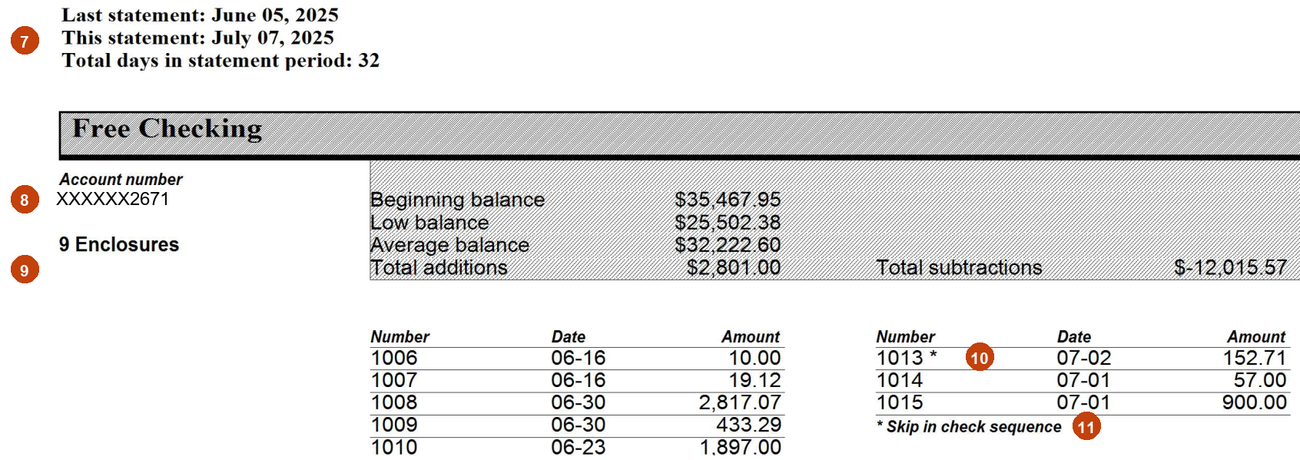
7. "Last statement: June 05, 2025. This statement: July 07, 2025." It fills the gap exactly, with no days left over on either side.
8. Beginning balance, $35,467.95. The same as the earlier statement's ending balance (callout 2).
9. Total additions, $2,801.00; total subtractions, ($12,015.57). $2,801.00 less $12,015.57 is a fall of $9,214.57, the figure the statements on either side predicted. But inside it are a deposit, two wires in, a government benefit, eight checks paid, care payments, card transfers, association dues and wire fees: more than twenty lines, four of them receipts, none of which the net figure could have shown. Our article on bank statements and checks reads this statement line by line.
*10. Check 1013 \.** Checks 1006 to 1010 and 1013 to 1015, eight checks, cleared in this month. Checks 1011 and 1012 did not, here or in any later statement for 2025.
*11. "\ Skip in check sequence."** So of the ten numbers the gap implied, eight were paid in the missing month and two were never paid at all. Without this statement, an account built from the balances would have had no way to know which.
Rebuilding a month you cannot get
First, try to get it. Banks and custodians can usually reproduce statements for several years, online or on request. Ask for every statement missing from the period, including the one that ends just before the period starts, which proves the opening balance.
If a statement truly cannot be obtained, rebuild the month from what can be:
- The register. The trustee's own record of checks written and deposits made.
- The other side of transfers. A brokerage statement showing money sent to this account, or a beneficiary's records showing money received from it (see our article on transfers between the estate's own accounts).
- Recurring items. Benefits, dues, insurance, rent and care payments that appear in the same amount in the months on either side.
- Check images in later statements. A check written in the missing month that cleared later appears, with its image, on the later statement.
- Payees' records. Invoices and receipts from the people the trust pays.
Then report what was rebuilt and how. Show each identified receipt and disbursement as its own line. If, after all of that, part of the change in balance remains unexplained, do not hide it inside another figure. Show it as what it is, an unidentified net change for a stated period, and explain in the report which statement is missing, what was done to obtain it, and how the rest was established.
Where each line lands
- Receipts and disbursements: every line from the missing statement once obtained, or every line that can be established from other records.
- Property on hand: the ending balance from the last statement of the period, adjusted for outstanding checks.
- The report: any statement that could not be obtained, the steps taken, the sources used to rebuild the month, and any amount that remains unexplained.
- Nowhere: a single "net activity" line standing in for a month that could have been obtained.
Common mistakes
- Not noticing the gap. Check the "last statement" line on every statement against the one before it.
- Using the net change. It hides receipts, and receipts are what beneficiaries most need to see.
- Treating equal balances as proof. They prove a net of zero, nothing more.
- Missing the statement before the period. Without it, the opening balance rests on a single figure.
- Ignoring check numbers. The numbers before and after a gap tell you how many checks it holds.
Checklist
- For every account, list each statement's period and confirm that each one begins where the last one ended.
- Get the statement ending just before the accounting period begins.
- For any gap, compute the change in balance and list the check numbers it must contain.
- Request the missing statement before rebuilding anything.
- If it cannot be had, rebuild from the register and other records, and disclose what remains.
Praise for Balanced
“This has by far been the best user-experience and I’ve been really impressed with your product thus far.”
“I’d also just like to say that I was a trusts & estates paralegal for 6 years prior to becoming an attorney myself, so I’ve done hundreds of accountings manually. I’ve also tried countless other ‘trust accounting’ products. This has by far been the best user-experience and I’ve been really impressed with your product thus far. Myself and my firm will be repeat customers.”
California Estate Planning Services PC
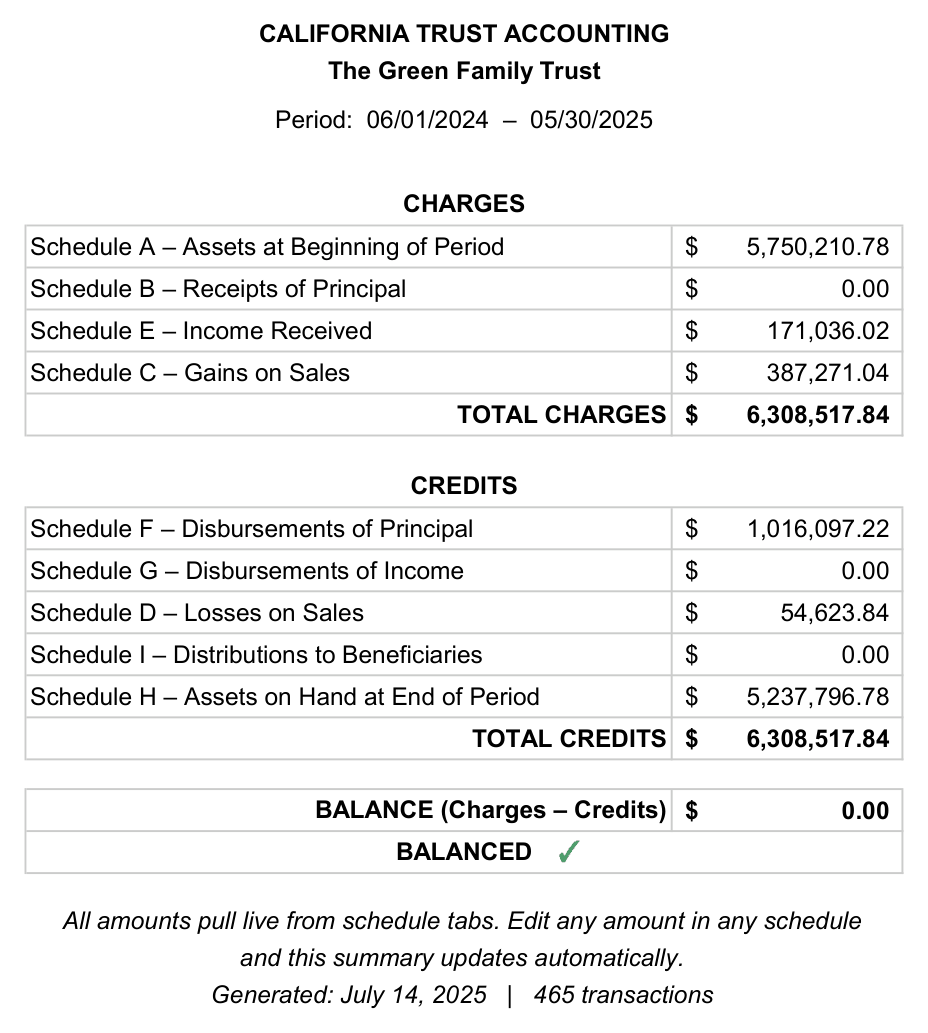
Inside a real Balanced workbook
$699 Flat. No Subscription. No Install.
Let Balanced do the reading
Gaps hide in a stack of statements; they are found only by checking every period against the next, every balance against the one before it, and every check number against the sequence. Doing that for every account and every month is hard, technical work. It is also what Balanced does. Add the PDF statements for the accounting period, including scanned or incomplete ones, and Balanced converts and organizes the data on them into the Probate Code schedules, flags any month that is missing, and shows each line traced to its page, as one editable Excel workbook balanced to the penny. It is $699 flat. Review the workbook against your statements. Start an accounting.
The Law and the Art of Fiduciary Accounting is a series by Balanced Legal Technology, LLC on complex California fiduciary accountings. General information only, current as of November 2026; not legal, tax or accounting advice. Statutes and rules change; confirm current law before relying on it.
About the author
Marc Joyce is a licensed, practicing California trusts and estates attorney, and the founder and developer of Balanced. He brings both sides to the problem: as a lawyer, and as an engineer. The Law and the Art of Fiduciary Accounting is his series on the hard cases where the two meet.
To see entries like these in a finished account, see the sample trust accounting and the estate accounting example, each with every schedule filled in.
Ready to generate yours? Add the PDF statements for the accounting period. Your PDFs stay on your computer.
$699 Flat. No Subscription. No Install.