 Balanced
A California conservator or guardian of the estate may file the simplified GC-405 account only when all four conditions of rule 7.575(d)(1) are met: no income-generating real property, no interest in a trade or business, an appraised value under $500,000 not counting the conservatee’s or ward’s personal residence, and no court order for a standard account. A simplified account lists the receipts and the disbursements one by one, in date order, instead of grouping them by category. The Summary of Account, GC-400(SUM)/GC-405(SUM), is used either way.
Have the statements? Balanced converts and organizes the data on them into the standard GC-400 account, which an estate that qualifies for GC-405 may also file, as one editable Excel workbook balanced to the penny. Scanned or incomplete statements work.
- Developed by a California trusts and estates attorney
- Works with any PDF statement, downloaded or scanned
- Statement entries are cited to the PDF and page they
came from, for easy verification - A fully editable Excel workbook, emailed in about 1 hour
$699 Flat. No Subscription. No Install.
This has by far been the best user-experience and I’ve been really impressed with your product thus far.
Kelsey B. Cooper, Esq., California Estate Planning Services PC
The four conditions
Under rule 7.575(c), every account is a standard account unless a simplified account is authorized by subdivision (d)(1). A simplified account may be filed only if all of these are true:
- The estate has no income-generating real property ((d)(1)(A)). A rental house rules it out.
- The estate has no interest in a trade or business, whole or partial ((d)(1)(B)).
- The appraised value of the estate, not counting the conservatee’s or ward’s personal residence, is less than $500,000 ((d)(1)(C)).
- The court has not directed a standard account ((d)(1)(D)).
If any one is missing, the account is a standard GC-400 account. See the conservatorship accounting guide for the standard account.
The five-page rule
Even when all four conditions are met, a long schedule changes format. If the simplified receipts schedule, GC-405(A), or the simplified disbursements schedule, GC-405(C), would run longer than five pages, that schedule is prepared in the standard format instead, on forms GC-400(A)(1) to (6) for receipts or GC-400(C)(1) to (11) for disbursements. The rest of the account may stay simplified (rule 7.575(d)(2)). Both forms say so on their face.
How the simplified account differs from the GC-400
| Standard account, GC-400 | Simplified account, GC-405 | |
|---|---|---|
| Receipts | Grouped by category on GC-400(A)(1) to (6), such as dividends, interest, pensions, rent and public benefits, each subtotaled | One list on GC-405(A), in date order: the date of each receipt, a description and the amount |
| Disbursements | Grouped by category on GC-400(C)(1) to (11), such as caregivers, care facility, fees, living and medical expenses, each subtotaled | One list on GC-405(C), in date order: the date, the payee and purpose, the check number, the amount, and the date of any order that authorized the payment |
| Your own schedules | Allowed in place of the optional GC-400 forms, if they use the same categories, information and general format (rule 7.575(e)(6)) | The GC-405 Schedules A and C must be used, and the GC-405 form for any asset, transaction or event a GC-405 form covers (rule 7.575(e)(7), (8)) |
| Summary of Account | GC-400(SUM)/GC-405(SUM), required | GC-400(SUM)/GC-405(SUM), required (rule 7.575(e)(5)) |
| When it is due | One year after appointment, then at least every two years, or more often if the court orders (Prob. Code §2620(a)) | |
| Documents filed with it | The same for both: closing statements for each account, and for a first account the statements from just before appointment; escrow statements for real property sold; care facility bills (§2620(c)) | |
The simplified account is a choice
The rule says a qualifying estate “may” file a simplified account (rule 7.575(d)(1)); it does not require one. A standard account groups receipts and disbursements into categories with subtotals, which lets a reviewer test one category at a time against the statements. When the estate is close to a limit, for example near $500,000 or about to rent out a property, a standard account also avoids changing formats from one account to the next.
Praise for Balanced
“This has by far been the best user-experience and I’ve been really impressed with your product thus far.”
“I’d also just like to say that I was a trusts & estates paralegal for 6 years prior to becoming an attorney myself, so I’ve done hundreds of accountings manually. I’ve also tried countless other ‘trust accounting’ products. This has by far been the best user-experience and I’ve been really impressed with your product thus far. Myself and my firm will be repeat customers.”
California Estate Planning Services PC
Inside a real Balanced workbook
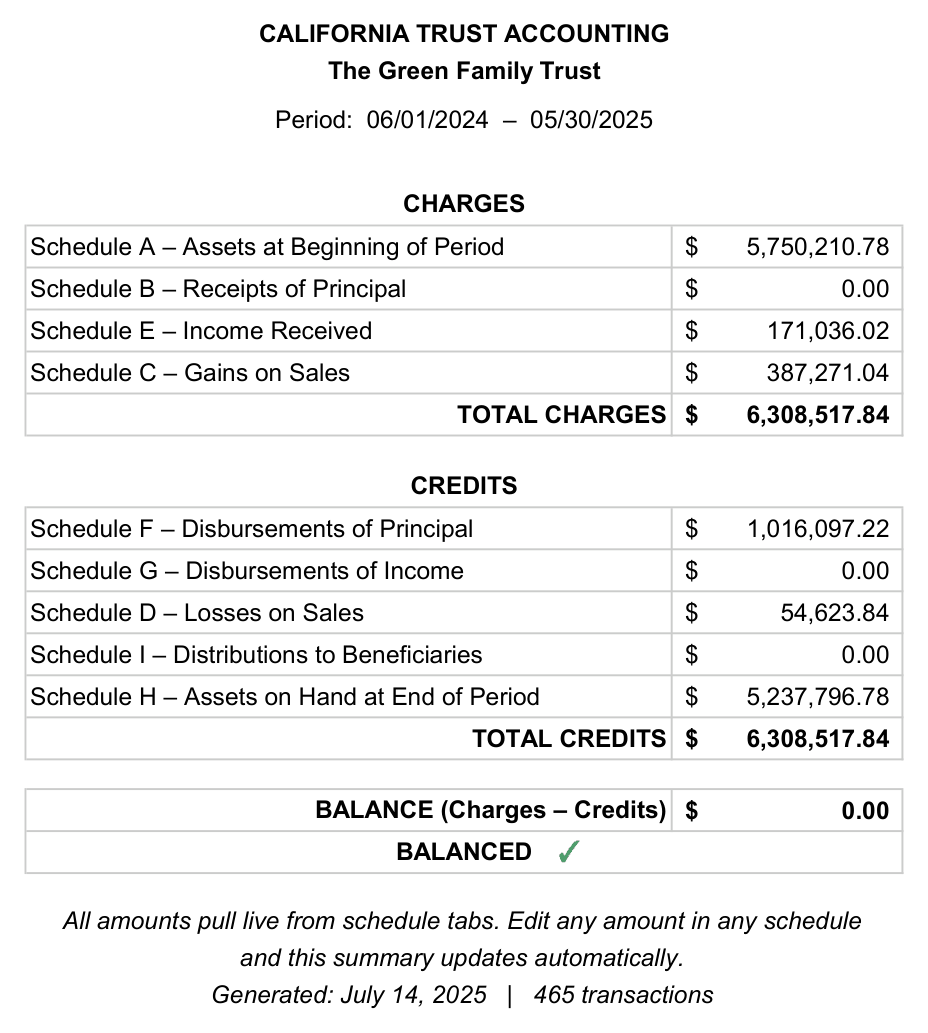
$699 Flat. No Subscription. No Install.
What to gather before you start
- Each account’s statements for the whole period, with no month missing, and for a first account the statements from immediately before appointment (Prob. Code §2620(c)).
- The inventory and appraisal, for a first account and to check the $500,000 test; for a later account, the prior account as filed.
- Check registers or copies of checks, for the check numbers and payees on GC-405(C).
- The court orders that authorized fees or distributions, for their dates.
Is the account due soon? Use the deadline calculator. If it is already late, see what happens when a conservatorship accounting is overdue.
Common questions
Does the conservatee’s house count toward the $500,000?
No. The value of the conservatee’s or ward’s personal residence is excluded from the appraised value used for the $500,000 test (Cal. Rules of Court, rule 7.575(d)(1)(C)).
Can I use the GC-405 if the estate owns a rental property?
No. An estate with income-generating real property must file the standard GC-400 account (rule 7.575(d)(1)(A)).
What if my receipts list runs longer than five pages?
That schedule is prepared in the standard format, on forms GC-400(A)(1) to (6). The rest of the account may stay simplified (rule 7.575(d)(2)).
Is the Summary of Account different for a simplified account?
No. The same form, GC-400(SUM)/GC-405(SUM), is used in every accounting (rule 7.575(e)(5)).
Can I file a standard account even if the estate qualifies for GC-405?
Rule 7.575 says a qualifying estate may file a simplified account; it does not require one. A standard GC-400 account is the default format.
Does Balanced generate the GC-405 forms?
Balanced organizes statement data into the standard GC-400 layout. An estate that qualifies for the simplified account may still file a standard account.
Generate it with Balanced
Balanced is a new kind of software for California fiduciary accountings. From the PDF bank and brokerage statements, Balanced converts and organizes the statement data into the GC-400 standard account exactly as the statements show it, using disclosed, standard accounting conventions you can change; everything beyond that comes from your own instructions. Most are generated and delivered in about 1 hour, rather than the days, weeks or months of manual work an accounting otherwise takes. Transactions are classified to their schedules, carry values tracked lot by lot, each account reconciled to its own statements, the summary balanced to the penny, and each entry cited to the statement and page it came from, delivered as one fully editable Excel workbook. $699 per accounting.
Ready to generate yours? Add the PDF statements for the accounting period. Your PDFs stay on your computer.
$699 Flat. No Subscription. No Install.