 Balanced
The statements
The pictures in this article come from a real December 2025 consolidated investment report that one custodian sent to a widow who is also the trustee of her late husband's trust. The report covers six accounts. The names, account numbers, trust date and the name of the custodian have been changed. Every value and amount is exactly as printed.
Families often receive one statement for everything: the decedent's trust, the survivor's own IRAs, education accounts for the grandchildren, a custodial account for a minor. The custodian groups them because they share an address or an adviser, not because they share an owner. The first question in reading such a statement is not what happened in each account, but which accounts belong in the accounting at all. The second, for any retirement account that does belong, is how to read a statement built for income tax reporting.
Have the statements? Balanced converts and organizes the data on them into this accounting, in the Probate Code format, as one editable Excel workbook balanced to the penny. Scanned or incomplete statements work.
- Developed by a California trusts and estates attorney
- Works with any PDF statement, downloaded or scanned
- Statement entries are cited to the PDF and page they
came from, for easy verification - A fully editable Excel workbook, emailed in about 1 hour
$699 Flat. No Subscription. No Install.
This has by far been the best user-experience and I’ve been really impressed with your product thus far.
Kelsey B. Cooper, Esq., California Estate Planning Services PC
What the law asks for
The account reports the fiduciary's property, and only that. The account lists the property on hand at the start and end of the period and everything received and paid in between (Prob. Code §§ 1061, 1062); a trustee's account does the same for the trust (§ 16063(a)). Property that belongs to someone else does not appear, however it is grouped on a statement.
Retirement accounts pass by beneficiary designation. A provision in a retirement plan or individual retirement account naming who takes it at death is a nonprobate transfer, effective without a will (Prob. Code § 5000). An IRA payable to a named person is that person's at death; it is not part of the probate estate, and it is not part of a trust unless the trust is the named beneficiary.
When it does belong. An IRA payable to the estate, or to the trust, is the fiduciary's property, and so is a conservatee's own IRA in a conservatorship. Payments from it are receipts. For a trust, the Uniform Fiduciary Income and Principal Act (Prob. Code § 16320 and following) has its own rules for dividing payments from retirement accounts and similar deferred payments between income and principal; apply them to what the trust actually receives, not to what the custodian calls the payment.
The consolidated report: one statement, six owners
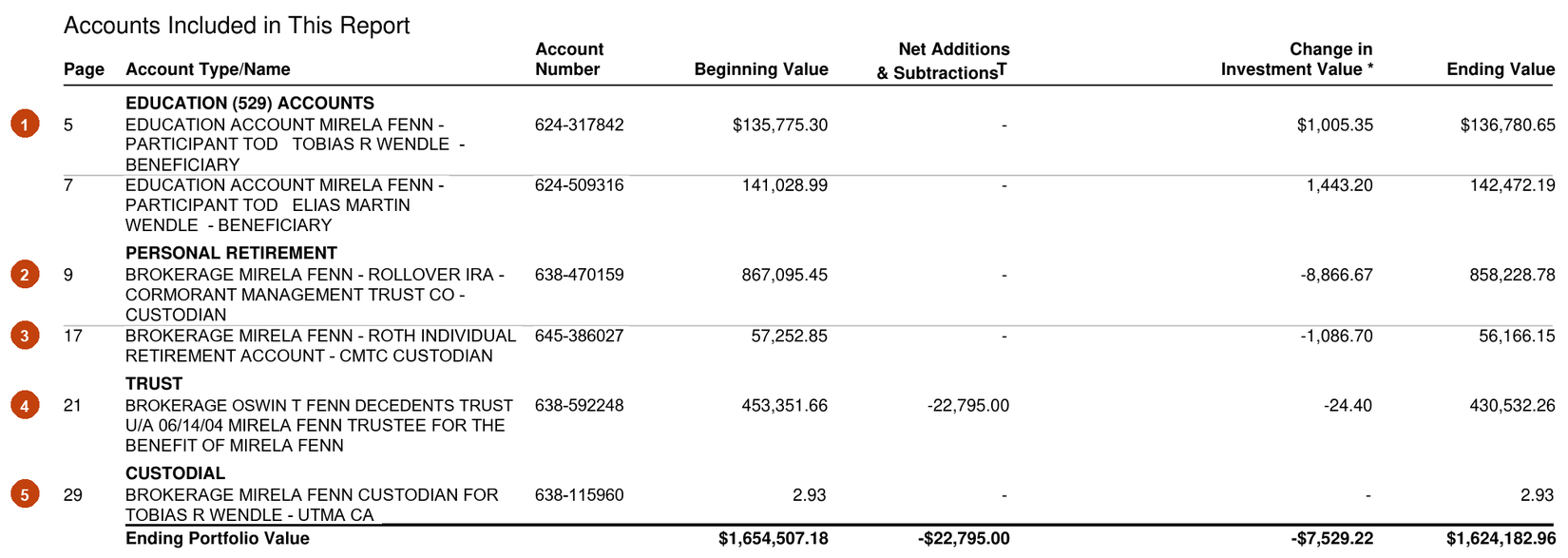
1. Two education (529) accounts. The survivor is the participant; each names a grandchild as beneficiary on her death. They are hers, not the trust's. They do not belong in the trust's accounting.
2. The survivor's rollover IRA. Her own retirement account, $858,228.78 at the end of December. Not trust property. If the decedent's IRA was rolled into it after his death, that rollover is the result of a beneficiary designation, and it still does not belong in the trust's accounting.
3. The survivor's Roth IRA. Also hers. Not in the accounting.
4. The decedent's trust, the only account that belongs. Beginning value $453,351.66, net subtractions of $22,795.00 in December, ending value $430,532.26. Its pages, and only its pages, are the trust's statement for the month.
5. A custodial (UTMA) account for a grandchild. The minor's property, held by a custodian. Not in the accounting, even if the custodian is also the trustee.
The report's "Ending Portfolio Value," $1,624,182.96, is the total of all six. Taken as the trust's property it would overstate the trust by $1,193,650.70. The same care applies to the "Net Additions & Subtractions" column, which the custodian footnotes as including "transfers between" its accounts: a transfer from the trust to the survivor's own account is a distribution to her, not a transfer between the trust's accounts.
An IRA's own pages: distributions, tax withheld and the RMD
The survivor's IRA does not belong in this trust's accounting. Its pages are pictured because they are a clean example of what any IRA statement shows, and how to read it when the IRA does belong: in an estate or trust that is the named beneficiary, or in a conservatorship, where the conservatee's IRA is part of the estate.
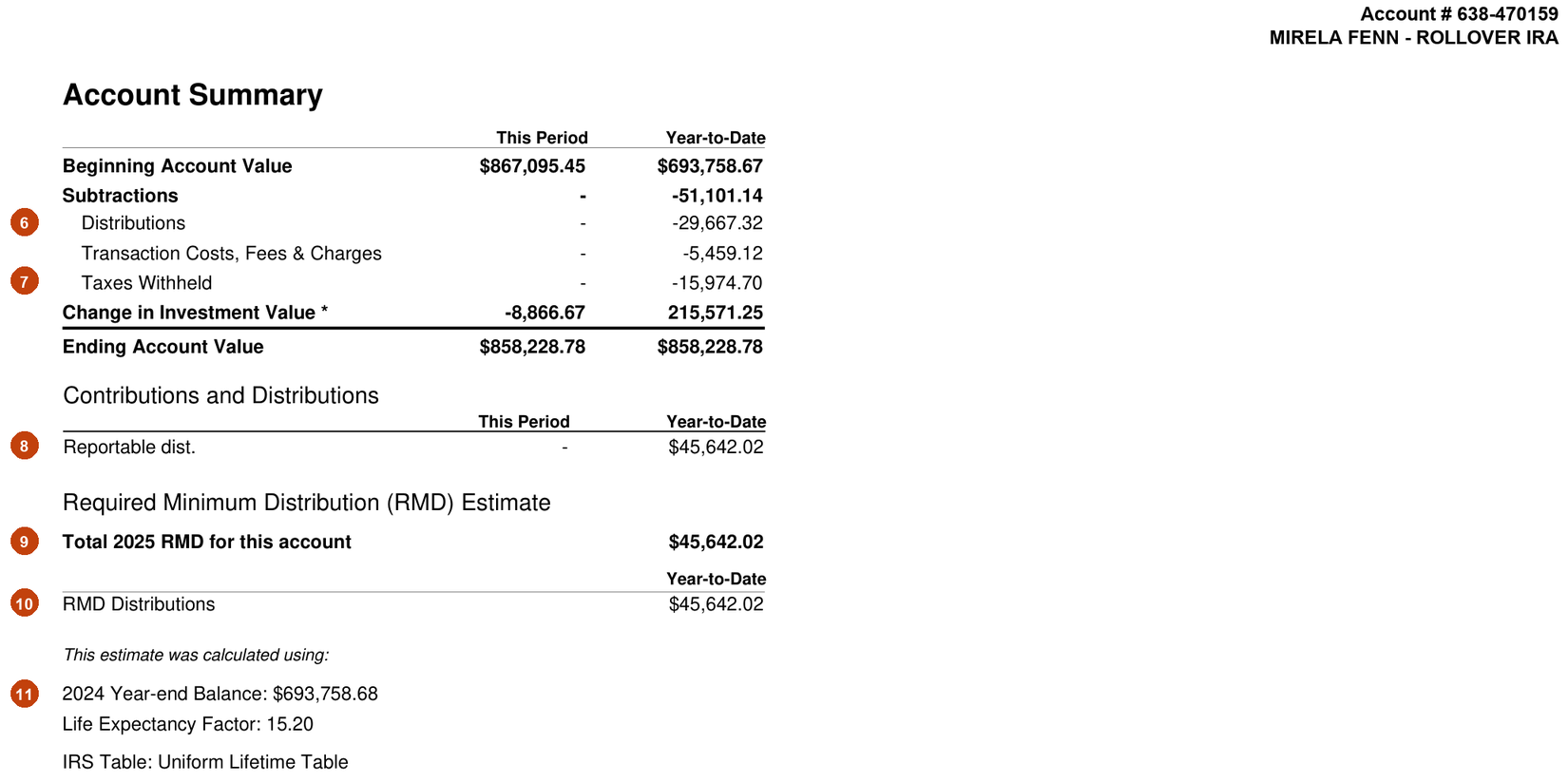
6. Distributions, $29,667.32 year to date. The cash that left the IRA and reached its owner during the year.
7. Taxes Withheld, $15,974.70 year to date. Income tax the custodian withheld from the distributions and sent to the taxing authorities. It never reached the owner, but it was paid on her behalf.
8. Reportable distributions, $45,642.02. The gross distribution, the figure the custodian will report for income tax: $29,667.32 paid out plus $15,974.70 withheld equals $45,642.02. When an IRA's distributions are the fiduciary's receipts, this is the receipt, and the withholding is a disbursement for tax paid, reported separately. Recording only the net cash understates both sides by the tax.
9. Total 2025 RMD for this account, $45,642.02. The required minimum distribution the custodian computed for the year.
10. RMD Distributions, $45,642.02 year to date. The requirement was met exactly. In a conservatorship, this pair of figures is the quickest proof that the conservator took the distribution the law required; a shortfall is a tax problem the report should disclose.
11. "2024 Year-end Balance: $693,758.68," "Life Expectancy Factor: 15.20." The basis of the computation: $693,758.68 divided by 15.20 is $45,642.02. Note that the account summary on the page before shows the year's beginning value as $693,758.67, a cent less. Two pages of one statement, two figures for the same date. When figures disagree by pennies, use the one the statement's own arithmetic depends on, and do not let the difference become an unexplained gap in the account.
When the IRA does belong
- Payable to the estate. The IRA is an estate asset. It appears in the inventory at its date of death value and on the schedules like any other account, and its distributions are receipts of the estate.
- Payable to the trust. The trust, as beneficiary, usually holds an inherited IRA account titled to the trust. The account is a trust asset; each distribution into the trust is a receipt, divided between income and principal under the act; withholding is a tax disbursement.
- A conservatee's own IRA. Part of the conservatorship estate throughout. Distributions to the conservatee's checking account are transfers between the estate's own accounts, not receipts (see our article on transfers between the estate's own accounts); withholding and the custodian's fees are disbursements.
- Payable to a named person. Not in the accounting. If the statements are in the file, set them aside and say so in the report, so that the reader knows the account was considered and why it is not there.
Where each line lands
- Nowhere: accounts owned by someone else, including the survivor's IRAs, education accounts and custodial accounts, even when they share a statement with the trust.
- Receipts: the gross distribution from an IRA that belongs to the estate or trust.
- Disbursements: income tax withheld, and the custodian's fees and charges.
- Property on hand: an IRA that belongs to the estate or trust, at carry value, with its market value where the schedules call for it.
- The report: which accounts on a consolidated statement were left out and why; any required distribution not taken.
Common mistakes
- Accounting for the whole statement. A consolidated report's total is a family's total, not the trust's.
- Including an IRA because the decedent owned it. Ownership at death is not enough; the beneficiary designation decides.
- Recording the net distribution. The receipt is the gross amount; the withholding is a disbursement.
- Missing the RMD. In a conservatorship, the required distribution is part of managing the estate; check the custodian's RMD page every year.
- Treating transfers to the survivor as transfers. Money moving from a trust account to the survivor's own account is a distribution to her.
Checklist
- List every account on every consolidated statement, with its title and owner.
- For each retirement account, find the beneficiary designation or the account title before deciding whether it belongs.
- For any IRA that belongs, take the gross distributions, the withholding and the fees from the summary, and tie them to the activity pages.
- Compare the RMD page with the distributions taken.
- In the report, name the accounts that were excluded and the reason.
Praise for Balanced
“This has by far been the best user-experience and I’ve been really impressed with your product thus far.”
“I’d also just like to say that I was a trusts & estates paralegal for 6 years prior to becoming an attorney myself, so I’ve done hundreds of accountings manually. I’ve also tried countless other ‘trust accounting’ products. This has by far been the best user-experience and I’ve been really impressed with your product thus far. Myself and my firm will be repeat customers.”
California Estate Planning Services PC
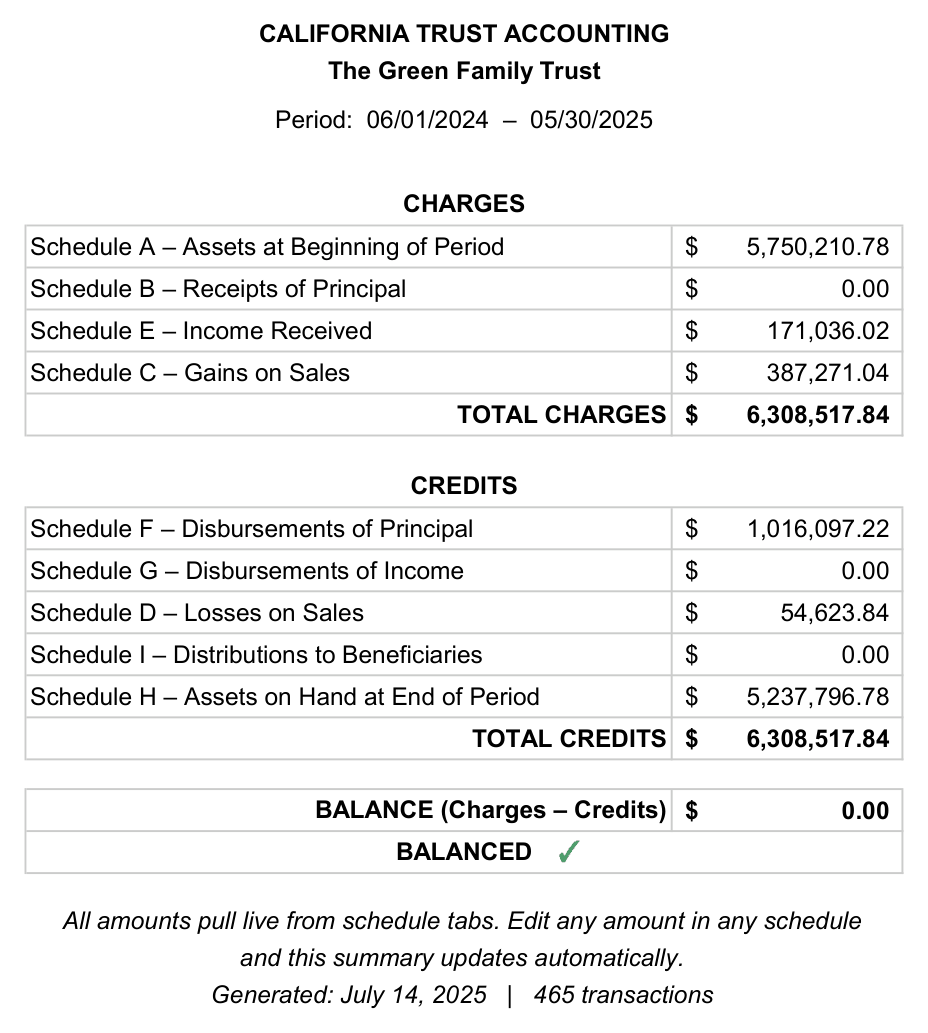
Inside a real Balanced workbook
$699 Flat. No Subscription. No Install.
Let Balanced do the reading
Consolidated statements mix the fiduciary's accounts with everyone else's, and retirement accounts mix cash, tax and required distributions into a single summary. Sorting the accounts by owner and reporting each retirement payment at its gross amount is hard, technical work. It is also what Balanced does. Add the PDF statements for the accounting period, including scanned or incomplete ones, and Balanced converts and organizes the data on them into the Probate Code schedules, account by account, each line traced to its page, as one editable Excel workbook balanced to the penny. It is $699 flat. Review the workbook against your statements. Start an accounting.
The Law and the Art of Fiduciary Accounting is a series by Balanced Legal Technology, LLC on complex California fiduciary accountings. General information only, current as of November 2026; not legal, tax or accounting advice. Statutes and rules change; confirm current law before relying on it.
About the author
Marc Joyce is a licensed, practicing California trusts and estates attorney, and the founder and developer of Balanced. He brings both sides to the problem: as a lawyer, and as an engineer. The Law and the Art of Fiduciary Accounting is his series on the hard cases where the two meet.
To see entries like these in a finished account, see the sample trust accounting and the estate accounting example, each with every schedule filled in.
Ready to generate yours? Add the PDF statements for the accounting period. Your PDFs stay on your computer.
$699 Flat. No Subscription. No Install.