 Balanced
The statements
The pictures in this article come from three real brokerage statements from three different custodians: a quarterly statement for a living trust, a monthly investment report and a monthly client statement. The names, account numbers, check numbers and the names of the institutions have been changed. Every date, amount and line is exactly as the custodian printed it, so every figure below can be checked against the picture.
Almost every brokerage account keeps its uninvested cash in a "sweep": an insured bank deposit program or a money market fund that the custodian moves cash into and out of automatically. Each custodian names it differently (Insured Cash Account, Core Fund, Bank Deposit Program, Cash Sweep, Insured Deposit Account), and each prints a section that reports every one of those automatic moves.
Those sections are long, they are full of dollar amounts, and they look exactly like activity. They are not. A sweep line is the cash side of something that already happened somewhere else on the statement: a dividend, a sale, a check, a fee. Entering it as well as the real transaction counts the month twice. On an active account the sweep section can run to more lines than everything else on the statement combined, which is why this is one of the commonest ways an account ends up wrong.
Have the statements? Balanced converts and organizes the data on them into this accounting, in the Probate Code format, as one editable Excel workbook balanced to the penny. Scanned or incomplete statements work.
- Developed by a California trusts and estates attorney
- Works with any PDF statement, downloaded or scanned
- Statement entries are cited to the PDF and page they
came from, for easy verification - A fully editable Excel workbook, emailed in about 1 hour
$699 Flat. No Subscription. No Install.
This has by far been the best user-experience and I’ve been really impressed with your product thus far.
Kelsey B. Cooper, Esq., California Estate Planning Services PC
What the law asks for
Receipts and disbursements, once each. A trustee's account states "the receipts and disbursements of principal and income that have occurred during the last complete fiscal year of the trust or since the last account" (Prob. Code § 16063(a)(1)). An account in the court format shows receipts (§ 1062(a)) and disbursements (§ 1062(b)) on their own schedules, and the summary must balance: "Total charges shall equal total credits" (§ 1061(c)).
Cash is property on hand. Property on hand at the end of the period, including cash, is listed at its carry value (§§ 1061(a)(10), 1062(f)). A deposit in a bank sweep or shares of a money market fund held as the account's cash are cash on hand, stated at face.
What a sweep is not. Moving the account's own cash from a cash balance into a deposit program and back again is not a receipt, a disbursement, a purchase or a sale of anything the account did not already own. Nothing in sections 1060 to 1064 asks for it to be reported, and reporting it as activity misstates both sides of the summary.
Income is still income. Interest the sweep earns, and dividends a money market fund pays, are income received by the trust or estate (§ 16340(c) for entity distributions such as fund dividends; interest generally under § 16345). Those few lines are real.
The sweep section: what the custodian says about its own lines
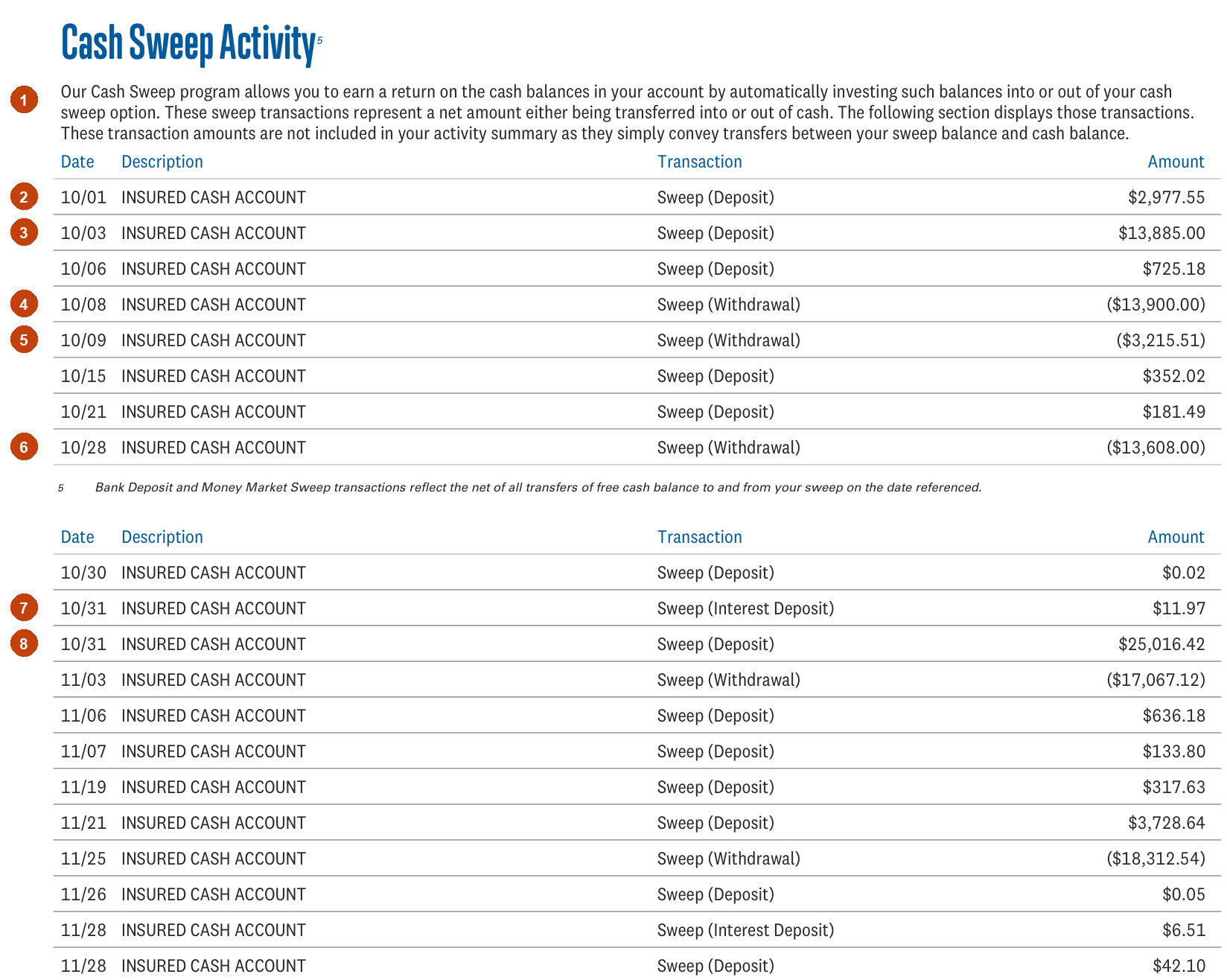
1. The custodian's own warning. Read the paragraph under the heading. The custodian says these lines "represent a net amount either being transferred into or out of cash" and that they "are not included in your activity summary as they simply convey transfers between your sweep balance and cash balance." The custodian does not count them. Neither should the account. The footnote adds the second reason they cannot be used: each line is "the net of all transfers" on that date, so one sweep line can hide several real transactions, and one real transaction can be split across days.
2. 10/01, deposit, $2,977.55. Not a receipt. It is the cash from four dividends: three paid on October 1 ($571.99, $1,324.19 and $761.65, all in the activity detail of this statement) and one of $319.72 paid on September 30 and reported in the activity detail of the September statement. $571.99 + $1,324.19 + $761.65 + $319.72 = $2,977.55. If the sweep line were entered as a receipt, all four dividends would be counted twice, and the September dividend would be counted in two different periods.
3. 10/03, deposit, $13,885.00. The cash from a voided check, reported in the activity detail on October 2 (callout 9). The void is the event; the sweep line is its echo.
4. 10/08, withdrawal, $13,900.00. Two disbursements netted together: a $13,885.00 check sent by courier on October 7 (callout 10) and the $15.00 courier fee charged the same day (callout 12). Neither amount appears in the sweep section; only their total does.
5. 10/09, withdrawal, $3,215.51. The advisory fee charged on October 8 (callout 13), one day earlier. The dates of sweep lines often lag the real transaction by a business day, which is another reason they cannot be matched to the schedules by date.
6. 10/28, withdrawal, $13,608.00. Again two disbursements: a $13,593.00 check on October 27 (callout 11) and a $15.00 express mail fee the same day.
7. 10/31, Sweep (Interest Deposit), $11.97. The one kind of line here that is real income: interest the insured deposit program paid for October. But it is reported again in the activity detail, as interest on the insured cash account for $11.97. Enter it once, from the activity detail, on the income schedule.
8. 10/31, deposit, $25,016.42. The proceeds of a mutual fund sale on October 30 ($25,000.00), plus a $16.15 dividend and $0.27 of credit interest the same day: $25,000.00 + $16.15 + $0.27 = $25,016.42. The sale belongs on the gains and losses schedule with its proceeds and carry value (§ 1062(d)); the dividend and interest belong on the income schedule. The sweep line belongs nowhere.
The activity detail: where the real transactions are
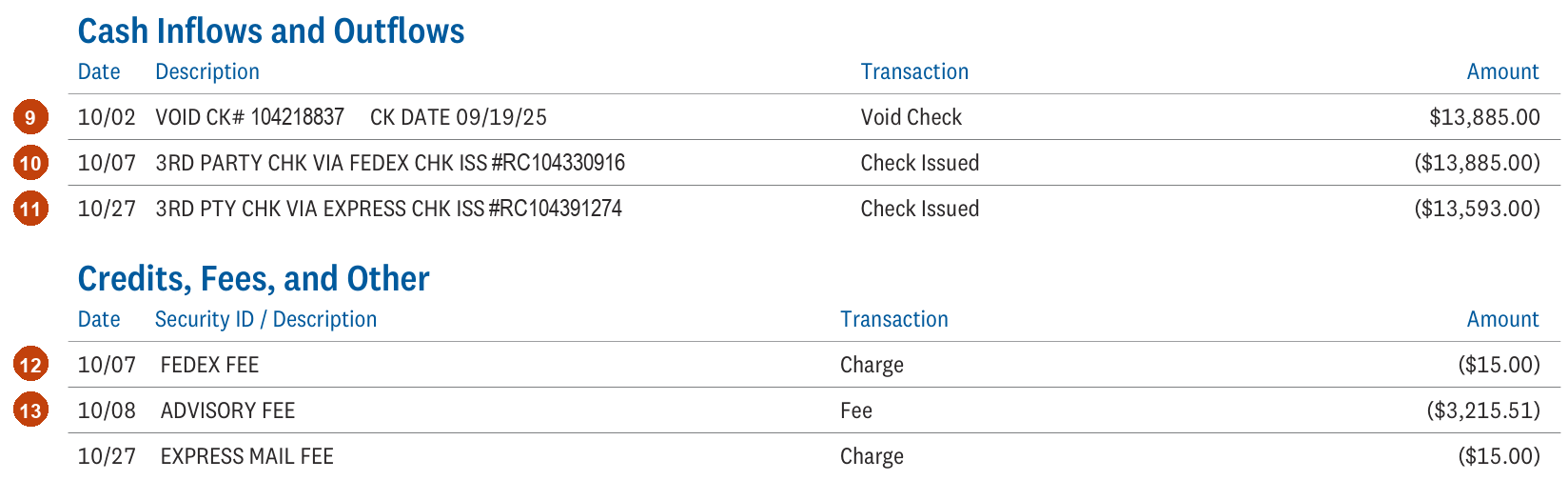
9. Void Check, $13,885.00. A check written in September and voided in October. The September account showed it as a disbursement; this line reverses it. Enter the reversal as what it is, a return of a disbursement, with a note tying it to the original check, not as a new receipt of principal.
10. and 11. Checks issued, $13,885.00 and $13,593.00. Disbursements for the disbursements schedule, each with its date, its amount and, from the check register or the invoice, its payee and purpose (§ 1062(b)). The statement alone often does not say who the check paid; the account must.
12. Courier fee, $15.00. A small disbursement, but a real one. Here it is folded into the sweep withdrawal of callout 4, which is exactly why a preparer working from the sweep would miss it.
13. Advisory fee, $3,215.51. A disbursement of the investment manager's compensation. Under the Uniform Fiduciary Income and Principal Act, a fiduciary generally charges one half of the regular compensation of a person providing investment advisory or custodial services to income and one half to principal, unless the fiduciary decides otherwise (Prob. Code § 16360 and following).
A second custodian: the core fund
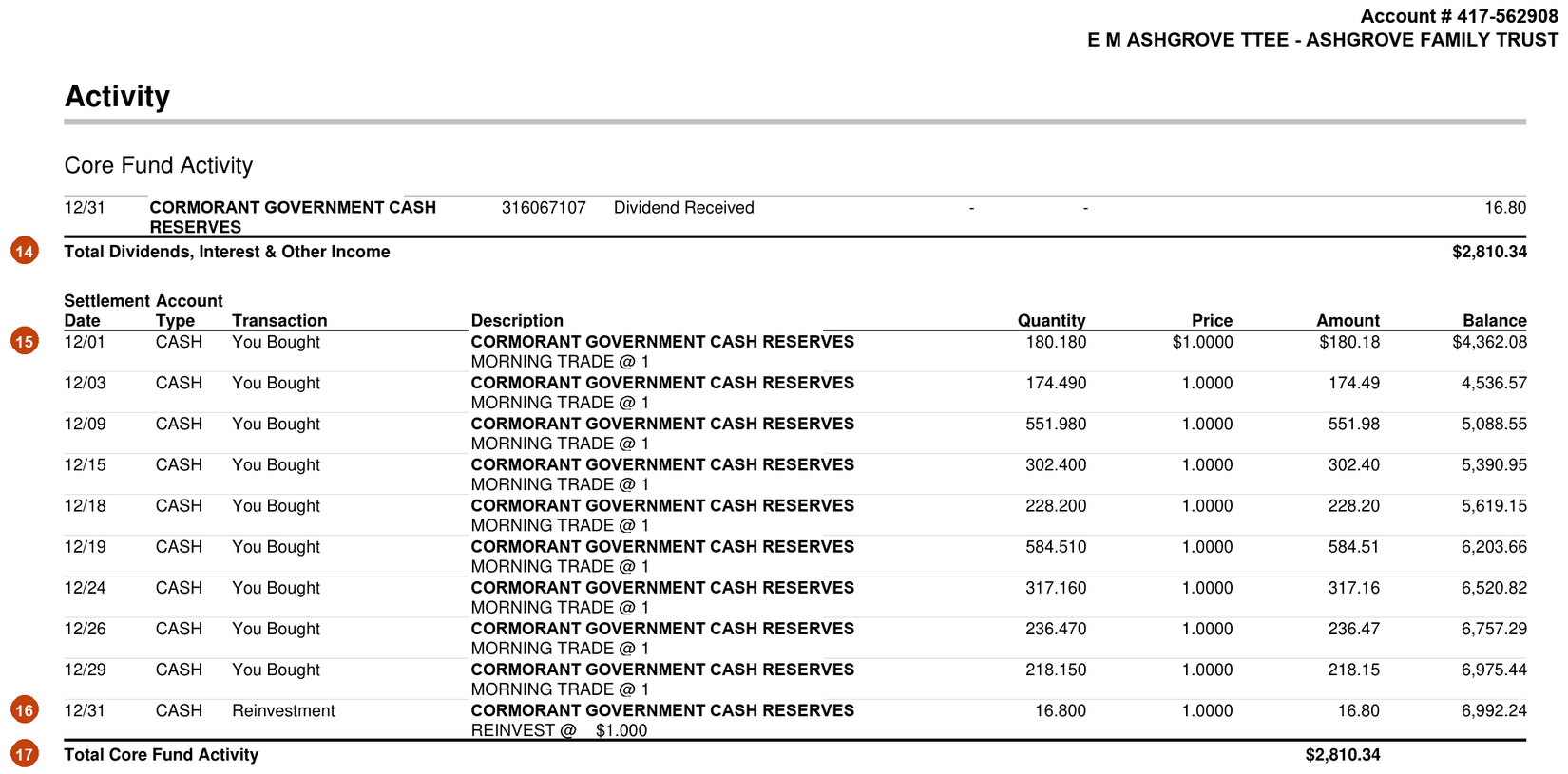
14. Total Dividends, Interest and Other Income, $2,810.34. The total of the month's income lines on the page before. Those lines, one by one, are the income schedule.
15. You Bought, core fund, every few days. At this custodian the sweep is a government money market fund called the core fund, and every time cash arrives the custodian "buys" shares of it at $1.00. These look like purchases. They are not changes in the form of the account's assets in any meaningful sense, because cash at $1.00 a share is still cash. The $551.98 bought on December 9, for example, is the three distributions paid that day by one fund, a dividend of $334.17, a long-term capital gain distribution of $122.10 and a short-term capital gain distribution of $95.71.
16. 12/31, Reinvestment, $16.80. The core fund's own monthly dividend, reinvested in more core fund shares. The dividend is real income (§ 16340(c)) and is already on the income page as a dividend received of $16.80. The reinvestment is cash staying cash.
17. Total Core Fund Activity, $2,810.34. Exactly the dividends total in callout 14. That is the whole lesson in one figure: every dollar of core fund activity this month is the income of the month, moving into the sweep. Enter the income lines; enter none of the core fund lines; use the matching totals to prove the month.
A third custodian: the bank deposit program

18. Automatic Redemption. The custodian took cash out of the bank deposit program to pay for something: a withdrawal, a purchase, a fee. Find that something in the activity detail.
19. Automatic Investment. Cash arriving (a dividend, interest, sale proceeds) and moving into the program.
20. Net Activity for Period, $(3,759.08). The month's net change in the bank deposit balance. It is a useful check (beginning cash plus receipts less disbursements, purchases and sales should move by the same amount), and it is not an entry.
Where each line lands
- Receipts and income schedules: the dividends, interest, capital gain distributions and deposits in the activity detail, one line each. Never the sweep, core fund or bank deposit program lines.
- Disbursements: the checks, fees and withdrawals in the activity detail, with their payees. Never the sweep withdrawals that pay for them.
- Gains and losses: sales from the activity detail, against carry value (§ 1062(d)). Never the sweep deposit of the proceeds.
- Income earned by the sweep itself: once, from the activity detail or the income section, on the income schedule.
- Property on hand at the end: the closing balance of the sweep, as cash, at face (§ 1062(f)).
- Nowhere: every Sweep (Deposit), Sweep (Withdrawal), You Bought core fund, Automatic Investment and Automatic Redemption line.
Common mistakes
- Entering the sweep and the detail. The single largest source of doubled receipts and disbursements in brokerage accounts.
- Entering the sweep instead of the detail. It looks complete, but it nets transactions together (callouts 4 and 6), shifts dates (callout 5), and pulls in last month's activity (callout 2). The account will be short of payees, wrong on dates, and impossible to trace.
- Treating core fund buys as purchases. They are not changes in form; listing them inflates the changes in form schedule with hundreds of lines of cash moving to cash.
- Missing the sweep's own interest. The one real line in the section; take it once from the activity detail.
- Missing a void. A voided check is a reversal of an earlier disbursement, and the earlier account may already show the check as paid.
Checklist
- Find the sweep section and the custodian's description of it; confirm the custodian excludes it from activity.
- Enter every receipt, disbursement and sale from the activity detail only.
- Tie a few sweep lines to their real transactions; if they tie, the detail is complete for those days.
- Take the sweep's own interest or dividend once, from the activity detail.
- Take the ending sweep balance as cash on hand.
- Prove the month: beginning cash, plus receipts, less disbursements, plus sales, less purchases, equals ending cash including the sweep.
Praise for Balanced
“This has by far been the best user-experience and I’ve been really impressed with your product thus far.”
“I’d also just like to say that I was a trusts & estates paralegal for 6 years prior to becoming an attorney myself, so I’ve done hundreds of accountings manually. I’ve also tried countless other ‘trust accounting’ products. This has by far been the best user-experience and I’ve been really impressed with your product thus far. Myself and my firm will be repeat customers.”
California Estate Planning Services PC
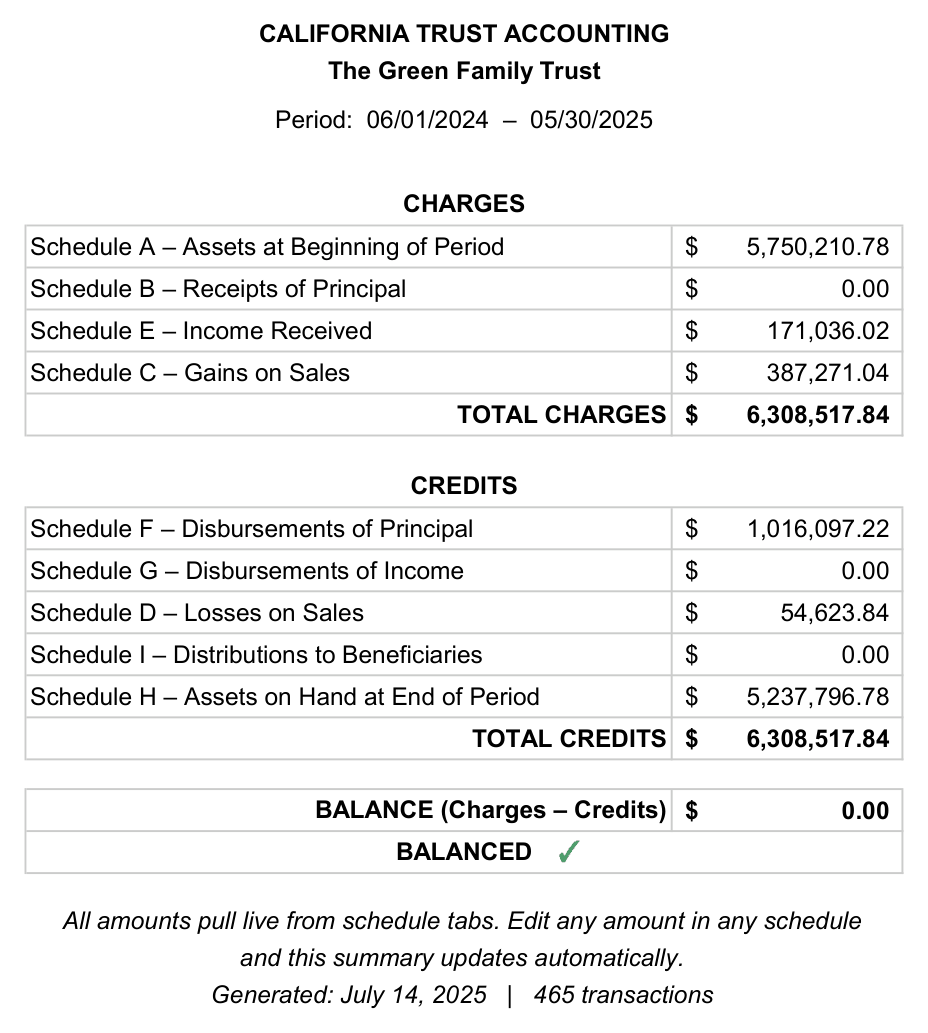
Inside a real Balanced workbook
$699 Flat. No Subscription. No Install.
Let Balanced do the reading
On an active account, the sweep section can be most of the statement, and a reliable account depends on setting every one of those lines aside while catching the few that are real. That is hard, technical work across twelve statements and several accounts. It is also what Balanced does. Add the PDF statements for the accounting period, including scanned or incomplete ones, and Balanced converts and organizes the data on them into the Probate Code schedules, one line per real transaction, each traced to its page, as one editable Excel workbook balanced to the penny. It is $699 flat. Review the workbook against your statements. Start an accounting.
The Law and the Art of Fiduciary Accounting is a series by Balanced Legal Technology, LLC on complex California fiduciary accountings. General information only, current as of November 2026; not legal, tax or accounting advice. Statutes and rules change; confirm current law before relying on it.
About the author
Marc Joyce is a licensed, practicing California trusts and estates attorney, and the founder and developer of Balanced. He brings both sides to the problem: as a lawyer, and as an engineer. The Law and the Art of Fiduciary Accounting is his series on the hard cases where the two meet.
To see entries like these in a finished account, see the sample trust accounting and the estate accounting example, each with every schedule filled in.
Ready to generate yours? Add the PDF statements for the accounting period. Your PDFs stay on your computer.
$699 Flat. No Subscription. No Install.