 Balanced
The statements
The pictures in this article come from four real statements from four custodians: two monthly statements for a living trust, a few months apart, after one of its trustees died; a monthly client statement; a year-end Form 1099-B; and a monthly statement from a bond account. The names, trust date, account numbers and the names of the institutions have been changed, and so has one date that would identify the date of death. Every other date, quantity and amount is exactly as printed.
Every custodian reports the gain or loss on each sale, often with the date each lot was acquired and what it cost. Those pages look like ready-made schedules of gains and losses. They are not. They are built for the income tax return, from the custodian's cost records, which may be the original purchase price, a stepped-up value, an amortized figure or nothing at all. The Probate Code measures gain and loss differently. Reading these pages correctly means using their dates, quantities and proceeds and setting their cost and gain columns aside, then computing the account's own figures from carry value.
Have the statements? Balanced converts and organizes the data on them into this accounting, in the Probate Code format, as one editable Excel workbook balanced to the penny. Scanned or incomplete statements work.
- Developed by a California trusts and estates attorney
- Works with any PDF statement, downloaded or scanned
- Statement entries are cited to the PDF and page they
came from, for easy verification - A fully editable Excel workbook, emailed in about 1 hour
$699 Flat. No Subscription. No Install.
This has by far been the best user-experience and I’ve been really impressed with your product thus far.
Kelsey B. Cooper, Esq., California Estate Planning Services PC
What the law asks for
Gain or loss against carry value. Every account includes a "Calculation of gains or losses on sale or other disposition" (Prob. Code § 1062(d)). Property on hand is stated at its carry value (§§ 1061(a)(10), 1062(f)), and the gain or loss on a sale is the difference between the proceeds and the carry value of what was sold.
Where carry value starts. In a first account the beginning figure is "the value of the property initially received by the fiduciary" (§ 1061(a)(1)), which for property received at a death is its value at the date of death, usually from the inventory and appraisal. In a later account it is the carry value on the closing schedule of the prior account. Property bought during administration is carried at its purchase price.
The method is the fiduciary's, and must be explained. No statute says how to measure the carry value of part of a position. Our article on lot-by-lot carry value covers the choice between lots and averaging. Whatever the method, the report explains transactions that are "not otherwise readily understandable from the schedule" (§ 1064(a)(1)).
Proceeds are principal. Money received from the sale or change in form of a principal asset is principal (§ 16343(b)).
One lot, two statements: the custodian changes its mind
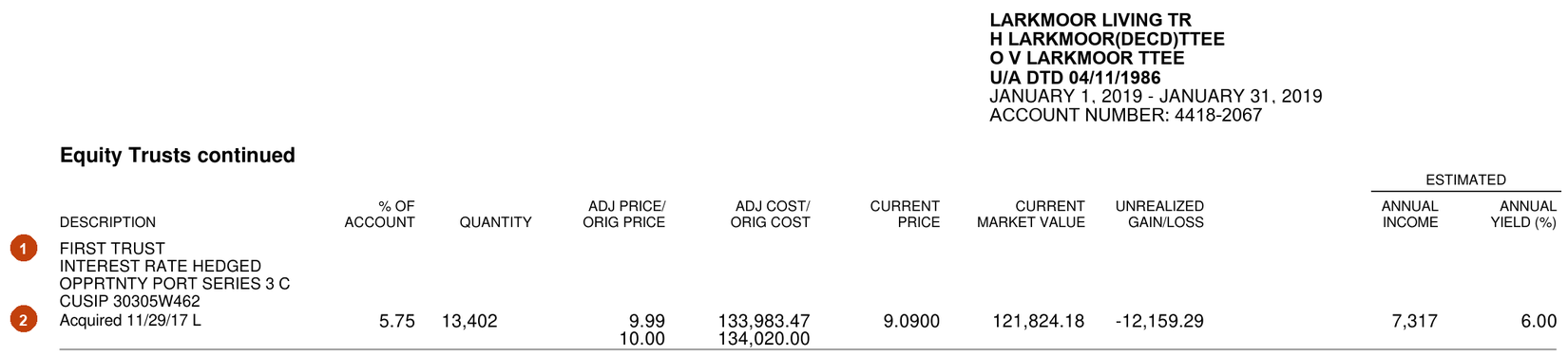
1. First Trust Interest Rate Hedged Opportunity Portfolio, 13,402 units. A unit investment trust held by the trust. One of the two trustees died in January; the statement already shows him as deceased.
2. "Acquired 11/29/17 L," adjusted cost $133,983.47, original cost $134,020.00. On the January statement the custodian still carries the units at their 2017 purchase cost: $9.99 a unit adjusted, $10.00 original. At the month-end price of $9.09, the custodian shows an unrealized loss of $12,159.29.
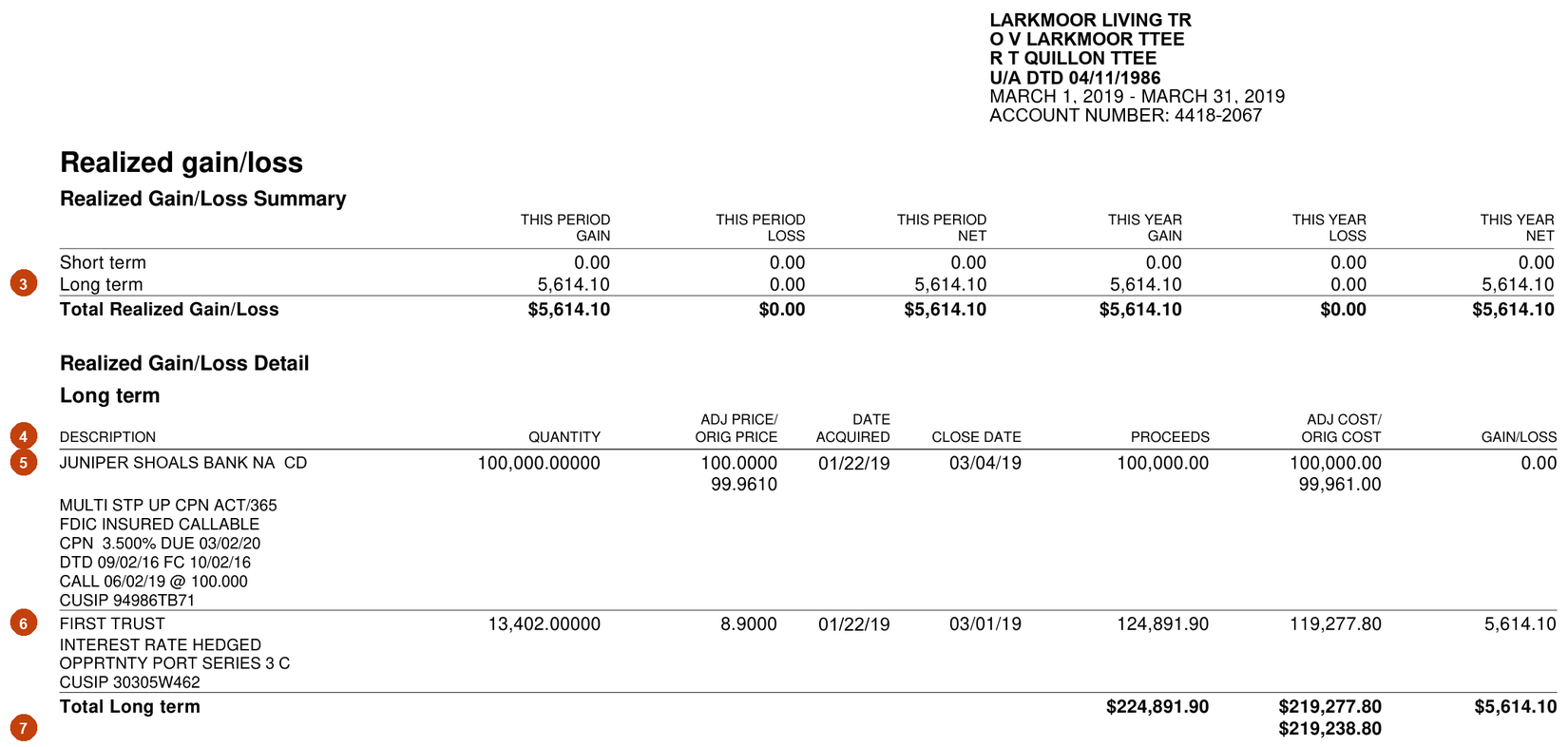
3. Realized Gain/Loss Summary, long term, $5,614.10. The custodian reports a gain this period. It is a total of the detail below, for income tax, and not an entry.
4. The column headings. Quantity, adjusted and original price, date acquired, close date, proceeds, adjusted and original cost, gain or loss. Use the quantity, the close date and the proceeds. Treat everything else as the custodian's opinion of cost.
5. A certificate of deposit, closed 03/04/19. Proceeds of $100,000.00 against an adjusted cost of $100,000.00 and an original cost of $99,961.00. A small example of the two cost columns disagreeing.
6. The same 13,402 units, sold 03/01/19 for $124,891.90. Now the date acquired reads 01/22/19, which for this article is the date of death, and the cost is $119,277.80, exactly $8.90 a unit. Between January and March the custodian reset the units' cost to their value at the death, as income tax law allows for inherited property. The custodian therefore reports a gain of $5,614.10. Had it not updated the cost, the same page would show a loss of $9,091.57 ($124,891.90 less $133,983.47). Same sale, same proceeds, a $14,705.67 swing, depending only on which month's records the custodian was using.
Notice also that the sale is reported as long term although the units were "acquired" less than six weeks earlier. Tax law treats inherited property as held long term. Nothing about that label matters for the Probate Code account.
7. Total long term, adjusted cost $219,277.80, original cost $219,238.80. Two totals for cost, neither of which is the account's.
What the account needs here is the units' carry value: in a first account, their value at the date of death from the inventory and appraisal. If the appraised value was $8.90 a unit, the account's figure happens to match the custodian's reset cost, and the gain is $5,614.10. But that is a coincidence to be checked, not a figure to be copied. Custodians reset cost late, reset it from a different date or price than the appraisal used, reset some lots and not others, or never reset it at all. The order of authority for carry value is the account's own records: the inventory and appraisal, or the prior account's closing schedule, never the custodian's cost column.
Lot detail for something that was not sold

8. GNMA Pool 002362, acquired 03/04/97, "sold" 01/01/20, proceeds $0.82, cost $0.86, loss $(0.04). No one sold anything. A Ginnie Mae mortgage pool returns a little principal every month as the underlying mortgages are paid down, and custodians report each paydown as a sale of a sliver of the original lot. Lot detail for bonds and pools is full of these.
9. The same pool, 02/01/20, proceeds $0.83. The next month's paydown, reported the same way. For the account, each paydown is a return of principal on a principal asset (§ 16343(b)), and it reduces the pool's carry value proportionately. The allocation between principal and income of payments on asset-backed securities follows the act's rule for those securities (Prob. Code § 16320 and following); the interest part of each payment arrives separately as income.
10. Net Realized Gain/(Loss) This Period, $(0.07). A total of four cents of tax losses on pennies of paydowns, measured from a 1997 purchase price. None of it is a Probate Code figure, and on a pool held at a death, the carry value will be the date-of-death value, not the 1997 cost.
The Form 1099-B: one line for many lots

11. 02/05/25, 831.105 shares, proceeds $7,629.63, date acquired "Various," cost $7,501.89, gain $127.74, "Total of 11 transactions." The year-end form combines eleven lots sold the same day into one line. "Various" means the custodian matched the sale against several purchase dates. The account cannot use this line as it stands: it needs the sale's date, quantity and proceeds from the monthly statement, and the carry value of the lots that were sold from its own records.
12. "Total of 2 transactions." Two lots, one line.
13. "Total of 10 transactions," loss $0.28. Ten lots of a fund whose price barely moved. The tax figure is close to zero; the account figure depends entirely on the carry value of those ten lots, which may be date-of-death values for some and purchase prices for others.
The same custodian's monthly statements explain how the lots were chosen: liquidating transactions are "automatically paired against holdings on a First In, First Out basis" unless the customer designates otherwise. That is a tax default. If the account carries lots individually, it must know which lots the custodian treated as sold, and apply the same identification to its own carry values, or explain why it did not.
A bond with two costs

14. Date Acquired, Unit Cost, Adjusted Cost Basis. Bond custodians print each lot with its acquisition date and an adjusted cost.
15. Acquired 03/02/12, 170,000 face, adjusted cost $170,014.37. The bond was bought at a premium, and the custodian has amortized that premium down toward par as the bond approaches maturity, as income tax rules require.
16. "Original Cost Basis: $203,306.40." What was actually paid. The difference, more than $33,000, is premium that tax law spreads over the bond's life. The Probate Code account does not: interest is allocated to income "without provision for amortization of premium" (§ 16345(b)), so the bond stays at its carry value until it is sold or matures, and principal recognizes the loss at that point. Our article on corporate actions and carry value discusses the premium rule. For reading the statement, the lesson is simple: an "adjusted" cost is the custodian's tax figure and is never the account's carry value.
Where each line lands
- Gains and losses schedule: for each sale, the date, the security, the quantity and the proceeds from the activity detail or the realized gain detail; the carry value from the account's own records; the difference (§ 1062(d)).
- Principal receipts or changes in form: paydowns and returns of principal on bonds and pools, reducing carry value.
- Property on hand at the end: remaining lots at carry value (§§ 1061(a)(10), 1062(f)).
- Report: the method used to measure the carry value of what was sold, and any sale the custodian's figures would misstate (§ 1064(a)(1)).
- Nowhere: the custodian's cost, adjusted cost, original cost, realized gain, holding period, realized gain summary and the 1099-B gain or loss column.
Common mistakes
- Copying the realized gain column. It is a tax figure measured from the custodian's cost, which may be original cost, reset cost, amortized cost or blank.
- Trusting a reset. A cost that was updated to the date of death is a helpful check, not a source; confirm it against the inventory and appraisal.
- Using the 1099-B line as one sale. "Various" means several lots with several carry values.
- Treating paydowns as sales at a loss. They are returns of principal; the pennies of tax loss are not account figures.
- Carrying bonds at adjusted cost. The account does not amortize premium.
Checklist
- Take dates, quantities and proceeds from the statement; take carry value from the inventory, the prior account or the purchase records.
- Note the date each lot was acquired and whether the custodian's cost is original, reset or adjusted, but do not use it.
- Identify which lots were sold, using the custodian's lot matching as a guide, and apply the account's own method consistently.
- Treat bond and pool paydowns as returns of principal that reduce carry value.
- Reconcile the year: proceeds on your gains and losses schedule should equal the proceeds on the Form 1099-B, even though the gains will not.
- Explain the method, and any large difference between the account's gain and the custodian's, in the report.
Praise for Balanced
“This has by far been the best user-experience and I’ve been really impressed with your product thus far.”
“I’d also just like to say that I was a trusts & estates paralegal for 6 years prior to becoming an attorney myself, so I’ve done hundreds of accountings manually. I’ve also tried countless other ‘trust accounting’ products. This has by far been the best user-experience and I’ve been really impressed with your product thus far. Myself and my firm will be repeat customers.”
California Estate Planning Services PC
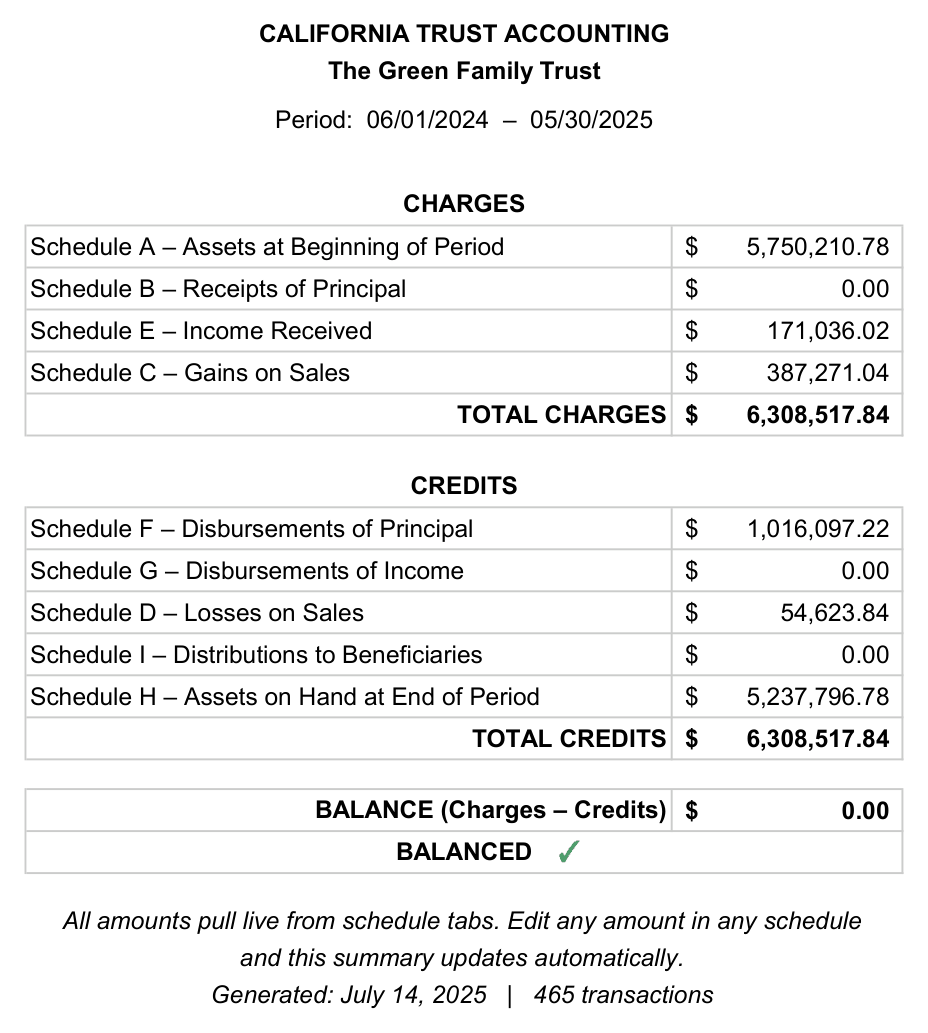
Inside a real Balanced workbook
$699 Flat. No Subscription. No Install.
Let Balanced do the reading
Realized gain pages are the most tempting shortcut on a statement and the most expensive one to take. Separating the figures the account can use from the ones it cannot, lot by lot and sale by sale, is hard, technical work. It is also what Balanced does. Add the PDF statements for the accounting period, including scanned or incomplete ones, and Balanced converts and organizes the data on them into the Probate Code schedules, with each sale measured against carry value, each line traced to its page, in one editable Excel workbook balanced to the penny. It is $699 flat. Review the workbook against your statements. Start an accounting.
The Law and the Art of Fiduciary Accounting is a series by Balanced Legal Technology, LLC on complex California fiduciary accountings. General information only, current as of November 2026; not legal, tax or accounting advice. Statutes and rules change; confirm current law before relying on it.
About the author
Marc Joyce is a licensed, practicing California trusts and estates attorney, and the founder and developer of Balanced. He brings both sides to the problem: as a lawyer, and as an engineer. The Law and the Art of Fiduciary Accounting is his series on the hard cases where the two meet.
To see entries like these in a finished account, see the sample trust accounting and the estate accounting example, each with every schedule filled in.
Ready to generate yours? Add the PDF statements for the accounting period. Your PDFs stay on your computer.
$699 Flat. No Subscription. No Install.