 Balanced
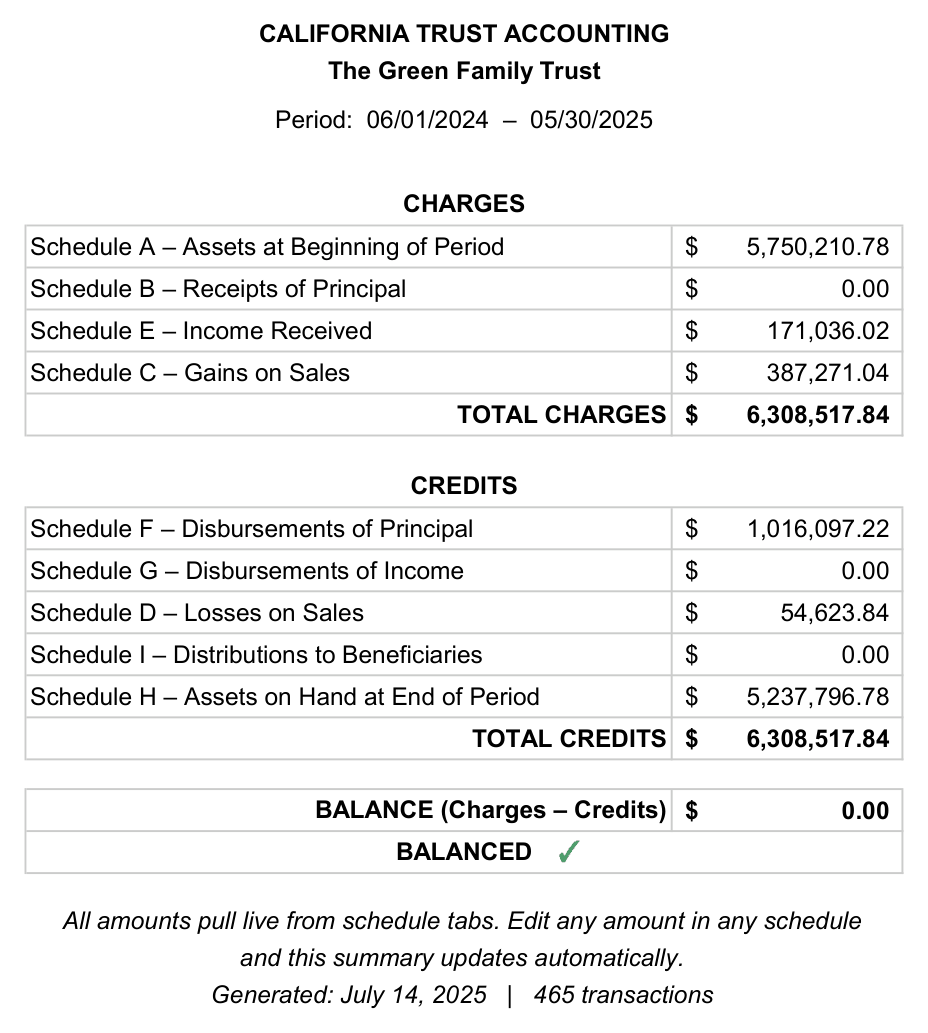
California Probate Code section 1061 requires every account filed with the court to state the period it covers and to open with a summary: the charges (property on hand at the beginning, property received, receipts, gains and business income) and the credits (disbursements, losses, business loss, distributions and property on hand at the end, at carry value). Total charges must equal total credits (§1061(c)).
Have the statements? Balanced converts and organizes the data on them into this accounting, in the Probate Code format, as one editable Excel workbook balanced to the penny. Scanned or incomplete statements work.
- Developed by a California trusts and estates attorney
- Works with any PDF statement, downloaded or scanned
- Statement entries are cited to the PDF and page they
came from, for easy verification - A fully editable Excel workbook, emailed in about 1 hour
$699 Flat. No Subscription. No Install.
This has by far been the best user-experience and I’ve been really impressed with your product thus far.
Kelsey B. Cooper, Esq., California Estate Planning Services PC
What section 1061 requires
Every account states the period it covers and contains a summary showing, to the extent they apply (§1061(a)):
- The property on hand at the beginning of the period: for a first account, the value of the property the fiduciary initially received; for a later account, the property on hand at the end of the prior account.
- The value of assets received during the period that were not on hand when administration of an estate began.
- Receipts of income or principal, other than the items in 1 and 2 and receipts from a trade or business.
- Net income from a trade or business.
- Gains on sales.
- Disbursements, other than disbursements for a trade or business and distributions.
- Losses on sales.
- Net loss from a trade or business.
- Distributions to beneficiaries, the ward or the conservatee.
- Property on hand at the end of the period, stated at its carry value.
The summary’s format
The summary must be in a format substantially the same as the one the section sets out, except that categories that do not apply need not be shown (§1061(b)):
| Side | Line of the Summary of Account |
|---|---|
| Charges | Property on hand at beginning of account (or Inventories) |
| Charges | Additional property received (or Supplemental Inventories) |
| Charges | Receipts (Schedule __) |
| Charges | Gains on Sale or Other Disposition (Schedule __) |
| Charges | Net income from trade or business (Schedule __) |
| Charges | Total Charges |
| Credits | Disbursements (Schedule __) |
| Credits | Losses on Sale or Other Disposition (Schedule __) |
| Credits | Net loss from trade or business (Schedule __) |
| Credits | Distributions (Schedule __) |
| Credits | Property on hand at close of account (Schedule __) |
| Credits | Total Credits |
The statute leaves the schedule letters blank. Practitioners assign their own; a conservator’s or guardian’s account uses the lettering of the Judicial Council’s GC-400 forms.
Total charges must equal total credits
“Total charges shall equal total credits” (§1061(c)). The charges say what the fiduciary was responsible for during the period: what was on hand at the start and what came in. The credits say what became of it: what went out, what was lost on sales, what was distributed, and what is still on hand. When the two totals are equal to the penny, every dollar is accounted for on the face of the account. That shows the arithmetic is consistent; whether each figure is right is checked against the statements. When they are not equal, see when a fiduciary accounting won’t balance.
Praise for Balanced
“This has by far been the best user-experience and I’ve been really impressed with your product thus far.”
“I’d also just like to say that I was a trusts & estates paralegal for 6 years prior to becoming an attorney myself, so I’ve done hundreds of accountings manually. I’ve also tried countless other ‘trust accounting’ products. This has by far been the best user-experience and I’ve been really impressed with your product thus far. Myself and my firm will be repeat customers.”
California Estate Planning Services PC
Inside a real Balanced workbook
$699 Flat. No Subscription. No Install.
Carry value, not market value
The property on hand at the end is stated at its carry value (§1061(a)(10)): the value the fiduciary was charged with, from the inventory or the prior account, adjusted only by what happened during the period. Unrealized changes in market value do not enter the summary; a gain or loss appears only when an asset is sold or otherwise disposed of. Market value is reported on its own schedule under section 1063(a). More in carry value in a California accounting.
Net income and net loss
“Net income” and “net loss” from a trade or business are used in accordance with general accounting principles, and the summary need not match the net income or loss on the tax returns for the same period (§1061(d)).
1061(c), (d). (c) Total charges shall equal total credits. (d) For purposes of this section, the terms “net income” and “net loss” shall be utilized in accordance with general accounting principles. Nothing in this section is intended to require that the preparation of the summary must include “net income” and “net loss” as reflected in the tax returns governing the period of the account.
Sections 1060 to 1064 at a glance
Chapter 4 of Part 1 of Division 3 of the Probate Code, five short sections, sets the format of every account filed with a California court:
| Section | What it covers |
|---|---|
| Section 1060 | Which accounts the rules govern |
| 1061 | The summary of account |
| Section 1062 | The supporting schedules |
| Section 1063 | Market value and the additional schedules |
| Section 1064 | What the petition or report must add |
All five together, with the reasoning behind the format and the mistakes that keep an account from balancing, are in Probate Code 1061 to 1064: the California accounting format. Each schedule, with what goes on it, is in California probate accounting schedules, and the whole format filled in is in the estate accounting example and the trust accounting example.
History of section 1061
Chapter 4 (sections 1060 to 1064) was added by Stats. 1996, ch. 862, sec. 4. Section 1061: Amended by Stats. 1997, ch. 724, sec. 6, effective January 1, 1998. The official text is at leginfo.legislature.ca.gov. Statutes change; confirm the current text before relying on it.
Common questions
What does Probate Code 1061 require?
That every account filed with a California court state its period and open with a summary of charges and credits, in substantially the format the section sets out, with total charges equal to total credits.
What are charges and credits in a California accounting?
Charges are what the fiduciary was responsible for: property on hand at the beginning, property received, receipts, gains and business income. Credits are what became of it: disbursements, losses, business loss, distributions and property on hand at the end.
Is the ending property shown at market value?
No. Section 1061(a)(10) states it at carry value. Market value goes on the separate schedule section 1063(a) requires.
Does the summary have to match the tax return?
No. Net income and net loss follow general accounting principles and need not match the tax returns for the period (section 1061(d)).
Generate it with Balanced
Balanced is a new kind of software for California fiduciary accountings. From the PDF bank and brokerage statements, Balanced converts and organizes the statement data into the Probate Code 1060 to 1064 format for a trust or a probate estate, or the GC-400 format for a conservatorship or guardianship, exactly as the statements show it, using disclosed, standard accounting conventions you can change; everything beyond that comes from your own instructions. Most are generated and delivered in about 1 hour, rather than the days, weeks or months of manual work an accounting otherwise takes. Transactions are classified to their schedules, carry values tracked lot by lot, each account reconciled to its own statements, the summary balanced to the penny, and each entry cited to the statement and page it came from, delivered as one fully editable Excel workbook. $699 per accounting.
For a finished estate accounting example, see the sample first and final account for a fictional decedent’s estate, every schedule filled in; a blank probate accounting template in Excel is free.
Ready to generate yours? Add the PDF statements for the accounting period. Your PDFs stay on your computer.
$699 Flat. No Subscription. No Install.