 Balanced
The statement
The pictures in this article come from a real December 2025 monthly statement for a decedent's trust, part of a consolidated report that also covers the surviving spouse's own accounts. The trust's name and number, the receiving banks, account numbers, reference numbers and the law firm's name have been changed. Every security, date and amount is exactly as printed.
Large lines get attention. Small lines get lost: a $15 wire fee, a $208.33 return of capital, a $12 card fee. Each is small, but each is a receipt or a disbursement the account must show, and many of them sit where a reader does not look, in a section called "Other Activity" or only in the detail, never in the summary. A return of capital is worse than lost when it is misread: it is counted as income, and the income beneficiary is paid money that belongs to principal.
Have the statements? Balanced converts and organizes the data on them into this accounting, in the Probate Code format, as one editable Excel workbook balanced to the penny. Scanned or incomplete statements work.
- Developed by a California trusts and estates attorney
- Works with any PDF statement, downloaded or scanned
- Statement entries are cited to the PDF and page they
came from, for easy verification - A fully editable Excel workbook, emailed in about 1 hour
$699 Flat. No Subscription. No Install.
This has by far been the best user-experience and I’ve been really impressed with your product thus far.
Kelsey B. Cooper, Esq., California Estate Planning Services PC
What the law asks for
Every receipt and disbursement, however small. The account shows the receipts and disbursements of the period (Prob. Code §§ 1062(a), 1062(b); § 16063(a)(1)), and the summary must balance (§ 1061(c)). A $15 fee left out is a $15 gap.
Returns of capital are principal. Money received in an entity distribution is income (§ 16340(c)), but money the fiduciary determines or estimates is a "capital distribution" goes to principal (§ 16340(d)(3)), and a capital distribution includes "A return of capital" (§ 16340(a)(1)). The fiduciary may rely on the entity's own characterization unless it knows the characterization "is or may be incorrect" (§ 16340(e)(1), (e)(1)(A)). Our article on corporate actions and carry value works through a partnership example and how a return of capital reduces carry value.
Expenses are divided by the act. The Uniform Fiduciary Income and Principal Act divides disbursements between income and principal (Prob. Code § 16360 and following): broadly, ordinary administration expenses and half of the regular compensation of the trustee and of investment advisers are charged to income, and the other half, together with the expenses of matters that concern primarily principal, to principal. The trust instrument may say otherwise.
The income summary: a total that is not all income
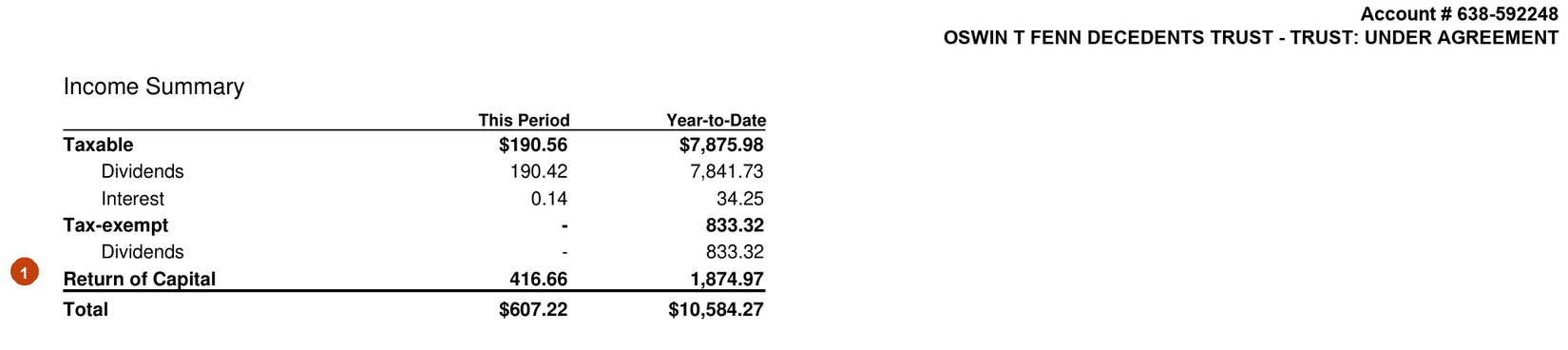
1. "Return of Capital," $416.66 this period, $1,874.97 year to date. The custodian's "Income Summary" lists the return of capital as a line of its own and adds it into "Total": $190.56 of taxable dividends and interest plus $416.66 is the $607.22 total for December. For the account, only the $190.56 is income. The $416.66 is principal. More than two thirds of the summary's total for December is principal. A preparer who takes that total as the month's income overstates income by $416.66 for December and by $1,874.97 for the year.
The detail: where the small lines are
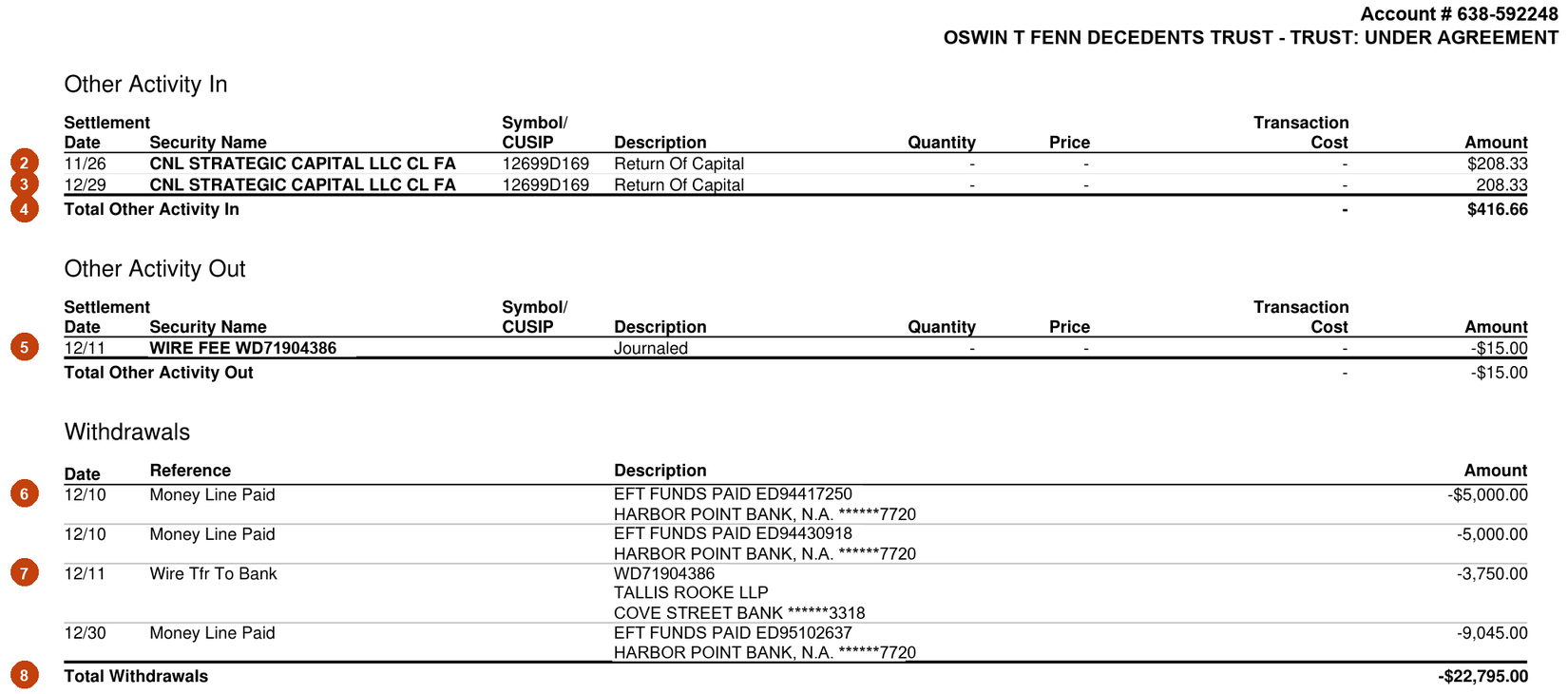
2. 11/26, CNL Strategic Capital, "Return Of Capital," $208.33. A monthly distribution from a non-traded investment company, posted by the custodian entirely as a return of capital. Note the date: November 26, on the December statement, because the custodian posted it late. On a cash basis it belongs to the period in which it was received; check that the November statement does not already show it (see our article on as of dates).
3. 12/29, the same, $208.33. December's distribution. The year-to-date figure in callout 1, $1,874.97, is nine of these: 9 times $208.33.
4. "Total Other Activity In," $416.66. The custodian files returns of capital under "Other Activity In," not under dividends. Read every section of the activity pages; a return of capital is rarely where the income is. For the account: a principal receipt, and in our practice a reduction of the investment's carry value by the same amount, with a gain only if the returns ever exceed it. Whatever method is used, state it. Before relying on the label, consider whether the fiduciary knows anything that makes it "is or may be incorrect" (§ 16340(e)(1)(A)).
5. 12/11, "WIRE FEE," "Journaled," ($15.00). The custodian's charge for the wire in callout 7, filed under "Other Activity Out," a different section from the wire itself. The account summary for December shows nothing under "Transaction Costs, Fees & Charges"; this fee appears only here. Report it as its own disbursement, beside the payment it accompanied and charged to the same side, income or principal.
6. 12/10, "Money Line Paid," two payments of $5,000.00 to an account at another bank. Electronic transfers to an account ending 7720, and a third, $9,045.00, on December 30. Who owns that account? If it is the trust's own bank account, these are transfers between the trust's accounts, reported as neither receipts nor disbursements (see our article on transfers between the estate's own accounts). If it is the surviving spouse's personal account, and she is the beneficiary, they are distributions to her. The statement does not say; the bank records do.
7. 12/11, "Wire Tfr To Bank," $3,750.00, to a law firm. A disbursement for legal services, with the payee in the wire's description. The engagement letter or invoice says what the work was, and so whether the fee is charged to principal, to income or divided between them under the act.
8. "Total Withdrawals," $22,795.00. $5,000.00 plus $5,000.00 plus $3,750.00 plus $9,045.00. One word, "withdrawals," for what may be a transfer, a distribution and a professional fee. The account summary carries the same $22,795.00 as a single subtraction. Nothing in that total can go on a schedule until each line is identified.
The small lines on other statements
The same habits apply everywhere. On a checking statement, an incoming wire fee or a card account fee is a disbursement of its own (see our article on bank statements and checks). On a brokerage statement, a courier fee can hide inside a sweep withdrawal (see sweep activity). A foreign dividend can carry both a tax and a depositary fee (see foreign dividends and currency). And an advisory fee, under the act, is generally divided equally between income and principal unless the trustee decides otherwise.
Where each line lands
- Principal receipts: returns of capital, with carry value reduced by the method stated.
- Income receipts: dividends and interest only, never the custodian's income total when it includes a return of capital.
- Disbursements: every fee, including wire, card and courier fees, as its own line, charged to income or principal under the act; professional fees with the payee and the work.
- Distributions: withdrawals to an account the beneficiary owns.
- Transfers: withdrawals to another of the trust's own accounts, reported as neither.
- The report: the method used for returns of capital, and any withdrawal whose receiving account could not be identified.
Common mistakes
- Using the income summary's total. It may include returns of capital.
- Missing "Other Activity." Returns of capital and fees often appear only there.
- Trusting the fee summary. A fee shown only in the detail is still a fee.
- One schedule for all withdrawals. Transfers, distributions and professional fees look identical on a custodian's withdrawal list.
- Ignoring the posting date. A distribution dated in one month and posted in the next can be counted in both.
Checklist
- Read every section of the activity pages, including "Other Activity In" and "Other Activity Out."
- Separate returns of capital from income in every month, and tie the year-to-date figure.
- List every fee, from the detail, not the summary.
- For each withdrawal, identify the receiving account and its owner.
- State the method used for returns of capital and the division of fees between income and principal.
Praise for Balanced
“This has by far been the best user-experience and I’ve been really impressed with your product thus far.”
“I’d also just like to say that I was a trusts & estates paralegal for 6 years prior to becoming an attorney myself, so I’ve done hundreds of accountings manually. I’ve also tried countless other ‘trust accounting’ products. This has by far been the best user-experience and I’ve been really impressed with your product thus far. Myself and my firm will be repeat customers.”
California Estate Planning Services PC
Inside a real Balanced workbook
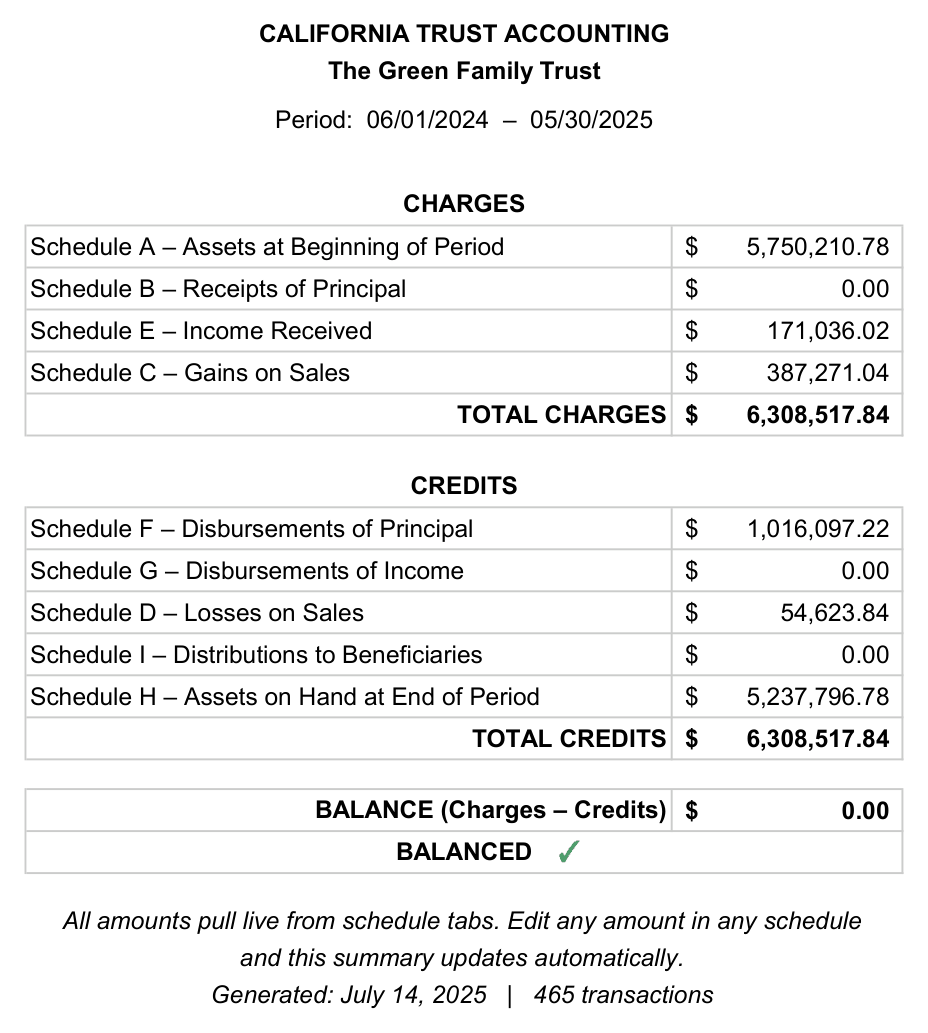
$699 Flat. No Subscription. No Install.
Let Balanced do the reading
Small lines are where accounts drift: a return of capital called income, a fee filed in a section nobody reads, a withdrawal that might be three different things. Finding every one of them, month after month, is hard, technical work. It is also what Balanced does. Add the PDF statements for the accounting period, including scanned or incomplete ones, and Balanced converts and organizes the data on them into the Probate Code schedules, every fee and every return of capital on its own line, each traced to its page, as one editable Excel workbook balanced to the penny. It is $699 flat. Review the workbook against your statements. Start an accounting.
The Law and the Art of Fiduciary Accounting is a series by Balanced Legal Technology, LLC on complex California fiduciary accountings. General information only, current as of November 2026; not legal, tax or accounting advice. Statutes and rules change; confirm current law before relying on it.
About the author
Marc Joyce is a licensed, practicing California trusts and estates attorney, and the founder and developer of Balanced. He brings both sides to the problem: as a lawyer, and as an engineer. The Law and the Art of Fiduciary Accounting is his series on the hard cases where the two meet.
To see entries like these in a finished account, see the sample trust accounting and the estate accounting example, each with every schedule filled in.
Ready to generate yours? Add the PDF statements for the accounting period. Your PDFs stay on your computer.
$699 Flat. No Subscription. No Install.