 Balanced
The statement
The pictures in this article are a real monthly statement for a trust's brokerage account. The trustees' names, the trust's name and date, the account number, and the names of the institution and its money market fund have been changed. One holding's share count was changed slightly, and every figure that depends on it was changed to match, so every total still ties. Every security, date and line is as the custodian printed it, so every number below can be checked against the page.
For this article, assume Edith Vessander died in November 2024, her trust became irrevocable, and her two successor trustees are preparing their first account. This is the March 2025 statement, one of many they will need.
A brokerage statement is not written for a fiduciary accounting. It is written for an investor and the investor's tax preparer. It reports the same events three or four times, in different places and from different angles: once as a total on the summary page, once in the transaction detail, once more as money moving into and out of the cash sweep, and again at year end on the tax forms. It shows values the accounting does not use (market value, unrealized gain, estimated income) next to the ones it does. And the figures it labels most prominently, such as "gain" and "cost basis," are usually not the figures the Probate Code asks for.
Finding the right figure on the right page, and knowing which of the others to leave alone, is most of the work. A careful person who counts a dividend twice, or takes the custodian's gain as the accounting's gain, ends with an account that does not balance or, worse, one that balances and is wrong.
Have the statements? Balanced converts and organizes the data on them into this accounting, in the Probate Code format, as one editable Excel workbook balanced to the penny. Scanned or incomplete statements work.
- Developed by a California trusts and estates attorney
- Works with any PDF statement, downloaded or scanned
- Statement entries are cited to the PDF and page they
came from, for easy verification - A fully editable Excel workbook, emailed in about 1 hour
$699 Flat. No Subscription. No Install.
This has by far been the best user-experience and I’ve been really impressed with your product thus far.
Kelsey B. Cooper, Esq., California Estate Planning Services PC
What the law asks for
The format. A trustee must keep the beneficiaries reasonably informed about the trust and its administration (Prob. Code § 16060) and account to them at least annually (§ 16062(a)). The account must contain, among other things, a statement of the receipts and disbursements of principal and income during the period and a statement of the trust's assets and liabilities at the end of it (§ 16063(a)(1), (2)). An account filed with the court is presented in the format of Probate Code sections 1060 and following (§ 16063(b)). Executors, administrators and conservators use the same chapter.
The summary and its schedules. The account opens with a summary of charges and credits, and "Total charges shall equal total credits" (§ 1061(c)). The supporting schedules show receipts (§ 1062(a)), disbursements (§ 1062(b)), the calculation of gains and losses on sales (§ 1062(d)), distributions (§ 1062(e)) and the property on hand at the end of the period (§ 1062(f)). Further schedules show the estimated market value of the assets on hand at the end of the period (§ 1063(a)), purchases and other changes in the form of assets (§ 1063(b)), and, where there are income beneficiaries, the split between principal and income (§ 1063(c)).
Two kinds of value. The beginning figure of a first account is "the value of the property initially received by the fiduciary" (§ 1061(a)(1)). Property on hand at the end is stated "at its carry value" (§ 1061(a)(10)); market value goes on its own schedule (§ 1063(a)). A brokerage statement prints market value almost everywhere and carry value almost nowhere.
Income and principal. Under the Uniform Fiduciary Income and Principal Act (Prob. Code § 16320 and following), money received in an entity distribution, such as a cash dividend, is generally income (§ 16340(c)), and the proceeds of selling a principal asset are principal (§ 16343(b)).
The letters. The statutes assign no schedule letters. This article uses the lettering of our workbooks: A (property on hand at the beginning), B (receipts of principal), C and D (gains and losses on sales), E (income received), F and G (disbursements of principal and of income), H (property on hand at the end), I (distributions), M (transfers between the estate's or trust's own accounts), plus the changes in form schedule.
The header: whose account, and which one

1. The account title. Before any figure, confirm the account belongs to the trust or estate whose account you are preparing. Here it is titled to the trustees of the trust. An account still titled in the decedent's own name, a joint account, or an account with a payable-on-death beneficiary may not belong in the accounting at all, or may belong only from the date it was retitled. That is a legal question for the attorney, and it should be settled before anything is entered.
2. The account number. Every line you take from this statement should carry the account it came from, usually by its last four digits. When the estate or trust has several accounts, this is what keeps a transfer between two of them from being counted as a disbursement from one and a receipt in the other (it belongs on Schedule M), and it is what lets a reader trace every figure back to its page.
The summary page: a map, not a source
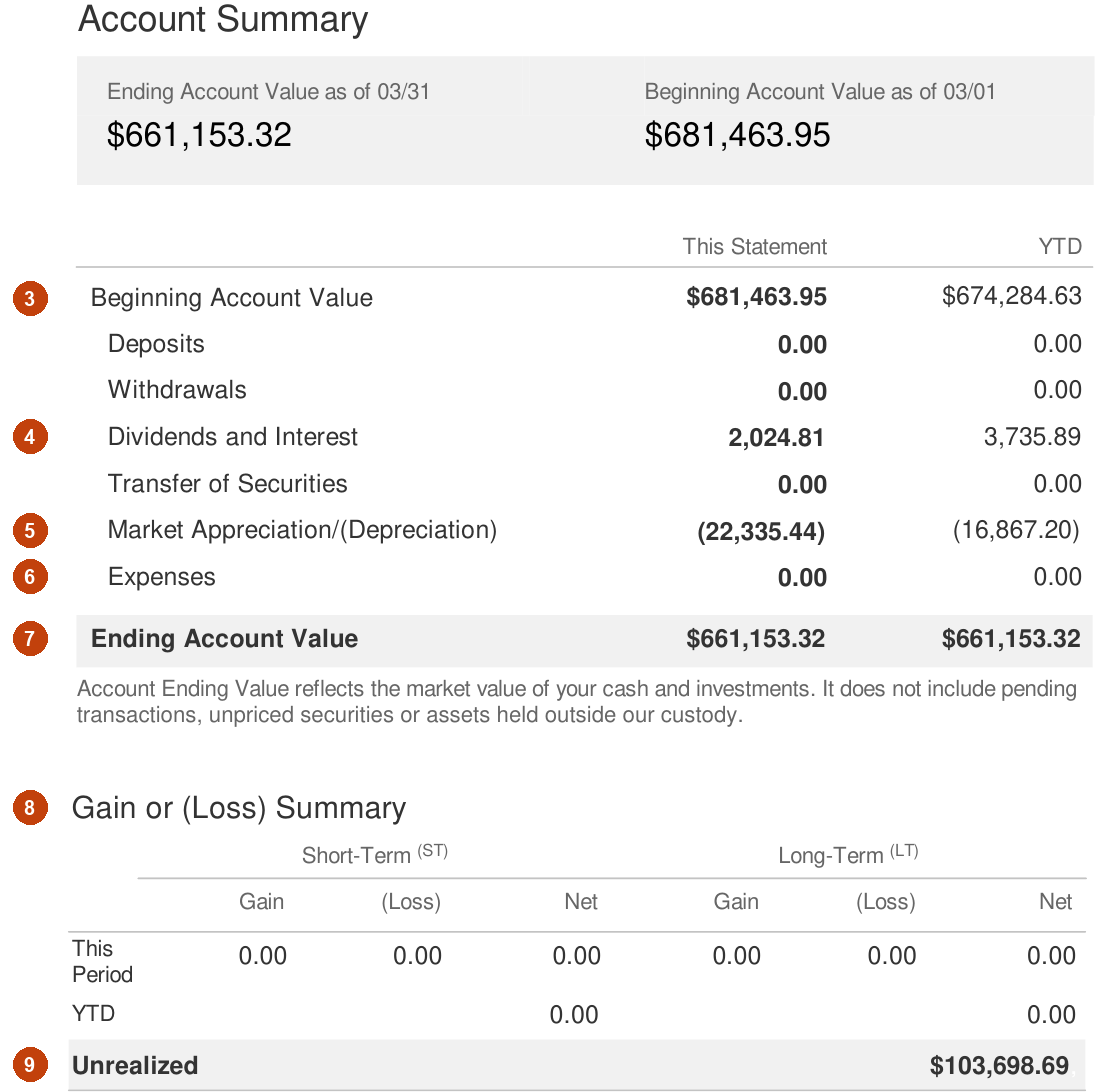
The summary page is the most tempting page on the statement and the least useful one for the schedules. Almost every figure on it is either a total of detail printed elsewhere or a market value. Use it to check your work, never as the source of a schedule entry.
3. Beginning Account Value, $681,463.95. This is the market value of everything in the account on March 1. It is not Schedule A. In a first account, Schedule A is the value of what the fiduciary received, measured at the date of death; in a later account it is the carry value of the property on hand at the end of the prior account. Neither is a March 1 market value. Even the statement covering the date of death is not the source: its beginning value is as of the first of that month, not the date of death, and its prices may not be the values used for the inventory.
4. Dividends and Interest, $2,024.81. A total. It is the sum of five detail lines on the activity page: cash dividends of $296.84, $220.78 and $840.82, interest of $2.03, and a money market dividend of $664.34 that was reinvested (callouts 16 to 18). Enter the five lines on Schedule E. Do not also enter the $2,024.81. This is the commonest way to double the income in an account.
5. Market Appreciation/(Depreciation), ($22,335.44). Ignore it. It is neither a receipt nor a loss. It is the custodian's plug: whatever change in market value is left after the cash flows. Notice that in the same month the custodian reports no realized gain or loss at all (callout 8), because nothing was sold. Both are true in their own terms, and neither is an accounting figure. A fiduciary accounting recognizes a gain or a loss only when property is sold or otherwise disposed of, measured against its carry value (§ 1062(d)). Unrealized swings in value appear only on the market value schedule (§ 1063(a)).
6. Expenses, $0.00 this month and $0.00 year to date. Nothing to enter. When this line is not zero, the summary does not say what the expenses were. Find each one on the activity pages, enter it there, and decide its allocation. If it is an investment management fee, the act generally charges one half of the regular compensation of anyone providing investment advisory or custodial services to income and one half to principal, unless the fiduciary decides otherwise (the Uniform Fiduciary Income and Principal Act, Probate Code section 16320 and following). Year-to-date columns are a cheap way to catch an expense or a deposit in a month you have not read closely. Here the year-to-date Dividends and Interest, $3,735.89, says $1,711.08 was received in January and February; each of those receipts is entered from its own month's activity page.
7. Ending Account Value, $661,153.32. Market value again. If the accounting period ended March 31, this total would be the check on the market value schedule (§ 1063(a)). It is not Schedule H, which states each asset at carry value (§ 1061(a)(10)).
8. Gain or (Loss) Summary, $0.00. The custodian's figure for income tax, computed against the custodian's cost basis. Here it is zero because nothing was sold this month. Even when it is not zero, it is not the Schedule C or D figure. See callout 13 for why the two can differ, by far more than the sale itself.
9. Unrealized, $103,698.69. Ignore it. It is market value less the custodian's cost basis for the positions still held. It has no place in the account.
The holdings page: what is on hand, but not at what value
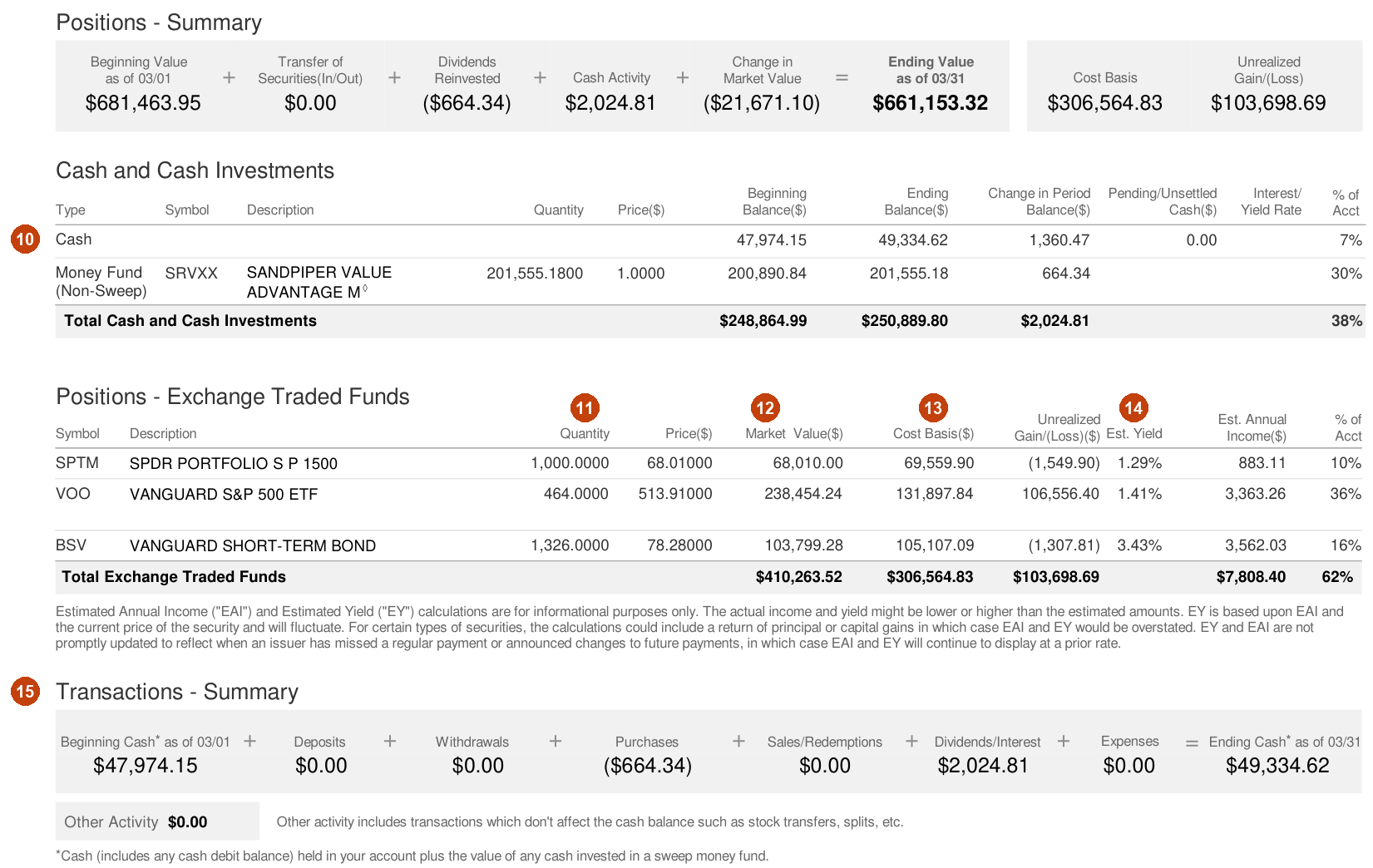
10. Cash, $49,334.62, and the money market fund, $201,555.18. The account's uninvested cash, and a money market fund the custodian lists beside it as a cash investment (marked Non-Sweep). The cash belongs on Schedule H as cash, at its face amount. The fund belongs there too, as 201,555.18 shares at $1.00 each. These ending balances are the source of the ending figures. The day-to-day movements of cash are not.
11. Quantity. The holdings page is the source for what is on hand at the end: which securities and how many shares. Check every count against the beginning holdings and the activity. The money market fund shows how: it began the month at $200,890.84, bought 664.34 more shares with its reinvested dividend on March 31 (callout 18), and ended with 201,555.18 shares. The three exchange-traded funds had no purchases or sales, so the February and April statements should show the same 1,000 shares of SPTM, 464 of VOO and 1,326 of BSV. A share count that does not chain from one statement to the next is the first sign of a missing statement, a corporate action or a transfer.
12. Market Value. The source for the market value schedule at the end of the period (§ 1063(a)), position by position. Not Schedule H.
13. Cost Basis. The custodian's tax cost, and the most misleading column on the page. Look at the Vanguard S&P 500 ETF: 464 shares carried at $131,897.84, about $284.26 a share, against a price of $513.91. The custodian is showing what the shares originally cost. Custodians often do not update cost basis to date-of-death values, or update it late, or mark it incomplete. The accounting's carry value for these shares in a first account is their value at the date of death, from the inventory or the date-of-death valuation, not this column. In a later account it is the carry value on the prior account's closing schedule. The difference matters as soon as the shares are sold. Suppose they were worth $520.00 a share on the date of death (a figure we assume for illustration), so the 464 shares are carried at $241,280.00, and the trustees sell them all at $513.91 for $238,454.24. The custodian would report a gain of $106,556.40 against its cost basis. The account shows a loss of $2,825.76 on Schedule D (§ 1062(d)). Same sale, same proceeds, a $109,382.16 difference, and an account built from the custodian's figures would be wrong by that amount.
14. Est. Yield and Est. Annual Income. Ignore both. They are the custodian's forecasts, as its own footnote says. Nothing here was received. Income enters the account only when it is paid (callout 16).
15. Transactions Summary. Another set of totals: ($664.34) of purchases and $2,024.81 of dividends and interest. Each repeats the activity detail. Use it to prove the month (beginning cash $47,974.15 less $664.34 plus $2,024.81 equals ending cash $49,334.62) and enter nothing from it. The $664.34 of "Purchases" is the reinvested money market dividend (callout 18), not a decision to buy anything.
The activity page: the source of truth
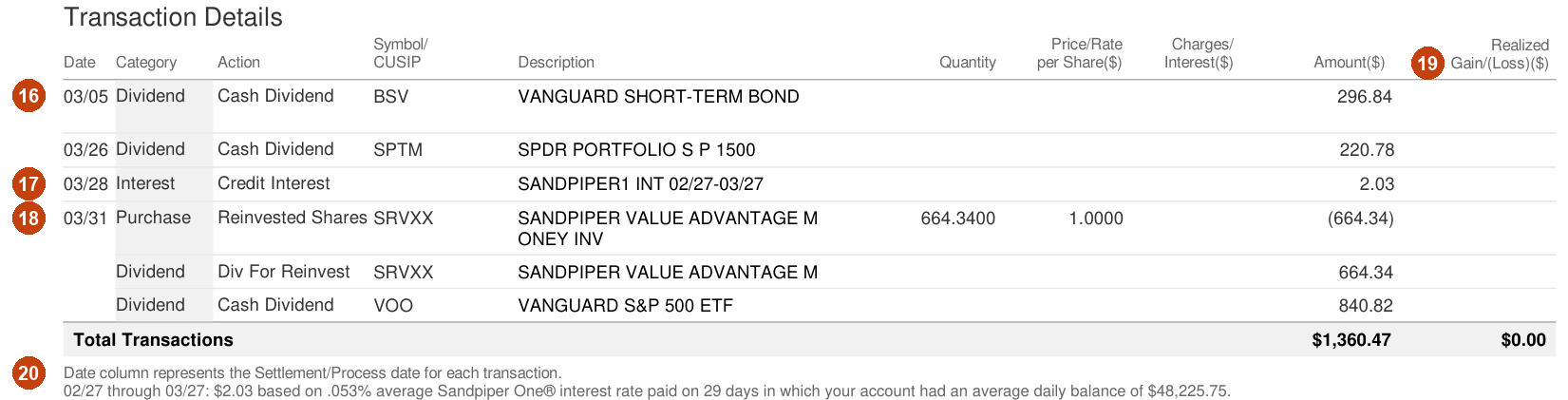
The transaction detail is where the schedules come from. Every receipt, disbursement, sale and purchase in the account appears here once, with its date, description and amount.
16. Dividends, $296.84, $220.78 and $840.82. Three income receipts for Schedule E, each with its date, the paying security and the amount (§ 1062(a)): BSV on March 5, SPTM on March 26 and VOO on March 31. A cash dividend is generally income (§ 16340(c)). One trap belongs here: a dividend paid shortly after death on shares held at death may have been declared, with a record date, before death. Depending on its dates it may belong to principal rather than income, and the act's rules on when an asset becomes subject to the trust and on apportioning receipts at that date decide it (the Uniform Fiduciary Income and Principal Act, Probate Code section 16320 and following). Check the first few dividends after death against their record dates.
17. Credit interest, $2.03. Income for Schedule E. The description and the footnote say it was earned from February 27 through March 27, so part of it accrued in February, and it was posted on March 28. Two periods, one receipt. Count it once, when it was received.
18. Reinvested Shares, ($664.34), and Div For Reinvest, $664.34. The money market fund paid a dividend of $664.34 and spent it the same day on 664.34 more shares at $1.00. Read the two lines together. The dividend is income for Schedule E; the purchase is a change in form, and the new shares are what the income bought (see our article on reinvested dividends). Entering neither because they net to zero loses the income; entering the shares as income as well doubles it.
19. Realized Gain/(Loss), $0.00. Ignore this column for the account. Nothing was sold this month, so it is empty, but in a month with sales it shows proceeds less the custodian's cost basis (callout 13), not the gain or loss against carry value that the account needs. The year-end realized gain and loss report repeats this column for the whole year and has the same problem.
20. "Date column represents the Settlement/Process date for each transaction." The dates are settlement dates. A trade is made a business day or so before it settles, so a sale traded on the last day of an accounting period can settle in the next one. Decide which date you use and use it consistently.
The pages not pictured
Sales. This statement has none. When there are sales, each appears in the transaction detail with the quantity in parentheses (shares going out, which reduce the count on Schedule H), a price, a small fee and a net amount. These are changes in the form of principal, and the proceeds are principal (§ 16343(b)). Each sale goes on Schedule C or D with its proceeds, its carry value and the difference (§ 1062(d)). The fee is part of the sale, not a separate disbursement. Whichever way you choose to show it, show it the same way every time.
Bank sweep activity. When an account's cash is held in a bank sweep, the custodian adds a section listing every movement into and out of the sweep. Ignore it for the schedules. Every line there is the cash side of a transaction already shown in the detail, so entering both sections doubles the month. On accounts with daily sweeps, this section can run to dozens of lines a month, none of them a receipt or a disbursement. Its value is as a check: beginning balance plus credits less debits should equal the sweep's ending balance on the holdings page.
Pending and open activity. Dividends declared but not yet paid, and trades not yet settled, appear in a section of their own, and the custodian says they are not included in account value. Each is received in the period in which it is paid or settles. If the accounting period ends on the statement date, a declared but unpaid dividend can be mentioned in a note, but it is not a receipt in this period.
Realized gain and loss reports. Many custodians add a page, or a separate year-end report, listing each sale with its cost basis, holding period and gain or loss. It is built for the tax return from the custodian's cost basis, so it has the same problem as callout 19. Use it to confirm the dates, quantities and proceeds of sales. Never take its gain or loss column for Schedule C or D.
Year-end tax pages and Forms 1099. The consolidated tax statement totals the year's dividends, interest and sale proceeds. Every figure on it repeats the monthly detail, so adding it to the monthly entries doubles the year. It is valuable as a check, and for one more reason: custodians sometimes reclassify a distribution after the fact, for example as a return of capital or a capital gain distribution. A reclassification can change whether a receipt belongs to income or principal, so compare the year-end figures with what you entered.
Income summaries and "top holdings." The income summary on page 2 of this statement repeats callout 4 by tax category, and the top holdings list repeats the holdings page. Neither is a source.
Where each line lands
- Schedule A, property on hand at the beginning: not this statement. The date-of-death values for a first account, or the prior account's closing schedule for a later one. The share counts on the first statement after death help confirm what was held.
- Schedule B, receipts of principal: the activity detail, for deposits of new principal (a refund, an insurance payment, a sale of other property deposited here).
- Schedules C and D, gains and losses: the activity detail's sales, for date, quantity and proceeds, against carry value from your own records. Never the realized gain column or report.
- Schedule E, income: the activity detail's dividends and interest, one line each. Never the summary total, the income summary, the bank sweep credits or the Form 1099.
- Schedules F and G, disbursements: the activity detail's withdrawals, checks and fees, with their payees, allocated between principal and income.
- Schedule H, property on hand at the end: the holdings page for the cash balance and the share counts, at carry value. Not the market value or cost basis columns.
- Changes in form: the activity detail's purchases and reinvestments.
- Schedule I, distributions: the activity detail's withdrawals to beneficiaries.
- Schedule M, transfers between accounts: the activity detail's journals and transfers, matched against the other account's statement, and the summary's "Transfer of Securities" line as a check.
- Market value schedule: the holdings page's market value column at the end of the period.
- Nowhere: market appreciation and depreciation, unrealized gain, estimated income and yield, the custodian's cost basis and realized gain, bank sweep activity, pending and unsettled lines, and every summary total.
Checklist
- Confirm the account title, and record the account number on every line.
- Enter receipts, disbursements, sales and purchases from the activity detail only, one line per event.
- Use summary totals, the transactions summary and the bank sweep activity only to check the month; never enter them.
- Ignore market appreciation, unrealized gain, estimated income and yield, and pending lines.
- Compute every gain or loss against carry value, not the custodian's cost basis (§ 1062(d)).
- Take ending share counts and cash from the holdings page; state them at carry value on Schedule H (§ 1061(a)(10)) and at market value on the market value schedule (§ 1063(a)).
- Chain every share count from one statement to the next; a break means a missing statement, a corporate action or a transfer.
- Read the year-to-date columns and the year-end tax pages for anything the monthly reading missed.
Praise for Balanced
“This has by far been the best user-experience and I’ve been really impressed with your product thus far.”
“I’d also just like to say that I was a trusts & estates paralegal for 6 years prior to becoming an attorney myself, so I’ve done hundreds of accountings manually. I’ve also tried countless other ‘trust accounting’ products. This has by far been the best user-experience and I’ve been really impressed with your product thus far. Myself and my firm will be repeat customers.”
California Estate Planning Services PC
Inside a real Balanced workbook
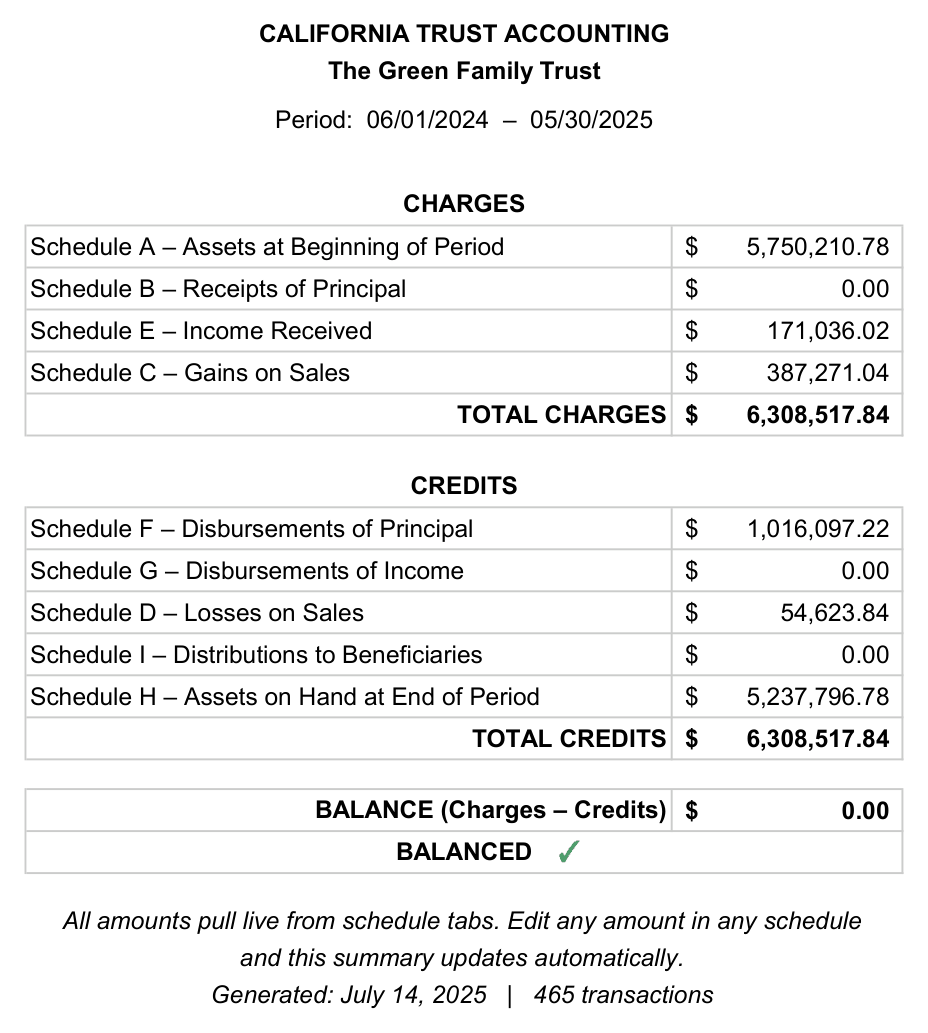
$699 Flat. No Subscription. No Install.
Let Balanced do the reading
Locating the right figure on the right page, across twelve statements for each account, and setting aside the many figures that only repeat it, is the hard, technical part of a fiduciary accounting. It is also what Balanced does. Add the PDF statements for the accounting period, including scanned or incomplete ones, and Balanced converts and organizes the data on them into the Probate Code schedules, one line per transaction, each traced to its page, as one editable Excel workbook balanced to the penny. It is $699 flat. Review the workbook against your statements. Start an accounting.
The Law and the Art of Fiduciary Accounting is a series by Balanced Legal Technology, LLC on complex California fiduciary accountings. General information only, current as of November 2026; not legal, tax or accounting advice. Statutes and rules change; confirm current law before relying on it.
About the author
Marc Joyce is a licensed, practicing California trusts and estates attorney, and the founder and developer of Balanced. He brings both sides to the problem: as a lawyer, and as an engineer. The Law and the Art of Fiduciary Accounting is his series on the hard cases where the two meet.
To see entries like these in a finished account, see the sample trust accounting and the estate accounting example, each with every schedule filled in.
Ready to generate yours? Add the PDF statements for the accounting period. Your PDFs stay on your computer.
$699 Flat. No Subscription. No Install.