 Balanced
The statements
The pictures in this article come from two real statements for the same living trust: a monthly brokerage statement from January 2026, and the trust's bank checking statements for the months on either side of it, plus one page from the month the checking account was opened. The names, account numbers, trace numbers and the names of the institutions have been changed. Every date and amount is exactly as printed.
Most trusts and estates hold more than one account: a brokerage account where the investments sit and a checking account the trustee pays bills from, sometimes a savings account, an old account of the decedent and a new one in the trustee's name. Money moves among them constantly. Every move appears twice, once going out of one account and once coming into another, often on different dates, on different statements, under different names. Neither side is a receipt or a disbursement of the trust. Counted as both, a single $18,000 transfer adds $18,000 to the receipts and $18,000 to the disbursements, and the account still balances, which is why the error survives.
Have the statements? Balanced converts and organizes the data on them into this accounting, in the Probate Code format, as one editable Excel workbook balanced to the penny. Scanned or incomplete statements work.
- Developed by a California trusts and estates attorney
- Works with any PDF statement, downloaded or scanned
- Statement entries are cited to the PDF and page they
came from, for easy verification - A fully editable Excel workbook, emailed in about 1 hour
$699 Flat. No Subscription. No Install.
This has by far been the best user-experience and I’ve been really impressed with your product thus far.
Kelsey B. Cooper, Esq., California Estate Planning Services PC
What the law asks for
One trust, one account. The account reports the property of the trust or estate as a whole: what it held at the start, what it received, what it paid out, and what it holds at the end (Prob. Code §§ 1061, 1062). A trustee's account states "the receipts and disbursements of principal and income" for the period (§ 16063(a)(1)). Money that leaves one of the estate's accounts and arrives in another has not been received from anyone or paid to anyone.
Property on hand includes every account. The schedule of property on hand at the end of the period lists all of it, cash in every account included, at carry value (§§ 1061(a)(10), 1062(f)). If a transfer is in transit on the last day, it is still the estate's cash; it is simply not in either account's balance.
Securities moved, not sold. A security moved from one of the estate's accounts to another has not been sold, so there is no gain or loss to report (§ 1062(d)) and no change in form (§ 1063(b)). It keeps its carry value.
The custodian's side: four withdrawals that look like two kinds
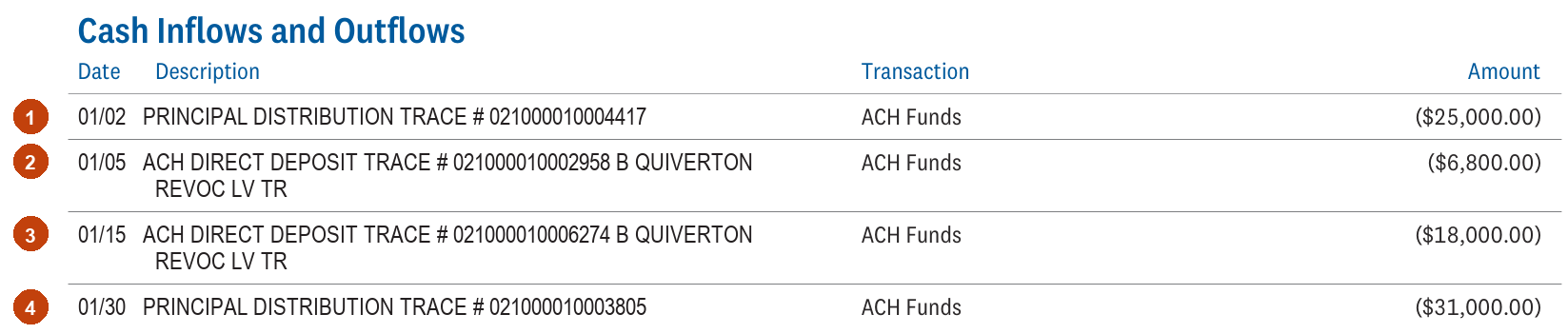
1. 01/02, "PRINCIPAL DISTRIBUTION," ACH Funds, ($25,000.00). The word "distribution" invites an entry on the distributions schedule. Do not make it yet. "Principal distribution" is the custodian's transaction code for money leaving a trust account from principal; it says nothing about who received it. The trust's own checking statement shows a $25,000.00 credit from this custodian on January 5. The money went from the trust to the trust.
2. 01/05, "ACH DIRECT DEPOSIT ... B QUIVERTON REVOC LV TR," ($6,800.00). This time the custodian names the receiving account: the trust itself. The checking statement shows a $6,800.00 credit from the custodian on January 6.
3. 01/15, the same description, ($18,000.00). It arrives in checking on January 16 (callout 5).
4. 01/30, "PRINCIPAL DISTRIBUTION," ($31,000.00). Labelled like callout 1, and again a transfer: it arrives in checking on February 2 (callout 6).
Two labels, one kind of transaction. All four withdrawals, $80,800.00 in the month, are cash moving from the trust's brokerage account to the trust's checking account. If the account reported callouts 1 and 4 as distributions to a beneficiary and the checking deposits as receipts, it would overstate both distributions and receipts by $56,000.00, and the beneficiaries would be told they had received money they never saw.
The bank's side: the same money arriving
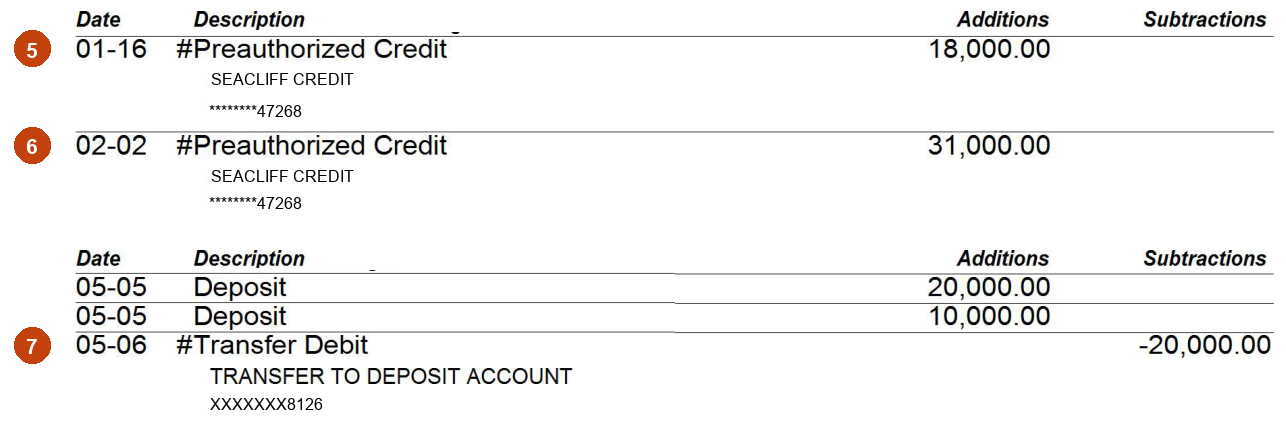
5. 01-16, "#Preauthorized Credit," SEACLIFF CREDIT, $18,000.00. The other side of callout 3, one business day later. The bank's description names only the sender and a masked account number. Neither side, read alone, tells you it is a transfer; the pair does.
6. 02-02, "#Preauthorized Credit," $31,000.00. The other side of callout 4. It left the brokerage account on January 30 and arrived on February 2. If the accounting period ended January 31, the $31,000.00 was in neither account's closing balance. It was the trust's cash in transit, and it belongs on the schedule of property on hand as exactly that, or the ending cash will be $31,000.00 short of what the trust owned.
7. 05-06, "#Transfer Debit," "TRANSFER TO DEPOSIT ACCOUNT XXXXXXX8126," ($20,000.00). A transfer inside the bank to another deposit account. Whose account? If it is the trust's savings or money market account, this is a transfer like the others, and that account's statements must be part of the accounting. If no statement for an account ending 8126 is in your file, the accounting is missing an account. The two deposits just above it, $20,000.00 and $10,000.00 the day before, need the same question: where did they come from?
Securities that move without being sold
The same rules apply when the custodian moves securities rather than cash. Statements call it a journal, a "journaled shares" line, a transfer of securities, an ACAT or a delivery in kind. A typical case: after a death, the custodian moves every position from the decedent's individual account into a new account titled to the successor trustee, and prints each position twice, once as "delivered out" on the old account and once as "received" on the new one, each with a dollar value.
That dollar value is the day's market value, and it is not the account's figure. A security moved in kind keeps its carry value: its value at the date of death in a first account (the value on the inventory), or its cost if the fiduciary bought it. Nothing is received, nothing is sold, and no gain or loss arises. Carry each lot across at the carry value it already had. Our article on lot by lot carry value explains why lots matter when the position is later sold.
The retitled account and the new account
After a death, the custodian may do one of two things. It may simply retitle the decedent's account, keeping the account number, so that the statements change their heading from the decedent's name to the trustee's. Or it may open a new account and move everything into it, closing the old one.
Both are common, and both can be reported correctly. One view treats the retitled account as the same account throughout: one account on the schedules, its title noted, no transfer at all. The other treats every change of account as a closing and an opening: the old account's property is transferred in kind at carry value to the new one. The choice is a matter of preference, and the accounting is right either way, so long as it is applied consistently, nothing is reported as a receipt or a disbursement, and the report says which view was taken so a reader can follow the account numbers.
Where each line lands
- Receipts and disbursements: neither side of a transfer between the estate's own accounts.
- Distributions: only money or property that actually reached a beneficiary, traced to an account the beneficiary owns, never on the strength of the word "distribution" on a custodian's statement.
- Property on hand: the cash in every account at the end of the period, plus any transfer that left one account before the period ended and arrived in another after it, shown as cash in transit.
- Changes in form: not a move in kind; securities moved between the estate's accounts keep their carry value and are not purchases or sales.
- The report: how retitled and new accounts are treated, and any transfer to an account whose statements are not in the file.
Common mistakes
- Trusting the label. "Principal distribution," "disbursement" and "withdrawal" are custodian codes. Only the receiving account tells you what happened.
- Counting both sides. The transfer becomes a receipt and a disbursement, the totals swell, and the account still balances.
- Losing money in transit. A transfer that straddles the last day of the period is in neither statement; the schedule of property on hand comes up short unless it is shown.
- Using the transfer value for securities. The dollar value printed beside a journal of shares is the day's market value, not carry value.
- Missing an account. A transfer to an account with no statements in the file is a sign the accounting is incomplete.
Checklist
- List every account that belonged to the trust or estate during the period, and get every statement for each.
- For every withdrawal and deposit between them, find the matching line on the other account and note both dates.
- At the end of the period, list transfers that left before and arrived after; show them as cash in transit.
- For securities moved in kind, carry each lot across at its existing carry value.
- Decide once how retitled and new accounts will be treated and state it in the report.
Praise for Balanced
“This has by far been the best user-experience and I’ve been really impressed with your product thus far.”
“I’d also just like to say that I was a trusts & estates paralegal for 6 years prior to becoming an attorney myself, so I’ve done hundreds of accountings manually. I’ve also tried countless other ‘trust accounting’ products. This has by far been the best user-experience and I’ve been really impressed with your product thus far. Myself and my firm will be repeat customers.”
California Estate Planning Services PC
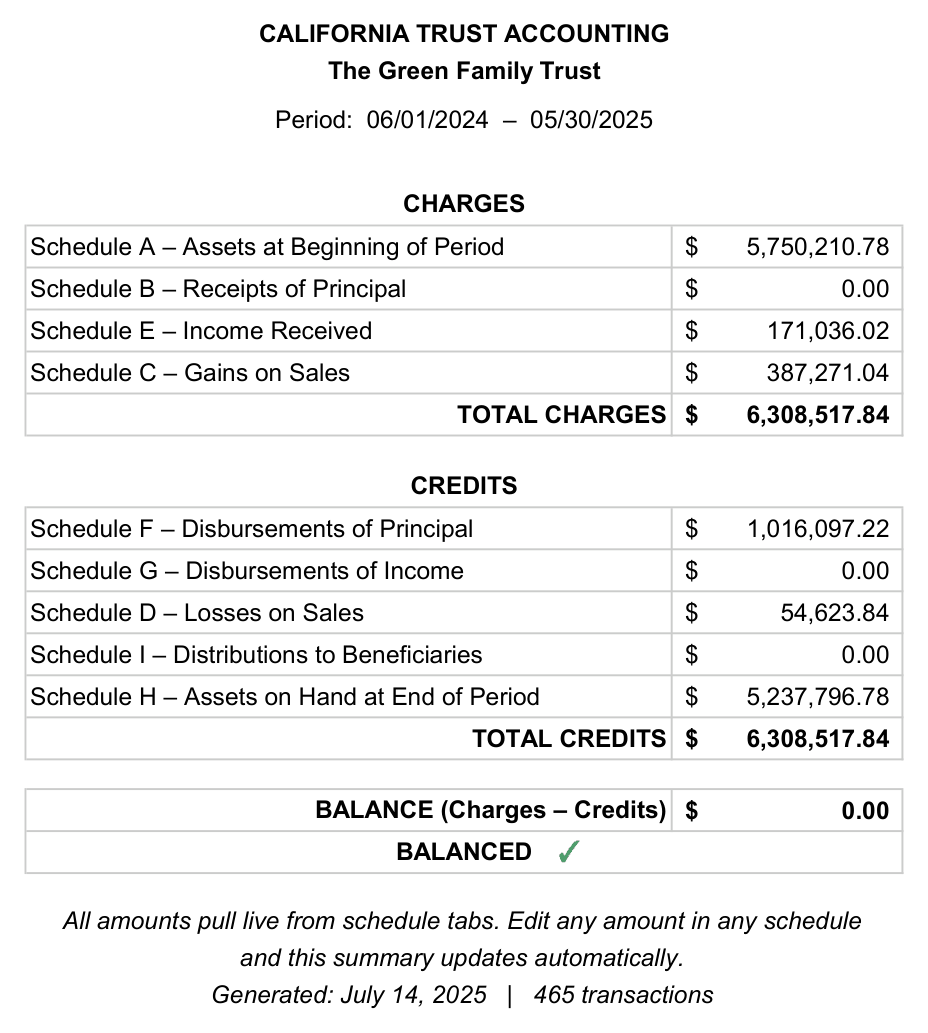
Inside a real Balanced workbook
$699 Flat. No Subscription. No Install.
Let Balanced do the reading
Transfers are invisible on any single statement; they appear only when every account is read together and each withdrawal is matched to the deposit it became. Doing that across a year of statements from several institutions, with different dates and different names for the same money, is hard, technical work. It is also what Balanced does. Add the PDF statements for the accounting period, including scanned or incomplete ones, and Balanced converts and organizes the data on them into the Probate Code schedules, with transfers between the estate's own accounts matched rather than counted, each line traced to its page, as one editable Excel workbook balanced to the penny. It is $699 flat. Review the workbook against your statements. Start an accounting.
The Law and the Art of Fiduciary Accounting is a series by Balanced Legal Technology, LLC on complex California fiduciary accountings. General information only, current as of November 2026; not legal, tax or accounting advice. Statutes and rules change; confirm current law before relying on it.
About the author
Marc Joyce is a licensed, practicing California trusts and estates attorney, and the founder and developer of Balanced. He brings both sides to the problem: as a lawyer, and as an engineer. The Law and the Art of Fiduciary Accounting is his series on the hard cases where the two meet.
To see entries like these in a finished account, see the sample trust accounting and the estate accounting example, each with every schedule filled in.
Ready to generate yours? Add the PDF statements for the accounting period. Your PDFs stay on your computer.
$699 Flat. No Subscription. No Install.