 Balanced
The statements
The pictures in this article come from two real brokerage statements: a 2025 quarterly statement for a living trust and a January 2019 monthly statement from another custodian. The names, account numbers and the names of the institutions are outside the crops or have been changed. Every date, security and amount is exactly as printed.
Every accounting period has two edges, and statements are not drawn to them. Dividends declared in one month are paid in the next and labelled "as of" the first. Tax pages move income back into the prior year. Statements list dividends that have been declared but not paid, with amounts the custodian says may change. The first account starts on a date of death that falls in the middle of a statement, and the last account ends on a date the custodian never heard of. A preparer who takes every line at the date printed beside it will put some receipts in the wrong period, count some twice across two accounts, and miss others altogether.
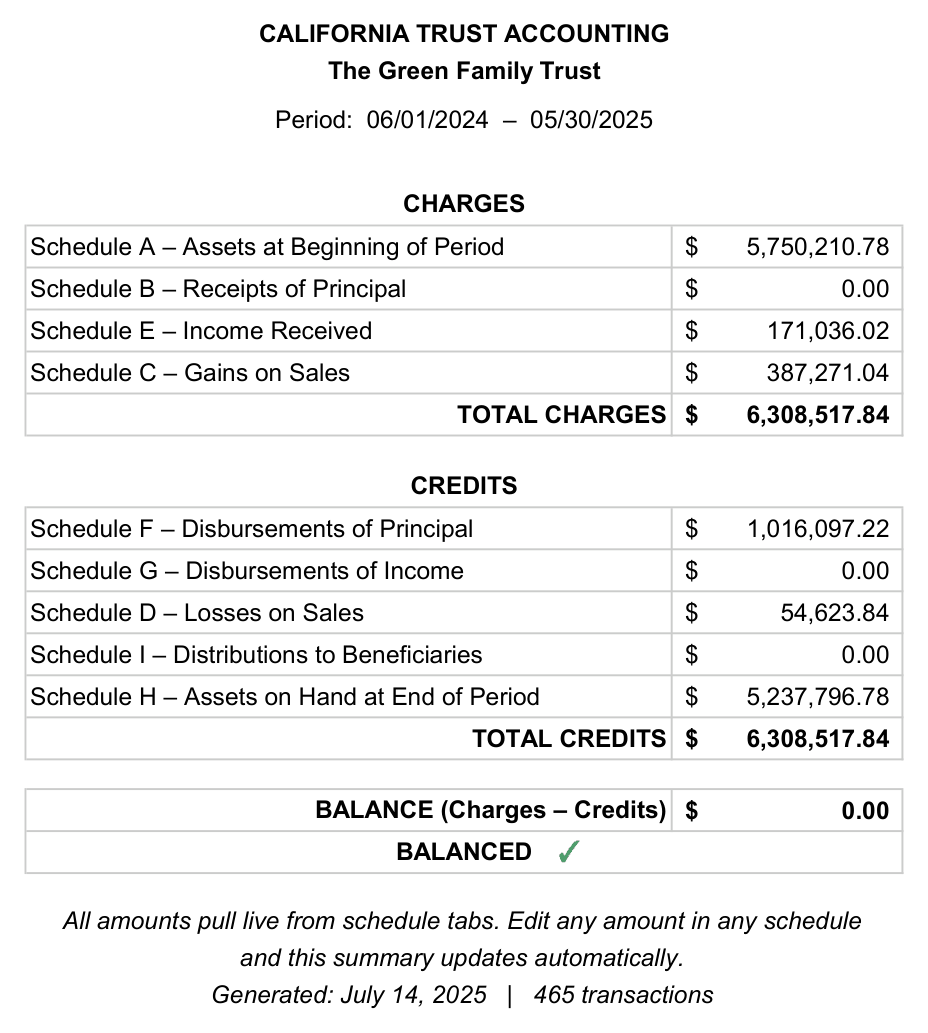
Have the statements? Balanced converts and organizes the data on them into this accounting, in the Probate Code format, as one editable Excel workbook balanced to the penny. Scanned or incomplete statements work.
- Developed by a California trusts and estates attorney
- Works with any PDF statement, downloaded or scanned
- Statement entries are cited to the PDF and page they
came from, for easy verification - A fully editable Excel workbook, emailed in about 1 hour
$699 Flat. No Subscription. No Install.
This has by far been the best user-experience and I’ve been really impressed with your product thus far.
Kelsey B. Cooper, Esq., California Estate Planning Services PC
What the law asks for
A defined period. A trustee's account covers "the last complete fiscal year of the trust or ... the last account" (Prob. Code § 16063(a)(1)), and an account in the court format covers a stated period, with the property on hand at its start and its end (§§ 1061, 1062(f)). Each receipt belongs to exactly one period.
Receipts when received. Fiduciary accounts are kept, in practice, on a cash basis: a receipt is reported in the period in which it was received, and a disbursement in the period in which it was paid. Whatever convention you use for dates on the statement, use it the same way at both edges of every period, so that nothing falls between two accounts or into both.
The date of death is different. For a trust that begins at a death, the act decides whether a receipt is principal or income by when it was due: a receipt due before the date of death is principal (§ 16376(a)), and a dividend is due on its record date (§ 16376(f)(1)). Our article on corporate actions and carry value works through an example.
"As of": paid in one period, dated in another
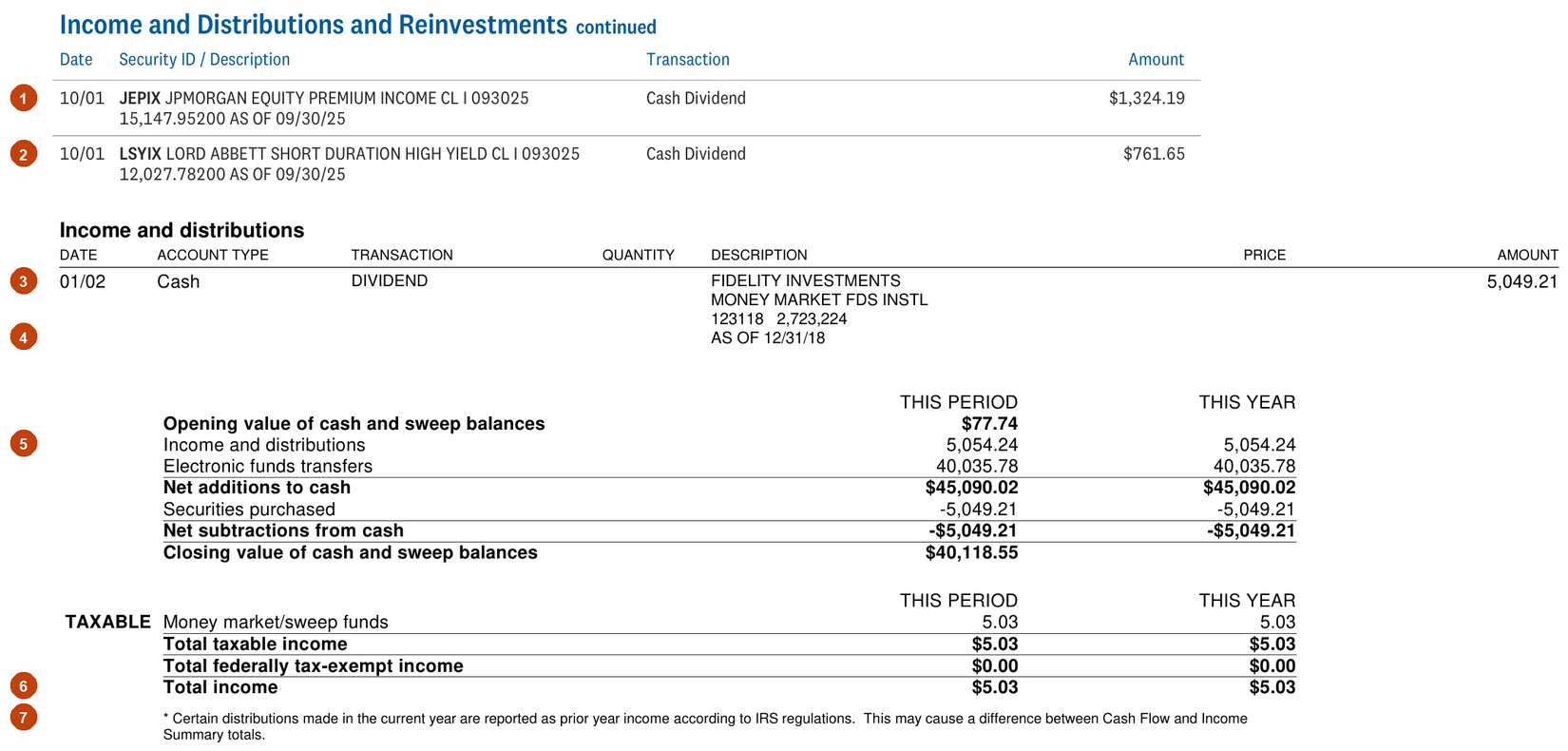
1. 10/01, JEPIX, Cash Dividend, $1,324.19, "AS OF 09/30/25." Posted on October 1, but dated as of September 30. On a cash basis, the dividend was received in October. If the accounting period ended September 30, this dividend belongs to the next account. If an earlier account already included it because the September statement showed it as declared, it must not be counted again here.
2. 10/01, LSYIX, $761.65, "AS OF 09/30/25." The same pattern. Mutual funds that accrue income daily routinely pay on the first business day of the next month as of the last day of the prior one. Pick a convention, posting date or "as of" date, and apply it at both ends of every period.
3. 01/02, dividend on a money market fund, $5,049.21. Paid on January 2, 2019.
4. "AS OF 12/31/18." Dated the last day of the prior year. A dividend that straddles a year end also straddles the first and second years of a trust's administration, and, where someone died near year end, possibly the date of death. Check the record date before deciding whether it is income of the period or a receipt due before death.
5. Cash flow summary, "Income and distributions," $5,054.24. The cash that arrived in January: the $5,049.21 dividend and $5.03 of sweep interest.
6. Income summary, "Total income," $5.03. The same statement, a few lines lower, reports January income of only $5.03.
7. "Certain distributions made in the current year are reported as prior year income according to IRS regulations." The custodian's footnote explains the gap. For income tax, a dividend declared in December and paid in January can be treated as received in December, so the tax pages move the $5,049.21 into 2018. The Probate Code account follows the cash: the dividend was received in January. Two pages of one statement, two answers, and the account must choose one and explain it when it matters.
Declared, not yet paid
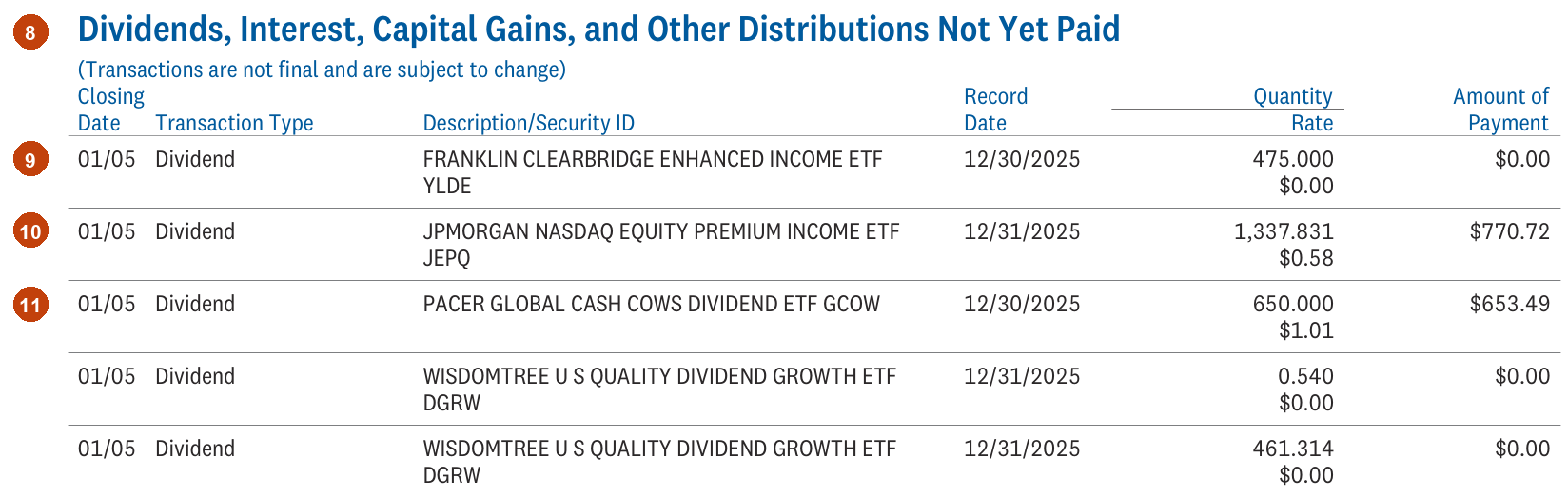
8. "Not Yet Paid (Transactions are not final and are subject to change)." Dividends whose record date has passed but which will be paid after the statement closes. They are not receipts of this period: no money has arrived, and the custodian says the amounts may change.
9. Franklin ETF, record date 12/30/2025, amount $0.00. The custodian does not yet know the rate. The line tells you to expect a dividend on the next statement, nothing more.
10. JPMorgan Nasdaq ETF, record date 12/31/2025, 1,337.831 shares at $0.58, $770.72. A known amount, payable January 5. If the account ends December 31, it is received in the next period; in a final account, it is a receivable to mention in the report and collect before distribution. If the account began with a death on, say, December 31, its record date makes it a receipt due before death, and so principal (§ 16376(a), (f)(1)).
11. Pacer ETF, $653.49. The same treatment. Note that the custodian already printed both amounts on the year-end statement; a careless reading would add them to December's income.
Where each line lands
- Receipts and income schedules: each receipt in the period in which it was received, on one consistent date convention.
- Receipts at the edge of a first account: tested against the date of death by record date (§ 16376).
- The report: dividends declared but not paid at the end of the period, and any line where the tax pages and the account disagree on the year.
- Nowhere in this period: not yet paid dividends, pending trades and anything the statement marks as not final.
Common mistakes
- Using two conventions. Posting date at one end of the period and "as of" date at the other drops a month of income or counts it twice.
- Following the tax pages. Year-end tax reporting moves some January receipts into December; the account follows the cash.
- Entering declared dividends. The not yet paid section is a forecast, not a receipt.
- Ignoring record dates at death. A dividend paid after death on a record date before death is principal.
Checklist
- Write down the account's first and last day, and the date convention you will use.
- At each edge, list the lines dated "as of" the other side and decide each one once.
- Reconcile the year's income to the cash, not to the tax summary, and note any difference.
- Read the not yet paid section at the end of every period and follow each item into the next statement.
- In a first account, test every receipt in the weeks after death against its record date.
Praise for Balanced
“This has by far been the best user-experience and I’ve been really impressed with your product thus far.”
“I’d also just like to say that I was a trusts & estates paralegal for 6 years prior to becoming an attorney myself, so I’ve done hundreds of accountings manually. I’ve also tried countless other ‘trust accounting’ products. This has by far been the best user-experience and I’ve been really impressed with your product thus far. Myself and my firm will be repeat customers.”
California Estate Planning Services PC
Inside a real Balanced workbook
$699 Flat. No Subscription. No Install.
Let Balanced do the reading
Period edges are where receipts go missing or appear twice, and they are found only by reading the dates beside the dates. Doing that consistently across every account and every month is hard, technical work. It is also what Balanced does. Add the PDF statements for the accounting period, including scanned or incomplete ones, and Balanced converts and organizes the data on them into the Probate Code schedules, one line per transaction, each traced to its page, as one editable Excel workbook balanced to the penny. It is $699 flat. Review the workbook against your statements. Start an accounting.
The Law and the Art of Fiduciary Accounting is a series by Balanced Legal Technology, LLC on complex California fiduciary accountings. General information only, current as of November 2026; not legal, tax or accounting advice. Statutes and rules change; confirm current law before relying on it.
About the author
Marc Joyce is a licensed, practicing California trusts and estates attorney, and the founder and developer of Balanced. He brings both sides to the problem: as a lawyer, and as an engineer. The Law and the Art of Fiduciary Accounting is his series on the hard cases where the two meet.
To see entries like these in a finished account, see the sample trust accounting and the estate accounting example, each with every schedule filled in.
Ready to generate yours? Add the PDF statements for the accounting period. Your PDFs stay on your computer.
$699 Flat. No Subscription. No Install.