 Balanced
The statements
The pictures in this article come from three real statements: a monthly trust company statement for a trust with an income beneficiary, a monthly brokerage statement for an account held in joint tenancy with a decedent, and a scanned personal bank statement. The names, account numbers, card number and the names of the institutions have been changed. Every security, date, rate and amount is exactly as printed.
Foreign money reaches an American account in a handful of ways: dividends on foreign shares, usually held as American depositary receipts (ADRs); wires from a bank abroad; and card purchases or payments in another currency. Each one prints several figures for a single event, and the figure the statement makes most prominent is rarely the one the account needs. The law of foreign currency in a trust accounting is covered in our article on margin, short sales and foreign currency. This article is about reading the lines.
Have the statements? Balanced converts and organizes the data on them into this accounting, in the Probate Code format, as one editable Excel workbook balanced to the penny. Scanned or incomplete statements work.
- Developed by a California trusts and estates attorney
- Works with any PDF statement, downloaded or scanned
- Statement entries are cited to the PDF and page they
came from, for easy verification - A fully editable Excel workbook, emailed in about 1 hour
$699 Flat. No Subscription. No Install.
This has by far been the best user-experience and I’ve been really impressed with your product thus far.
Kelsey B. Cooper, Esq., California Estate Planning Services PC
What the law asks for
The dividend is income, at its gross amount. Money received in an entity distribution is income (Prob. Code § 16340(c)). The receipt is what the trust earned, before anything was taken out of it.
Tax on income is paid from income. "A tax required to be paid by a fiduciary that is based on receipts allocated to income shall be paid from income" (§ 16365(a)). Foreign tax withheld from a dividend is a tax on an income receipt.
Every receipt and disbursement, separately. The account shows receipts (§ 1062(a)) and disbursements (§ 1062(b)), and where there is an income beneficiary, the receipts and disbursements of principal and of income (§ 16063(a)(1); § 1063(c)). Netting a tax or a fee into a receipt hides both.
The account is kept in dollars. Foreign amounts enter the account at the dollar figure actually received or paid. Anything the act does not allocate is charged to principal by default (§ 16325(c)), which is why the treatment of anything unusual should be stated.
A foreign dividend on a trust company statement
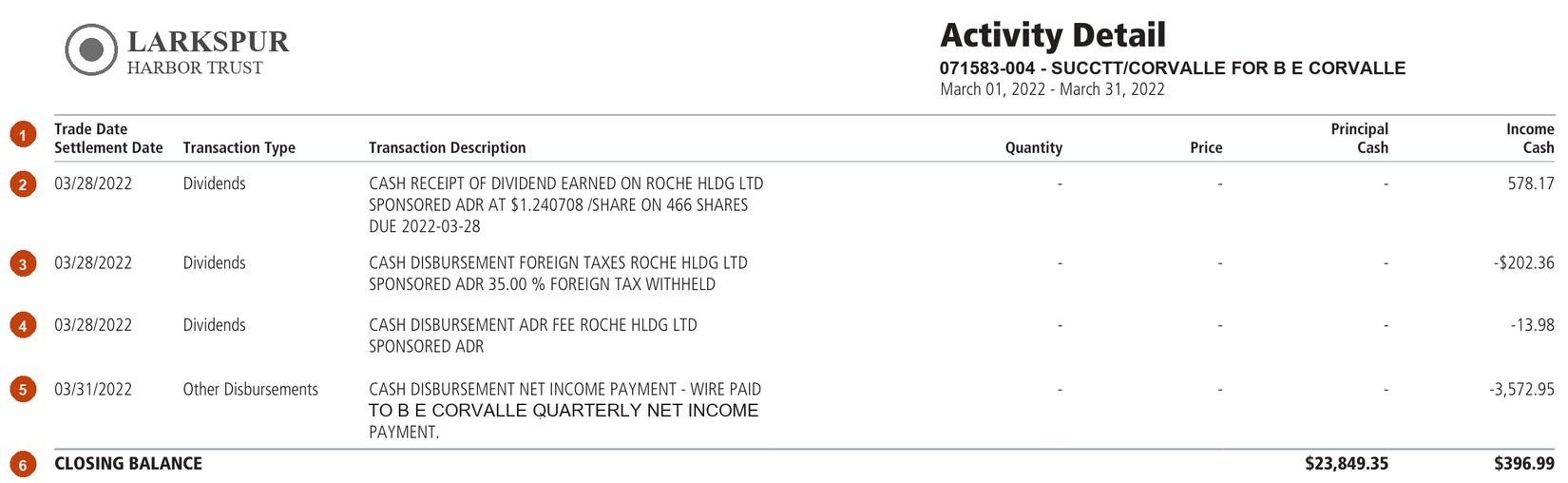
1. Principal Cash and Income Cash. Trust company statements often keep two cash columns, already separating principal from income. That is a useful check on your own allocation, not a substitute for it: the allocation is the trustee's, and a trust company applies its own defaults.
2. 03/28/2022, dividend on Roche Holding ADR, $578.17, income cash. The gross dividend: 466 shares at $1.240708 a share. This is the receipt for the income schedule (§ 16340(c)). The description shows the per-share rate and the share count, so you can prove the figure.
3. 03/28/2022, foreign taxes, "35.00 % FOREIGN TAX WITHHELD," ($202.36), income cash. The Swiss tax withheld at source: 35 percent of $578.17 is $202.36. Enter it as a separate disbursement, a tax charged to income (§ 16365(a)). Do not net it into the dividend. The full rate is often higher than the rate a tax treaty allows, so part of it may later be refunded; a refund can only be matched to the right tax if the tax was shown separately in the first place.
4. 03/28/2022, ADR fee, ($13.98), income cash. The depositary bank's charge for passing the dividend through to ADR holders. It is a real disbursement, charged here against income. In our view it is an expense of collecting the income and belongs to income; whichever treatment you adopt, state it.
So the trust actually received $361.83 in cash ($578.17 less $202.36 less $13.98). Brokerage statements that report only the net figure force you to rebuild the gross from the per-share rate; this statement shows all three lines, and the account should too.
5. 03/31/2022, "NET INCOME PAYMENT - WIRE PAID TO" the income beneficiary, ($3,572.95), income cash. The quarterly distribution of net income to the income beneficiary. It is a distribution (§ 1062(e)), not an expense, and it is paid out of the income the quarter earned, after the foreign tax and fees. If the dividend were entered net, the distribution would still balance, but the income schedule, the taxes paid and the fees would all be wrong.
6. Closing Balance, principal cash $23,849.35, income cash $396.99. Two cash balances at the end. The schedule of property on hand lists cash once, at its total; the principal and income allocation shows how much of it is undistributed income.
A wire in pounds sterling
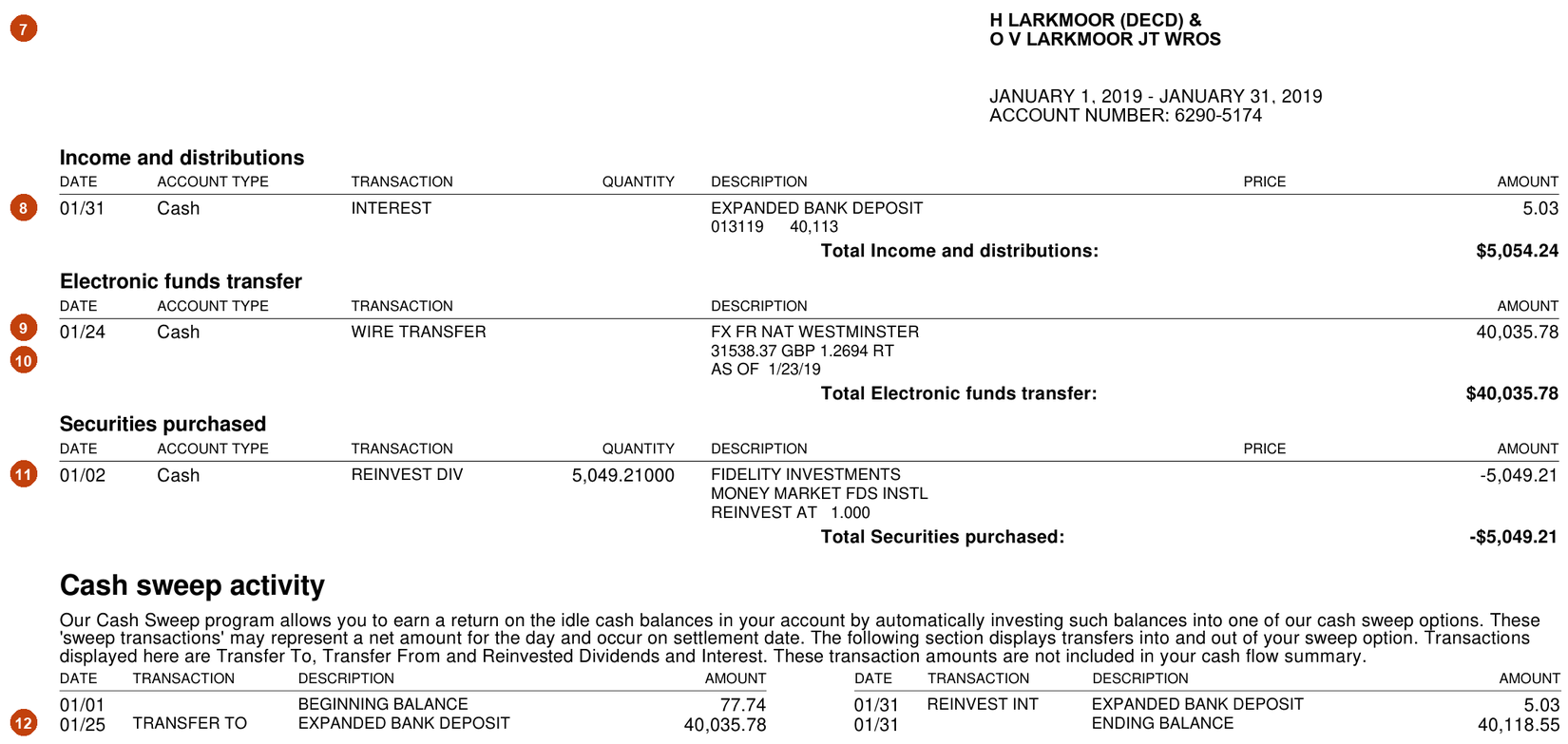
7. The account title: a decedent "& [survivor] JT WROS." Before reading a single line, read the title. This account was held in joint tenancy with right of survivorship with someone who has died. Property held that way generally passes to the surviving joint tenant by operation of law, outside the estate and outside the trust. Whether this account belongs in the accounting at all is a legal question for the attorney, and it should be settled before anything here is entered.
8. 01/31, interest on the bank deposit sweep, $5.03. Income. The "Total Income and distributions" of $5,054.24 beneath it also includes a $5,049.21 money market dividend shown on the previous page; enter each line once, not the total.
9. 01/24, wire transfer, "FX FR NAT WESTMINSTER," $40,035.78. Money arrived from a bank in the United Kingdom, already converted to dollars. $40,035.78 is the receipt. Where it came from, and whether it is principal or income, the statement does not say; the account must (a sale of property abroad, a refund, an inheritance, a pension), and a large unexplained wire is one of the first things a reviewing attorney will ask about.
10. "31538.37 GBP 1.2694 RT," "AS OF 1/23/19." The amount in pounds, the exchange rate, and the value date. Multiply them and you get $40,034.81, not $40,035.78: the printed rate is rounded to four places, and the difference is 97 cents. Use the dollars actually credited, never your own conversion. The value date (January 23) and the posting date (January 24) can also differ; use one consistently, and note it when the two fall on either side of a death or the end of a period. If the pounds were held by the estate or trust before conversion (a foreign bank account, for example), the conversion is a change in form of that asset, and the difference between the dollars received and the pounds' carry value in dollars is a gain or a loss (§ 1062(d)).
11. 01/02, "REINVEST DIV," a money market fund, 5,049.21 shares, ($5,049.21). A dividend reinvested in more shares at $1.00. The dividend is income; the reinvestment is a purchase (see our article on reinvested dividends).
12. Cash sweep, 01/25, "TRANSFER TO EXPANDED BANK DEPOSIT," $40,035.78. The wire's dollars moving into the sweep the next day. Not a second receipt (see our article on sweep activity).
A card purchase in a foreign currency

13. Card Purchase, ($119.25). The dollar amount charged to the account for a purchase made in pounds. This is the disbursement, at its dollar amount, with its payee and purpose (§ 1062(b)).
14. "Pound Sterl, 89.00 X 1.339888 (Exchg Rte)." The original amount and the rate the card network used: 89.00 times 1.339888 is $119.25. Useful to prove the line, not a separate entry.
15. Foreign Exch Rt ADJ Fee, ($3.57). The bank's foreign transaction fee on the same purchase, posted as its own line. It is a separate disbursement, a bank charge, and it is easy to miss because it sits beside a larger line with the same merchant name. On a decedent's or conservatee's bank account, a run of these fees is also a sign of foreign spending that the account may need to explain.
Where each line lands
- Income schedule: foreign dividends at their gross amount, in dollars (§ 16340(c)).
- Disbursements charged to income: foreign tax withheld (§ 16365(a)); in our view, ADR fees, with the treatment stated.
- Distributions: net income payments to an income beneficiary (§ 1062(e)).
- Receipts: wires and other foreign-currency receipts at the dollars credited, with their source explained.
- Disbursements: card charges at the dollars charged, and each foreign transaction fee as its own line.
- Gains and losses: conversion of foreign cash the estate or trust already held, against its carry value in dollars (§ 1062(d)).
- Nowhere: the foreign amount and rate (except as proof), net dividend figures, income totals and the sweep transfer of a wire.
Common mistakes
- Entering the net dividend. Understates income, hides the tax, and loses any treaty refund.
- Converting at your own rate. The account uses the dollars actually received or paid.
- Ignoring the account title. A joint tenancy or payable-on-death account may not belong in the accounting.
- Missing the fee line. Foreign transaction and ADR fees are small, separate and easy to skip.
- Leaving a large foreign wire unexplained. Its source decides whether it is principal, income or something that belongs elsewhere.
Checklist
- Read the account title first.
- For every foreign dividend, find the gross amount, the tax withheld and any fee; enter all three.
- Charge foreign tax on income to income; state your treatment of ADR fees.
- Enter foreign-currency receipts and payments at the dollars on the statement, with the original amount and rate as proof.
- Explain the source of every foreign wire.
- Watch for refunds of foreign tax in later statements and match them to the tax.
Praise for Balanced
“This has by far been the best user-experience and I’ve been really impressed with your product thus far.”
“I’d also just like to say that I was a trusts & estates paralegal for 6 years prior to becoming an attorney myself, so I’ve done hundreds of accountings manually. I’ve also tried countless other ‘trust accounting’ products. This has by far been the best user-experience and I’ve been really impressed with your product thus far. Myself and my firm will be repeat customers.”
California Estate Planning Services PC
Inside a real Balanced workbook
$699 Flat. No Subscription. No Install.
Let Balanced do the reading
Foreign lines multiply: one dividend becomes three entries, one wire carries a rate, a value date and a sweep, and one card purchase brings a fee. Getting each one into the right schedule, in dollars, is hard, technical work. It is also what Balanced does. Add the PDF statements for the accounting period, including scanned or incomplete ones, and Balanced converts and organizes the data on them into the Probate Code schedules, one line per transaction, each traced to its page, as one editable Excel workbook balanced to the penny. It is $699 flat. Review the workbook against your statements. Start an accounting.
The Law and the Art of Fiduciary Accounting is a series by Balanced Legal Technology, LLC on complex California fiduciary accountings. General information only, current as of November 2026; not legal, tax or accounting advice. Statutes and rules change; confirm current law before relying on it.
About the author
Marc Joyce is a licensed, practicing California trusts and estates attorney, and the founder and developer of Balanced. He brings both sides to the problem: as a lawyer, and as an engineer. The Law and the Art of Fiduciary Accounting is his series on the hard cases where the two meet.
To see entries like these in a finished account, see the sample trust accounting and the estate accounting example, each with every schedule filled in.
Ready to generate yours? Add the PDF statements for the accounting period. Your PDFs stay on your computer.
$699 Flat. No Subscription. No Install.