 Balanced
When a conservatee dies, the conservator of the estate still has work to do. The conservator tells the court on the Notice of Conservatee’s Death, form GC-399, keeps custody of the estate until it is delivered to the personal representative of the conservatee’s estate or otherwise disposed of according to law (§2467(a)), and, when the court requires it, files a final account in two parts: one for the period ending on the date of death and a separate accounting for the period after it (§2620(b)).
Have the statements? Balanced converts and organizes the data on them into this accounting, in the GC-400 format, as one editable Excel workbook balanced to the penny. Scanned or incomplete statements work.
- Developed by a California trusts and estates attorney
- Works with any PDF statement, downloaded or scanned
- Statement entries are cited to the PDF and page they
came from, for easy verification - A fully editable Excel workbook, emailed in about 1 hour
$699 Flat. No Subscription. No Install.
This has by far been the best user-experience and I’ve been really impressed with your product thus far.
Kelsey B. Cooper, Esq., California Estate Planning Services PC
Step 1: give notice of the death
File the Notice of Conservatee’s Death, GC-399. The California courts’ self-help guide says to file it within 30 days after the death, and to keep a copy, because the court keeps the original. The conservator also gives notice of the death to the persons entitled to notice under the Probate Code, including anyone who asked for special notice, and files proof that the notice was delivered (§2361(a)). If the conservator makes the funeral, burial or memorial arrangements, notice of their date, time and place goes to the same people (§2361(b)).
Step 2: keep the estate safe
The duty to keep and protect the estate continues after the death, until the estate is delivered to the personal representative or otherwise disposed of according to law (§2467(a)). Keep every record of the conservatee’s money and property. The self-help guide says not to spend or give away any of it unless the court says you can.
The Code allows a few payments after death: a reasonable sum for the last illness and the disposition of the remains, unpaid court-approved attorney’s fees, and unpaid expenses of the conservatorship, from the conservatee’s personal property in the conservator’s hands (§2631(a)). Check with the court before paying anything you are unsure of.
Step 3: the final account, in two periods
The final court accounting after the conservatee’s death has two parts: an accounting for the period that ends on the date of death, and a separate accounting for the period after the date of death (§2620(b)). The death does not end the court’s power to settle the conservator’s accounts (§2630). The self-help guide says the court will tell you whether a final accounting is needed, and that it must be completed before the court can close the case.
The format does not change. An estate files the standard GC-400 account, or the simplified GC-405 account if it qualifies (Cal. Rules of Court, rule 7.575), and the same supporting documents are filed with it: the account statements, escrow statements for real property sold, and care facility bills (§2620(c)). The property on hand on the date of death closes the first period and opens the second.
Praise for Balanced
“This has by far been the best user-experience and I’ve been really impressed with your product thus far.”
“I’d also just like to say that I was a trusts & estates paralegal for 6 years prior to becoming an attorney myself, so I’ve done hundreds of accountings manually. I’ve also tried countless other ‘trust accounting’ products. This has by far been the best user-experience and I’ve been really impressed with your product thus far. Myself and my firm will be repeat customers.”
California Estate Planning Services PC
Inside a real Balanced workbook
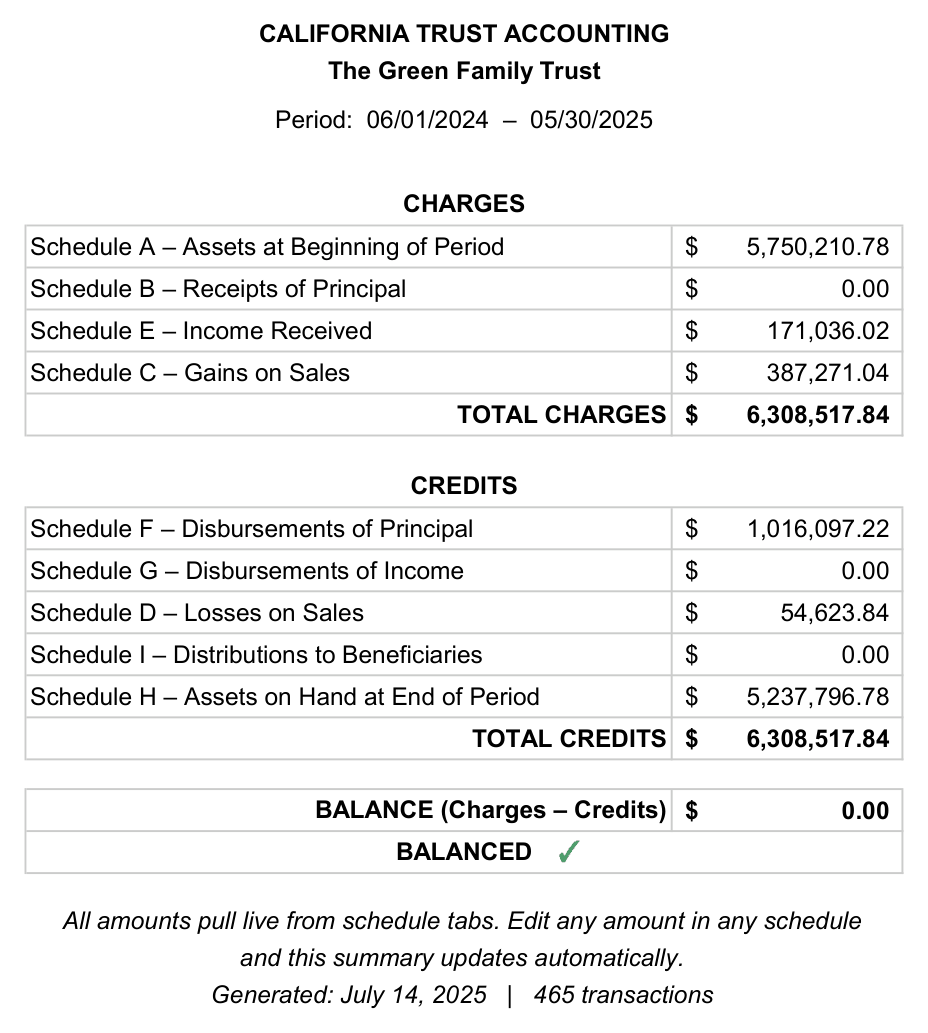
$699 Flat. No Subscription. No Install.
Step 4: hand the estate on
The property goes to the personal representative of the conservatee’s estate, the executor or administrator appointed in the probate, or is otherwise disposed of according to law (§2467(a)). For a small estate, the Code gives a shorter path: if what remains is worth no more than the amount set by §13100, the conservator may petition for an order to liquidate it, and what is left after the allowed expenses may be transferred under the small estate procedures that begin at §13000 (§2631(b), (c)). Some courts set their own deadlines for the final account in local rules, so check yours.
What to gather
- Every account’s statements through the end of the period, including the statements that show each balance on or near the date of death
- The prior account as filed, because its ending property is this account’s beginning property
- Records of anything paid after the death, such as funeral and last illness bills, and the court orders for fees
- The filed GC-399 and proof of the notice of death
See how a conservatorship account is laid out in the GC-400 example, or work from the free GC-400 template. More on the regular cycle in the conservatorship accounting guide.
Common questions
Does the conservatorship end when the conservatee dies?
The conservatorship is terminated by the conservatee’s death (Probate Code section 1860), but the conservator of the estate keeps the duty to protect the estate until it is delivered to the personal representative or otherwise disposed of (section 2467(a)), and the court keeps the power to settle the conservator’s accounts (section 2630).
How soon do I tell the court?
The California courts’ self-help guide says to file the Notice of Conservatee’s Death, form GC-399, within 30 days after the death.
Why are there two accounting periods?
Probate Code section 2620(b) requires the final accounting after the conservatee’s death to cover the period ending on the date of death and, separately, the period after the date of death.
Can I pay the funeral bill from the conservatorship account?
Probate Code section 2631(a) allows a reasonable sum for the disposition of the remains and the last illness to be paid from the conservatee’s personal property in the conservator’s hands. Check with the court if you are unsure.
Who receives the property?
The personal representative of the conservatee’s estate, or whoever the law otherwise provides (Probate Code section 2467(a)). A small estate may be transferred under the small estate procedures (section 2631).
Generate it with Balanced
Balanced is a new kind of software for California fiduciary accountings. From the PDF bank and brokerage statements, Balanced converts and organizes the statement data into the GC-400 account exactly as the statements show it, using disclosed, standard accounting conventions you can change; everything beyond that comes from your own instructions. Most are generated and delivered in about 1 hour, rather than the days, weeks or months of manual work an accounting otherwise takes. Transactions are classified to their schedules, carry values tracked lot by lot, each account reconciled to its own statements, the summary balanced to the penny, and each entry cited to the statement and page it came from, delivered as one fully editable Excel workbook. $699 per accounting.
Ready to generate yours? Add the PDF statements for the accounting period. Your PDFs stay on your computer.
$699 Flat. No Subscription. No Install.