 Balanced
The statement
The main picture in this article comes from a real scanned statement: a January 2022 monthly statement for a trust's investment account that was printed, scanned and saved as a PDF. The trust's name, the account number, the custodian's name and logo and the name of its sweep have been changed. Every figure is exactly as printed on the page.
Most statements in a trust or estate file are not clean downloads. They are paper statements found in a desk, scanned at an office, photocopied for a court file, faxed by a bank, photographed on a phone. Many such PDFs carry an invisible "text layer," added by the scanner's text recognition, so that the page can be searched and copied. The text layer is not the statement. It is a machine's guess at the statement, and it is often wrong in exactly the places that matter: commas, decimal points, dollar signs and the digits beside them.
Have the statements? Balanced converts and organizes the data on them into this accounting, in the Probate Code format, as one editable Excel workbook balanced to the penny. Scanned or incomplete statements work.
- Developed by a California trusts and estates attorney
- Works with any PDF statement, downloaded or scanned
- Statement entries are cited to the PDF and page they
came from, for easy verification - A fully editable Excel workbook, emailed in about 1 hour
$699 Flat. No Subscription. No Install.
This has by far been the best user-experience and I’ve been really impressed with your product thus far.
Kelsey B. Cooper, Esq., California Estate Planning Services PC
What the law asks for
Accurate figures, balanced. The account states the receipts, disbursements and property on hand (Prob. Code §§ 1061, 1062; § 16063(a)), and the summary must balance (§ 1061(c)). A misread figure either throws the balance off or, worse, is balanced away somewhere else.
The statements are the evidence. A beneficiary or a court checks the account against the statements; a conservator files the original statements with the account (Prob. Code § 2620(c)). Every figure in the account must be one a reader can find on the page.
Never a guess. Where a figure cannot be read, the account should not present a guess as if it were printed. Either establish it from the statement's own arithmetic and say so, or obtain a clean copy.
The page and its text layer
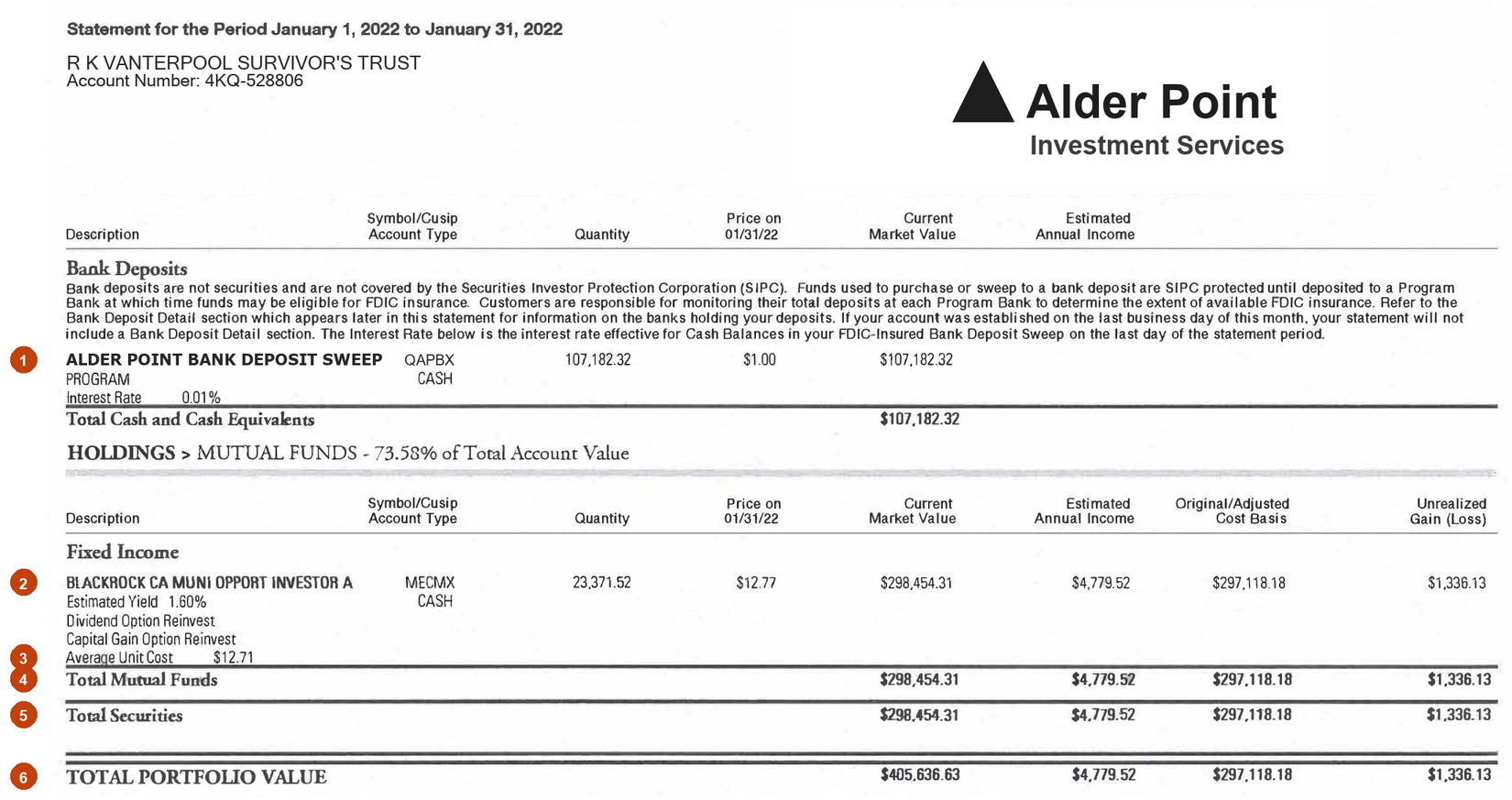
1. The bank deposit sweep, 107,182.32 units at $1.00, $107,182.32. Read correctly by the text layer. Most of a scanned page usually is, which is what makes the errors dangerous: they hide among correct figures.
2. The fund, 23,371.52 shares at $12.77, market value $298,454.31, cost $297,118.18, unrealized gain $1,336.13. Also read correctly on this line. Note the arithmetic it carries: 23,371.52 times $12.77 is $298,454.31, and $298,454.31 less $297,118.18 is $1,336.13.
3. "Average Unit Cost $12.71." The text layer reads the label as "Avera e Unit Cost." The figure is right; the word is broken. On the March statement for the same account, the text layer reads "Dividend Option" as "0 ividend Option." Harmless here, but a sign of how the recognition is doing.
4. Total Mutual Funds. On the page: $298,454.31, $4,779.52, $297,118.18, $1,336.13. In the text layer: "$298,454.31," "$4,779.52," "$297.118.18" and "$1.336.13." Two commas became periods. A program, or a person copying and pasting, could read $297.118.18 as $297.11, or as nothing at all.
5. Total Securities. On the page, the same four figures. In the text layer, the estimated income becomes "$4.779:52" and the gain again "$1.336.13."
6. Total Portfolio Value, $405,636.63. Read correctly: $107,182.32 plus $298,454.31.
The same cost figure appears four times on this page, and the text layer reads it two different ways. The page, and the arithmetic in callout 2, show that all four are $297,118.18.
Other ways a scan goes wrong
- Shading. Bank statements often print balances over a crosshatched or grey background. Text recognition reads the pattern as letters. On the checking statements pictured in our article on missing statements and gaps, one reading of the shaded summary box returned "Wt," "We" and "ys" in place of the balance, and the bank's own text layer turned "$35,467.95" into "S35 467 95," "$58,110.54" into "SSB 110 54" and "Low balance" into "Law balance."
- Rotation and skew. A page scanned sideways or at an angle can be read column by column in the wrong order, attaching amounts to the wrong lines.
- Grey photocopies and faxes. Faint digits drop out: 8 becomes 3, 6 becomes 5, a leading 1 disappears.
- Cut edges. A page copied off-center loses its right-hand column, which is usually the amount.
- Stamps, staples and handwriting. A "received" stamp or a note in the margin lands on a figure.
How to settle an unclear figure
A statement is full of arithmetic, and the arithmetic is the best evidence of what an unclear figure must be.
- Quantity times price equals value. For every holding (callout 2).
- Detail equals total. Every section total is the sum of its lines; every summary figure is the sum of a section.
- Beginning plus activity equals ending. For cash and for every holding. The next statement's beginning figures are a second copy of this one's ending figures.
- The same figure, elsewhere. A total repeated on the summary page, the tax pages or the next statement.
When the arithmetic establishes a figure the page does not show clearly, use it, and note that the figure was established from the statement's arithmetic rather than read from the page. When it cannot, ask the bank or custodian for a clean copy; they can usually reproduce statements for several years. Either way, the account never carries a figure no one can trace.
Where each line lands
- Every schedule: figures read from the page, checked against the statement's arithmetic, never taken from the text layer alone.
- Notes on the schedules: any figure established from the arithmetic rather than read directly, and how.
- The report: any page that could not be read and could not be replaced, and what was done.
Common mistakes
- Trusting copy and paste. The text layer is a guess; read the image.
- Trusting a total over its lines, or a line over its total. Check each against the other.
- Guessing a faint digit. Establish it or obtain a copy; do not pick the likeliest number.
- Fixing the balance elsewhere. A misread figure that is balanced away by changing another line leaves two errors instead of one.
Checklist
- Open every scanned statement and compare a few figures in the text layer with the image.
- For every holding, check quantity times price against value.
- Tie every section total to its lines, and every ending balance to the next statement's beginning.
- Note every figure established by arithmetic.
- Request clean copies of pages that cannot be read.
Praise for Balanced
“This has by far been the best user-experience and I’ve been really impressed with your product thus far.”
“I’d also just like to say that I was a trusts & estates paralegal for 6 years prior to becoming an attorney myself, so I’ve done hundreds of accountings manually. I’ve also tried countless other ‘trust accounting’ products. This has by far been the best user-experience and I’ve been really impressed with your product thus far. Myself and my firm will be repeat customers.”
California Estate Planning Services PC
Inside a real Balanced workbook
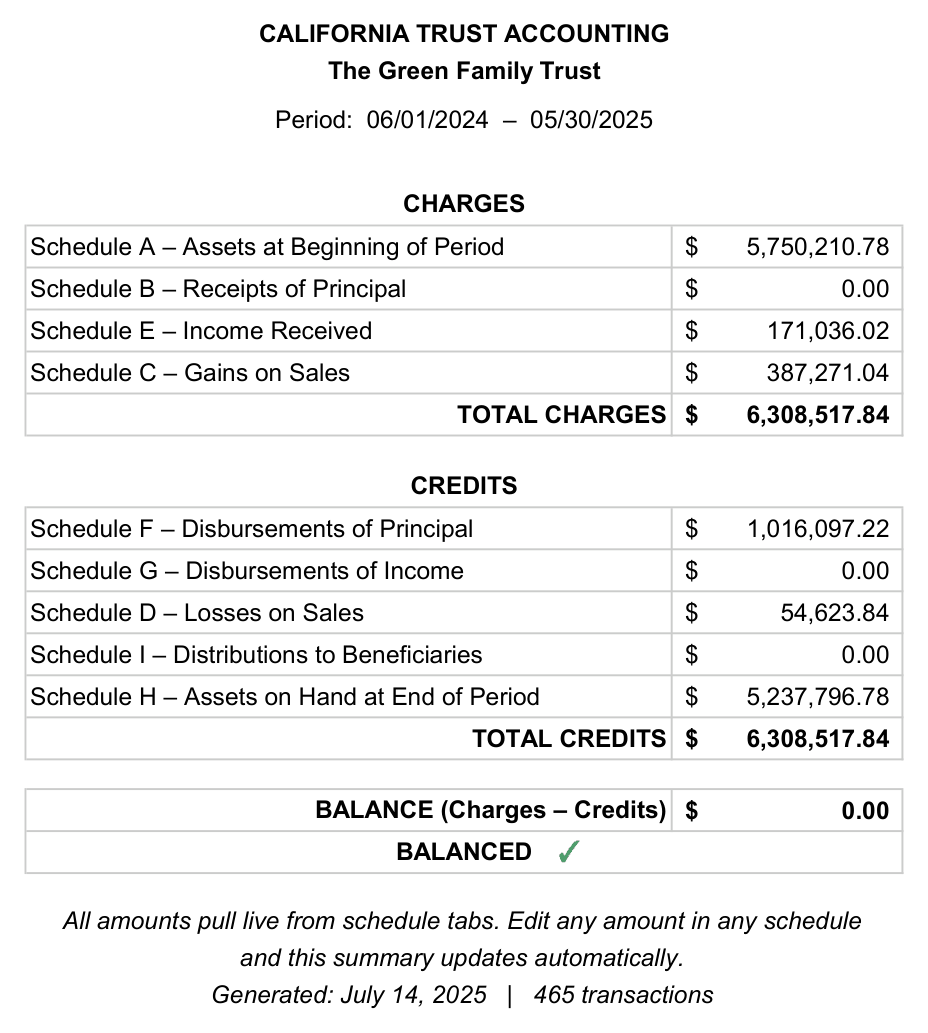
$699 Flat. No Subscription. No Install.
Let Balanced do the reading
Damaged scans and missing pages are the normal condition of a fiduciary's file, not the exception. Reading every page as an image, checking every figure against the statement's own arithmetic and flagging what cannot be established is hard, technical work. It is also what Balanced does. Add the PDF statements for the accounting period, including scanned or incomplete ones, and Balanced converts and organizes the data on them into the Probate Code schedules, each line traced to its page, as one editable Excel workbook balanced to the penny. It is $699 flat. Review the workbook against your statements. Start an accounting.
The Law and the Art of Fiduciary Accounting is a series by Balanced Legal Technology, LLC on complex California fiduciary accountings. General information only, current as of November 2026; not legal, tax or accounting advice. Statutes and rules change; confirm current law before relying on it.
About the author
Marc Joyce is a licensed, practicing California trusts and estates attorney, and the founder and developer of Balanced. He brings both sides to the problem: as a lawyer, and as an engineer. The Law and the Art of Fiduciary Accounting is his series on the hard cases where the two meet.
To see entries like these in a finished account, see the sample trust accounting and the estate accounting example, each with every schedule filled in.
Ready to generate yours? Add the PDF statements for the accounting period. Your PDFs stay on your computer.
$699 Flat. No Subscription. No Install.