 Balanced
The statements
The pictures in this article come from a real monthly checking statement for a living trust, covering June 6 to July 7, 2025, including one of the check images the bank printed at the back. The names, addresses, account numbers, reference codes, payees, the bank's name and the signature have been changed, and the handwriting on the check has been replaced. Every date, check number and amount is exactly as printed.
A brokerage statement tells you a great deal about each line. A bank statement tells you almost nothing: a date, an amount, and a description the bank wrote for its own purposes. "Check 1008, $2,817.07." "Preauthorized Wd, $2,929.38." "Deposit, $50.00." The account must say who was paid and why, and who paid the trust and why, because whether a receipt is principal or income, and whether a disbursement is an expense, a distribution or a loan, depends on facts the bank never prints. Those facts are on the check images, the deposit tickets, the register and the invoices. The bank statement is where the search starts, not where it ends.
Have the statements? Balanced converts and organizes the data on them into this accounting, in the Probate Code format, as one editable Excel workbook balanced to the penny. Scanned or incomplete statements work.
- Developed by a California trusts and estates attorney
- Works with any PDF statement, downloaded or scanned
- Statement entries are cited to the PDF and page they
came from, for easy verification - A fully editable Excel workbook, emailed in about 1 hour
$699 Flat. No Subscription. No Install.
This has by far been the best user-experience and I’ve been really impressed with your product thus far.
Kelsey B. Cooper, Esq., California Estate Planning Services PC
What the law asks for
Receipts and disbursements, with their character. The account shows the receipts (Prob. Code § 1062(a)) and the disbursements (§ 1062(b)) of the period, and a trustee's account shows them separately for principal and income (§ 16063(a)(1)). A line that cannot be identified cannot be placed on either side of that line.
Payees. Each disbursement is reported with its date, its amount and, from the check, the register or the invoice, the person paid and the purpose. That is what lets a beneficiary or a court see whether the money was spent for the trust.
Original statements in a conservatorship. A guardian or conservator must also file the original account statements with the account (Prob. Code § 2620(c)), so the court will compare the schedules with the bank's own pages line by line.
Expenses and their side. Ordinary expenses and the trustee's regular charges are generally paid from income, and other items from principal, under the Uniform Fiduciary Income and Principal Act (Prob. Code § 16360 and following). The allocation cannot be made until the disbursement is identified.
The checking statement
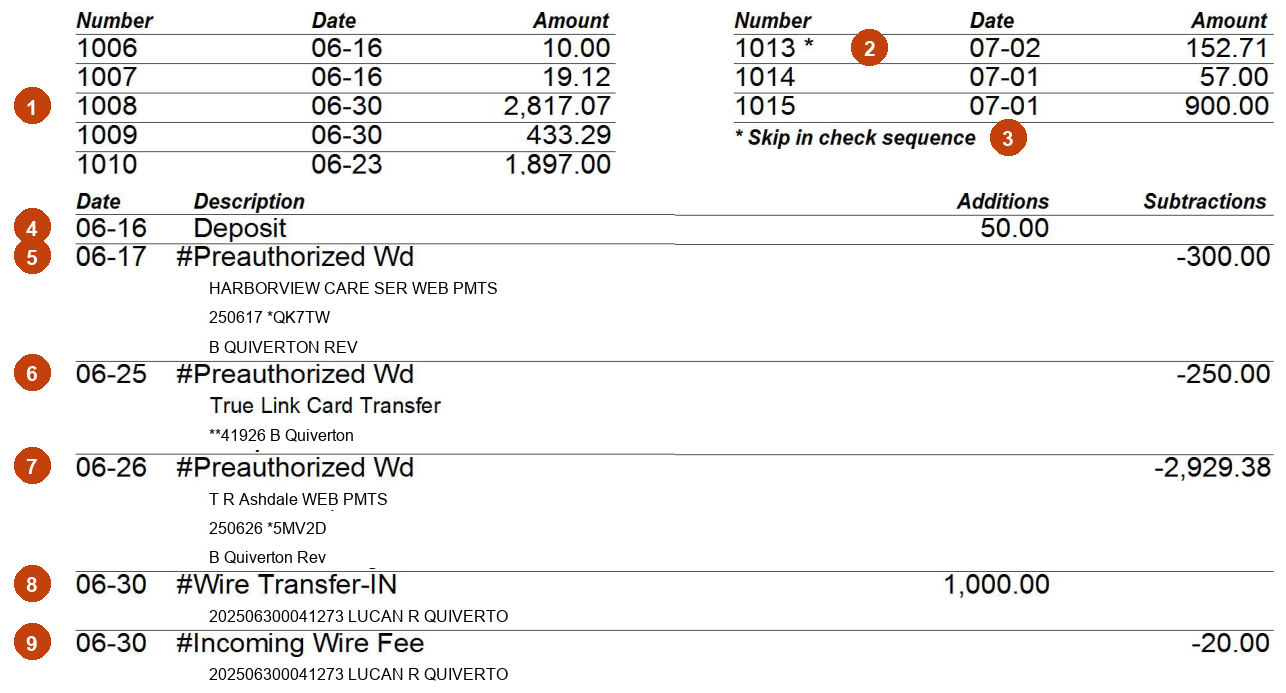
1. Check 1008, paid 06-30, $2,817.07. The check list gives the number, the date the bank paid it and the amount. It does not give the payee. For that you need the check image (callout 11) or the register.
*2. Check 1013 \.** The asterisk means the number before it in the list is not the number before it in the checkbook: checks 1011 and 1012 did not clear this month. In this account they never cleared; none of the statements for the rest of 2025 shows them. A missing number is one of three things: a voided check, a lost check, or a check written and still outstanding. The register says which. An outstanding check is still the trust's money at the end of the period and must be followed into the next account.
*3. "\ Skip in check sequence."** The bank's own flag. Read it on every statement; it is the quickest list of checks that need explaining.
4. 06-16, Deposit, $50.00. A receipt with no source. The deposit ticket image, the register or the person who made the deposit must say what it was. A rent payment is income; the return of a deposit or the sale of an asset is principal; a gift into the trust is an addition to principal. Until the source is known, it cannot be classified.
5. 06-17, Preauthorized withdrawal, $300.00, "HARBORVIEW CARE SER WEB PMTS." An electronic payment, with the payee in the bank's description: a care provider. Enter it as a disbursement to that payee, and keep the invoice or agreement that shows what the trust was paying for.
6. 06-25, "True Link Card Transfer," $250.00. Money moved to a prepaid card. What it is depends on whose card it is. If the card account belongs to the trust and is used for a beneficiary's expenses, this is a transfer between the trust's own accounts, and the card statements, not this line, show the real disbursements (see our article on transfers between the estate's own accounts). If the card belongs to the beneficiary, it is a distribution or a payment for the beneficiary's benefit when made.
7. 06-26, Preauthorized withdrawal, $2,929.38, "T R Ashdale WEB PMTS." A payment to a named individual. The bank's line tells you who, not why. Professional fees, reimbursements, wages to a caregiver and distributions all look like this. Find the invoice or the agreement before choosing the schedule.
8. 06-30, Wire Transfer-IN, $1,000.00, from a named individual. A receipt from a family member, repeated every month on these statements. It might be a contribution to the trust, a loan, a repayment, or rent. Each is reported differently, and none can be guessed from the wire.
9. 06-30, Incoming Wire Fee, ($20.00). The bank's fee for receiving the wire. Report the receipt at its full $1,000.00 and the fee as its own disbursement; netting them hides the fee and understates the receipt.
The check image
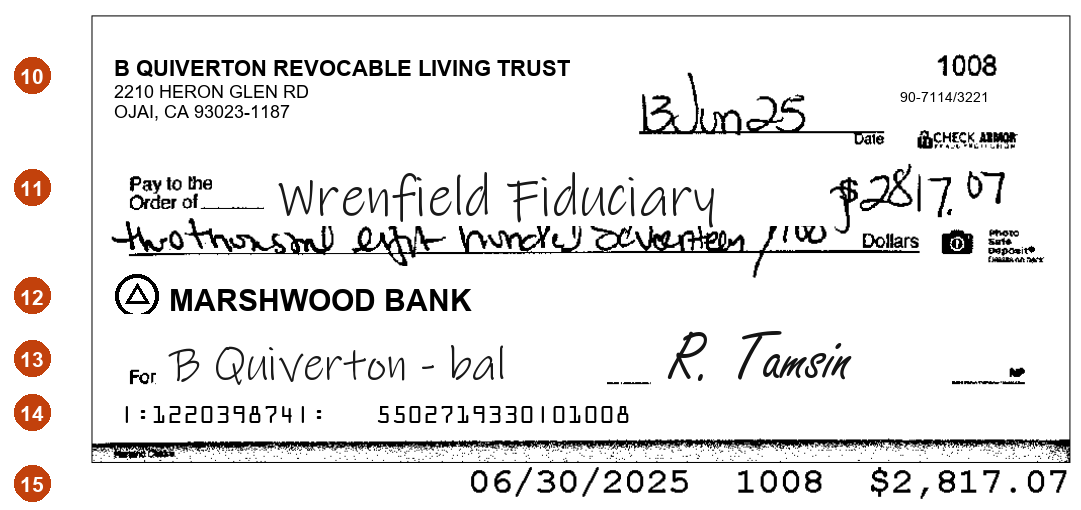
10. The printed name. The check is drawn on the trust's account, in the trust's name. A check drawn on someone else's account, even for a trust expense, is not a trust disbursement; it may be a claim for reimbursement instead.
11. "Pay to the Order of." The payee, here a professional fiduciary firm. This is the only place on the bank's pages where the payee of check 1008 appears.
12. The bank. Confirms which account the check was drawn on when the trust has accounts at more than one bank.
13. The memo line. Whatever the writer chose to note, here a name and "bal." Quote it as written in the description of the disbursement. Do not turn it into a purpose it does not state; if the purpose matters, find the invoice.
14. The encoded line. The bank routing number, the account number and the check number, 1008, machine printed. It ties the image to the check list.
15. 06/30/2025, 1008, $2,817.07. The bank's caption: the date it paid the check, the number and the amount. Note that the check is dated June 13 in the writer's hand and was paid June 30. Use the same date convention for every check, and when a check is written before the end of a period and paid after it, show it as outstanding at the end of the first period and paid in the next.
The register and the bank
The bank statement records when money left; the trustee's register records when a check was written, to whom and why. Neither is complete without the other. Reconcile them each month: every check in the register either cleared, is outstanding, or was voided; every electronic payment on the statement appears in the register with a payee and purpose; every deposit has a source. The accounting is built from the bank's dates and amounts and the register's payees and purposes, and the two must agree on the ending balance after outstanding items.
Where each line lands
- Receipts: each deposit and incoming wire at its full amount, once its source and character are known.
- Disbursements: each check and electronic payment, with its payee and purpose from the check image, the register or the invoice; bank fees, including wire fees, as their own lines.
- Distributions: payments that reached a beneficiary, or were made for a beneficiary's benefit, identified as such.
- Transfers: moves to another of the trust's own accounts, including a card account the trust owns, reported as neither a receipt nor a disbursement.
- Property on hand: the bank balance at the end of the period, adjusted in the report for checks written and not yet paid.
- The report: skipped check numbers that never cleared, and any receipt or payment whose source or purpose could not be documented.
Common mistakes
- Payees left blank. A disbursement schedule of check numbers and amounts tells a reader nothing; the check images are on the statement for a reason.
- Guessing the purpose. A memo or a payee name is evidence, not a conclusion. Quote it; document the rest.
- Netting fees. The wire fee is a disbursement, not a reduction of the receipt.
- Ignoring skipped numbers. A missing check may be outstanding, and outstanding checks change the ending cash.
- Treating card loads as spending. Money moved to a card the trust owns is spent when the card is used.
Checklist
- For every check, take the payee from the image or the register, and the date and amount from the bank.
- List the skipped check numbers and account for each: void, lost or outstanding.
- Identify the source of every deposit and wire, and its character.
- Report every bank fee as its own disbursement.
- Reconcile the register to the statement each month, including outstanding checks at the end of the period.
Praise for Balanced
“This has by far been the best user-experience and I’ve been really impressed with your product thus far.”
“I’d also just like to say that I was a trusts & estates paralegal for 6 years prior to becoming an attorney myself, so I’ve done hundreds of accountings manually. I’ve also tried countless other ‘trust accounting’ products. This has by far been the best user-experience and I’ve been really impressed with your product thus far. Myself and my firm will be repeat customers.”
California Estate Planning Services PC
Inside a real Balanced workbook
$699 Flat. No Subscription. No Install.
Let Balanced do the reading
A year of checking statements can hold hundreds of checks and electronic payments, each needing a payee and a purpose that the bank's line does not give. Putting every one of them on its own line, keeping the bank's description, and finding what still needs a payee or a source is hard, technical work. It is also what Balanced does. Add the PDF statements for the accounting period, including scanned or incomplete ones, and Balanced converts and organizes the data on them into the Probate Code schedules, with every check, electronic payment and bank fee on its own line, the bank's description quoted, and each line traced to its page, as one editable Excel workbook balanced to the penny. It is $699 flat. Review the workbook against your statements. Start an accounting.
The Law and the Art of Fiduciary Accounting is a series by Balanced Legal Technology, LLC on complex California fiduciary accountings. General information only, current as of November 2026; not legal, tax or accounting advice. Statutes and rules change; confirm current law before relying on it.
About the author
Marc Joyce is a licensed, practicing California trusts and estates attorney, and the founder and developer of Balanced. He brings both sides to the problem: as a lawyer, and as an engineer. The Law and the Art of Fiduciary Accounting is his series on the hard cases where the two meet.
To see entries like these in a finished account, see the sample trust accounting and the estate accounting example, each with every schedule filled in.
Ready to generate yours? Add the PDF statements for the accounting period. Your PDFs stay on your computer.
$699 Flat. No Subscription. No Install.