 Balanced
The statements
The pictures in this article come from three real brokerage statements from three custodians, printed seven years apart: a 2025 quarterly statement for a living trust, a 2025 monthly investment report, and a 2018 monthly statement. The names, account numbers and the names of the institutions have been changed. Every date, security, quantity and amount is exactly as the custodian printed it, except on the 2018 statement, where the amounts were changed slightly and every share count and total recomputed to match.
When a dividend is reinvested, the custodian pays the dividend and, the same day, spends it on more shares of the same security. The statement reports both halves. Each custodian does it differently: some print the dividend first and the purchase second, some print the purchase first, some net them on the summary page under a heading of their own, and older statements report the purchase as an ordinary "Buy." In every case there are two events, and the account needs both.
The usual mistakes run in opposite directions. One preparer sees the dividend and the purchase cancel to zero and enters neither, so the income schedule is short and the new shares appear from nowhere at year end. Another enters the dividend as income and also counts the reinvested shares as income received in kind, so the same dollars are income twice.
Have the statements? Balanced converts and organizes the data on them into this accounting, in the Probate Code format, as one editable Excel workbook balanced to the penny. Scanned or incomplete statements work.
- Developed by a California trusts and estates attorney
- Works with any PDF statement, downloaded or scanned
- Statement entries are cited to the PDF and page they
came from, for easy verification - A fully editable Excel workbook, emailed in about 1 hour
$699 Flat. No Subscription. No Install.
This has by far been the best user-experience and I’ve been really impressed with your product thus far.
Kelsey B. Cooper, Esq., California Estate Planning Services PC
What the law asks for
The dividend is income. Money received in an entity distribution, such as a cash dividend, is generally income (Prob. Code § 16340(c)). It is income when it is paid, whether the custodian hands it over in cash or spends it on shares the same day.
Capital gain distributions are not. A capital gain dividend from a regulated investment company, such as a mutual fund, is principal (§ 16340(d)(4)). A fund's short-term capital gain distributions are generally reported to shareholders as ordinary dividends rather than capital gain dividends, and in our view follow the income rule. Whichever treatment you adopt, state it and apply it consistently.
The purchase is a change in form. Buying shares with the dividend changes the form of an asset the trust or estate already owns, cash, into shares. Every account includes a schedule of "purchases or other changes in the form of assets" (§ 1063(b)). The new shares are carried at what was paid for them, and they appear on the schedule of property on hand at the end at that carry value (§§ 1061(a)(10), 1062(f)).
Where there is an income beneficiary, the reinvestment matters twice. Income cash that buys shares has been invested in assets that sit beside principal. The account must show the receipts and disbursements of principal and income separately (§ 16063(a)(1)), and where the law requires it, a schedule allocating receipts and disbursements between principal and income (§ 1063(c)). Our article on corporate actions and carry value covers the law in more depth; this article is about finding the two lines and putting each in its place.
The quarterly statement: dividend, then purchase
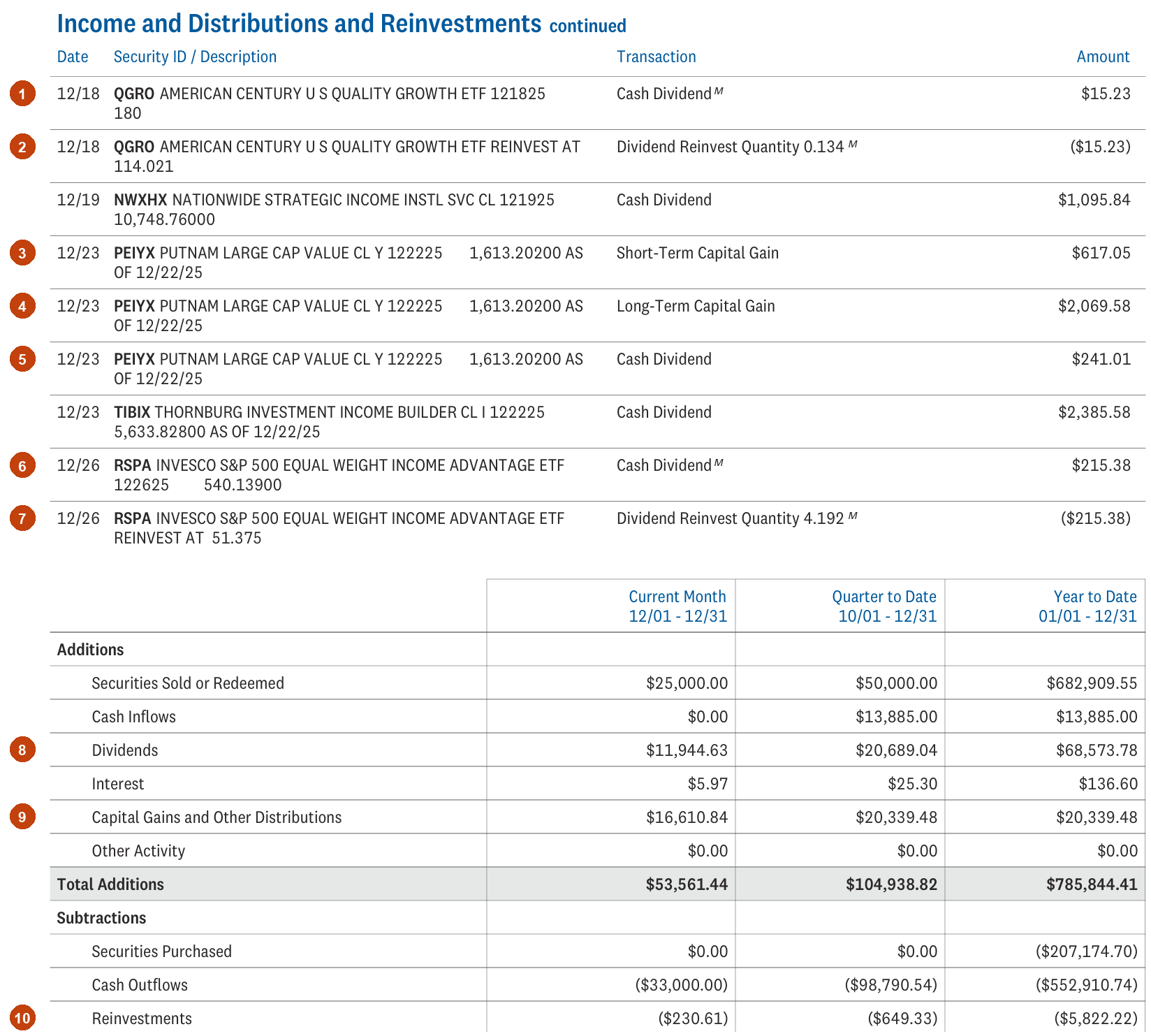
1. 12/18, QGRO, Cash Dividend, $15.23. The income half. Enter it on the income schedule as a dividend received on December 18 (§ 16340(c)).
2. 12/18, QGRO, Dividend Reinvest Quantity 0.134, ($15.23). The purchase half: 0.134 of a share bought at $114.021. Enter it on the changes in form schedule as a purchase of 0.134 shares for $15.23. Those 0.134 shares are carried at $15.23, their cost, and they join the position on the closing schedule of property on hand. The dividend and the purchase cancel in cash, which is exactly why neither can be left out: the cash nets to zero, but the account gained income and gained shares.
3. 12/23, PEIYX, Short-Term Capital Gain, $617.05. A mutual fund distribution, not a dividend from earnings. In our view it follows the income rule (see above), but treat it as a decision you make and explain.
4. 12/23, PEIYX, Long-Term Capital Gain, $2,069.58. A capital gain dividend from a mutual fund: principal (§ 16340(d)(4)). It is the largest of the three distributions this fund paid that day and the one most often put on the income schedule by mistake, because the statement prints it under "Income."
5. 12/23, PEIYX, Cash Dividend, $241.01. The fund's ordinary dividend: income. Note that none of this fund's three distributions was reinvested. The holdings page marks it "C": dividends and capital gains are paid in cash. Reinvestment is an election made security by security, so one account can hold some positions that reinvest and some that do not. Read every line.
6. and 7. 12/26, RSPA, Cash Dividend $215.38, then Dividend Reinvest Quantity 4.192, ($215.38). The same pattern as callouts 1 and 2: income of $215.38, and a purchase of 4.192 shares at $51.375 carried at $215.38.
8. Activity Summary, Dividends, $11,944.63 for December. A total that includes the reinvested dividends of callouts 1 and 6. It is a check on the income schedule, never an entry.
9. Capital Gains and Other Distributions, $16,610.84. Another total, and a mixed one: it lumps together short-term and long-term distributions that belong on different sides of the account (callouts 3 and 4). Never enter it.
10. Reinvestments, ($230.61) for December, ($649.33) for the quarter. The total of the month's purchases with reinvested dividends: $15.23 + $215.38 = $230.61. It is the check on the changes in form schedule. If your purchases from reinvestment do not add to this figure, a reinvestment was missed.
The monthly report: purchase first, dividend second
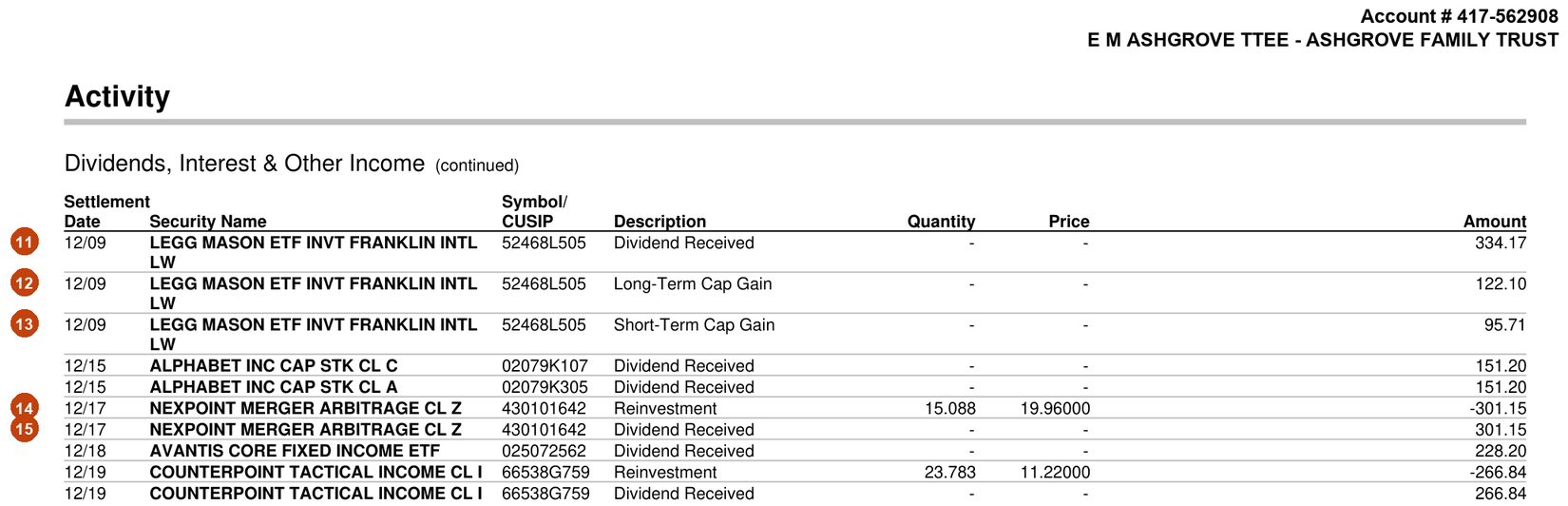
11. 12/09, Legg Mason ETF, Dividend Received, $334.17. Income.
12. 12/09, the same fund, Long-Term Cap Gain, $122.10. Principal (§ 16340(d)(4)), even though this custodian prints it in a section called "Dividends, Interest and Other Income."
13. 12/09, the same fund, Short-Term Cap Gain, $95.71. Follows the income rule in our view, as in callout 3.
14. 12/17, NexPoint, Reinvestment, 15.088 shares at $19.96, -$301.15. This custodian prints the purchase first, as a negative amount inside the income section, with the quantity and price. It is the changes in form entry: 15.088 shares carried at $301.15.
15. 12/17, NexPoint, Dividend Received, $301.15. The income entry. Read the pair together: the negative line is not a refund, a fee or a reversal of the dividend. The Counterpoint fund two lines below shows the same pattern on December 19: a reinvestment of 23.783 shares for $266.84 and a dividend of $266.84. Many preparers drop the negative lines because they look like corrections. Doing so loses every reinvested share.
The older format: every dividend becomes a purchase
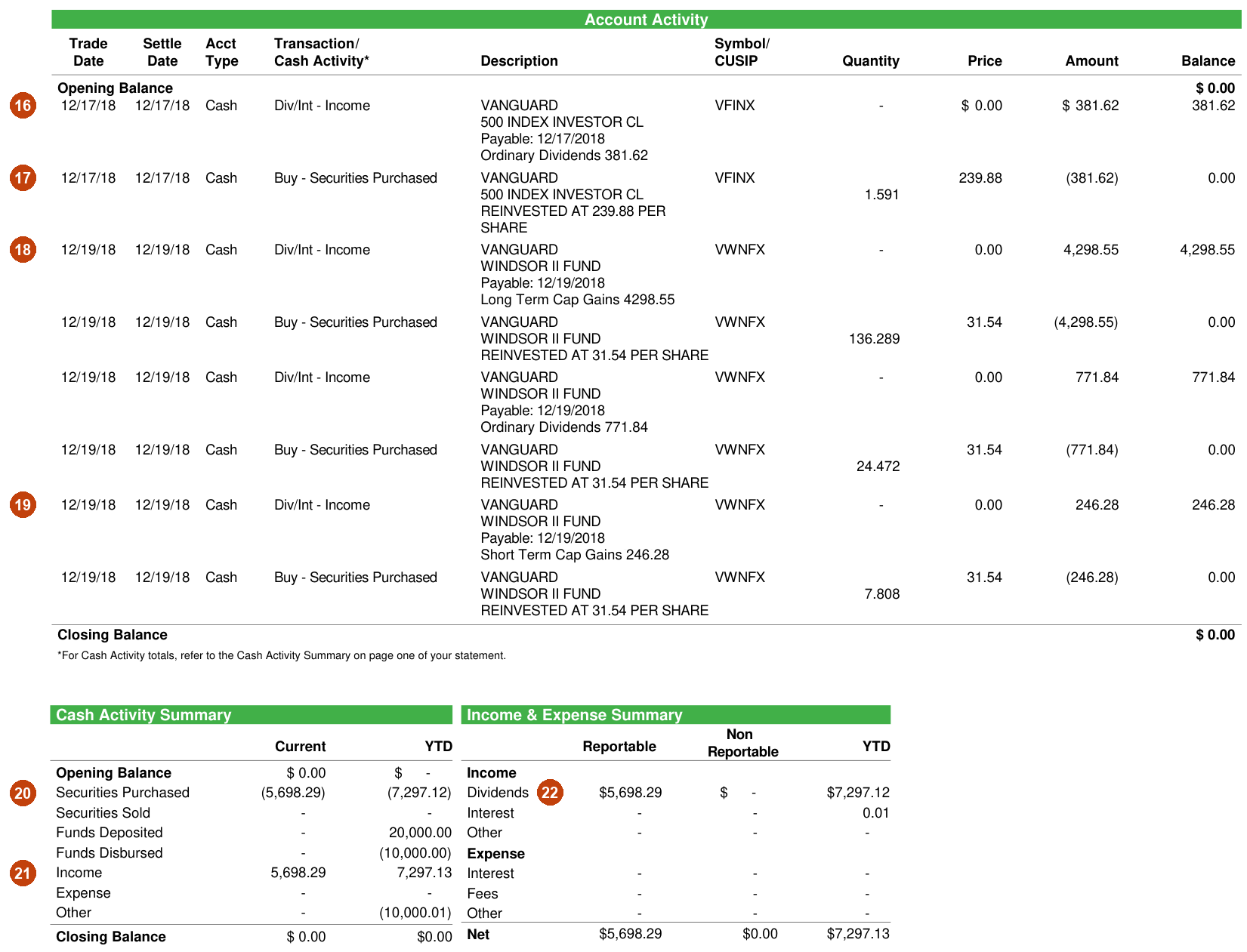
Older statements, and many current ones from smaller custodians, do not label a reinvestment as one. This account reinvested every distribution, and the statement reports each one as an income line followed by an ordinary purchase.
16. 12/17/18, Vanguard 500 Index Investor, Div/Int - Income, $381.62. Income: the description calls it "Ordinary Dividends 381.62."
17. 12/17/18, the same fund, Buy - Securities Purchased, 1.591 shares at $239.88, ($381.62). The reinvestment. The transaction type is a plain purchase; only the description, "REINVESTED AT 239.88 PER SHARE," and the fact that it follows the dividend on the same day for the same amount, say it is a reinvestment. It is still a change in form, carried at $381.62.
18. 12/19/18, Vanguard Windsor II, Div/Int - Income, $4,298.55, then 136.289 shares bought for $4,298.55. The same pattern, but read the description: "Long Term Cap Gains 4298.55." This is a capital gain distribution, principal (§ 16340(d)(4)), even though the transaction type says Div/Int - Income. The fund's ordinary dividend of $771.84 the same day, reinvested in 24.472 shares, is income.
19. 12/19/18, Windsor II, "Short Term Cap Gains 246.28," then 7.808 shares bought for $246.28. The pattern again, for the third distribution from one fund on one day. In our view the short-term distribution follows the income rule, as in callout 3. A fractional share count that grows by a fraction of a share every quarter is the clearest sign, on the holdings page, that a position reinvests.
20. Cash Activity Summary, Securities Purchased, (5,698.29). On this statement there were no ordinary purchases at all. Every dollar of "Securities Purchased" is reinvested distributions. A preparer who took this line at face value would show $5,698.29 of investment decisions that the fiduciary never made.
21. Income, 5,698.29. The total of the month's distributions, every one of them reinvested. It is a check on the receipts schedules, and it matches Securities Purchased to the penny: this account reinvested everything it received and held no cash at all.
22. Income and Expense Summary, Dividends, $5,698.29. The summary calls the whole amount "Dividends." It is not: $4,544.83 of it ($4,298.55 and $246.28) is capital gain distributions, and $4,298.55 of that is principal. Summaries built for the tax return group distributions by how they are reported, not by how the account must treat them. Take the character of each receipt from its own line.
Where each line lands
- Income schedule: every dividend, at its gross amount, on the date paid, including the dividends that were reinvested (§ 16340(c)).
- Principal receipts: long-term capital gain distributions from mutual funds (§ 16340(d)(4)).
- Short-term capital gain distributions: in our view income; state the treatment.
- Changes in form schedule: every reinvestment, as a purchase of the number of shares bought, at the amount paid (§ 1063(b)).
- Property on hand at the end: the reinvested shares, inside each position, at their cost (§§ 1061(a)(10), 1062(f)).
- Principal and income allocation: where there is an income beneficiary, the income that was invested (§ 1063(c)).
- Nowhere: the summary totals (dividends, capital gains, reinvestments, securities purchased, income), each of which repeats the detail.
Common mistakes
- Netting the pair to zero. The cash nets to zero; the account does not. Income is understated and the new shares have no source.
- Counting the shares as income too. The dividend is the income. The shares are what the income bought.
- Dropping negative lines. A reinvestment printed as a negative amount in the income section is a purchase, not a correction.
- Treating every "Buy" as an investment decision. On older statements a reinvestment is a purchase that follows a dividend for the same amount on the same day.
- Calling a capital gain distribution a dividend. Long-term capital gain distributions are principal, however the statement groups them.
- Losing the lot. Each reinvestment is a separate purchase with its own date and cost. When those shares are sold, the carry value of what was sold depends on those lots (see our article on lot-by-lot carry value).
Checklist
- For every dividend, look for a purchase of the same security, the same day, for the same amount.
- Enter the dividend on the income schedule and the purchase on the changes in form schedule.
- Separate ordinary dividends from capital gain distributions; long-term capital gain distributions go to principal.
- Carry the reinvested shares at their cost and add them to the position on the closing schedule.
- Check the month: the reinvestments you entered should equal the statement's reinvestment or securities purchased total.
- Where there is an income beneficiary, show the income that was invested in the principal and income allocation, and consider whether reinvestment should continue.
Praise for Balanced
“This has by far been the best user-experience and I’ve been really impressed with your product thus far.”
“I’d also just like to say that I was a trusts & estates paralegal for 6 years prior to becoming an attorney myself, so I’ve done hundreds of accountings manually. I’ve also tried countless other ‘trust accounting’ products. This has by far been the best user-experience and I’ve been really impressed with your product thus far. Myself and my firm will be repeat customers.”
California Estate Planning Services PC
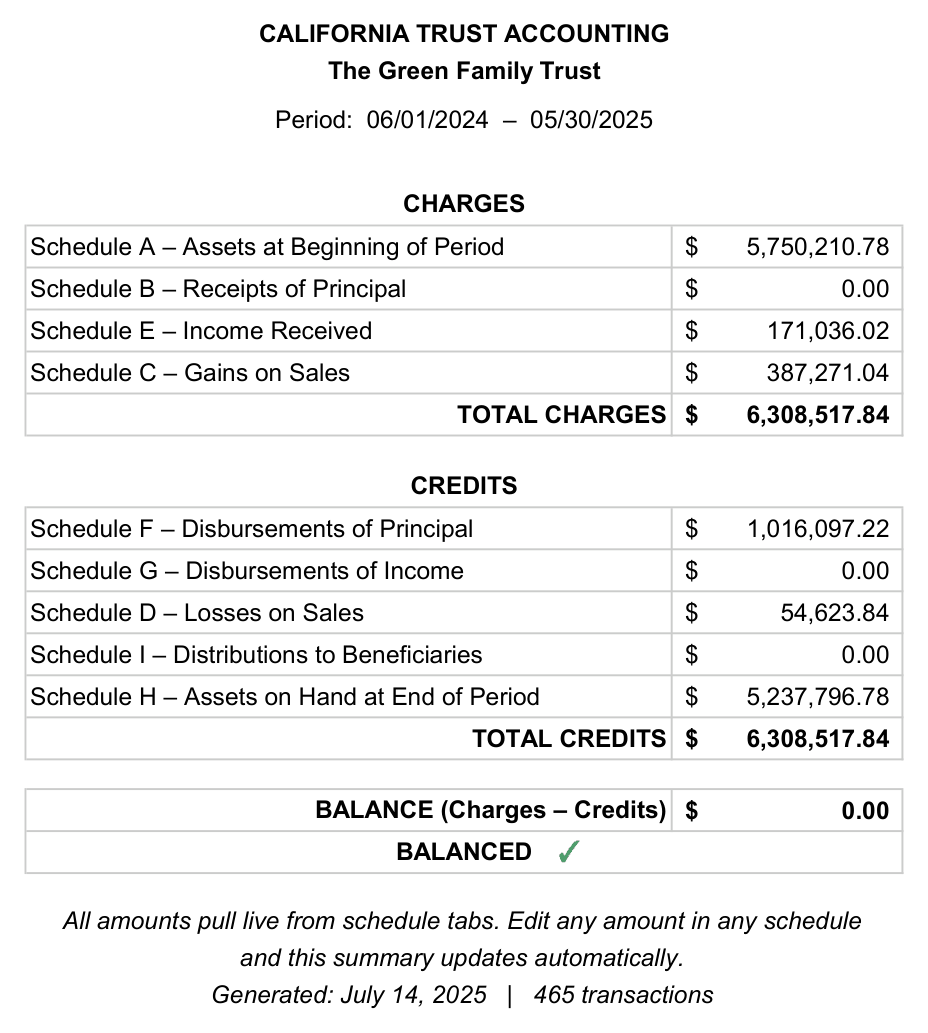
Inside a real Balanced workbook
$699 Flat. No Subscription. No Install.
Let Balanced do the reading
A year of statements for an account that reinvests holds hundreds of these pairs, printed differently by every custodian and sometimes not labelled at all. Finding each pair, splitting it correctly and carrying each new lot at its cost is hard, technical work. It is also what Balanced does. Add the PDF statements for the accounting period, including scanned or incomplete ones, and Balanced converts and organizes the data on them into the Probate Code schedules, one line per transaction, each traced to its page, as one editable Excel workbook balanced to the penny. It is $699 flat. Review the workbook against your statements. Start an accounting.
The Law and the Art of Fiduciary Accounting is a series by Balanced Legal Technology, LLC on complex California fiduciary accountings. General information only, current as of November 2026; not legal, tax or accounting advice. Statutes and rules change; confirm current law before relying on it.
About the author
Marc Joyce is a licensed, practicing California trusts and estates attorney, and the founder and developer of Balanced. He brings both sides to the problem: as a lawyer, and as an engineer. The Law and the Art of Fiduciary Accounting is his series on the hard cases where the two meet.
To see entries like these in a finished account, see the sample trust accounting and the estate accounting example, each with every schedule filled in.
Ready to generate yours? Add the PDF statements for the accounting period. Your PDFs stay on your computer.
$699 Flat. No Subscription. No Install.