 Balanced
The statement
The pictures in this article come from one real brokerage statement: the December 2020 monthly statement of a managed account, which ends with a recap of the year's corporate actions. Nothing on the cropped pages identifies the account holder; the account name, the account number and the custodian's name are outside the crops. A few share counts were changed slightly, with every figure that depends on them recomputed to match. Every security, date and description is exactly as printed.
The account holds dozens of large companies, many of them foreign. In a single year those companies spun off divisions, merged, renamed themselves, split their shares and paid dividends in shares and in rights, and every one of those events left a trace on the statement. In one year this statement shows two spin-offs on the same day as a merger the custodian calls a name change, two stock splits, several stock dividends, rights that left the account with "no value," and a fraction of a share paid in cash.
The law for these events is covered in our article on corporate actions and carry value. This article is about reading them: what each one looks like on the page, what the custodian's label does and does not tell you, and what the account needs that the statement does not give.
Have the statements? Balanced converts and organizes the data on them into this accounting, in the Probate Code format, as one editable Excel workbook balanced to the penny. Scanned or incomplete statements work.
- Developed by a California trusts and estates attorney
- Works with any PDF statement, downloaded or scanned
- Statement entries are cited to the PDF and page they
came from, for easy verification - A fully editable Excel workbook, emailed in about 1 hour
$699 Flat. No Subscription. No Install.
This has by far been the best user-experience and I’ve been really impressed with your product thus far.
Kelsey B. Cooper, Esq., California Estate Planning Services PC
What the law asks for
Property received is principal. Property received in an entity distribution that is not money, such as shares distributed in a spin-off, is principal (Prob. Code § 16340(d)(1)). Money or property received from the "change in form of a principal asset" is principal too (§ 16343(b)).
A corporate action is a change in form, not a receipt of new value. Every account includes a schedule of "purchases or other changes in the form of assets" (§ 1063(b)). Shares that arrive in a spin-off do not add to what the trust or estate is charged with; they divide what it already had.
Carry value follows the property. Property on hand at the end is listed at its carry value (§§ 1061(a)(10), 1062(f)), and a gain or loss on a later sale is measured from it (§ 1062(d)). After a corporate action, the carry value of the old position must be traced into the new one, or divided between the old and the new.
What the schedules cannot show, the report must explain. The petition or report describes transactions that are "not otherwise readily understandable from the schedule" and explains "any unusual items appearing in the account" (§ 1064(a)(1), (2)).
The corporate actions page: shares that arrive with no amount
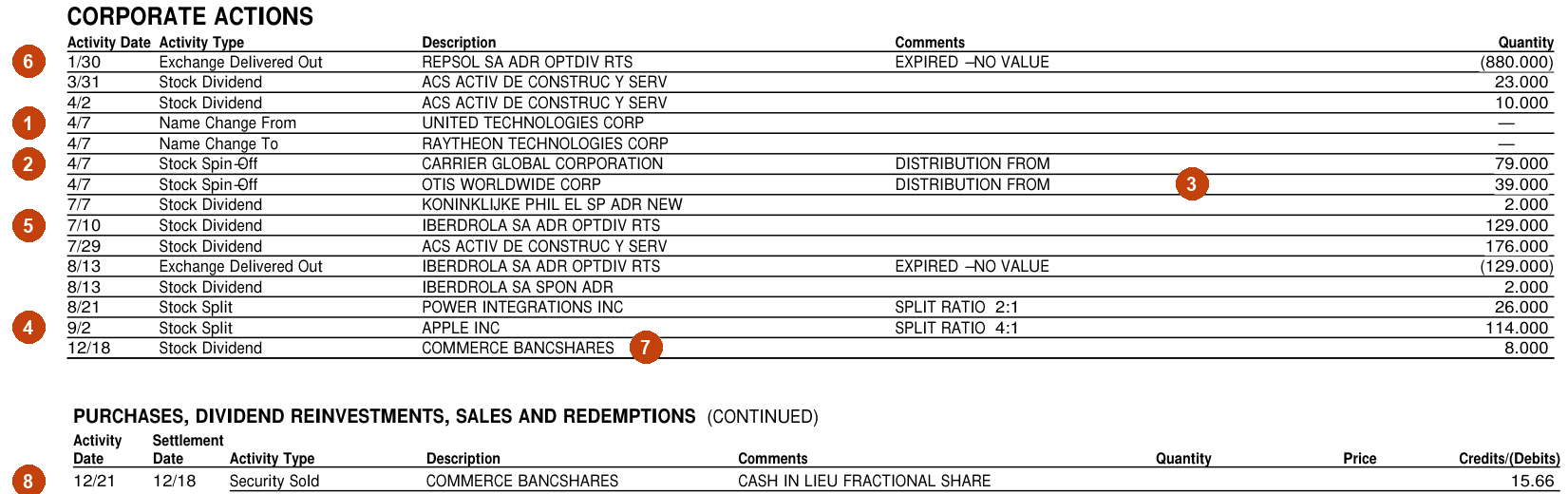
1. 4/7, Name Change From United Technologies Corp, Name Change To Raytheon Technologies Corp, no quantity. The custodian calls it a name change. A true name change is the simplest corporate action there is: same company, same shares, new name, and the carry value moves across unchanged. But look at the two lines below it, dated the same day (callouts 2 and 3): the account also received shares of two new companies. What happened in April 2020 was a separation and a merger: United Technologies distributed its Carrier and Otis businesses to its shareholders, combined with Raytheon Company, and took the name Raytheon Technologies. For a holder of the old shares, one position became three. Never rely on the custodian's label alone. The issuer's notice of the transaction, often filed as IRS Form 8937, says what happened and how the basis of the old shares is divided, and that is the document the account's carry values should follow.
2. 4/7, Stock Spin-Off, Carrier Global Corporation, "DISTRIBUTION FROM," 79.000. New shares arrived and no money moved. This section has no price or amount column at all, and it is printed apart from the cash activity, which is exactly why these lines are so easy to skip. On the account it is a significant event: a new position worth thousands of dollars that did not exist the day before. Carrier was distributed one share for each share of United Technologies, so the account held 79 shares of the parent. The comment "DISTRIBUTION FROM" does not even finish its sentence; the description, the date and the issuer's notice say where the shares came from. For a trust or estate that began during the period, also check whether the record date fell before or after the death: the act decides whether a distribution belongs to the beginning property or arrived during administration by its record date (§ 16376(f)(1)).
3. 4/7, Stock Spin-Off, Otis Worldwide Corp, 39.000. A second spin-off from the same parent on the same day, at one Otis share for every two of the parent. Half of 79 is 39.5, and the statement shows 39 whole shares. The half share was not delivered as a share; custodians usually sell such a fraction and pay cash in lieu (callout 8 shows what that line looks like), so look for it among the month's sales before the account is finished.
4. 9/2, Stock Split, Apple Inc, "SPLIT RATIO 4:1," 114.000. A split adds shares of the same security; it does not create a new one. The quantity printed is only the shares added: in a four-for-one split, 114 new shares mean the account held 38 shares before the split and 152 after. The position's total carry value is unchanged, and only the per-share figure falls (callout 13). The Power Integrations line above it is the same event at two for one.
5. 7/10, Stock Dividend, Iberdrola SA ADR OPTDIV RTS, 129.000. Read it with the two Iberdrola lines dated 8/13: the same rights delivered out as "EXPIRED - NO VALUE," (129.000), and a "Stock Dividend" of 2.000 shares of the company's ADRs. The company paid its dividend in rights that the holder could take as cash or as new shares (an optional dividend), and the custodian booked each step under a label of its own. Read together, the lines suggest the rights were turned into the 2 new shares, not that the dividend was lost; the issuer's notice says which. The category labels do not tell you what happened. That matters because each kind of event is accounted for differently. A stock split and a stock dividend in the same shares add shares to an existing position and leave its total carry value unchanged. A spin-off creates a different security, and part of the carry value of the old position moves to it. A dividend the holder could have taken in cash needs its own decision, stated in the account. The three ACS lines labelled "Stock Dividend" are the same kind of event for another company.
6. 1/30, Exchange Delivered Out, Repsol SA ADR OPTDIV RTS, "EXPIRED - NO VALUE," (880.000). Rights from another optional dividend, leaving the account with no shares and no cash beside them. Either the cash was paid elsewhere on the statement, or the rights were exchanged for shares, or they lapsed. Each is entered differently, and the corporate actions page alone does not say which. An exchange usually has a second leg, which may appear on a different page or a different day; find the matching cash or share line before entering either. These entries are also often booked days or weeks after the effective date, so an event near the end of an accounting period can land in the next period's statement.
7. 12/18, Stock Dividend, Commerce Bancshares, 8.000. A true stock dividend: more shares of the same company, and the position's total carry value unchanged. The new shares are principal, and they change the per-share carry value of every share in the position (callout 12).
8. 12/21, Security Sold, Commerce Bancshares, "CASH IN LIEU FRACTIONAL SHARE," $15.66. The fraction of a share the stock dividend would have produced, sold by the custodian and paid in cash. That small receipt is the proceeds of a sale of part of the new shares: principal, with a sliver of carry value allocated to it and a small gain or loss (§ 1062(d)). Notice where it is printed: among the ordinary purchases and sales, with a settlement date of 12/18 and an activity date three days later, not in the corporate actions section.
The holdings page: the history of every corporate action
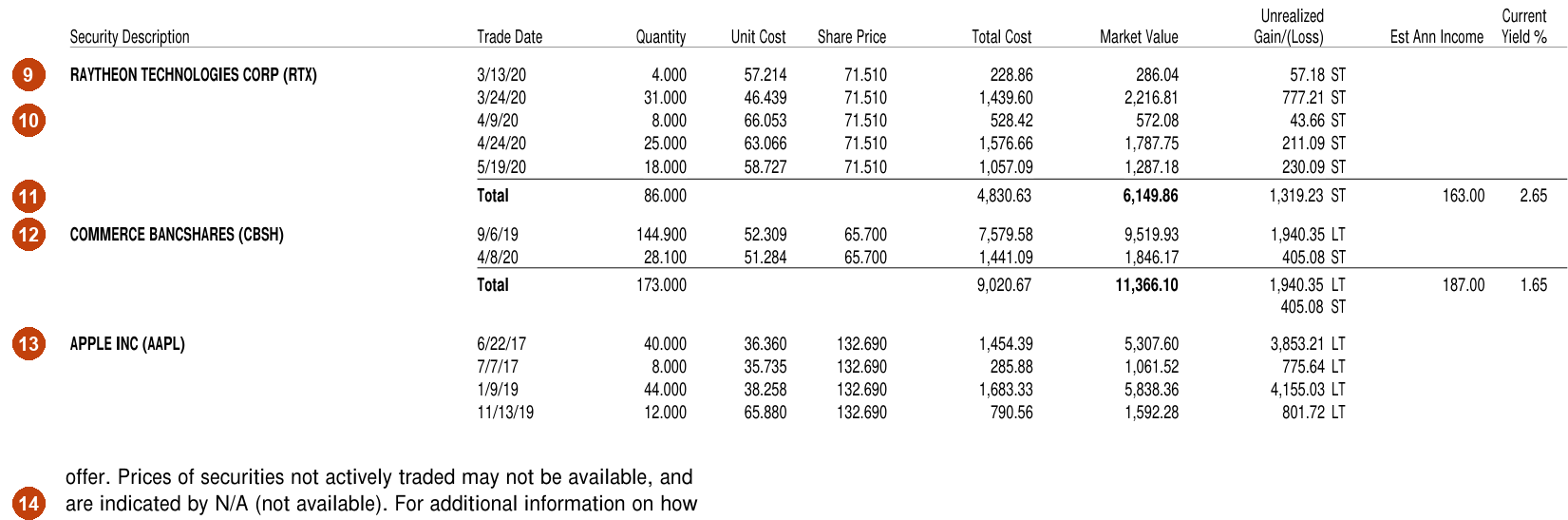
9. Raytheon Technologies, lots dated 3/13/20 and 3/24/20. These shares were bought as United Technologies, before the April separation, and are now carried under the new name. Their unit costs, $57.214 and $46.439, are well below what United Technologies shares cost at the time, because the custodian has already moved part of each lot's cost to the Carrier and Otis shares. That is the custodian's tax allocation, applied to its own cost figures. The account must make the same division of its own carry value.
10. Lots dated 4/9/20 and later. Bought after the separation, as Raytheon Technologies, at full cost. One position now holds two kinds of lots, and every one of them needs a carry value that can be traced back to what the trust or estate paid or received.
11. Total, 86.000 shares, cost $4,830.63. The custodian's tax cost for the position. It does not decide the account's carry value, which in a first account comes from the date-of-death values; and the statement offers no help in dividing that carry value after a spin-off. The issuer's allocation must be applied to the account's own figures.
12. Commerce Bancshares, 144.900 and 28.100 shares. The 8 new shares from callout 7 have been spread across the existing lots, which is why the lots now hold fractions of a share, and each lot's unit cost has been lowered to match. A stock dividend handled this way leaves no separate lot to find; only the share count and the per-share cost show that it happened.
13. Apple Inc, lot dated 6/22/17, 40.000 shares at $36.360. Bought three years before the split as 10 shares at about $145.44 each, and now shown as four times the shares at a quarter of the unit cost, for the same total of $1,454.39. That is the right way to carry a split: the total carry value is unchanged, and only the count and the per-share figure move.
14. "Prices of securities not actively traded may not be available, and are indicated by N/A (not available)." None of this account's holdings is unpriced, but many old accounts hold one: a company delisted years ago, one in bankruptcy, a private placement. The custodian keeps carrying the shares, with N/A or NP where the price should be, because no one has told it to remove them. For the account, the shares are still property on hand: list them on the closing schedule at their carry value (often $0.00 at the date of death, if they were worthless then), show them on the market value schedule with a note that no market value is available, and explain them in the report (§ 1064(a)(2)). If the shares are later abandoned or written off as worthless, that is a disposition, and any remaining carry value becomes a loss. Shares of a company in bankruptcy may be cancelled, may be exchanged for new shares under a plan, or may produce a small cash distribution years later. Each of those outcomes is a corporate action of its own; until one happens, the shares stay on the property on hand schedule with an explanation.
What the statement does not show
- The allocation. No statement says how to divide carry value between the old shares and the new. The issuer publishes it, usually as a percentage of basis allocated to each, on Form 8937 or an investor notice. Apply it to the account's carry value and show the calculation.
- Cash in lieu. When a spin-off or a split would produce a fraction of a share, many custodians sell the fraction and pay "cash in lieu." That small receipt is the proceeds of a sale of part of the new shares: principal, with a sliver of carry value allocated to it and a small gain or loss (§ 1062(d)).
- The second leg. A merger or exchange usually prints the shares delivered out and the shares or cash received in, sometimes on different dates. Find both before entering either.
- Stock splits. A split looks exactly like a spin-off on this page: shares received with no amount (callouts 2 and 4). The difference is that the new shares are the same security, so the position's total carry value is unchanged and only the per-share figure falls. A split that is entered as a spin-off, or as a receipt of new value, overstates the account.
Where each line lands
- Spin-off shares received: changes in form schedule, with the carry value moved from the parent shown as a calculation (§ 1063(b)); principal (§ 16340(d)(1)); not a receipt that increases charges.
- Name change: a note or a line on the changes in form schedule; carry value moves unchanged.
- Stock split or stock dividend in the same shares: the new share count on the closing schedule, total carry value unchanged.
- Cash in lieu of fractional shares: a sale on the gains and losses schedule (§ 1062(d)).
- Delisted, bankrupt or unpriced shares: property on hand at carry value, market value noted as unavailable, explained in the report (§ 1064(a)(2)).
- Nowhere: the $0.00 price, the "$ -" amount or the missing amount column on a corporate action line, which describe the cash effect (none), not the value received.
Common mistakes
- Skipping lines with no money. A spin-off moves no cash, so a preparer working from cash entries misses it, and the new shares appear on the closing schedule from nowhere.
- Booking the new shares at market value as a receipt. That adds value the trust never received and overstates the charges.
- Trusting the category. "Stock Dividend" covered rights from an optional dividend here; "Name Change" covered a merger and a separation into three companies.
- Dividing carry value by market value on the day. Use the issuer's published allocation; it is the figure the tax records will also use.
- Dropping unpriced holdings. Shares the custodian cannot price are still property on hand until they are disposed of.
Checklist
- Read every line with a quantity and no amount; each is a corporate action or a transfer.
- Read the description, not just the category; identify spin-off, split, stock dividend, name change, merger or exchange.
- Find the issuer's notice and its basis allocation for every spin-off and reorganization.
- Divide carry value using that allocation; show the calculation; keep the total unchanged.
- Find the second leg of every exchange, and any cash in lieu.
- Chain every share count from statement to statement; a new position or a changed name must be explained by an event.
- List unpriced, delisted and bankrupt holdings with an explanation.
Praise for Balanced
“This has by far been the best user-experience and I’ve been really impressed with your product thus far.”
“I’d also just like to say that I was a trusts & estates paralegal for 6 years prior to becoming an attorney myself, so I’ve done hundreds of accountings manually. I’ve also tried countless other ‘trust accounting’ products. This has by far been the best user-experience and I’ve been really impressed with your product thus far. Myself and my firm will be repeat customers.”
California Estate Planning Services PC
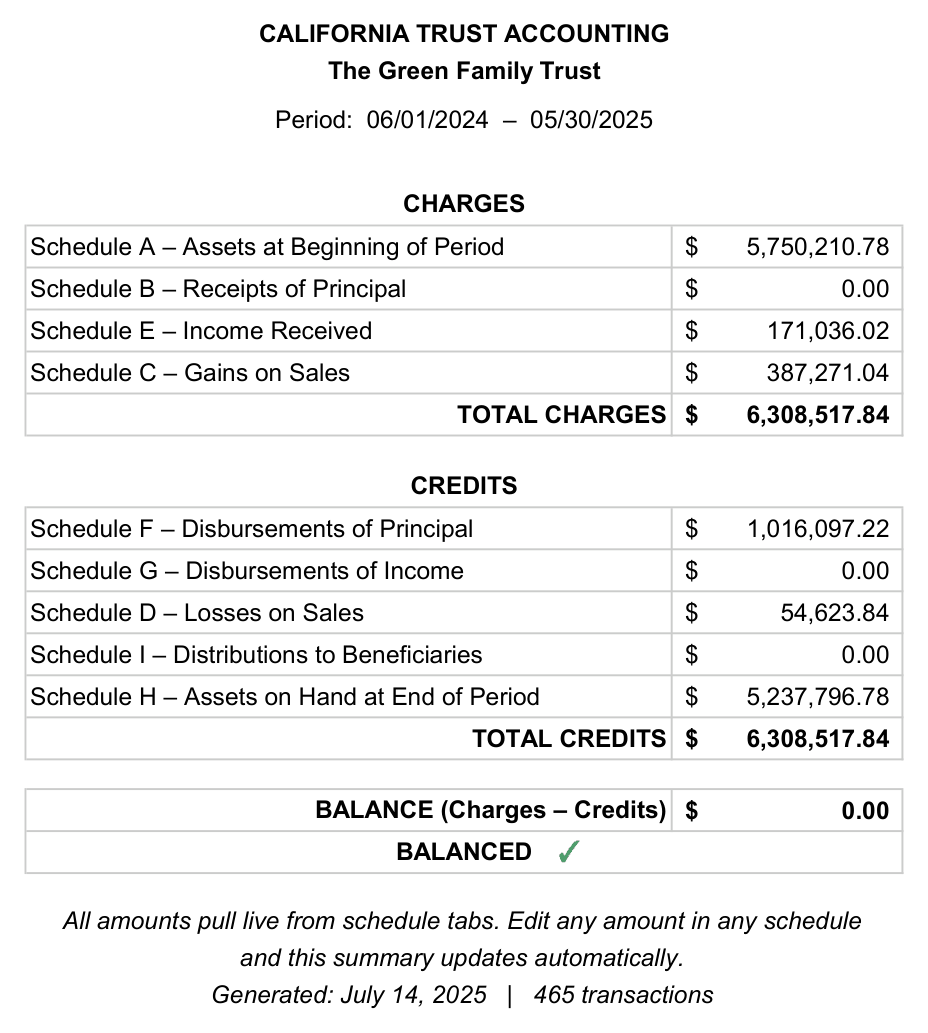
Inside a real Balanced workbook
$699 Flat. No Subscription. No Install.
Let Balanced do the reading
Corporate actions are where accounts most often go quietly wrong: the lines carry no money, the labels mislead, and the carry value must be traced through every event. Reading them correctly across a year of statements is hard, technical work. It is also what Balanced does. Add the PDF statements for the accounting period, including scanned or incomplete ones, and Balanced converts and organizes the data on them into the Probate Code schedules, one line per transaction, each traced to its page, as one editable Excel workbook balanced to the penny. It is $699 flat. Review the workbook against your statements. Start an accounting.
The Law and the Art of Fiduciary Accounting is a series by Balanced Legal Technology, LLC on complex California fiduciary accountings. General information only, current as of November 2026; not legal, tax or accounting advice. Statutes and rules change; confirm current law before relying on it.
About the author
Marc Joyce is a licensed, practicing California trusts and estates attorney, and the founder and developer of Balanced. He brings both sides to the problem: as a lawyer, and as an engineer. The Law and the Art of Fiduciary Accounting is his series on the hard cases where the two meet.
To see entries like these in a finished account, see the sample trust accounting and the estate accounting example, each with every schedule filled in.
Ready to generate yours? Add the PDF statements for the accounting period. Your PDFs stay on your computer.
$699 Flat. No Subscription. No Install.