 Balanced
The statement
The pictures in this article come from a real quarterly statement, for January to March 2024, that a mutual fund company sent to a bank serving as trustee of a charitable trust. The bank's name, the trust's name and date, the account numbers and the name of the fund company have been changed. Every security, date, share count and amount is exactly as printed.
A brokerage statement describes one account. A mutual fund company's statement often describes several: one for each fund held directly with the fund company, each with its own number, and sometimes a brokerage account as well, all under one registration and one total. The layout is different, the vocabulary is different ("purchases," "withdrawals," "net sweep"), and a gift of shares appears as a purchase. Read as if it were a brokerage statement, a fund company statement leads to purchases that were never made and receipts counted twice.
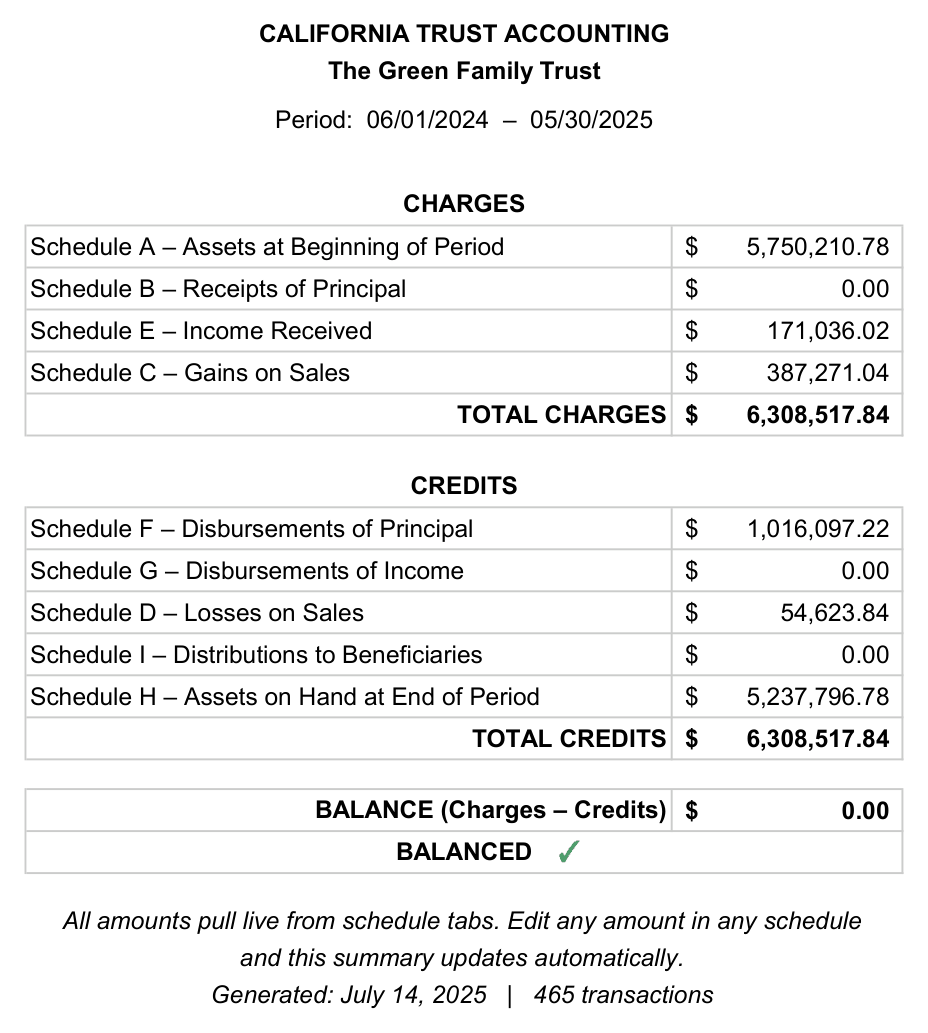
Have the statements? Balanced converts and organizes the data on them into this accounting, in the Probate Code format, as one editable Excel workbook balanced to the penny. Scanned or incomplete statements work.
- Developed by a California trusts and estates attorney
- Works with any PDF statement, downloaded or scanned
- Statement entries are cited to the PDF and page they
came from, for easy verification - A fully editable Excel workbook, emailed in about 1 hour
$699 Flat. No Subscription. No Install.
This has by far been the best user-experience and I’ve been really impressed with your product thus far.
Kelsey B. Cooper, Esq., California Estate Planning Services PC
What the law asks for
Every account, once. The account covers all of the trust's property and every receipt and disbursement (Prob. Code §§ 1061, 1062; § 16063(a)(1)). Each fund account and the brokerage account are part of it; the statement's total is a check, not an entry.
Additions to the trust are receipts. Property received by the trust during the period, including a gift of shares, is reported as a receipt of principal at its value when received, and then carried at that value.
Fund distributions follow the entity rules. Money a fund distributes is income (§ 16340(c)), except, among others, capital gain dividends of a regulated investment company or real estate investment trust, which are principal (§ 16340(d)(4)), and capital distributions, including a return of capital (§ 16340(a)(1), (d)(3)). The fiduciary may rely on the fund's own characterization unless it knows the characterization is or may be incorrect (§ 16340(e)(1)).
The overview: two kinds of account under one name
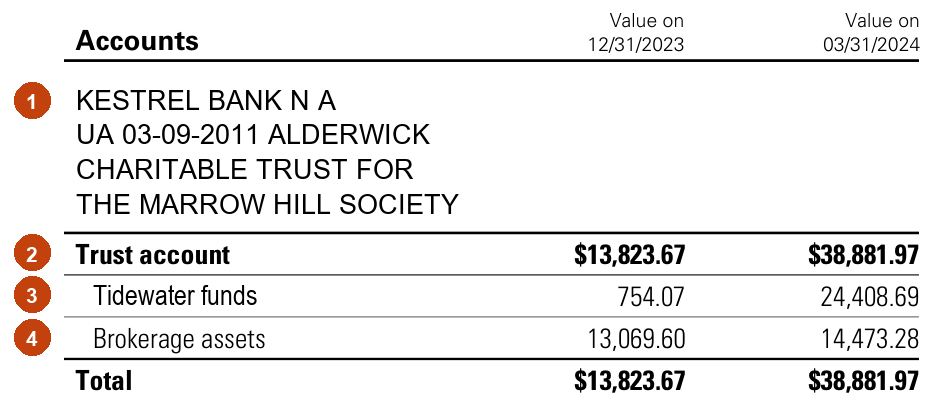
1. The registration. A bank, as trustee under an agreement dated in 2011, for a charitable trust. Confirm the registration on every page; a fund company may print several registrations in one envelope.
2. Trust account, $13,823.67 to $38,881.97. The total of everything under this registration. Most of the increase did not come from investment results; it came from a gift (callout 10).
3. "Tidewater funds," $754.07 to $24,408.69. Mutual funds held directly with the fund company, outside any brokerage account.
4. "Brokerage assets," $13,069.60 to $14,473.28. A separate brokerage account under the same registration. $24,408.69 plus $14,473.28 is $38,881.97.
The detail: a brokerage account, two fund accounts and a sweep between them
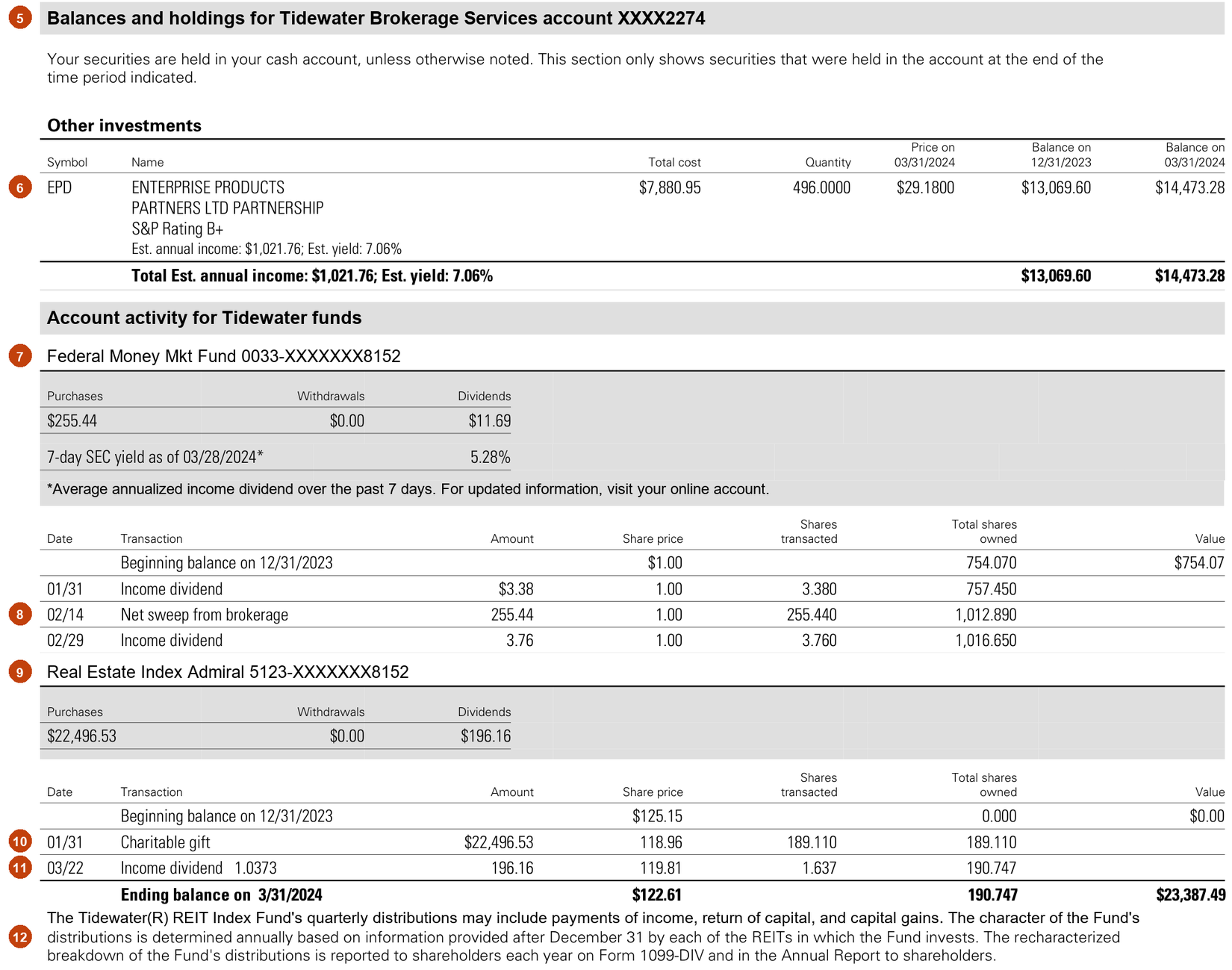
5. "Balances and holdings for Tidewater Brokerage Services account XXXX2274." The brokerage account has its own number, different from the fund accounts below. List it as its own account on the schedules.
6. EPD, 496 units of a publicly traded partnership, total cost $7,880.95, balance $14,473.28. 496 units at $29.18 is $14,473.28. The custodian's "total cost" is its tax figure; carry value comes from the inventory or the trust's own purchase records. Partnership distributions are usually reported largely as a return of capital, which matters for principal and income; see our article on returns of capital, fees and other small lines.
7. "Federal Money Mkt Fund 0033-XXXXXXX8152." A fund account. The number has two parts: the fund's number, 0033, and the account number, ending 8152. Every fund this trust holds directly shares the account number and has its own fund number in front (compare callout 9). On some statements and tax forms the fund number is all that distinguishes one holding from another, so keep both parts.
8. 02/14, "Net sweep from brokerage," $255.44. The money market fund is the brokerage account's settlement fund: cash that arrives in the brokerage account is swept into it. This $255.44 is the partnership's distribution on the 496 units of callout 6, about 51.5 cents a unit, arriving in the brokerage account and sweeping into the fund. The receipt is the distribution, once, from the brokerage activity. The sweep is the same money moving, not a receipt, and the fund's "Purchases $255.44" is not a purchase of anything new (see our article on sweep activity). The fund's own dividends, $3.38, $3.76 and $4.55, $11.69 for the quarter, are income.
9. "Real Estate Index Admiral 5123-XXXXXXX8152." A second fund account: fund 5123, the same account number.
10. 01/31, "Charitable gift," $22,496.53, 189.110 shares at $118.96. A donor gave the trust shares of this fund. 189.110 shares at $118.96 is $22,496.53. The fund company's summary counts it among "Purchases," but the trust paid nothing. For the trust it is an addition to principal, received in kind: a receipt at $22,496.53, its value on the day received, which becomes the shares' carry value. It is not a purchase, and it is not a change in form.
11. 03/22, "Income dividend 1.0373," $196.16, reinvested at $119.81 for 1.637 shares. $1.0373 a share on 189.110 shares is $196.16. As with any reinvested dividend, there are two entries: a receipt of $196.16 and a purchase of 1.637 shares for $196.16, a new lot carried at that cost (see our article on reinvested dividends).
12. The fund's footnote. The real estate fund's "quarterly distributions may include payments of income, return of capital, and capital gains," and their character "is determined annually," after December 31, and reported on Form 1099-DIV. The $196.16 is labelled an income dividend today, but its final character is not yet known. A sensible practice is to report it as income when received, relying on the fund's characterization at the time (§ 16340(e)(1)), and to review the year-end breakdown: the part later reported as a capital gain dividend is principal (§ 16340(d)(4)), and a return of capital is a capital distribution (§ 16340(a)(1), (d)(3)). Whether to revise an account already prepared is a judgment; whichever is done, say so in the report.
Other things fund company statements do
- Dividend and capital gain options. Many fund statements print "Dividend Option: Reinvest" and "Capital Gain Option: Reinvest" under each fund. Those options mean every distribution becomes a pair of lines, a receipt and a purchase.
- Average cost. Fund companies usually report cost for tax on the average cost method. The account's carry value is lot by lot; see our article on lot by lot carry value.
- Quarterly and annual statements. Fund companies often send statements only quarterly or annually, with every transaction since the last one. Make sure the statements in the file cover the whole period, with no gap at either end.
Where each line lands
- Receipts: the partnership's distribution, once; the fund's dividends; the gift of shares, at its value when received, as an addition to principal.
- Changes in form: reinvestment purchases, each a new lot at its cost.
- Nowhere: the net sweep into the settlement fund, and the fund company's count of a gift as a purchase.
- Principal and income: fund dividends to income when received; capital gain dividends and returns of capital to principal, revisited when the year-end characterization arrives.
- Property on hand: each fund account and the brokerage account separately, each fund identified by its fund number and account number.
Common mistakes
- Treating the statement as one account. Fund accounts and the brokerage account each need their own lines.
- Counting the sweep and the distribution. The same $255.44 appears in two places; enter it once.
- Reporting a gift as a purchase. No cash left the trust; the shares are a receipt.
- Dropping the fund number. Two holdings with the same account number are told apart only by it.
- Treating the label as final. A real estate fund's "income dividend" may later be partly capital gain or return of capital.
Checklist
- List every fund account and brokerage account under the registration, with fund and account numbers.
- Tie the overview's totals to the detail for each account.
- Find each sweep and match it to the receipt that caused it.
- Record gifts in kind as receipts at value on the date received.
- Watch for the year-end characterization of real estate and other fund distributions.
Praise for Balanced
“This has by far been the best user-experience and I’ve been really impressed with your product thus far.”
“I’d also just like to say that I was a trusts & estates paralegal for 6 years prior to becoming an attorney myself, so I’ve done hundreds of accountings manually. I’ve also tried countless other ‘trust accounting’ products. This has by far been the best user-experience and I’ve been really impressed with your product thus far. Myself and my firm will be repeat customers.”
California Estate Planning Services PC
Inside a real Balanced workbook
$699 Flat. No Subscription. No Install.
Let Balanced do the reading
Fund company statements put several accounts, a sweep between them and the occasional gift of shares into a format unlike any brokerage statement. Separating the accounts, matching each sweep to its cause and reporting a gift as a receipt is hard, technical work. It is also what Balanced does. Add the PDF statements for the accounting period, including scanned or incomplete ones, and Balanced converts and organizes the data on them into the Probate Code schedules, each line traced to its page, as one editable Excel workbook balanced to the penny. It is $699 flat. Review the workbook against your statements. Start an accounting.
The Law and the Art of Fiduciary Accounting is a series by Balanced Legal Technology, LLC on complex California fiduciary accountings. General information only, current as of November 2026; not legal, tax or accounting advice. Statutes and rules change; confirm current law before relying on it.
About the author
Marc Joyce is a licensed, practicing California trusts and estates attorney, and the founder and developer of Balanced. He brings both sides to the problem: as a lawyer, and as an engineer. The Law and the Art of Fiduciary Accounting is his series on the hard cases where the two meet.
To see entries like these in a finished account, see the sample trust accounting and the estate accounting example, each with every schedule filled in.
Ready to generate yours? Add the PDF statements for the accounting period. Your PDFs stay on your computer.
$699 Flat. No Subscription. No Install.